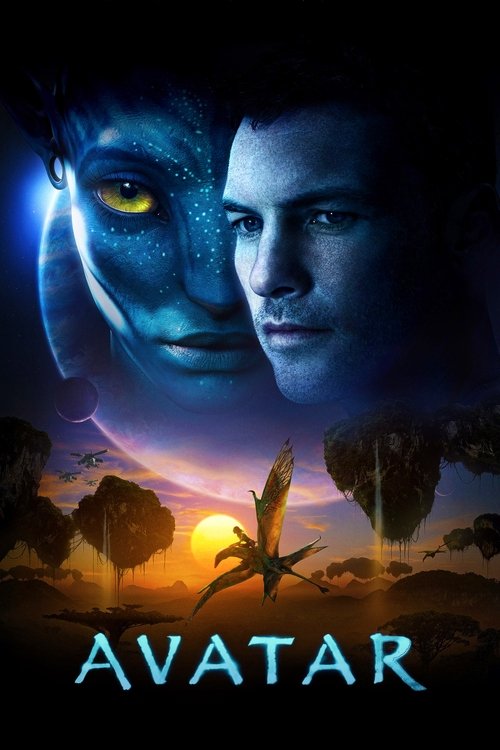
Avatar
2009 · James Cameron
Perpetually doubted, perpetually vindicated: Avatar: The Way of Water's $2.3B silenced "no cultural footprint" jokes without ever quite ending them. His pronouncements on AI, streaming, and running times are treated as oracle statements.
For when you want to be transported — a big, earnest spectacle night, ideally on the largest screen available. Comfort viewing at epic scale: you know roughly where it's going, and that's part of the pleasure.
What it's about
In the 22nd century, a paraplegic ex-Marine is shipped to Pandora, a lush alien moon where a human corporation is mining a precious mineral under the homeland of the indigenous Na'vi. His job is to pilot an 'avatar' — a lab-grown Na'vi body — and win the locals' trust. The deeper he goes into their world, and the closer he grows to the warrior who teaches him its ways, the harder it gets to remember whose side he's on.
The experience
Pure immersion — two and a half hours of being somewhere else, with floating mountains, bioluminescent forests, and battles staged at enormous scale. The story beats are familiar on purpose; the sensation of the place is what stays with you.
Performances
Zoe Saldaña, acting entirely through performance capture as Neytiri, gives the film its fiercest and most emotionally alive presence — proof that a digital character can carry real feeling.
The craft
James Cameron spent years building the tools to make this possible: performance capture that preserves an actor's face, and a fully computer-generated world rendered to photoreal density, designed for stereoscopic 3D. Every frame is packed with invented biology that feels coherent and touchable. If any film justifies the best screen and sound you can find, it's this one.
Why it matters
It became one of the highest-grossing films ever made, set off a worldwide 3D boom, and reset expectations for what visual effects could do — a technological before-and-after moment for blockbusters.
Snapshot
Avatar is James Cameron's first narrative feature since Titanic (1997), a science-fiction epic set on the forested moon Pandora in the 22nd century. A paralyzed ex-Marine, Jake Sully, is recruited to pilot a genetically engineered Na'vi body — an "avatar" — as part of a human corporate operation to mine a valuable mineral beneath the homeland of Pandora's indigenous people. Jake's growing identification with the Na'vi, and with the warrior Neytiri, turns him against the operation he was sent to serve. The film is best understood less as a story than as a delivery system for a technological argument: Cameron spent roughly a decade waiting for and then helping to build the tools that could render a fully photoreal computer-generated world experienced largely in stereoscopic 3D. Its narrative is deliberately archetypal — a frontier captivity tale, a conversion narrative, a colonial allegory — and its ambitions are concentrated in immersion and spectacle. On release it became the highest-grossing film released to that point, displacing Cameron's own Titanic, and it is widely credited with triggering the late-2000s 3D exhibition boom.
Industry & production
Avatar was a 20th Century Fox release, produced through Cameron's Lightstorm Entertainment, with visual effects led principally by Weta Digital in New Zealand. Cameron had drafted a treatment (the so-called "scriptment") in the mid-1990s but shelved the project, judging that the technology required to realize Pandora and its inhabitants convincingly did not yet exist. He returned to it in the 2000s, in part after the photoreal character work of Weta's The Lord of the Rings films and Gollum demonstrated that performance-driven CG creatures could carry dramatic weight.
The production was unusually long and technologically front-loaded: years of development on capture systems and pipeline preceded principal photography, and post-production and rendering were correspondingly massive. The film carried one of the largest budgets of its era; precise figures vary across sources and reporting, so I will not assert a single number, but it was understood at the time to be among the most expensive films ever made, with substantial additional spending on marketing. Fox's willingness to underwrite that scale rested heavily on Cameron's track record with Titanic. The release was positioned as an event, with a strong emphasis on premium formats — 3D and IMAX 3D — and it became the commercial anchor of the 3D push that studios pursued aggressively in 2010 and after.
The film's success reshaped studio calculus around premium-format pricing and franchise-scale world-building, and Cameron committed to a multi-sequel program. The first follow-up, Avatar: The Way of Water, did not arrive until 2022, an exceptionally long gap reflecting both the technological development each installment required and Cameron's deliberate pace.
Technology
Technology is the center of Avatar's historical significance. The production advanced several intersecting tools rather than a single invention.
The first was a performance-capture stage — Cameron's team called it "the Volume" — substantially larger than prior capture spaces, allowing actors to move through a defined area while their facial and body performances were recorded simultaneously. Facial capture used a head-mounted camera rig worn by each actor, feeding close-range imagery of the face directly into the system so that expression data could be retained rather than reconstructed after the fact. The stated aim was to preserve the actor's performance through to the digital Na'vi character, treating capture as an extension of acting rather than a separate animation stage.
The second was the "virtual camera," a handheld monitor-and-tracking device that let Cameron look into the captured scene as if through a viewfinder and frame the digital world in real time — panning, pushing in, choosing angles within an environment that existed only as data. This collapsed the distinction between shooting a set and composing inside a simulation, and it gave the CG sequences a handheld, observed quality rather than the weightless precision often associated with all-digital camerawork.
The third was stereoscopic 3D capture, for which Cameron and Vince Pace had developed the Fusion Camera System, a rig pairing two cameras to record live-action elements with controllable interocular distance and convergence. Cameron's stated philosophy was to use 3D for depth and immersion rather than gimmickry — minimizing objects thrust at the audience in favor of a sense of space receding into the frame.
The fourth was Weta Digital's rendering and simulation work to make Pandora photoreal: subsurface skin scattering on the Na'vi, the bioluminescent flora, dense vegetation, and atmospheric depth. The integration of performance-captured characters into these environments, lit and rendered to filmic standards, is the film's central technical claim.
Technique
Cinematography
Cinematographer Mauro Fiore shot the live-action photography (the human-world interiors, the avatar "driver" and base sequences), while the Pandora material was authored through the virtual-camera process rather than photographed conventionally. The film's look unifies these two domains: a relatively cool, hard, industrial palette for the human installations against the saturated greens, teals, and bioluminescent purples and blues of Pandora, with the night-forest sequences making the strongest case for the design. Fiore's contribution was recognized within the industry's craft awards for the year. The aesthetic project was less about individual striking compositions than about sustained spatial legibility in stereo — keeping the deep, layered Pandoran environments readable as three-dimensional space.
Editing
The film was edited by Cameron with John Refoua and Stephen Rivkin. The cut has to manage an unusual problem: large stretches of the picture are CG sequences whose "footage" was generated through the virtual camera, so editorial choices were entangled with the production pipeline rather than purely downstream of it. The result is a long film (over two and a half hours in its theatrical form) that builds methodically — a deliberately slow acclimatization to Pandora in the first half, accelerating into the extended aerial-and-ground battle of the climax. The pacing reflects an immersive rather than economical logic: the audience is meant to learn the world before the plot demands urgency.
Mise-en-scène / staging
Production designers Rick Carter and Robert Stromberg, with creature and world design supported by Cameron's longtime conceptual collaborators, built Pandora as a coherent ecology: floating "Hallelujah" mountains, the home-tree of the Omaticaya clan, the neural connectivity of the planet's flora and fauna. The staging contrasts two orders of life — the sealed, mechanized, fluorescent human compound and exo-suits versus the open, networked, organic Pandoran biosphere — and the film's visual argument is carried by that opposition as much as by dialogue. The Na'vi were designed as tall, lithe, blue-skinned humanoids legible enough to read human emotion while remaining clearly other.
Sound
The sound design renders Pandora as a dense, living acoustic environment, layering insect, animal, and vegetal sound into an enveloping field, and the film made prominent use of premium theatrical sound presentation. The contrast between the machinic clangor of the human technology and the organic soundscape of the forest parallels the visual opposition. The film was recognized in the sound and visual craft categories of the year's awards season.
Performance
The principal Na'vi roles were performed through capture: Zoe Saldaña as Neytiri, Sam Worthington as Jake Sully (in both his human and avatar forms), CCH Pounder, Wes Studi, and others as Omaticaya. Sigourney Weaver plays the scientist Dr. Grace Augustine, Stephen Lang the militarized security chief Colonel Quaritch, and Giovanni Ribisi the corporate administrator. The film's implicit argument is that capture preserves rather than replaces acting — that Saldaña's Neytiri is a performance, not an animation — and Neytiri became the most frequently cited evidence for that claim. The human-side performances are pitched broader, with Lang's Quaritch in particular functioning as a near-archetypal antagonist.
Narrative & dramatic mode
Avatar's dramatic mode is mythic and archetypal rather than psychologically intricate. It fuses several durable templates: the captivity-and-conversion narrative in which an outsider crosses into and is transformed by another culture; the disability-and-rebirth arc, in which Jake's paralysis is answered by the freedom of the avatar body; and the messianic outsider who becomes the indigenous people's champion. Cameron's screenplay foregrounds clarity over ambiguity — motivations are legible, the moral architecture is explicit, and the emotional beats are broadly drawn. This has been both the film's commercial strength and the principal target of its critics, who have read the "outsider redeems the natives" structure as a recurrence of the white-savior pattern. The story's function is to give the spectacle moral stakes and an emotional through-line strong enough to sustain immersion.
Genre & cycle
The film sits at the intersection of science fiction, action, and adventure, drawing on the ecological-SF tradition and on a longer lineage of frontier and colonial-contact narratives. Within Cameron's own work it extends the technophilic, militarized SF of Aliens (1986) and The Terminator (1984) and the spectacle-romance of Titanic, while inverting Aliens' framing: here the heavily armed human military is the threatening force and the "alien" world is the object of sympathy. It belongs to the cycle of effects-driven tentpole filmmaking that came to dominate the 2000s, and it became a defining instance of the brief 3D-spectacle cycle it helped ignite.
Authorship & method
Avatar is an auteur production in the strong sense: Cameron wrote, directed, co-edited, and co-produced it, and drove the technological development that made it possible. His method couples meticulous engineering with populist storytelling — a pattern visible across his career, where each major film is organized around a technical problem (underwater shooting, liquid-metal CG, large-scale historical reconstruction) solved in service of mass-audience emotion.
Key collaborators include cinematographer Mauro Fiore; production designers Rick Carter and Robert Stromberg; editors John Refoua and Stephen Rivkin; and composer James Horner, reuniting with Cameron after Aliens and Titanic. Horner's score blends a large orchestral idiom with ethnic-vocal and percussive textures meant to evoke the Na'vi, and the film's closing song was a prominent awards-season presence; Horner's collaboration with Cameron makes the music a signature element of the director's blockbuster mode. Weta Digital, under senior visual-effects supervision including Joe Letteri, functioned as a near-co-author of the film's imagery, and the work was recognized with the year's top visual-effects honors.
Movement / national cinema
Avatar is a product of the American studio system — a Hollywood tentpole — but its making was substantially transnational, with the bulk of its visual-effects and rendering work executed in New Zealand at Weta Digital. In that sense it exemplifies the globalized, post-national organization of contemporary blockbuster production, in which a US studio film is realized through a distributed international effects pipeline. It is not affiliated with any aesthetic movement; if anything it represents the institutional logic of effects-house-centered filmmaking that has shaped the New Zealand screen sector since the Lord of the Rings era.
Era / period
The film is a landmark of late-2000s digital cinema, arriving as theatrical exhibition was transitioning to digital projection and as studios sought a value proposition that home viewing could not match. Avatar supplied that proposition in 3D, and its release accelerated the conversion of screens to digital-3D capability. It thus sits at a hinge: the culmination of decades of CGI maturation and the opening of a (ultimately short-lived) period in which 3D was treated as the future of mainstream exhibition.
Themes
The film's themes are stated plainly. Ecological interdependence is literalized in Pandora's neural biosphere, where all life is networked and the planet itself functions as a connected organism. Anti-colonial and anti-extractive critique runs throughout: a corporate-military complex seeks to displace an indigenous people for a mineral resource, and the film aligns the audience squarely against that project. Embodiment and identity are explored through Jake's movement between his disabled human body and his able Na'vi avatar, culminating in a literal transfer of self. Against these, the film sets a spiritualized vision of harmony with nature. Critics have noted the tension between the film's anti-extractive, anti-imperial message and its own status as a maximal technological commodity, as well as the white-savior structure noted above; these debates are part of the film's reception rather than incidental to it.
Reception, canon & influence
Critical reception was broadly strong, with near-universal praise for the visual achievement and immersive 3D and more divided responses to the screenplay's familiarity and thematic bluntness — the dominant critical formula treating the film as a technical landmark wrapped around a conventional story. It was a major awards-season presence, winning in several technical and craft categories while losing the top prizes; I will avoid listing specific wins I cannot verify precisely here, but its strength lay in the visual, art-direction, and cinematography categories. Commercially it became the highest-grossing film released to that date.
Backward, the film draws on an unusually wide set of sources: the ecological science fiction and colonial-contact tradition; frontier and captivity narratives; and a body of comparison-pieces critics raised at release concerning earlier "outsider joins the natives" stories. Within the medium, it builds directly on the photoreal performance-capture lineage advanced by Weta on The Lord of the Rings and on decades of CGI development.
Forward, Avatar's influence is concentrated in industry and craft more than in style. It is widely credited with driving the 2010s 3D exhibition boom and the broader studio investment in premium large-format presentation, and its performance-capture and virtual-camera workflows fed into subsequent effects-heavy productions. Its longer-term cultural footprint has been debated — commentators have periodically argued it left a smaller imprint on popular imagination than its box office implied — but its technological and exhibition consequences are not in dispute, and Cameron's sequel program has kept the franchise an ongoing test bed for high-end stereoscopic and capture technology.
A Deleuzian reading
Jake Sully, newly jacked into his avatar for the first time, ignores the scientists yelling at him to stay still.
The full Deleuzian reading of Avatar →
Reception
In 2009 it was a genuine event — people queued for weeks and it dethroned Titanic as the biggest film ever — but within a decade the take had flipped to 'huge hit, zero cultural footprint.' Then The Way of Water made $2.3 billion in 2022 and forced everyone to admit the audience never actually left.
How Avatar was received, from release to now →
Influences: the films it descends from and the films it influenced
- The Abyss (1989) — Cameron's CG water pseudopod (built with ILM) was his first proof that a fully synthetic, photoreal character could convincingly share a frame with live actors — the core problem Avatar scales up.
- Terminator 2: Judgment Day (1991) — The liquid-metal morphing of the T-1000 established Cameron's signature method of organizing an entire production around solving one unprecedented CG problem in service of mass-audience emotion.
- Titanic (1997) — Large-scale digital set extension, motion-control crowd simulation, and the reunion with composer James Horner that codified the orchestral-plus-vocal blockbuster scoring mode Avatar reuses.
- Jurassic Park (1993) — ILM's seamless compositing of photoreal CG organisms into live-action plates was the breakthrough that made believable digital creatures — and thus a fully CG biosphere — possible.
- The Lord of the Rings: The Two Towers (2002) — Weta's Gollum and Andy Serkis built the actor-driven performance-capture pipeline (facial mapping onto a CG character) that Avatar industrialized into a full cast of capture-performed Na'vi.
- The Polar Express (2004) — First feature built end-to-end on full-body performance capture and a virtual camera, the volume-stage workflow Cameron refined with his head-mounted facial rig and real-time simulcam.
- Final Fantasy: The Spirits Within (2001) — The first attempt at fully photoreal CG human performers, exposing the uncanny-valley failure that Avatar's dedicated facial-capture rig was explicitly engineered to overcome.
- Dances with Wolves (1990) — Supplies the conversion-captivity / white-savior structure — an outsider assimilates into an indigenous people and turns against his own side — that Avatar transplants wholesale onto an alien world.
- A Man Called Horse (1970) — The captivity-and-initiation narrative in which a captured outsider earns tribal belonging through ordeal, the rite-of-passage template behind Jake Sully's Na'vi initiation.
- Princess Mononoke (1997) — Ecological-interdependence worldbuilding and an animate-forest cosmology pitting industrial resource extraction against a sentient nature, the eco-mythic frame Avatar adopts.
- The Lord of the Rings: The Return of the King (2003) — Cameron absorbed both the on-set performance-capture methodology developed for Gollum and MASSIVE-derived digital crowd simulation into a unified virtual production pipeline — Cameron explicitly named Gollum as the proof of concept that made Avatar's production model possible — extending ROTK's practical-digital synthesis to its endpoint by replacing the photographed practical element itself with a virtual camera environment.
- King Kong (2005) — Scaled Weta's performance-capture pipeline and Kong-era personnel up to wholly synthetic, fully emotive lead characters, completing the line Kong's solo creature began.
- Rise of the Planet of the Apes (2011) — Weta extended Avatar's facial-capture rig to on-location daylight shooting, capturing Serkis's Caesar outdoors and proving the technique beyond the controlled volume.
- The Adventures of Tintin (2011) — Spielberg adopted Cameron's virtual-camera and performance-capture stage to 'shoot' an entirely CG film with live-action camera grammar and handheld framing.
- Life of Pi (2012) — A photoreal CG tiger and stereoscopic 3D deployed for intimate narrative immersion rather than action spectacle, building directly on Avatar's depth-staging grammar.
- Gravity (2013) — Virtual cinematography and CG-constructed long takes that treat stereoscopic depth as an immersive storytelling instrument, the post-Avatar legitimization of digital 3D as craft.
- The Jungle Book (2016) — An entirely virtual photoreal environment populated by CG animals around a single live actor, scaling Avatar's virtual-production pipeline into a full studio methodology.
- Alita: Battle Angel (2019) — Cameron-produced and Weta-built, it advanced the facial-capture rig to render a CG-eyed protagonist seamlessly among live actors — the most direct technical heir to Avatar's pipeline.
- Avatar: The Way of Water (2022) — Solved underwater performance capture and high-frame-rate stereoscopic rendering, continuing Cameron's franchise as a standing test bed for capture and 3D technology.
- The Avengers (2012) — Coupled performance capture with the stereoscopic-3D event-film economics that Avengers chases through its (notoriously rushed) post-conversion to 3D.
- Chappie (2015) — Advanced the performance-capture pipeline for emotive, photoreal CG protagonists, raising the believability bar that lets Chappie carry a film as a fully synthetic lead.
- Avengers: Endgame (2019) — Established full performance-capture with a head-mounted facial rig driving a CG character's expressions — the pipeline that lets Josh Brolin's Thanos register subtle acting choices.
- Ready Player One (2018) — Built the performance-capture-plus-virtual-camera pipeline — directors framing CG worlds through a tracked handheld monitor in real time — that RPO's OASIS shoot adopts wholesale.
- Kingdom of the Planet of the Apes (2024) — Introduced the head-mounted facial-capture rig and on-set virtual camera that let actors perform photoreal creatures within naturalistic environments.
- Project Hail Mary (2026) — Its performance-capture pipeline made a photoreal non-human character carry lead emotional weight, establishing the creature-as-co-lead craft standard PHM's Rocky inherits.
- Pacific Rim: Uprising (2018) — The neural-link drive — a human consciousness piloting a remote body via mind-bridge — is the same control-interface fantasy Uprising's Drift and drone-Jaegers operationalize for combat.
- Warriors of the Wind (1984) — Descends from Nausicaä's networked-living-ecosystem worldbuilding and its climactic swarm-of-nature-turning-back-invaders, restaging the Ohmu stampede as Pandora's animals repelling the military.
- How to Train Your Dragon (2010) — Released months earlier, it runs the same beat in parallel: taming a flying mount and the first-flight bonding sequence as the emotional hinge, with performance-driven creature emotion.
- Transformers (2007) — Extends the same hyper-complex CG-character-integration frontier, pairing performance capture with photoreal live-action compositing beyond what Transformers achieved.
- How to Train Your Dragon 2 (2014) — Parallel innovation in the aerial-flight bonding sequence — rider and winged beast filmed with continuous long-lens virtual camera moves through vast atmospheric skyscapes as an emotional set piece.
- The Hobbit: The Battle of the Five Armies (2014) — Cameron's Weta-built facial performance-capture and his stated push toward high-frame-rate exhibition run parallel to the HFR and mocap ambitions this trilogy productionized.
- War for the Planet of the Apes (2017) — Parallel push to make performance-capture protagonists carry dramatic weight in believable environments via facial-capture rigs, developed in the same Weta-adjacent R&D milieu.
Similar films
- Avatar: The Way of Water (2022) — influence & lineage
- Jurassic Park (1993) — influence & lineage
- The Abyss (1989) — influence & lineage
- Titanic (1997) — influence & lineage
- Terminator 2: Judgment Day (1991) — influence & lineage
- Alita: Battle Angel (2019) — influence & lineage
- Gravity (2013) — influence & lineage
- Life of Pi (2012) — influence & lineage
All the films related to Avatar →
Watch it with: curated runs of related films
- Studio-Sized Mythmaking — A run of blockbuster quest epics — fellowships forged, dark lords faced, and long roads home — that rhyme on scale, world-building, and the pull of a saga you can lose a weekend inside.