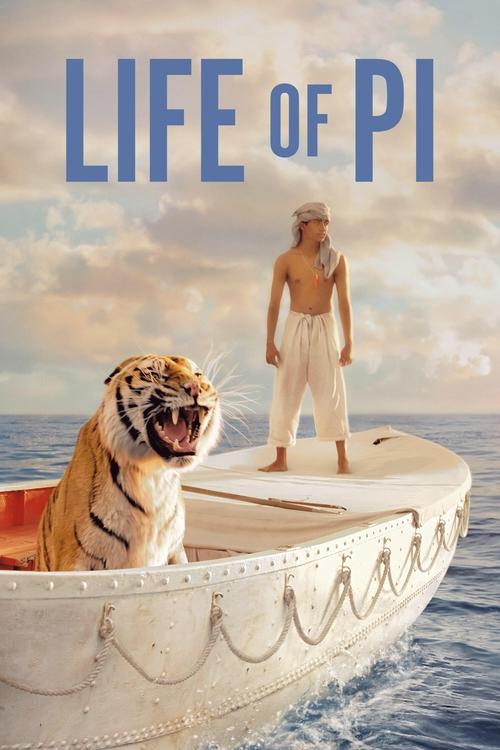
Life of Pi
2012 · Ang Lee
When you want a film to chew on for days — something visually overwhelming and spiritually searching rather than easy. Best saved for a night you can give it your full attention.
What it's about
Pi Patel grows up curious about every religion he meets, the son of a zookeeper in 1970s India. When the family emigrates by cargo ship with their animals, a storm sinks the vessel in the middle of the Pacific — and Pi finds himself adrift in a lifeboat with a handful of zoo animals, most dangerously a full-grown Bengal tiger named Richard Parker. What follows is a survival story told years later by the adult Pi, who promises it will make you believe in God.
The experience
Awe is the operating mode — stretches of terror and grief give way to images of the ocean so luminous they feel hallucinatory, and the whole thing settles over you like a parable. It's contemplative and slow-burning, then quietly devastating, and it leaves you turning the story over afterward.
Performances
Newcomer Suraj Sharma, acting mostly alone against a digital tiger on open water, carries the film's physical and emotional weight with startling conviction, and Irrfan Khan gives the adult Pi a grave, gentle magnetism.
The craft
Ang Lee turned a supposedly unfilmable novel into a landmark of digital effects and 3D — the tiger is a photorealistic creation you never stop believing in, and the ocean sequences (flying fish, phosphorescent night seas, a whale breach) are among the most beautiful images of their era. See it on the biggest, best screen you can; it won Oscars for its direction, cinematography, and visual effects for a reason.
Why it matters
It proved cutting-edge spectacle could serve a serious, spiritual art film rather than an action franchise, won Ang Lee his second Best Director Oscar, and reset the bar for digital creature work.
Snapshot
Life of Pi is Ang Lee's adaptation of Yann Martel's 2001 novel — a shipwreck survival tale nested inside a meditation on faith, storytelling, and the uses of belief. A young Indian man, Piscine "Pi" Patel, survives the sinking of a cargo ship carrying his family's zoo animals and spends 227 days adrift in a lifeboat with a Bengal tiger named Richard Parker. Lee frames this as a story told in retrospect by the adult Pi to a visiting novelist, and closes on a second, animal-free account of the ordeal, inviting the listener — and the audience — to choose "the better story." The film became a landmark of digital-3D filmmaking, marrying photorealistic visual effects to a contemplative, spiritually serious art-house sensibility. It won four Academy Awards, including Best Director for Lee, and was both a critical success and a substantial commercial one, grossing more than $600 million worldwide.
Industry & production
The project reached the screen only after a protracted development history. Martel's novel won the Booker Prize in 2002 and was widely considered "unfilmable" — a first-person interior narrative dominated by a boy and a tiger on the open sea. Fox 2000, a specialty division of Twentieth Century Fox, held the rights and cycled through several high-profile directors over the 2000s; M. Night Shyamalan, Alfonso Cuarón, and Jean-Pierre Jeunet were each associated with the material at various points before departing. Ang Lee took it on around 2009, drawn to its blend of adventure spectacle and philosophical inquiry, and committed to shooting it in stereoscopic 3D — a decision that reframed the film as a technological as well as an artistic gamble.
Production centered on Taiwan, where Lee had a self-built infrastructure at his disposal. The core lifeboat and ocean sequences were shot in an enormous self-generating wave tank constructed at a decommissioned airport in Taichung — reportedly one of the largest such tanks built for a film, engineered to produce controllable, programmable swells. Additional photography took place in India (Pondicherry and Munnar, standing in for Pi's hometown and the family zoo) and Montreal (the framing-story interiors). The budget was substantial for a film with no established stars and an untested lead, generally reported around $120 million, and Fox's willingness to underwrite it reflected both Lee's prestige after Brokeback Mountain and the studio appetite for premium 3D spectacle in the wake of Avatar (2009).
The film's release also became bound up in one of the era's defining industry controversies. Its visual effects were led by Rhythm & Hues Studios, which filed for bankruptcy in early 2013 — weeks before the company's artists won the Academy Award for Best Visual Effects. Protests by VFX workers outside the Oscars ceremony, and the truncation of the winners' acceptance speech, turned Life of Pi into a symbol of the structural precarity of the effects industry even at its most celebrated.
Technology
Life of Pi is a signal work in the history of digital stereoscopy. Lee and cinematographer Claudio Miranda shot natively in 3D using digital cameras (principally RED Epic bodies on 3D rigs), rather than converting a 2D image in post — a choice that let Lee treat depth as an expressive variable rather than an add-on. The film is frequently cited alongside Avatar and Hugo as one of the productions that argued for 3D as a compositional tool: Lee uses the format for immersion and for isolating figures in fields of water and sky, not for gimmicky protrusion toward the viewer.
The greater technological achievement is the water and the tiger. The programmable wave tank gave the production physically real, controllable water to photograph, but vast portions of the ocean, sky, and horizon were digitally created or extended, and Richard Parker is overwhelmingly a computer-generated animal. Real tigers were used for reference and for a limited number of shots, but the tiger the audience believes it sees — its wet fur, musculature, breath, and behavior — is a VFX creation of a photorealism that reset expectations for digital animals. The bioluminescent seascapes, the breaching whale, and the surreal carnivorous "floating island" pushed fluid simulation, lighting, and rendering in ways that were widely studied within the effects community.
Technique
Cinematography
Claudio Miranda's photography, which won the Academy Award, is defined by luminous digital control and a painterly use of the frame. Working almost entirely with artificial and managed light on the tank stage, Miranda achieved a wide tonal range — from the storm's near-monochrome violence to the mirror-calm nights where sea and sky merge into a single reflective field. The most celebrated images treat the horizon as a compositional pivot, placing the lifeboat as a small dark mass in an enveloping expanse, and exploiting 3D depth to render water as a tactile, dimensional volume. The film's color and light shift with Pi's spiritual state, moving from documentary naturalism toward something closer to visionary tableau.
Editing
Tim Squyres, Lee's longtime editor (their collaboration runs back through The Ice Storm, Crouching Tiger, Hidden Dragon, and beyond), had the unusual task of cutting a film whose co-star and much of whose environment did not exist during principal photography. Editing decisions had to anticipate effects that would be completed later, shaping performance rhythm around an animal to be added in post. Squyres also structures the film's nested chronology — the adult Pi's narration, the childhood prologue, the ordeal at sea, and the framing conversation — so that the storytelling frame is felt continuously rather than bracketed only at the ends.
Mise-en-scène / staging
The film's staging is organized around confinement and vastness in tension: a single small boat and a raft tethered to it, two animals negotiating territory, set against an unbounded ocean. Lee choreographs the evolving détente between Pi and Richard Parker as a spatial drama — who controls the boat, who is exiled to the raft, how proximity is earned. The zoo prologue establishes the film's ethical grammar (Pi's father's lesson that the tiger is not a friend), and the surreal island interlude functions as a self-contained set piece with its own internal logic. Throughout, the human figure is repeatedly dwarfed to underline scale and precarity.
Sound
The sound design alternates between overwhelming force — the sinking of the Tsimtsum in the storm — and vast, exposed quiet, where the lap of water and the tiger's breathing carry enormous weight. The soundscape supports the film's oscillation between spectacle and contemplation, using silence and ambient minimalism to render the loneliness of the open sea.
Performance
The film rests on Suraj Sharma, cast as the teenage Pi from thousands of applicants despite no prior acting experience. He carries most of the film alone, acting against an absent animal and, often, against the practical demands of the water tank, and sustains a physically and emotionally punishing solo performance. Irrfan Khan, as the adult Pi recounting the tale, provides the film's reflective register — his measured delivery of the narration gives the frame its gravity and its final, unsettling turn. Rafe Spall plays the writer-listener; Tabu and Adil Hussain appear as Pi's parents, and Gérard Depardieu has a brief role as the ship's cook, a figure who resurfaces, transformed, in the film's alternate account.
Narrative & dramatic mode
The defining feature of Life of Pi is its embedded, self-interrogating narration. The film is not simply a survival adventure but a story about the telling of that adventure, and its dramatic power depends on the frame. Near the end, Japanese insurance investigators reject the fantastical animal narrative, and Pi offers a second version in which the animals are people — his mother, the cook, a sailor, and himself — and the acts of survival are correspondingly brutal. Neither story changes the outcome (the ship sank; Pi alone survived), and Pi asks which story the listener prefers. The film thereby stages a parable about faith and fiction: the "better story," the one with the tiger, is offered as an analog for religious belief, chosen not because it is provably true but because it makes the unbearable meaningful. This structure — adventure spectacle resolving into an epistemological and theological question — is the film's central formal wager.
Genre & cycle
Life of Pi sits at the intersection of the survival-at-sea adventure, the coming-of-age story, and the spiritual/philosophical drama. As survival narrative it belongs to a lineage running through castaway and lost-at-sea tales; as a prestige literary adaptation released in premium 3D, it belongs specifically to the early-2010s cycle of ambitious, effects-forward films that sought to legitimize digital 3D as a medium for serious cinema, alongside Avatar (2009), Hugo (2011), and Gravity (2013). Its fusion of family-adventure surface with adult metaphysical content also aligns it with a tradition of "unfilmable" literary properties reimagined through visual-effects spectacle.
Authorship & method
Ang Lee's authorship is legible in the film's pluralism and restraint. Across a career that spans Taiwanese family drama, Jane Austen, a wuxia epic, a superhero film, and an American Western romance, Lee has consistently pursued emotional interiority within genre frameworks and has moved fluidly between cultures — a cosmopolitanism that suits Pi's syncretic embrace of Hinduism, Christianity, and Islam. His method here combined an art-cinema patience with a frontier appetite for technology, treating 3D and VFX as instruments of feeling rather than as ends.
His key collaborators shaped the result decisively. Cinematographer Claudio Miranda executed Lee's vision of light as a spiritual medium. Composer Mychael Danna — a longtime collaborator with directors including Atom Egoyan — provided the Oscar-winning score, drawing on Indian instrumentation and vocal textures to root the film's mysticism in a specific cultural sound world; his opening piece "Pi's Lullaby" won the Academy Award for Best Original Song. Editor Tim Squyres managed the film's temporal architecture and its effects-dependent assembly. Screenwriter David Magee performed the crucial adaptation, distilling Martel's interior, digressive novel into a dramatically viable structure while preserving the pivotal double-story ending — the element that makes the film more than a spectacle.
Movement / national cinema
The film resists a single national label, which is part of its identity. It is a Hollywood studio production (Fox), directed by a Taiwanese-born, US-based filmmaker, adapted from a Canadian novel set largely in India and on the Pacific, and physically produced in Taiwan, India, and Canada. It exemplifies a globalized, transnational mode of prestige filmmaking in which capital, talent, locations, and subject matter cross borders freely. Within Lee's own trajectory it also represents a return to Asian settings and a Pacific imaginary, and its strong reception in Asian markets — China in particular — reflected both that resonance and the film's arrival amid a rapid expansion of 3D exhibition in the region.
Era / period
Life of Pi is a product of the immediate post-Avatar moment, when studios were investing heavily in stereoscopic 3D and in the photorealistic digital creation of living creatures and environments. It belongs to the early-2010s convergence of computer graphics maturity and exhibition upgrades that briefly made "serious" 3D a viable prestige category. It is equally a period marker of the visual-effects labor crisis: released as the outsourced, fixed-bid VFX economy was collapsing under its own margins, it became — through Rhythm & Hues' bankruptcy — a case study in the gap between onscreen achievement and the financial conditions of the artists who produce it.
Themes
The film's governing theme is the relationship between faith and narrative — the proposition that stories are how humans make suffering bearable and meaning possible, and that the choice of a "better story" is itself a model for belief in God. Around this core cluster several others: survival and the will to live; the ambiguous boundary between the human and the animal, and between civilization and savagery, dramatized in the wary partnership of Pi and Richard Parker; religious pluralism and the compatibility of multiple faiths; and the unreliability of memory and testimony. The alternate ending reframes the entire preceding spectacle as a possible act of psychological self-protection, so that the film's beauty becomes inseparable from a question about what beauty conceals.
Reception, canon & influence
Life of Pi was broadly acclaimed on release, with particular praise for Lee's direction, Miranda's cinematography, the visual effects, and the emotional force of the animal-boy relationship; the most common critical reservation concerned whether the film's spiritual thesis felt earned or imposed by its framing device. It was a major awards success, winning four Academy Awards — Best Director, Best Cinematography, Best Original Score, and Best Visual Effects — the most of any film that year, though it did not win Best Picture. Commercially it was a strong performer, exceeding $600 million worldwide and drawing notably robust audiences in Asia.
Looking backward, the film's influences are literary and cinematic at once. Its primary source is Martel's Booker-winning novel, itself part of a tradition of philosophical fable and castaway literature; its survival-at-sea premise draws on a deep lineage of shipwreck narrative. Formally, its embrace of native 3D was shaped by the example of Avatar and by the broader ambition, shared with Scorsese's Hugo, to prove the format's expressive legitimacy.
Looking forward, its legacy is chiefly technological and aesthetic. The photorealistic CG tiger advanced the state of the art in digital animal creation and is regularly cited as a precedent for later effects-driven films built around convincing synthetic creatures and environments — a line that runs toward productions such as the digitally remade The Jungle Book (2016) and beyond. Its water-simulation and stereoscopic work fed directly into the technical conversation that surrounded subsequent open-environment spectacles. And its release helped catalyze the visual-effects labor movement: the Rhythm & Hues bankruptcy and the Oscar-night protests became a rallying point for VFX workers' organizing efforts, giving the film an afterlife in industry history quite apart from its images. Within Ang Lee's filmography it stands as the fullest early statement of his subsequent preoccupation with cinema technology, anticipating the higher-frame-rate experiments of his later work.
A Deleuzian reading
The sea goes flat.
The full Deleuzian reading of Life of Pi →
Reception
In 2012 it was the miracle nobody thought possible — the 'unfilmable' novel turned Avatar-grade 3D spectacle, winning Ang Lee his second Best Director Oscar. Today it's remembered less as a canon classic than as the high-water mark of the prestige-3D moment, its legacy forever entangled with the collapse of the VFX house that made it.
How Life of Pi was received, from release to now →
How to watch Life of Pi: what to notice on a first viewing
- Watch where Lee puts the horizon line in the ocean shots. Miranda treats the horizon as a pivot, the lifeboat a small dark mass in an enveloping field. On the flat nights sea and sky merge and the line disappears entirely. The composition keeps telling you how small the boy is and how little of his situation he controls.
- Listen for the tiger's breathing and water lapping wood at night. The sound design swings between the crushing noise of the sinking ship and long exposed quiet. In the quiet stretches, breath and water carry the whole scene. Whole passages have no event except that a body is still alive, and the sound makes that enough.
- Track who holds the boat and who is pushed onto the raft. Lee stages the truce between Pi and Richard Parker as territory. Proximity gets negotiated inch by inch, the tether shortening and lengthening as the days pass. The relationship is told in space rather than dialogue, so you read it the way animals do.
- Watch Suraj Sharma's eyes when he looks at the tiger. Sharma had never acted and had no animal in front of him in the Taichung tank. His fear, then his wariness, then his attention are aimed at empty air. Everything you believe about Richard Parker arrives through a first-time actor looking at nothing.
The whole guide to watching Life of Pi, with the keys for a rewatch →
Influences: the films it descends from and the films it influenced
- Avatar (2009) — Established the native stereoscopic-3D production grammar — purpose-built fusion camera rig and depth-as-immersion staging — that Lee adopted to make horizon planes and water read as expressive rather than gimmick.
- The Curious Case of Benjamin Button (2008) — Claudio Miranda's DP breakthrough in seamlessly lighting photoreal digital elements to match naturalistic sources — the CG-live-action lighting integration he carries into Pi.
- TRON: Legacy (2010) — Miranda's high-contrast, source-in-frame illumination and comfort shooting whole environments as controlled digital light, feeding Pi's treatment of light as a spiritual medium.
- Jurassic Park (1993) — The foundational photorealistic CG animal — muscle, skin, and weight integrated against live action — the direct technical precedent for the digital Richard Parker.
- Titanic (1997) — Pioneered large-scale controllable water-tank filmmaking fused with CG ocean, the production model behind Pi's programmable Taichung wave tank.
- The Perfect Storm (2000) — Early photoreal CG fluid/ocean simulation for towering waves, the fluid-dynamics lineage feeding Pi's storm sequences and synthetic sea.
- Cast Away (2000) — Sustained near-solo survival performance dramatized through a non-human 'companion' (Wilson), the confinement dramaturgy Lee applies to Suraj Sharma and the tiger.
- Crouching Tiger, Hidden Dragon (2000) — Lee's own transnational-prestige template, deploying genre spectacle as a vehicle for interior emotion and cross-cultural address that Pi's syncretic fable extends.
- Rashomon (1950) — The unreliable competing-testimony structure that forces the viewer to choose which account to believe — the formal ancestor of Pi's double-story ending.
- Big Fish (2003) — Embedded fabulist framing that pits a magical story against a mundane one and makes 'which do you prefer?' the theme, prefiguring Pi's faith-and-narrative gambit.
- The Green Mile (1999) — Lee extends the practical-digital hybrid creature challenge—sustaining the photorealistic presence of an impossible animal across sustained close-proximity performance with a single human actor—and wraps it in the same retrospective-confession frame with a simultaneously miraculous and deniable supernatural register, the film's concluding question about which story is true directly echoing the ambiguous ontology of John Coffey's gift.
- Atonement (2007) — A frame narrative whose ending reveals the consoling story to be a fiction the narrator chose to tell — the same 'fiction as atonement' reveal that retroactively turns the tale against itself.
- The Jungle Book (2016) — Photoreal CG animals surrounding a lone live-action child, the direct extension of Pi's synthetic-animal-with-real-boy compositing and creature-realism pipeline.
- The Revenant (2015) — Survival ordeal staged around a photoreal CG animal attack and available-light naturalism, building on Pi's digital-creature realism and light-as-medium cinematography.
- Billy Lynn's Long Halftime Walk (2016) — Lee's next step in cinema-as-technology, pushing Pi's 'tech as an instrument of feeling' into 120fps high-frame-rate 3D for heightened perceptual presence.
- Gemini Man (2019) — Extends Pi's photoreal-synthesis experiments from animal to human, pairing HFR 3D with a fully digital de-aged performer.
- Remarkably Bright Creatures (2026) — Pioneered the photoreal animal co-lead that must carry emotional weight and register as a real creature rather than an effect — the exact stand-or-fall problem the octopus poses, plus a survivor's frame narration.
- Hugo (2011) — Belongs to the same prestige campaign to legitimize native 3D as a painterly, emotional medium, using enveloping stereoscopic depth for interiority the way Pi uses it for the sea and sky.
- All Is Lost (2013) — Near-wordless single-actor survival-at-sea built on ambient sound and silence, extending Pi's solo-confinement minimalism and reliance on the horizon and elements as drama.
- Gravity (2013) — Immersive long-take 3D of a lone survivor in a hostile void, using fully digital environments and confinement-versus-vastness staging as a rebirth arc — Pi's spectacle grammar transposed to space.
- Project Hail Mary (2026) — A lone protagonist carries the film acting against a fully CG non-human co-lead, setting the photoreal-creature-performance benchmark a feature-length Rocky must clear.
- Where the Crawdads Sing (2022) — Showcases composer Mychael Danna's signature here: a world-music-inflected, restrained score that lends survival-in-nature melodrama a dignified emotional lift rather than swelling it into bombast.
- F1 (2025) — Claudio Miranda's Oscar-winning cinematography honing the naturalistic light and immersive spatial framing he brings to Kosinski's practical projects including F1.
Similar films
- The Revenant (2015) — influence & lineage · often watched together
- Titanic (1997) — influence & lineage
- Avatar (2009) — influence & lineage
- Avatar: The Way of Water (2022) — same viewing thread
- Rashomon (1950) — influence & lineage · often watched together
- The Curious Case of Benjamin Button (2008) — influence & lineage · often watched together
- Pather Panchali (1955) — often watched together
- Flow (2024) — shared sensibility
All the films related to Life of Pi →
Watch it with: curated runs of related films
- Worlds Worth Getting Lost In — A run of maximalist, effects-driven pictures that each conjure a whole world from scratch — watch them when you want to be swept somewhere on the biggest screen you can find.