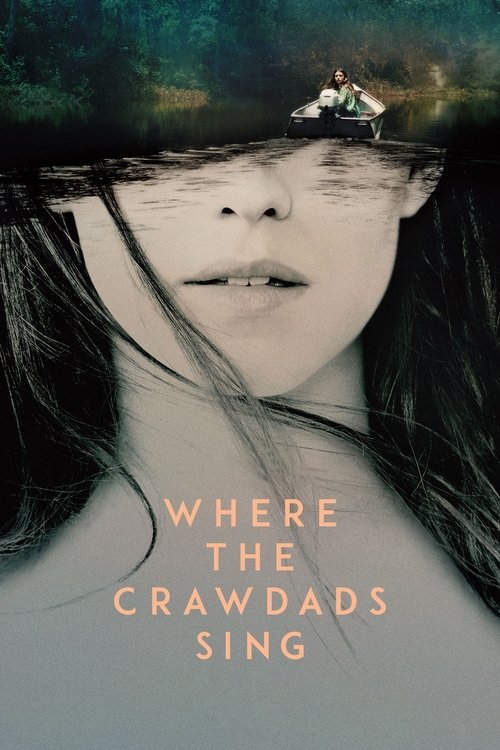
Where the Crawdads Sing
2022 · Olivia Newman
For a rainy-evening, curl-up-with-a-blanket watch — especially if you loved the novel or want a romance with a mystery hook. Comfort viewing with just enough darkness at the edges to keep you turning pages.
What it's about
Abandoned piece by piece by her family, a girl called Kya raises herself alone in the North Carolina marshes, learning the wetlands like a language and growing into a self-taught naturalist and artist — while the nearby town brands her 'the Marsh Girl.' When a local golden boy she was once involved with turns up dead, suspicion lands on her instantly, and her life story unspools alongside the murder trial that will decide her fate.
The experience
A slow-burn Southern gothic that braids coming-of-age romance with courtroom mystery, all wrapped in lush, humid scenery. It's more swoony and sad than suspenseful — a page-turner rhythm rather than a thriller's — with an undertow of loneliness and survival.
Performances
Daisy Edgar-Jones carries nearly every scene as Kya, making her wariness and hunger for connection legible without overplaying the wild-child notes.
The craft
The marsh itself is the star — golden-hour water, herons, hand-drawn field sketches — photographed with a storybook lushness that makes isolation look seductive. The adaptation keeps the novel's three-strand structure intact, and Taylor Swift's original song 'Carolina' seals the mood over the credits.
Why it matters
Proof that the book-club blockbuster still moves audiences: adapted from one of the best-selling novels of its decade, it drew the adult, largely female audience studios had been ignoring, and became a hit despite chilly reviews.
Snapshot
Where the Crawdads Sing is a handsomely mounted adaptation of Delia Owens's blockbuster 2018 debut novel, a book that sold in the millions largely on the strength of Reese Witherspoon's book-club endorsement. The film braids three modes that the source material had already fused: a coming-of-age story about an abandoned girl raising herself in the coastal marshes of North Carolina; a doomed romance triangulated between two very different young men; and a courtroom murder mystery framed around the death of one of them. Directed by Olivia Newman and produced under Witherspoon's Hello Sunshine banner, it is a studio prestige drama built for an audience the industry had spent years insisting did not exist — adult women, especially readers — and it found that audience decisively even as critics were cool. Its cultural footprint is doubled by two extra-textual currents: an original Taylor Swift song, "Carolina," written for the film, and a persistent real-life shadow involving the novelist's own biography and an unsolved killing in Zambia. The result is a film more interesting as a phenomenon of adaptation, marketing, and reception than as a formal object, though its landscape photography and its lead performance give it genuine texture.
Industry & production
The project is a case study in the Witherspoon-era logic of adapting "book-club" IP. Owens's novel became one of the best-selling American titles of its era after being selected for Reese's Book Club, and Witherspoon's Hello Sunshine — a company explicitly founded to develop female-centered stories — moved to adapt it, partnering with Sony's 3000 Pictures label and Sony Pictures for distribution. The pre-sold property carried a built-in audience of tens of millions of readers, a fact that shaped every downstream decision: fidelity to the book's plot beats, a PG-13 rating to preserve breadth of access, and a marketing campaign that leaned on the novel's brand recognition.
Olivia Newman, whose only prior feature was the well-received independent drama First Match (2018), was an unusual choice for a wide studio release — a hire consistent with Hello Sunshine's stated interest in elevating women directors. The screenplay was written by Lucy Alibar, who had earned an Academy Award nomination for co-writing Beasts of the Southern Wild (2012), another story of a fierce, self-reliant girl in a Southern wetland; the pairing was clearly deliberate. Production relocated the North Carolina Lowcountry setting to the bayous and swamps of Louisiana, filming in and around the New Orleans region, where tax incentives and comparable marsh ecology made the shoot feasible. The budget was modest by studio standards — reported in the low tens of millions — and the film's strong commercial performance relative to that outlay (it substantially out-earned its production cost in worldwide theatrical release) confirmed the underlying thesis that a mid-budget adult drama with a devoted readership could still be profitable in a marketplace dominated by franchise tentpoles. I want to flag that precise budget and gross figures circulate in slightly different forms across sources, so I describe the outcome directionally rather than citing an exact number.
Technology
The film was shot digitally in a naturalistic, location-driven register that prioritizes available and golden-hour light over stylization. I don't have a reliably sourced record of the specific camera and lens package, so I won't attribute one. What is legible on screen is a workflow built around the challenges of shooting in and on water: the marsh is not merely a backdrop but the film's controlling environment, and much of the production's technical labor plainly went into capturing boats, tidal flats, and dense vegetation with continuity across seasons and years. The visual-effects work is largely invisible and conservative — set extension, sky and water enhancement, era-appropriate cleanup — in keeping with a film that wants its wilderness to read as real rather than composited.
Technique
Cinematography
The photography is by Polly Morgan (ASC, BSC), whose credits include A Quiet Place Part II, and it is the film's strongest craft element. Morgan treats the marsh as a character: reflective water, backlit reeds, mist, and a warm, saturated palette that edges toward the pictorial. The camera favors Kya's point of view onto the natural world — herons, fireflies, shells, feathers — cutting the human melodrama with a naturalist's attentiveness that mirrors the protagonist's vocation as a self-taught illustrator and biologist. Critics who otherwise dismissed the film frequently exempted the cinematography, and fairly: the images do real narrative work, using light and season to mark the passage of years and to romanticize the swamp as sanctuary rather than menace.
Editing
The edit, by Alan Edward Bell (The Fault in Our Stars, 500 Days of Summer, The Amazing Spider-Man), carries the adaptation's central structural burden: interleaving the 1969 murder investigation and trial with the long chronological flashback of Kya's life from childhood through young adulthood. This dual-timeline construction is the film's engine, doling out backstory so that courtroom testimony and remembered experience comment on one another, and withholding the mystery's resolution until the very end. The cutting is smooth and legible to a fault — it privileges clarity and emotional accessibility over friction — which is both why the film "reads" easily for a mass audience and why some critics found it airless and overly tidy.
Mise-en-scène / staging
Production design splits cleanly between two worlds: the ramshackle, hand-built intimacy of Kya's shack and the marsh, versus the starched, hostile order of Barkley Cove — its courtroom, diner, and general store standing in for a community that has cast her out. Period detail spans the late 1950s to 1969, and costuming tracks Kya's arc from feral child to composed woman without ever fully "civilizing" her. The staging repeatedly isolates Edgar-Jones within wide compositions — a small figure in a vast wetland — literalizing the theme of solitude, then crowds her in the courtroom to dramatize social judgment.
Sound
Sound design foregrounds the marsh's ambient life — water, insects, birds — as a near-constant bed, reinforcing the idea of nature as Kya's true society. Mychael Danna's score (with Jeff Danna) is lyrical and restrained, leaning on strings and folk-inflected textures. The most conspicuous sonic element is extra-diegetic: Taylor Swift's original song "Carolina," written and performed for the film, which threads a spare, banjo-tinged Americana motif through the marketing and end credits and became the film's most awarded component, earning recognition in the original-song categories of the season's awards circuit.
Performance
Daisy Edgar-Jones, coming off the acclaimed series Normal People, anchors the film as Kya and is its second-strongest asset after the photography. She modulates wariness, intelligence, and hunger for connection while carrying an accent and a physical wildness that could easily have tipped into caricature. Taylor John Smith plays Tate, the tender first love, and Harris Dickinson plays Chase, the charismatic town golden boy whose death drives the plot; David Strathairn lends gravity as the retired lawyer who defends her. The ensemble is competent but subordinated to Edgar-Jones, around whom the film is unambiguously organized.
Narrative & dramatic mode
The dramatic architecture is a mystery-in-reverse fused with a bildungsroman. The frame is a whodunit — did Kya kill Chase? — but the film spends most of its runtime not investigating the crime so much as accumulating sympathy for the accused, so that the courtroom becomes a referendum on how a community treats an outsider. The mode is melodrama in the classical sense: heightened emotion, moral legibility, a heroine wronged by social prejudice, and a plot that turns on secrets, letters, and reveals. Owens's novel supplies a final twist that recontextualizes everything, and the film honors it; the effect is to convert the courtroom acquittal into dramatic irony. This ending has been the film's most debated narrative feature, precisely because it asks the audience to hold sympathy and culpability together.
Genre & cycle
The film sits at the intersection of several traditions: the Southern Gothic (marsh setting, town cruelty, buried violence), the coming-of-age wilderness story, the courtroom drama, and the sweeping literary romance. Its nearest kin is the "prestige book-club adaptation" cycle of the 2010s and early 2020s — glossy, emotionally direct films drawn from best-selling women's fiction, of which Hello Sunshine's Big Little Lies and Little Fires Everywhere (television) and the broader wave of Nicholas Sparks–style romances are the commercial ancestors. Alibar's involvement also links it, thematically if not tonally, to the more magical-realist Beasts of the Southern Wild. Against those touchstones, Crawdads is notably more conventional and more sanitized than either its Gothic or its social-realist relatives.
Authorship & method
Authorship here is diffuse and producer-forward. Newman directs with tact and a clear commitment to Kya's interiority, but the film's controlling sensibility is arguably that of its adaptation pipeline — Owens's plot, Alibar's screenplay, and Witherspoon's brand of empathetic, women-centered literary drama. Among the key collaborators, three shape the film's identity most: Polly Morgan, whose cinematography supplies the naturalist romanticism; Mychael Danna, an Academy Award winner for Life of Pi and a longtime Ang Lee collaborator, whose score gives the emotion a dignified restraint; and Lucy Alibar, whose screenplay had to compress a decade-spanning, dual-timeline novel into a legible feature. Editor Alan Edward Bell is effectively a fourth author, since the film exists as a braid of timelines that lives or dies in the cut. The method throughout is fidelity: this is an adaptation that trusts its source and its readership, minimizing directorial reinterpretation.
Movement / national cinema
The film belongs to no movement in the art-historical sense. It is mainstream American studio cinema of the streaming-adjacent 2020s — specifically the mid-budget theatrical drama that the majors had increasingly ceded, revived here by a producer with a distinct market thesis. If it participates in anything larger, it is the industrial "movement" of female-led development companies (Hello Sunshine chief among them) building a pipeline from best-selling women's fiction to screen, a business phenomenon more than an aesthetic one.
Era / period
Two eras matter. As a setting, the film spans roughly the late 1950s through 1969 in the Jim Crow–era coastal South, though it keeps its period politics largely in the background, foregrounding class and gender ostracism over the era's racial order — an omission some critics noted. As a product, it is a post-pandemic 2022 release, arriving as theaters were still recovering and as studios were testing whether adult dramas could draw audiences back; its commercial success became a modest data point in that ongoing industry argument.
Themes
The film's central themes are isolation and belonging — Kya's exile from human society and her adoption of the natural world as kin — and the cruelty of communal judgment toward those who don't conform. Nature functions as refuge, teacher, and moral mirror; Kya's scientific attentiveness to the marsh is offered as a nobler form of knowing than the town's gossip and prejudice. Survival, self-education, and the transformation of a "swamp girl" into a published naturalist form an uplift narrative about self-authorship. Running beneath all of this is a darker meditation, drawn from the novel, on predation and self-defense — the idea, voiced through Kya's observations of animal behavior, that the boundary between survival and violence may be thinner than civilized morality admits. The ending weaponizes this theme, which is what gives an otherwise soft film its lingering unease.
Reception, canon & influence
Critical reception was broadly mixed-to-negative. Reviewers tended to praise Edgar-Jones and Morgan's photography while faulting the film as glossy, overlong, tonally soft, and dramatically sanitized — a swamp story with the danger drained out, and a courtroom mystery whose emotional shorthand smoothed over the source's thornier implications. Audiences diverged sharply from critics: the film drew strong exit reactions and performed well commercially relative to its budget, confirming the resilience of the book's fanbase. In awards terms, its most durable recognition attached to "Carolina," Taylor Swift's original song, which figured in the season's original-song conversation.
The influences on the film run backward through best-selling literary melodrama (the Nicholas Sparks romance tradition), the Southern Gothic, and, via Alibar, the wilderness-child lineage of Beasts of the Southern Wild. Its legacy forward is so far more industrial than artistic: it stands as a proof point in Hello Sunshine's model of converting book-club properties into profitable mid-budget films, reinforcing studio appetite for adult, female-driven literary adaptations at a moment when such films were considered risky.
Finally, no honest account can omit the extra-textual controversy that trailed the release. Author Delia Owens, who lived in Zambia for years as a wildlife conservationist, had been named in connection with the unsolved on-camera killing of a suspected poacher during that period — a matter reported at length in journalism predating the film (notably Jeffrey Goldberg's investigation) — and Zambian authorities had reportedly sought to question members of the Owens family. Because the novel and film turn on a possibly-justified killing that goes unpunished, this real-world shadow became part of the film's reception discourse in 2022. I state this carefully: the reporting concerns questions and unresolved allegations rather than adjudicated findings, and I make no claim beyond what the public record documents. It remains, nonetheless, an inseparable part of how Where the Crawdads Sing was read.
A Deleuzian reading
The film keeps leaving the people.
The full Deleuzian reading of Where the Crawdads Sing →
Reception
Critics savaged it in 2022 (a rare book-club-blockbuster with a rotten Tomatometer), but audiences turned it into a $140M sleeper hit anyway — and it's since settled into 'critic-proof phenomenon' status rather than getting any real reappraisal.
How Where the Crawdads Sing was received, from release to now →
How to watch Where the Crawdads Sing: what to notice on a first viewing
- Count the cuts to herons, shells, fireflies, and feathers. Polly Morgan keeps leaving the people for the marsh. Those inserts are not scenery: Kya is a self-taught illustrator and naturalist, and looking closely at animals is how she lives. Every cut to a bird is a cut into her attention. The film shows her mind by showing what she watches.
- Compare the wide marsh shots with the packed courtroom. Outside, Edgar-Jones is a small figure in an enormous wetland with nobody else in frame. Inside Barkley Cove, the film crowds her with benches, faces, and a town that has already decided. The film alternates space and pressure. Two places, two moral orders, and you feel which one she breathes in.
- Watch how often the light is dawn or dusk. Morgan shoots the marsh in low gold, backlit reeds, mist over shallow water. Seasons and light do the work of marking the years passing in Kya's life. The swamp is photographed as sanctuary rather than threat. That choice carries most of the film's sympathy.
- Listen to the insects, water, and birds under every scene. The marsh ambience runs almost continuously. Mychael and Jeff Danna's score stays restrained, strings and folk textures, so the natural sound keeps its place in the mix. Nature is the company she keeps. The soundtrack treats it as her society rather than as background.
- Watch the film move between the trial and Kya's childhood. Alan Edward Bell braids two timelines: the 1969 case and a long chronological account of her growing up. Testimony and remembered scenes keep answering each other across the cut. The past arrives in the order the trial needs it. The structure builds sympathy while the case is argued.
The whole guide to watching Where the Crawdads Sing, with the keys for a rewatch →
Influences: the films it descends from and the films it influenced
- Beasts of the Southern Wild (2012) — Shares screenwriter Lucy Alibar and her feral-wilderness-child grammar — a marsh-dwelling outsider observed at ground level, nature filmed as kin rather than backdrop — which Alibar transplanted almost wholesale into Kya's bayou.
- Days of Heaven (1978) — Establishes the magic-hour naturalist idiom Polly Morgan quotes: landscape shot only in the low golden light of dawn/dusk, punctuated by inserted close POV of birds, insects and water as an emotional counter-melody to the human drama.
- To Kill a Mockingbird (1962) — The template for the Southern small-town courtroom drama built around a socially-cast-out defendant, where the trial becomes a moral spectacle of the community judging its own prejudice as much as the accused.
- The Notebook (2004) — Codifies the Nicholas Sparks book-club-romance machine Crawdads runs on: a retrospective framing device that braids a present-day reckoning with a soft-lit Southern love story, tuned for maximum audience-vs-critic exit warmth.
- The Piano (1993) — Precedent for the near-mute woman defined by interiority rather than dialogue, set inside an untamed wilderness that reads as simultaneously erotic refuge and site of male threat.
- Legends of the Fall (1994) — Ancestor of the golden-hour landscape-melodrama epic, where sweeping magic-hour vistas and a lush romantic score do the emotional heavy lifting for a generation-spanning literary adaptation.
- A River Runs Through It (1992) — Sets the precedent for the reverent nature-as-scripture cinematography — sunlit water, wildlife inserts and a hushed elegiac score — that treats a wild American landscape as the film's true co-protagonist.
- Wild (2014) — The Reese Witherspoon-produced proof-of-concept directly preceding this: a female-centered nature-immersion narrative that launched the empathetic-women's-literary-drama brand Hello Sunshine industrialized with Crawdads.
- Little Fires Everywhere (2020) — A Hello Sunshine sibling product in the same book-club-to-screen pipeline, confirming the producer-forward model of converting adult, female-driven bestsellers into mid-budget adaptations with fidelity to the fanbase.
- Remarkably Bright Creatures (2026) — Newman's own template for the sincere bestseller adaptation — Polly Morgan's landscape-conscious cinematography and a buried small-town mystery surfaced through clean, emotionally legible coverage — is the direct production model this film extends.
- Winter's Bone (2010) — Same portrait of a young woman surviving alone against an insular, suspicious rural community and its coded violence, staged with isolating naturalist compositions that root character in a specific hostile landscape.
- Mud (2012) — Extends the same Southern-riverine naturalism — a child's-eye view of an adult world of fugitives, self-defense and love filmed in the humid light of a working delta ecosystem.
- Life of Pi (2012) — Showcases composer Mychael Danna's signature here: a world-music-inflected, restrained score that lends survival-in-nature melodrama a dignified emotional lift rather than swelling it into bombast.
- Gone Girl (2014) — Parallel construction of a female-driven literary adaptation as a dual-timeline mystery whose withheld final twist retroactively reframes a possibly-justified killing and the question of who the law can touch.
- Atonement (2007) — Model for the prestige literary adaptation whose entire payoff is an editing-driven late reveal — the braided timeline conceals a narrative fact that recontextualizes everything once disclosed.
- Little Women (2019) — Demonstrates the same authorship-in-the-cut Alan Edward Bell attempts: a decade-spanning female literary property made legible by intercutting two color-graded timelines so the edit, not the plot, carries the meaning.
- Cold Mountain (2003) — Sibling in the bestselling-novel-to-prestige-film mode: an Appalachian wilderness-survival romance that leans on naturalist landscape photography and a folk-scored original song to sell literary melodrama.
Similar films
- Beasts of the Southern Wild (2012) — influence & lineage
- Remarkably Bright Creatures (2026) — same viewing thread
- The Quiet Girl (2022) — same viewing thread
- "Wuthering Heights" (2026) — shared sensibility
- The Wild Robot (2024) — shared sensibility
- Moonrise Kingdom (2012) — shared sensibility
- Girls Like Girls (2026) — shared sensibility
- Sense and Sensibility (2026) — shared sensibility
All the films related to Where the Crawdads Sing →
Watch it with: curated runs of related films
- The Quiet Thaw of Grief — A run of hushed, big-hearted films where a widow, a widower, or a withdrawn child is coaxed back toward life by one unlikely bond — watch them near each other when you want to be moved, not wrung out.