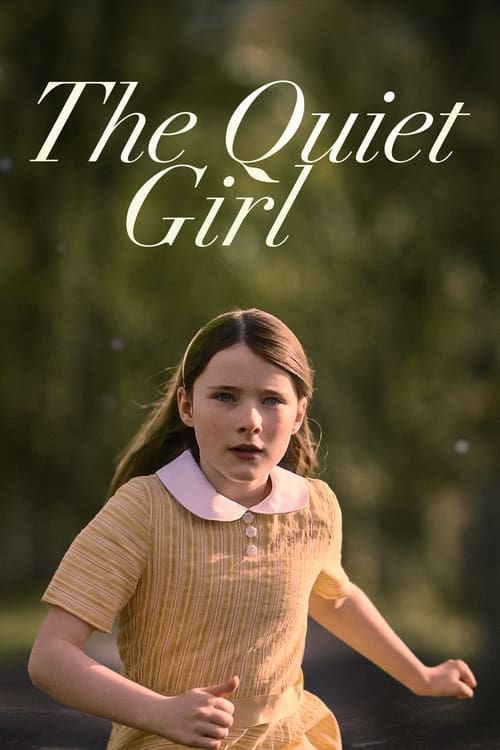
The Quiet Girl
2022 · Colm Bairéad
When you need a good cry that's earned rather than forced — a tender, unhurried film for a quiet evening with your phone in another room. Comforting and heartbreaking in equal measure.
What it's about
Rural Ireland, 1981. A withdrawn nine-year-old girl from a crowded, neglectful household is sent to spend the summer with distant relatives on a working farm in County Waterford. In the quiet order of their home she begins, cautiously, to bloom — while sensing an old sorrow the couple never speak of.
The experience
Gentle, hushed, and precise — a film of small gestures where a hand held or a biscuit offered lands like thunder. It builds such quiet feeling that by the end it can undo you completely; the final minutes are famously shattering in the softest way.
Performances
Catherine Clinch, in her first role, gives one of the great child performances — nearly wordless, everything in the eyes — and Carrie Crowley and Andrew Bennett make the foster couple's reserve and warmth equally palpable.
The craft
Bairéad tells the story from a child's eye level, with patient framing, natural light, and a sound design of farmyards, water, and silence that makes the sparse dialogue count double. Most of it unfolds in the Irish language, which gives its tenderness a particular music.
Why it matters
It became the first Irish-language feature nominated for the Best International Feature Oscar, a landmark for Irish cinema and proof that a tiny, quiet film could travel worldwide.
Snapshot
The Quiet Girl (Irish: An Cailín Ciúin) is a chamber drama of childhood neglect and belated tenderness, adapted by writer-director Colm Bairéad from Claire Keegan's 2010 novella Foster. Set in rural Ireland in 1981, it follows Cáit, a withdrawn nine-year-old from a crowded, impoverished, emotionally barren household, who is sent for the summer to distant relatives, the Cinnsealachs, on a working farm in County Waterford. In the ordered warmth of their home she slowly unfolds — and gradually intuits the grief the couple carry, a dead child whose absence shapes everything unspoken between them. The film is largely in the Irish language, a fact central to both its texture and its place in cinema history: it became the first Irish-language feature to be nominated for the Academy Award for Best International Feature Film, at the 95th Academy Awards. Restrained, patient, and shot in a near-square Academy frame, it is a work built almost entirely from observation, withholding, and the granular attention of a child's-eye view.
Industry & production
The Quiet Girl is a product of a specific and deliberate Irish cultural-industrial initiative. It was financed principally through Cine4, a scheme launched jointly by Screen Ireland (Fís Éireann), the Irish-language broadcaster TG4, and the Broadcasting Authority of Ireland to fund Irish-language feature films — a policy instrument designed to build a sustainable production stream in the language rather than one-off cultural gestures. The film was produced by Inscéal, the company run by producer Cleona Ní Chrualaoi, Bairéad's partner and long-time collaborator. This is, in other words, a low-budget national-cinema production made possible by targeted public subvention, not by the commercial mainstream.
The economics matter to how the film looks and behaves: a modest budget, a compact shooting schedule, a small cast, and largely single-location farmhouse-and-fields staging. What distinguishes it from many such subsidized films is the disproportion between its means and its reception. It premiered in the Generation Kplus strand of the 2022 Berlin International Film Festival, where it won the Grand Prix of the Generation Kplus International Jury (the Crystal Bear). It went on to a strong festival and arthouse-distribution life, a wide sweep at the Irish Film & Television Academy (IFTA) awards, and the Oscar nomination that gave it international visibility far beyond the usual reach of a debut-feature adaptation in a minority language. It has been widely reported as the highest-grossing Irish-language film to that point; I would treat the precise figures cautiously, but the pattern of unusual commercial success for the category is well established.
Technology
Technologically the film is unshowy and consistent with contemporary independent digital production. It was shot digitally, on an interior-and-exterior naturalism that depends less on any single tool than on controlled light and a disciplined palette. The most consequential formal-technical decision is the 1.37:1 Academy aspect ratio — a near-square frame rather than widescreen. This is a "technology" choice in the sense that the frame is the film's primary instrument: it encloses Cáit, isolates single figures, and refuses the horizontal sweep that would contextualize her within landscape or family group. Beyond the frame, the film relies on available-light aesthetics, shallow-focus lensing, and post-production color grading toward warm domestic interiors and cool, damp exteriors. There is no visual-effects dimension to speak of; the technological argument of the film is one of restraint and precision rather than capability.
Technique
Cinematography
The cinematography, by Kate McCullough, is the film's most discussed formal achievement and the engine of its meaning. Working in the boxy Academy ratio, McCullough builds an aesthetic of proximity and partial disclosure: frequent close framing on Cáit's face, low camera heights that adopt a child's sightline, and compositions that place her at the edge of frames or glimpse adult life through doorways and gaps. Focus is used expressively — soft backgrounds isolate the girl, and the film repeatedly withholds full visual information the way it withholds narrative information. Light is domestic and directional, favouring window light and lamplight in the Cinnsealach home against the grayer register of Cáit's original household. The result is a cinematography of attention: the camera watches Cáit watching, and the spectator is placed inside her limited but intensifying comprehension.
Editing
The editing, by John Murphy, is patient and elliptical. Scenes are allowed to breathe; the film trusts duration, holding on faces and small actions (a hand washed, a well drawn from, hair brushed) rather than cutting for information. Crucially, the edit organizes the film around gaps — it declines to spell out the Cinnsealachs' loss, letting the viewer assemble the buried history from fragments (a boy's clothes, a wallpaper, a averted answer). The cutting rhythm mirrors Cáit's own slow thaw, accumulating meaning by accretion rather than exposition, and reserving its emotional release for a final passage whose power depends entirely on the restraint that precedes it.
Mise-en-scène / staging
The film's mise-en-scène draws a sustained contrast between two households. Cáit's family home is crowded, disordered, and neglectful — a place of too many children, too little money, and no attention. The Cinnsealach farm is clean, orderly, and quietly abundant: routines of cooking, farming, and care are staged as a kind of grace. Production and costume design fix the film precisely in 1981 rural Ireland without heritage-film ostentation. Objects carry the drama — the well, the biscuit tin, clothes kept in a drawer — and the staging repeatedly frames Cáit as an observer at thresholds, physically marking her passage from neglect into belonging.
Sound
Sound is integral to a film titled for quietness. The design privileges ambient rural texture — wind, water, farm animals, the creak of a house — and the deliberate sparseness of speech. Silence is dramatized rather than merely present: the film thematizes what is not said, most explicitly in Seán's counsel that many people have lost much by failing to say nothing. Onto this restrained soundscape, composer Stephen Rennicks lays a spare, tender score that supports rather than dictates feeling. The bilingual sound world — Irish predominating, English intruding at the edges — also carries meaning, marking warmth and belonging against coldness and rupture.
Performance
Performance is calibrated to the film's minimalism. Catherine Clinch, in her debut as Cáit, carries the film almost wordlessly, working in glances, stillness, and small physical adjustments; the role's power lies in legibility of interior life rather than dialogue. Carrie Crowley as Eibhlín and Andrew Bennett as Seán give performances of controlled reticence — Eibhlín's active tenderness and Seán's gruff, slowly disclosed affection — that model different routes toward the same care. The register throughout is understatement; the film's climactic emotion lands precisely because the performances have banked so much restraint.
Narrative & dramatic mode
The dramatic mode is quietist realism organized around restricted narration: we know essentially only what Cáit perceives, and the film's central "secret" — the Cinnsealachs' drowned son — is revealed to us as it dawns on her, through a neighbor's gossip and accumulated domestic clues. This is a coming-into-awareness structure rather than a plot-driven one. Its arc is seasonal and internal: arrival, thaw, belonging, and the threatened return to the original home. The film's dramatic power is concentrated in withholding and in a final gesture that resolves emotionally without resolving narratively — an ending calibrated for ambiguity and ache rather than closure. It belongs to a tradition of childhood-perspective art cinema in which the drama is epistemological (what the child understands) as much as eventful.
Genre & cycle
Formally it sits within the art-house childhood drama, a lineage that runs through films told from a child's limited vantage in which the adult world is glimpsed and misread. It also participates in the rural-Irish literary-adaptation strain and in a broader contemporary cycle of quiet, observational, festival-oriented realism. Within Irish cinema specifically, it can be read as part of an emergent cycle of Irish-language features enabled by Cine4 — a deliberate movement rather than an isolated instance. Its kinship is less with genre conventions than with a mode: minimalist, humanist, attentive to care and neglect.
Authorship & method
The Quiet Girl is a feature debut of unusual assurance for Colm Bairéad, who both wrote and directed. His method here is fidelity to source combined with cinematic translation: Keegan's spare, first-person novella becomes a film that finds visual and sonic equivalents for prose interiority — the child's narration rendered as sustained looking and listening. Bairéad's authorship is inseparable from his key collaborators. Kate McCullough's cinematography supplies the child's-eye grammar and the expressive frame; John Murphy's editing supplies the ellipsis and patience; Stephen Rennicks's score supplies restrained emotional underlining; and producer Cleona Ní Chrualaoi anchored the project within the Cine4/Inscéal framework. The originating author, Claire Keegan, is a decisive collaborator in absentia: the film's economy, its trust in the unsaid, and its emotional architecture are transposed from her fiction.
Movement / national cinema
The film is best understood as a landmark of a policy-driven national-cinema initiative. It is not the product of an aesthetic manifesto but of an institutional effort — Cine4 — to make Irish-language feature filmmaking viable and visible. In that sense it belongs to the ongoing project of Irish cinema's self-definition, and specifically to the assertion of the Irish language as a living medium of contemporary art rather than a heritage artifact. Its international breakthrough gave that project a legitimacy and profile that arguments about cultural funding alone could not, and it now functions as the flagship example of the scheme's ambitions.
Era / period
The film is set precisely in 1981 — a specificity signaled through period design and, in a much-noted detail, radio references to the events of that year (the Northern Irish hunger strikes) that fix the moment without foregrounding politics. That historical framing keeps larger Irish turmoil at the far edge of a story deliberately confined to a child's domestic world. As a production, it belongs to the early-2020s wave of internationally successful small-nation art films, and to a post-2010 moment in which minority-language and regionally specific stories found unusual global traction on the festival-to-streaming circuit. The gap between its 1981 setting and its 2022 making is part of its texture: a memory-tinged, almost fabular Ireland recovered with care rather than nostalgia.
Themes
At its center is the theme of care versus neglect — the transformative power of attention on a child who has been overlooked, and the quiet damage of a home without it. Around this cluster related concerns: silence and the unsaid, both as wound and as wisdom; grief and its displacement, as the Cinnsealachs' loss is redirected into tending Cáit; belonging and its impermanence, since the summer's grace is borrowed and must end; and language and identity, carried by the film's Irish-language texture. There is a persistent motif of thresholds and of things drawn up from depth — the well most literally — that gathers the film's concern with what is hidden and what is brought, tenderly, into the light.
Reception, canon & influence
Critical reception was strongly and unusually unanimous in its admiration; reviewers repeatedly singled out its restraint, McCullough's cinematography, Catherine Clinch's debut performance, and the emotional force achieved through understatement. Its festival trajectory (the Berlinale Crystal Bear), its dominance at the IFTAs, and above all its Academy Award nomination for Best International Feature Film — a first for an Irish-language film — secured its standing quickly. It lost the Oscar to All Quiet on the Western Front, but the nomination itself became the film's historic marker.
Looking backward, its influences are chiefly literary and modal: *Claire Keegan's Foster*** first, and behind that a tradition of pared-down realist fiction and of child's-perspective art cinema attentive to perception and the withheld. One can situate it within an international lineage of quiet, observational humanist filmmaking, though the film wears such affiliations lightly.
Looking forward, its influence is most concrete at the level of national cinema and cultural policy: as the breakout success of the Cine4 model, it materially strengthened the case for Irish-language feature production and raised expectations for the films that followed it. It has also functioned as a proof of concept for minority-language cinema's international viability. Because it is recent, claims about its longer-term artistic legacy remain provisional — the honest position is that its canonical place within Irish cinema is already secure, while its wider influence on filmmaking practice is still being written.
A Deleuzian reading
The film stops on water more than once, and never for a reason the plot needs.
The full Deleuzian reading of The Quiet Girl →
Reception
A tiny Irish-language debut that premiered quietly at Berlinale 2022, rode pure word of mouth to become the highest-grossing Irish-language film ever, and ended up making history as the first Irish-language film nominated for an Oscar. No reappraisal needed — it went from festival sleeper to national treasure in about a year.
How The Quiet Girl was received, from release to now →
How to watch The Quiet Girl: what to notice on a first viewing
- Watch how square and boxy every frame feels. Kate McCullough shoots in the near-square Academy ratio, so there is no horizontal room. You glimpse the rest of the house only through doorways and gaps. The frame itself decides what you are and are not allowed to see.
- Watch the light change between the two houses. Cáit's own home reads gray and flat, while the Cinnsealach farmhouse glows with window light and lamplight, warm even in ordinary daylight scenes. You can tell which house is caring for her before either house says a word.
- Listen for how little anyone needs to say here. Wind, water, farm animals, and a creaking house fill the space where dialogue would normally sit, and speech itself stays sparse throughout. The quiet is not empty; it is where the film keeps its most careful attention.
- Watch an ordinary chore, like washing hands, play out in full. John Murphy holds on small actions, a hand washed, water drawn from a well, hair brushed, well past the point most films would cut away. The extra seconds are the point: you are asked to pay Cáit the attention no one else has.
- Notice which objects the camera lingers on: a well, a tin. The film returns to the same handful of things, a well drawn from, a biscuit tin, clothes kept folded in a drawer, more than once each. Objects here are doing quiet narrative work.
The whole guide to watching The Quiet Girl, with the keys for a rewatch →
Influences: the films it descends from and the films it influenced
- The Spirit of the Beehive (1973) — Establishes the film's core grammar of holding on a silent girl's face as she watches an adult world she can't decode, lit through the honeyed available light of farmhouse interiors.
- Cría Cuervos (1976) — Restricts the narration to a solemn child's perception of household grief and withheld emotion, sustaining unbroken close attention to Ana Torrent's watchful, near-mute face.
- The 400 Blows (1959) — Model for anchoring the whole film to a child's restricted point of view and closing on a held, unresolved facial image rather than narrative resolution.
- Kes (1969) — Template for the neglected working-child drama built on understated non-professional performance and care-versus-neglect measured in small domestic gestures rather than melodrama.
- Ratcatcher (1999) — Supplies the elliptical, sensory editing keyed to a child's tactile sightline and the drowning-well motif of water as a lurking domestic threat.
- Days of Heaven (1978) — Precedent for magic-hour and available-light rural cinematography paired with a spare, withholding child's voice that names little and implies much.
- The Tree of Wooden Clogs (1978) — Grounds the patient agrarian realism — non-professional farm cast, chores filmed in natural light, meaning accreting through observed labor and routine.
- Nobody Knows (2004) — Refines the observational restraint whereby neglect and care register through accumulated quiet detail and ellipsis rather than stated event.
- Ponette (1996) — Demonstrates eliciting a naturalistic debut child performance through patient, documentary-like proximity to the child's face and unhurried takes.
- My Life as a Dog (1985) — Shares the fostered-out-child structure in which a boy sent to warmer rural relatives is healed by their attentive care, told with tender understatement.
- Ghostlight (2024) — Contemporary festival melodrama that withholds a family's central grief and lets it surface through accumulated quiet detail and a nonprofessional child performance, extending Ghostlight's earned-scene-by-scene, gradual-disclosure grammar.
- Small Things Like These (2024) — Direct sibling adaptation of Claire Keegan's spare Irish prose, transposing her trust in the unsaid into dramatized silence and restrained, interior performance.
- Aftersun (2022) — Extends the same restricted-narration device of a child registering an adult's unspoken interior life, built from ellipsis and an ambiguous, ache-laden final withholding.
- Petite Maman (2021) — Shares the pared-down child's-eye register — short runtime, hushed diegetic ambience, care and grief conveyed through spare framing and near-silence.
- Playground (Un monde) (2021) — Locks the camera to a child's eye-height in a boxy ratio with shallow focus that isolates her from a blurred adult world just out of comprehension.
- The Florida Project (2017) — Keeps the vantage at the child's level so adult crises pass at the frame's margins, glimpsed but not understood by the young protagonist.
- Close (2022) — Works in shallow-focus intimacy pressed to a child's face, letting elliptical omission and performance understatement carry emotion that dialogue never states.
- Summer 1993 (2017) — Near-twin premise executed with the same craft: a quiet child handed to relatives for a rural summer, shot observationally and low, where a nonprofessional lead's silences and a final ambiguous emotional break do the work.
- Kneecap (2024) — The other Irish-language film to break through to major international awards, jointly proving Gaeilge on screen can travel — the commercial-viability sibling Kneecap is explicitly paired with.
Similar films
- Close (2022) — influence & lineage
- Petite Maman (2021) — influence & lineage
- Small Things Like These (2024) — influence & lineage
- Nobody Knows (2004) — influence & lineage
- Remarkably Bright Creatures (2026) — same viewing thread
- My First Summer (2020) — shared sensibility
- Memoir of a Snail (2024) — shared sensibility
- Blue Heron (2026) — shared sensibility
All the films related to The Quiet Girl →
Watch it with: curated runs of related films
- The Quiet Thaw of Grief — A run of hushed, big-hearted films where a widow, a widower, or a withdrawn child is coaxed back toward life by one unlikely bond — watch them near each other when you want to be moved, not wrung out.