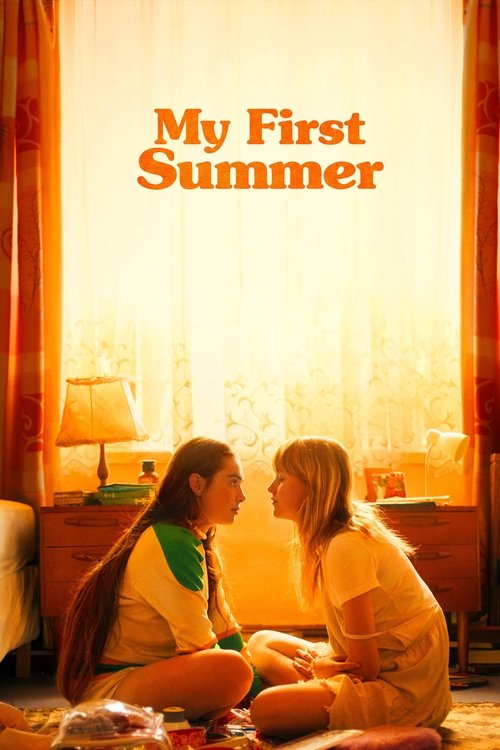
My First Summer
2020 · Katie Found
For a soft evening when you want to fall in love a little and don't mind a lump in your throat — a comfort watch with a bruise in it. Good when you want something short, sincere, and warm.
What it's about
Sixteen-year-old Claudia has spent her whole life hidden away on a remote Australian property, raised in total seclusion by her novelist mother. When her mother dies and Claudia is left alone, a spirited local girl named Grace finds her — and instead of telling anyone, keeps her secret. What grows between them is a first love built inside that fragile concealment.
The experience
Tender, sun-dappled, and small in the best way — a gentle two-hander that moves at the pace of a long summer afternoon, with grief humming quietly underneath the sweetness. It's touching without being cloying.
The craft
Katie Found's debut is confident in its restraint: seventy-seven minutes, two girls, one house, and the golden light of rural Victoria doing much of the emotional work. The film trusts glances and textures over dialogue, giving it the feel of a held breath.
Why it matters
A small but noticed entry in the recent wave of queer coming-of-age cinema, and a calling card for an Australian first-time director working with striking tonal control.
Snapshot
My First Summer is a debut feature of unusual tonal confidence and unusual modesty of scale: a seventy-seven-minute Australian two-hander, shot in the goldfields country of central Victoria, about a girl who has never been outside and the girl who finds her. Katie Found's film opens with a drowning — Veronica Fox, a writer who has raised her daughter in total seclusion, walks into a reservoir — and is witnessed by a local teenager, Grace, who tells the police less than she knows. What follows is not a mystery but its inverse: Grace goes back, finds sixteen-year-old Claudia alone in the house her mother left behind, and instead of reporting her, keeps her. The concealment is the film's foundation, and the love story is built on top of it.
The film's distinctiveness lies in what it declines to dramatize. Claudia has been taught that the outside world is evil; the picture is not about correcting that belief through trauma but about dissolving it through strawberry milk, boiled sweets, a swimming hole, a borrowed cassette. Nor is it a coming-out narrative. Found has said plainly that sexuality was never conceived as an obstacle between the two girls, and the screenplay honors that: no character objects to the romance, no one is required to declare anything, and the antagonist is not a homophobic community but the state — a child-protection apparatus that is entirely correct on the facts and entirely destructive in its effect.
It premiered at the Adelaide Film Festival in October 2020, into a festival year hollowed out by the pandemic, and reached most of its eventual audience through queer film festivals, specialist distributors and streaming platforms rather than cinemas. It was nominated for Best Indie Film at the 2021 AACTA Awards. It is a minor film in the register of the industry and a genuinely accomplished one in the register of craft, and it is worth attention partly for itself and partly as a node — several of the people who made it went on immediately to more visible work.
Industry & production
The production is a clean example of the low-budget Australian feature model as it stood at the end of the 2010s. My First Summer was produced by Alisha Hnatjuk and Jonathan auf der Heide for Noise & Light, with Found herself among the executive producers (alongside Shaun Miller) through Found Films. It was shot on location in rural Victoria near Castlemaine, in the box-ironbark country north-west of Melbourne, and was made — in the phrasing that recurs in Australian trade coverage — on a shoestring.
Auf der Heide's involvement is the most interesting production fact. He directed Van Diemen's Land (2009), the Alexander Pearce convict-cannibalism film, one of the harshest entries in the modern Australian landscape tradition: men destroyed by wilderness. That he produced a pastoral idyll in which the bush is a refuge suggests something deliberate about the inversion, though I have not found him on record framing it that way, and the connection should be read as a resonance rather than a stated intention.
Precise financing details — which agencies invested, at what level, and against what budget — are not available in the publicly accessible record, and I will not guess at them. What is documented is the distribution outcome, which for a film at this scale is the more consequential number anyway. The film opened theatrically in Australia in limited release in March 2021, streamed domestically on Stan, and was subsequently sold into roughly a dozen territories through a slate of specialist queer-cinema distributors — among them Peccadillo Pictures, Salzgeber, Outplay and Supo Mungam — covering the United States, the United Kingdom and Ireland, France, the German-speaking territories, Scandinavia, Spain, Brazil and Japan, mostly for 2022 release. This is the standard survival route for a small LGBTIQ+ feature: a festival premiere at home, a circuit of queer festivals abroad (Mardi Gras, Melbourne Queer, BFI Flare, Santa Barbara, Inside Out, OUTshine), and then a patchwork of territory-by-territory arthouse and platform deals. The film did not have a commercial theatrical life in any meaningful sense; it had a festival life and a streaming afterlife.
Technology
There is little to report here in the way of apparatus, and the honest observation is that this is itself the point. The capture format is not documented in any source I can verify — an ordinary gap for a film of this budget, where camera choices are rarely publicized. What can be described is the technique of resource allocation. The film's look is produced almost entirely by three things that cost nothing but scheduling: the hour, the weather, and the palette.
Matthew Chuang shoots for available light and low sun, and the film's warm haze is a function of shooting when the light does that, not of filtration or post-processing. Color is the principal effect, and it is designed rather than found — Grace arrives in pink tulle and primary blocks against Claudia's washed-out neutrals, a scheme that Screen International's Wendy Ide described as a "sugary confection of a color palette." Carolin Saan's production design does the rest, dressing a single house and its garden as an entire cosmology.
The one genuinely modern production fact concerns the score. Kyle Morton — the songwriter and frontman of the Portland band Typhoon — was approached by Found in spring 2019 and, by his own account, wrote and recorded most of the music across the following year. That is a Melbourne film scored from Oregon, largely during 2020, which places the collaboration inside the distributed, file-transfer workflow that the pandemic normalized and that micro-budget features had already been using out of necessity. The most decisive technology in this film's history, though, is not on set at all: online festival delivery (BFI Flare ran virtually in March 2021) and subscription streaming are what gave it an audience.
Technique
Cinematography
Chuang's work here is the film's most-praised element and the reason it retains interest. He was, at the time, an Australian cinematographer on the cusp: within two years he would shoot Blue Bayou (2021, sharing the role with Ante Cheng, on 16mm, into Cannes' Un Certain Regard) and both of Goran Stolevski's 2022 features, You Won't Be Alone and Of an Age. My First Summer reads as an early statement of the sensibility those films confirmed: handheld or lightly floated proximity to faces, shallow focus that isolates skin and hair and fabric from an out-of-focus wash of green and gold, and a preference for the tactile detail over the establishing view.
The landscape is filmed as enclosure rather than expanse. Australian cinema's inherited grammar for the bush is the wide, indifferent vista in which human figures are dwarfed; Chuang mostly refuses it, staying inside the trees, inside the grass, inside the water. When the frame does open up, it tends to do so around the reservoir — the one location that means death — so that scale itself becomes the threat. The two girls are consistently lit and graded warmer than their surroundings, a simple, effective device that makes them a self-sufficient light source in a world otherwise cooling toward blue.
Editing
Annabelle Johnson cuts the film as a sequence of sensations rather than a chain of causes. Long stretches proceed by montage: hands, food, water, running, sleeping. Reviewers noticed, and not always kindly — Ide's assessment was that an underdeveloped screenplay had been "padded out with several montages," which is a fair reading of the effect if not of the intent. The counter-reading is that a film about a girl encountering ordinary experience for the first time has to be organized around first times, and first times do not have plots. The montages are the story.
Where the cutting is most disciplined is in the interleaving of the police investigation. The detectives appear in short, cool, procedural fragments spliced into the idyll, and the edit uses them as a clock. Nothing is explained about how close the authorities are; the audience simply feels the intervals shortening.
Mise-en-scène / staging
The film has essentially one set — the mother's house and its garden — and stages it as a preserved interior. Veronica's things are still where she left them; the space is a shrine that Claudia has not yet understood is a shrine. Grace's function in the staging is contamination in the benign sense: she brings in objects from outside (packaged food, pop music, color) and each one is placed in the frame as an intrusion before it becomes furniture.
The garden is the transitional zone, and the reservoir is the boundary. The film's spatial logic is a series of concentric rings — bedroom, house, garden, bush, water, town — and Claudia's progress outward is measured almost entirely in how far from the house a scene is set. The final movement returns her to the water, which is both the film's most obvious symmetry and its most legible statement: the reservoir took the mother and gives back the daughter.
Sound
Morton's score is the film's second-best asset. It works in a songwriterly idiom — plucked and bowed strings, wordless vocal lines, unhurried figures that repeat rather than develop — and it is used generously, sometimes wall-to-wall under the montage sequences. Its function is to hold a mood steady while the images accumulate, and it is doing a great deal of the film's emotional load-bearing.
Against it, the location sound is used as a register of the world Claudia has been kept from: birds, insects, wind in dry grass, the specific acoustic of a house with too few people in it. The film's silences are placed with care around the mother — Veronica exists as absence more than as presence, and the sound design keeps the house acoustically too large.
Performance
Markella Kavenagh plays Claudia as someone assembled out of interiority and very little practice at expression. She had come from a run of Australian television — the 2018 Picnic at Hanging Rock miniseries, Romper Stomper, The Cry — and would shortly leave for the Amazon Lord of the Rings series as Nori Brandyfoot, a juxtaposition Australian trade press noted with some relish when this film sold abroad. The performance is watchful, slightly stiff, and unglamorous about grief; Ide's review found Kavenagh less at ease than her co-star, which is a defensible observation and also, arguably, correct casting for a character who has never been at ease anywhere.
Maiah Stewardson's Grace is the engine. She has the harder job — the character has to be charming enough to justify Claudia's entire transformation and dishonest enough to have lied to the police in the first act — and she keeps both alive at once. Edwina Wren appears as Veronica in fragments, and Steve Mouzakis and Harvey Zielinski play the detectives with a deliberate absence of villainy: the film is careful that its antagonists are decent people executing a correct procedure.
Narrative & dramatic mode
The dramatic structure is a suspended idyll under external pressure — closer to a pastoral than to a three-act drama. The inciting incident is not the meeting but the lie: Grace withholds Claudia's existence from the police, and every subsequent tenderness is therefore also a concealment. This is a genuinely elegant piece of construction, because it means the romance and the danger have the same source and grow at the same rate. When the pressure finally lands, it arrives through an almost comic mechanism — the police find Claudia's dog; Grace claims it; Grace's parents contradict her — and the modesty of the trigger is the point. A secret this large is undone by a domestic detail.
The mode is elliptical and sensory rather than expository. Backstory is delivered in glimpses; the mother's illness is never diagnosed on screen, only implied. Dialogue is sparse and rarely does explanatory work. The risk of this approach is thinness, and the film does not entirely escape it — at under eighty minutes it can feel like a fully realized sixty-minute piece with twenty minutes of atmosphere. The reward is that the ending, which involves Claudia's flight and near-drowning and Grace's rescue, plays as an emotional inevitability rather than a plot event.
Genre & cycle
The film belongs squarely to the international queer coming-of-age cycle that consolidated between roughly 2007 and 2020 — Céline Sciamma's Water Lilies (2007), Abdellatif Kechiche's Blue Is the Warmest Colour (2013), Catherine Corsini's Summertime (2015), Desiree Akhavan's The Miseducation of Cameron Post (2018), Wanuri Kahiu's Rafiki (2018), and Sciamma again with Portrait of a Lady on Fire (2019). Its most direct structural ancestor is Paweł Pawlikowski's My Summer of Love (2004), with which it shares a title cadence, a rural setting, a two-girl closed system, and a romance founded on a lie.
Within that cycle it sits on the later, "post-coming-out" side: the generation of films in which queerness is the given rather than the problem, and the obstacle is displaced onto class, family, or — here — the state. Found is explicit that this was the design.
It also draws on a second, weirder lineage: the raised-in-isolation film. Ide reached for Yorgos Lanthimos's Dogtooth (2009) in her review before concluding the resemblance dissolved "like spun sugar," which is accurate. My First Summer has the premise of that subgenre — the child constructed by a parent's private cosmology — without any of its cruelty, and this refusal to exploit the setup is either the film's integrity or its softness depending on the viewer.
Authorship & method
Katie Found wrote, directed and executive-produced; the film is her first feature, following short-form work developed in Victoria. The authorial signature is a consistent preference for warmth over friction. Everything in the premise — a dead mother, a feral child, a police investigation, a suicide attempt — points toward a harsher film, and at every junction Found chooses the gentler option. That is a legible artistic position, and it is what makes the picture unusual within its cycle.
The collaborators are, in retrospect, the more consequential story. Matthew Chuang, ACS, was building toward the international breakthrough that arrived the following year; My First Summer is a useful document of his Australian period and of a visual approach — intimate, warm, tactile, allergic to the establishing shot — that he carried directly into Stolevski's Of an Age. Annabelle Johnson edits toward mood over mechanism. Kyle Morton brings an indie-rock songwriter's ear to a scoring assignment, with the strengths (melodic memorability, emotional directness) and the limitations (some over-application) that implies. Carolin Saan's production design does an enormous amount with one house. Beyond these credits, the below-the-line record for the film is thin in accessible sources, and I have not extended attributions past what is documented.
Movement / national cinema
Australian cinema has a long-standing landscape tradition in which the continent is hostile to those on it — Wake in Fright (1971), Walkabout (1971), Picnic at Hanging Rock (1975), and, in the modern period, auf der Heide's own Van Diemen's Land. My First Summer is legibly in conversation with that tradition and systematically reverses it. The bush does not swallow these girls; it hides them. The danger comes from town, in a car, with a badge. Kavenagh's presence sharpens the point — she had recently played one of the vanished schoolgirls in the 2018 Picnic at Hanging Rock series, and this film puts her back in the Victorian bush and lets her stay.
Its closest domestic relative is Cate Shortland's Somersault (2004): another Australian feature about an adolescent girl, sensory rather than expository, more interested in skin and light and weather than in narrative. Contemporaneously, the film sits in a small but real cluster of Australian queer features from 2019–2020 — Samuel Van Grinsven's Sequin in a Blue Room (2019), Monica Zanetti's Ellie & Abbie (& Ellie's Dead Aunt) (2020) — that emerged from the same low-budget, festival-funded, agency-supported ecology, alongside adjacent work like Shannon Murphy's Babyteeth (2019). Whether that cluster constitutes a movement or merely a coincidence of funding cycles is an open question; it is too soon, and the sample too small, to say.
Era / period
The film was completed in 2020 and released into the worst possible conditions for a small independent feature. Its Adelaide premiere took place in a truncated festival year; its Australian theatrical release in March 2021 was limited; its international rollout ran through 2022, largely via online festivals and platform deals. Almost nothing about that trajectory reflects the film's quality — it reflects the collapse of the theatrical window for micro-budget arthouse work, accelerated by the pandemic and already well underway before it.
Within the period's aesthetics, the film belongs to the post-Call Me by Your Name (2017) vogue for the sun-drenched, tactile, ellipsis-driven summer romance, and to a broader 2015–2022 tendency in which queer cinema moved from narrating oppression to depicting ordinary life. Read against Australia's own timeline — marriage equality legislated in late 2017 — the film's refusal to make sexuality a source of conflict is a period marker as much as an artistic choice.
Themes
Isolation as inheritance. Claudia's confinement is not abuse in the conventional sense; it is a mother's illness transmitted as a worldview. The film is careful never to make Veronica a monster, and the resulting portrait of inherited fear is its most adult idea.
The benevolent institution as antagonist. Child protection is right: a grieving, unschooled sixteen-year-old living alone should not be left alone. The film accepts this and still treats the intervention as catastrophic. That refusal to resolve the tension is unusual and to the film's credit.
Queerness as unremarkable. Nobody comes out; nobody objects. The romance is simply the most functional relationship in the film.
Water. The reservoir opens the film and closes it — the same body of water that takes the mother nearly takes the daughter and instead returns her. It is not a subtle scheme, but it is a coherent one.
Taste, texture, first contact. Candy, milk, music, fabric. The film's method is to render ordinary consumer experience as revelation, which is the most reliable emotional device it has and the one it uses most often.
Reception, canon & influence
Critical reception was warm but qualified, and consistently divided along the same line: near-unanimous praise for the images, reservations about the script. Wendy Ide's Screen International review from BFI Flare called it a "candyfloss Australian debut," admired the color design and the magic-hour glow, and found the screenplay underdeveloped and padded with montage. Brad Newsome in The Sydney Morning Herald was more enthusiastic, describing it as magical, dreamlike and spellbinding. Annice White at The Film Magazine singled out Chuang's cinematography as the film's most striking aspect and reached for The Virgin Suicides as a comparison; Julia J. Hynek's Harvard Crimson notice praised the film's ability to carry heavy material without being dragged down by it. Industry recognition amounted to the 2021 AACTA nomination for Best Indie Film. Aggregate scores exist but the sample of professional reviews is small enough that I would not put weight on them.
Influences on the film. The pastoral queer two-hander of My Summer of Love; the sensory adolescent realism of Shortland's Somersault; the tactile, hand-and-skin grammar of Sciamma; the isolated-upbringing premise of the Dogtooth strand, deployed and then declined; and the Australian landscape film, inverted. The film wears these openly rather than covertly.
What it shaped. Honestly assessed: not much, yet, and it would be false to claim otherwise. Its influence to date is mostly personnel and precedent. Chuang's subsequent trajectory — Blue Bayou, the two Stolevski features, Jimpa, and episodic work including Chief of War — has drawn far more attention to a visual approach this film demonstrates early. Kavenagh's casting in The Lord of the Rings: The Rings of Power has retroactively given the film a larger audience than it could otherwise reach. And within Australian queer cinema, it functions as a working proof that a micro-budget feature built around a lesbian teenage romance, with no coming-out plot and no violence, could premiere at a major domestic festival, secure a dozen international territories, and land an AACTA nomination.
Its longer-term standing will depend on Found's subsequent work, which as of this writing has not yet produced a second feature of comparable visibility. For now it is best understood as a small, well-made, generous film that belongs to a cycle rather than defining one — and as a document of several careers a year or two before they became legible.
Reception
It slipped out quietly during the pandemic after premiering at the Adelaide Film Festival in October 2020, then found its real audience later on streaming — helped along once Markella Kavenagh became a familiar face as Nori in The Rings of Power and viewers went digging through her back catalog.
How My First Summer was received, from release to now →
How to watch My First Summer: what to notice on a first viewing
- Notice the camera stay close to skin, hair, and fabric. Chuang shoots in shallow focus, isolating tactile detail against an out-of-focus wash of green and gold rather than establishing wide views of the landscape. The film wants you inside sensation, not looking at scenery from a comfortable distance.
- Watch the two girls lit warmer than everything around them. Claudia and Grace are consistently graded warmer than their surroundings, so they read as their own light source in a world otherwise cooling toward blue. The color grading alone tells you these two are the warmth in this story, before anything happens between them.
- Notice how far from the house each scene is set. The film moves in concentric rings, bedroom, house, garden, bush, water, and measures Claudia's progress almost entirely by how far outward a scene takes her. You can track her whole transformation just by noticing which ring of the map she's standing in.
- Notice long stretches of hands, food, water, and running. The editing organizes itself around montage rather than cause and effect, built out of ordinary sensations rather than a chain of plot events. The film is organized around Claudia experiencing things for the first time, and first times don't have plots.
- Listen for strings and wordless vocals under the montages. Morton's score of plucked and bowed strings repeats rather than develops, sometimes running wall-to-wall to hold one mood steady while the images accumulate. The music is doing much of the film's emotional work, holding a feeling in place across the cuts.
The whole guide to watching My First Summer, with the keys for a rewatch →
Influences: the films it descends from and the films it influenced
- My Summer of Love (2004) — The template for the pastoral queer two-hander: Ryszard Lenczewski's handheld available-light coverage of two girls in an unpoliced rural interval, with the relationship built on a founding lie one partner tells about her origins — the exact structural device Found reuses for Grace's seclusion.
- Somersault (2004) — Shortland and DP Robert Humphreys construct adolescent interiority from tactile fragment close-ups — breath on glass, hands in fabric, skin against wool — and from color used as emotional weather rather than dialogue; the seed's shallow-focus Australian sensory realism descends directly from this grammar.
- Portrait of a Lady on Fire (2019) — Sciamma and Claire Mathon's hand-and-look grammar — two women alone in a house on isolated ground, desire tracked through window- and firelight exposure and the geography of touch rather than through plot beats — is the direct model for the seed's concentric single-location staging.
- Water Lilies (2007) — Established the queer adolescent film with no coming-out scene and no punitive third act, observing attraction through bodies at rest in summer light; Found inherits the specific refusal to convert the girls' desire into a crisis the narrative must resolve.
- Dogtooth (2009) — Supplies the founding-lie architecture — a parent sealing a child inside a fabricated world with an invented account of what lies past the fence — which Found quotes in Grace's upbringing and then deliberately declines to escalate into horror or grotesquerie.
- The Virgin Suicides (1999) — Edward Lachman's flared, filtered summer diffusion paired with scored montage as the primary narrative engine — girls sealed inside a house, time rendered as gauzy fragments — is the comparison critics reached for, and it is earned in Chuang's magic-hour grade and Johnson's mood-first assembly.
- Picnic at Hanging Rock (1975) — Russell Boyd shot through bridal veil to diffuse Australian light into something that absorbs the girls; Found and Chuang keep the diffusion and the landscape-as-enclosure framing but invert its function, making the bush a shelter concealing the girls from the state rather than swallowing them.
- Badlands (1973) — The self-built pastoral hideout occupied by two young people while police close in — magic-hour available light, elliptical montage of domestic play staged outdoors, original score deployed as lyric rather than suspense — is the structural ancestor of the seed's idyll-under-investigation.
- Fish Tank (2009) — Robbie Ryan's boxed-ratio handheld pressed close to an adolescent body, working with whatever light the location gives and letting focus fall away a foot behind the actor, codified the available-light shallow-focus idiom of contemporary teen realism that Chuang works inside.
- Of an Age (2022) — Direct personnel descent: Matthew Chuang carried this film's approach — no establishing shots, faces held in warm shallow focus, domestic interiors lit by practicals and windows — straight into Stolevski's two-hander, where the identical grammar compresses a romance into a single day.
- Blue Bayou (2021) — Chuang's international breakthrough extends the seed's technique — grainy warmth, close roaming handheld, faces read against practical sources — onto a story of the state pursuing a person through paperwork, applying the same state-as-antagonist pressure to a naturalist intimacy.
- You Won't Be Alone (2022) — Chuang shoots a full period folk-horror in available light and firelight with continuously roaming close handheld, extending the seed's demonstration that natural-light shallow-focus coverage can sustain a feature without a single conventional establishing wide.
- Petite Maman (2021) — A two-hander working the same concentric single-location space — house, woods, hut — and the same warmth-over-friction ethic, resolving grief through play rather than conflict; the closest sibling in method to Found's choosing the gentler option at every junction.
- Aftersun (2022) — Wells and DP Gregory Oke build a two-hander inside one holiday location from elliptical fragments and warm ambient location sound, letting montage and score carry emotional information the screenplay withholds — the same mood-over-mechanism cutting logic Annabelle Johnson applies here.
- Babyteeth (2019) — Contemporary Australian sibling: Andrew Commis's handheld available-light shooting plus chapter-card ellipsis lets a micro-budget teen film with a fatal premise stay buoyant — the same refusal to let heavy material dictate a heavy register.
- Ellie & Abbie (& Ellie's Dead Aunt) (2020) — Released the same year out of the same Australian micro-budget ecosystem, staging a lesbian teenage romance with no coming-out trauma and no violence; together the two films constitute the domestic cycle the seed belongs to rather than defines.
- Rafiki (2018) — Kahiu's saturated warm-palette treatment of a queer teenage romance under state prohibition uses color design as an act of protection — deliberate prettiness as counter-pressure to surveillance in the plot — the same strategy behind Found and Chuang's candy-coloured grade.
Similar films
- Petite Maman (2021) — influence & lineage
- Aftersun (2022) — influence & lineage
- Girls Like Girls (2026) — shared sensibility
- Falcon Lake (2022) — shared sensibility
- Young Hearts (2024) — shared sensibility
- The Quiet Girl (2022) — shared sensibility
- Summer 1993 (2017) — shared sensibility
- Cactus Pears (2025) — shared sensibility