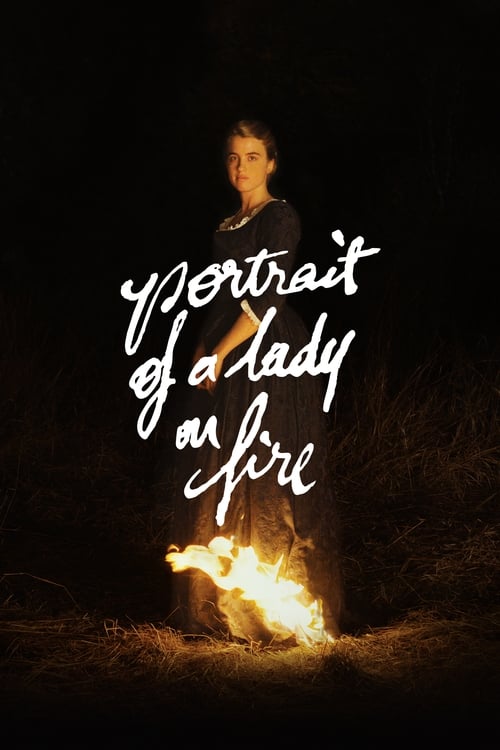
Portrait of a Lady on Fire
2019 · Céline Sciamma
For when you want to fall in love and have your heart broken properly — a deliberate, immersive evening, best with your phone in another room. Bring someone, or bring tissues.
What it's about
On a windswept island off Brittany at the end of the 1700s, a painter arrives with a secret assignment: paint the wedding portrait of a young woman who refuses to sit for one, studying her face during daytime walks and working from memory at night. In a house nearly empty of men, watcher and watched begin to look back at each other, and the days before the portrait's deadline become the whole of a love story. Bounded by an arranged marriage neither woman can stop, every glance starts to count.
The experience
Slow-burning and intensely focused — long silences, crashing waves, and glances that carry more charge than most love scenes. It builds to moments of overwhelming feeling and leaves you wrecked in the quietest possible way.
Performances
Noémie Merlant and Adèle Haenel hold the film between them — a two-hander of watching and being watched where the smallest shift of an eye reads like a confession. Haenel's slow thaw from statue to living woman is extraordinary.
The craft
Every frame is composed like a canvas — candlelit interiors, gray-green sea, dresses that burn against the rock — and the film uses almost no score, so the few eruptions of music land like lightning. Sciamma's screenplay, a prizewinner at Cannes, builds the romance from ritual and repetition: walks, sittings, shared meals. On a big screen with good sound, the bonfire scene alone is worth the ticket.
Why it matters
An instant landmark of queer cinema and one of the most beloved art-house films of its decade — its images of women looking at each other became a shorthand for a whole new way of filming desire.
Snapshot
Portrait de la jeune fille en feu is a French period romance written and directed by Céline Sciamma, set on the rugged Atlantic coast of Brittany in the late eighteenth century. A painter named Marianne arrives at an isolated estate under a deception: her patron's daughter Héloïse has refused to sit for her wedding portrait, so Marianne must study her in secret, memorizing her face across days of enforced companionship before committing the likeness to canvas. As the portrait develops, so does something the film refuses to sentimentalize — a love that is lucid, voluntary, and always bounded by the knowledge of its imminent ending. The film won the Best Screenplay prize and the Queer Palm at the 2019 Cannes Film Festival, where it competed in the main selection, and became one of the defining art-cinema works of its decade.
Industry & production
The film was produced by Bénédicte Couvreur for Lilies Films, Sciamma's production company, in co-production with Arte France Cinéma. Sciamma wrote the screenplay as an original work — not an adaptation — and had been developing the concept for several years before production. The premise gave the script a structural ingenuity rare in literary period drama: painting as observation, observation as desire, and the canvas as the only form of permanence available to women without legal or economic agency.
The cast is almost entirely female: Noémie Merlant as Marianne, Adèle Haenel as Héloïse, Luàna Bajrami as Sophie (the estate's young servant, whose subplot involving an unwanted pregnancy Sciamma interweaves with the main romance without subordinating it), and Valeria Golino as the Countess, Héloïse's mother. Male characters are referred to or briefly glimpsed but never present in any meaningful scene. This absence is both a narrative condition — the father and the Milanese fiancé are always elsewhere — and a deliberate formal logic that restructures the entire economy of looking.
The film was selected as France's submission for Best International Feature Film at the 92nd Academy Awards but was not shortlisted for nomination. It received wide theatrical distribution across Europe and North America, and its critical profile grew steadily through the following years as streaming made it more broadly accessible.
Technology
Cinematographer Claire Mathon, already emerging as one of the most assured practitioners of her generation, shot the film with a palette and discipline drawn explicitly from eighteenth-century painting. The lighting scheme eschews artificial fill in favour of daylight, candle flame, and firelight — recreating, within a production budget that precluded elaborate rigs, the luminous interiors of Chardin and Vermeer while giving the frame an atmospheric warmth that reads as historically consonant rather than artificially antique. The result is a consistent textural unity between the paintings the characters discuss and the film in which they appear. The specific camera format and sensor used have not been extensively documented in trade sources this author has verified, so no claim about format is made here.
The film's aspect ratio contributes to its formal argument. The frame's proportions gesture toward the dimensions of a painted canvas, making every composition feel like a potential subject — a choice that keeps the viewer aware of the act of representation even as they are drawn into narrative absorption.
Technique
Cinematography
Mathon's greatest achievement in the film is her management of the gaze as a cinematic structure rather than a decorative flourish. The camera repeatedly frames characters in the act of looking — Marianne studying Héloïse's posture at the cliff's edge, Héloïse watching Marianne work — so that point-of-view becomes the film's primary dramatic mechanism. Shots are held long enough to register duration: we feel the accumulation of minutes in a glance, the weight of attention returned. This is not passivity; it is patience deployed as a formal argument.
The outdoor sequences on the island use overcast Atlantic light that flattens color and gives the landscape a gray severity against which the warmth of interior candle-lit scenes registers as intimacy. The bonfire sequences — particularly the nocturnal gathering where women from the nearby village congregate to sing — use fire as both light source and thematic rhyme: the film's fire motif runs from a spark on a hem to a conflagration of feeling.
Editing
The editing, credited to Julien Lacheray, favours a measured pace that refuses to hurry revelation. Cuts are mostly clean rather than associative, and the film resists the montage-of-longing shortcuts typical of literary romance adaptations. Time is treated as a substance: each day on the island has a felt duration, which makes the approach of the last day genuinely harrowing without the film needing to underscore the point. A single flash-cut intrusion — a vision Marianne has of Héloïse in her wedding dress — stands out precisely because the surrounding fabric is so uninterrupted.
Mise-en-scène / staging
Sciamma's spatial organization of the estate is strict and meaningful. The paintings in progress function as mirrors of the relationship's development. The portrait that Héloïse eventually rejects, the one that sees Marianne in a societal role she cannot claim, contrasts with the final, hidden portrait — smaller, unofficial, personally authorized. The communal scenes, particularly the women reading the myth of Orpheus and Eurydice aloud and debating its meaning, are staged as collective inquiry rather than exposition: characters disagree, change positions, argue from feeling and from principle.
The most formally striking staging decision is the bonfire scene, during which Héloïse's hem catches fire and she stands momentarily wreathed in flame, serene. It is an image that carries allegorical freight without demanding a single interpretation: sacrifice, transformation, the sublime indifference to risk that comes with having nothing left to protect.
Sound
The film has no composed score. Sciamma's decision to forgo a soundtrack entirely — one of its most discussed formal choices — is not merely a fashionable austerity but a structural commitment. The film's emotional weight is carried by dialogue, by ambient sound (the sea, wind, the creak of floorboards, the scratch of a brush), and by two diegetic musical moments that consequently arrive with the force of events rather than atmospherics.
The first is the communal choral singing at the bonfire: a piece performed by the gathered women in a modal, archaic style that connects the narrative to a broader female world beyond the estate. The second is a later encounter with Vivaldi's "Summer" from The Four Seasons — heard at a concert, the instrument of devastating narrative consequence. Héloïse's emotional response to the Vivaldi, and the callback to it in the film's closing minutes, gives those final moments their formal precision: music as a clock that cannot be stopped, measuring the distance between what was and what is.
Performance
Merlant and Haenel give performances built almost entirely from physical and optical comportment — posture, direction of gaze, the angle of the jaw. Haenel, in particular, had been known primarily for more naturalistic work in French social realism (most prominently in the Dardenne brothers' L'enfant d'en haut, 2012); here she locates a stillness that is not blankness but compressed attention. The scene in which Héloïse finally agrees to sit for the portrait and stares back directly at Marianne — and by extension at the camera — is calibrated as a pivot point for the entire film's system of looking, and it lands exactly as intended. Merlant's physicality as a working painter — the movement of her hands, the practiced confidence of her body at the easel — gives Marianne a professional reality that prevents the romance from consuming her entirely into its gravity.
Narrative & dramatic mode
The film operates in a mode of tragic lucidity: the lovers know from the outset that their time is finite, and the drama is not whether but how they will inhabit that finitude. This is unusual in romantic cinema, where suspense is usually organized around the question of whether love will be achieved or confessed. Sciamma removes that suspense and replaces it with a different and arguably more demanding question: what does love look like when both parties see its ending clearly?
The myth of Orpheus and Eurydice, explicitly invoked in dialogue as the three women read it and debate it, provides the film's structural frame. Sciamma's revision is to give Eurydice an interior: to ask what she wanted, and to propose that Orpheus's backward glance may have been not failure but a gift — giving Eurydice a last image rather than the slow extinction of being led blind into the world above. The film's final sequence executes this reading with great precision.
Genre & cycle
Portrait of a Lady on Fire sits within several overlapping cycles. It is a queer period romance, joining a cluster of films from the 2010s — Todd Haynes's Carol (2015) being the most prominent predecessor — that brought same-sex desire into the formal register of literary costume drama without treating that desire as pathology or tragedy of the conventional kind. It is an art film in the European sense, with durational pacing, non-generic narrative resolution, and formal self-awareness. And it belongs to a tradition of films centered on the female gaze as productive force — not simply as alternative to the male gaze Laura Mulvey theorized in 1975, but as a wholly different epistemology of looking.
Within French cinema it participates in a period when a generation of women directors — among them Mati Diop, whose Atlantiques Mathon also shot in the same year — were reshaping what French prestige cinema could address and how.
Authorship & method
Céline Sciamma trained at La Fémis, the French national film school, and has worked consistently as a writer-director across a body of films exploring the formation of female and queer identity: Naissance des pieuvres (2007), Tomboy (2011), Bande de filles (2014), Portrait de la jeune fille en feu (2019), and Petite Maman (2021). The through-line across her work is an interest in the moment before identity solidifies — adolescence, liminality, the provisional self.
For Portrait, her collaboration with Claire Mathon was central. Mathon's ability to construct emotionally legible space from available light, and to hold the camera with the patience the material demanded, made possible the film's sustained meditation on looking. The working relationship between a director whose films are consistently about female self-constitution and a cinematographer capable of imaging that constitution without voyeurism represents one of the more significant authorial partnerships of recent French cinema. Sciamma has been forthcoming in interviews about the feminist intentionality of the film's construction — the active avoidance of the conventions by which classical cinema positions female bodies as objects of male attention — and that intentionality is legible in every formal decision from framing to cutting to sound.
Adèle Haenel, with whom Sciamma had had a prior personal relationship that had ended before the film was made, brought to the project a trust and a knowledge of Sciamma's method that the performance reflects. The professional collaboration following a personal rupture is itself a quiet echo of the film's themes of loss transformed into art. Haenel subsequently became a prominent public voice in France's own reckoning with sexual violence in the film industry.
Movement / national cinema
The film is French in production, language, and institutional affiliation, but its concerns and its formal solutions are not primarily legible as expressions of a national tradition. If it has lineage, it is partly in the rigorous feminism of Chantal Akerman — the long take as a refusal of the male-directed cut, the domestic space as a site of female consciousness — and partly in the international queer art cinema that gathered force through the 1990s and 2000s. It does not belong to the French tradition of literary adaptation, nor to the New Wave's improvisatory energy, nor to the social realism of the Dardenne-adjacent school. Its period setting and painterly formalism align it more closely with a strand of carefully crafted European prestige cinema whose audience is as international as it is domestic.
Era / period
Portrait belongs to a moment in global cinema — roughly 2014 to 2022 — when the industrialization of streaming and the concurrent mainstreaming of feminist and queer cultural discourse combined to create real theatrical and critical space for films whose formal ambition would previously have confined them to very limited art-house release. It appeared two years after the acceleration of the #MeToo movement began to reshape conversations about gender and power in the film industry, and while it is not a film about those events, it was received in that context and its explicit engagement with the male gaze as a problem acquired additional resonance from it.
Themes
The film's primary themes are the relationship between love and representation, the ethics of looking, and the question of what it means to consent to being seen. The painting is not simply a plot device but the central philosophical object: to paint someone is to construct a version of them; Héloïse's initial refusal of the portrait is a refusal of that construction; her eventual participation is an act of self-determination.
Alongside this runs a meditation on memory as the only form of permanence available to those without institutional power. The women in the film cannot marry, cannot publish, cannot hold property as they choose; what they can do is remember, and the film argues — most explicitly in its final sequence — that to be truly seen by another person, and to carry that seeing forward in time, is a form of immortality that no legal or social structure can entirely annul.
The Sophie subplot, involving an unwanted pregnancy that the three women address together through practical solidarity, extends the film's feminist argument beyond romance into the domain of bodily autonomy. Sciamma refuses to subordinate this storyline to the main narrative; it runs in parallel as an assertion that these questions are not exceptional but structural.
Reception, canon & influence
Portrait de la jeune fille en feu arrived at Cannes with a level of critical consensus rarely achieved by a film in competition, and its reception on the festival circuit and subsequently in theatrical release sustained that consensus with unusual consistency. It regularly appeared at or near the top of year-end critical lists in 2019 and has since been included in several polls of the greatest films of the 2010s, as well as appearing in the British Film Institute's 2022 Sight and Sound poll, indicating a rapid canonization for a film only three years old at the time of voting.
The influences the film looks backward toward are multiple. The eighteenth-century French and Dutch painting tradition — Chardin's domestic light, Vermeer's frozen instants — is visually present throughout. The feminist art history tradition, most associated with Linda Nochlin's 1971 essay "Why Have There Been No Great Women Artists?", provides an intellectual scaffolding for the film's inquiry into who has been permitted to look and who to paint. Todd Haynes's Carol is the most obvious immediate predecessor in terms of genre and formal approach, both films using the conventions of period costume drama to give queer desire the gravity and visual seriousness those conventions carry.
Looking forward, the film's influence has been felt primarily in two registers. First, in the expansion of critical and directorial vocabulary around the "female gaze" as a constructive practice — the film gave concrete, widely accessible form to an idea that had been discussed in theory but rarely been so legibly embodied in a theatrical release. Second, in demonstrating the international commercial viability of formally rigorous, non-compromised queer art cinema at a scale that encouraged further production and distribution of comparable work. Whether it directly shaped specific subsequent films is harder to trace in the record, but its presence in the discourse around what queer period cinema could be is substantial and ongoing. Claire Mathon's profile rose sharply in the aftermath, and she has continued to be one of the most sought-after cinematographers working in European art cinema.
A Deleuzian reading
She agrees to be looked at, and then she looks back.
The full Deleuzian reading of Portrait of a Lady on Fire →
Reception
It won Best Screenplay and the Queer Palm at Cannes 2019 but was famously passed over as France's Oscar submission — then Letterboxd and the lockdown era turned it into a phenomenon, and by 2022 it had cracked the Sight & Sound critics' top 100, an almost unheard-of rise for a film barely three years old.
How Portrait of a Lady on Fire was received, from release to now →
Influences: the films it descends from and the films it influenced
- Jeanne Dielman, 23 Commerce Quay, 1080 Brussels (1975) — Akerman's method of holding a static camera on female domestic action without editorial relief — duration as the medium of female experience, diegetic-only sound as ethical refusal of underscoring — is the formal template for Sciamma's sustained observation sequences and the direct origin of the Akerman-lineage facet.
- Orphée (1950) — Cocteau's Orphée centers cinema's first sustained reckoning with the myth's core prohibition — the impossibility of looking at what you love without destroying it — as a governing formal problem; Sciamma's climactic orpheus-revision directly inverts Cocteau's conclusion, making mutual witness a feminist counter-grammar to his legend of male looking.
- The Passion of Joan of Arc (1928) — Dreyer's relentless extreme close-up on Falconetti's face — holding a gaze at a woman's interior state for feature length without cutting for relief — established the face as the primary cinematographic unit of female interiority and the ethics of sustained looking as cinema's central moral problem; Mathon's close-up grammar on Haenel and Merlant descends directly from this method.
- Cléo from 5 to 7 (1962) — Varda establishes the grammatical distinction between being-looked-at and looking, tracking the moment when a woman turns the camera's moral authority back on the world that objectifies her — the precise 'ethics of looking' and 'female gaze' problem Sciamma inherits and resolves through Mathon's shared-gaze construction.
- La Belle Noiseuse (1991) — Rivette's four-hour film makes the painter-model session the film's entire drama across real time — the negotiation of power, exposure, and image-control between artist and subject as primary cinematographic action — directly establishing the painting-as-narrative-mirror staging Sciamma uses to make the canvas the arena of mutual self-constitution.
- Days of Heaven (1978) — Néstor Almendros's golden-hour available-light cinematography — working within natural light rather than correcting toward a neutral baseline — codified available light as painterly ideal in art cinema; Mathon's available-light commitment on Portrait inherits this understanding of natural light as moral and aesthetic stance rather than technical limitation.
- Persona (1966) — Bergman builds the film entirely around two female faces in sustained mutual close-up, making the question of who is looking at whom the central epistemological problem; the grammar of two women constituting meaning through prolonged gaze-exchange rather than dialogue or action is the direct structural ancestor of Sciamma's sustained-gaze sequences.
- Hiroshima mon amour (1959) — Resnais's flash-cut intrusions of traumatic memory into present-tense continuity — sudden cuts to a different time register that puncture narrative flow without conventional flashback grammar — are the formal template for Portrait's flash-cut-intrusion editing device, particularly the recurring eruptions of the final parting into the narrative present.
- Carol (2015) — Haynes and Ed Lachman use period costume drama's visual formalism to grant queer female desire the cinematographic weight those conventions traditionally reserved for heterosexual romance — the direct generic template for Portrait — with Lachman's available-light interior work through glass and diffusion also establishing the available-light approach to period queer cinema that Mathon extends.
- In the Mood for Love (2000) — Wong constructs desire entirely through withholding its consummation — repeated choreographed encounters, available-light frames held as paintings, a recurring musical theme whose return marks emotional return — making longing into formal structure; Sciamma inherits this method of building erotic tension through durational staging and a single recurring piece of music rather than narrative action.
- Caravaggio (1986) — Jarman stages scenes as explicit recreations of Caravaggio's canvases, making the painter-model relationship and the question of who controls the image the film's central drama while simultaneously reclaiming the artist as queer historical subject — the combined inheritance of painting-as-narrative-mirror staging and queer historical revision that Portrait takes up.
- The Piano (1993) — Campion and Stuart Dryburgh establish a mode of imaging female interiority through available exterior light and contained physical gesture — the female body's relationship to period and domestic space as political condition — in a film where the woman's subjectivity is communicated through what she makes rather than what she says, anticipating Mathon's available-light grammar.
- Ammonite (2020) — The most direct formal response to Portrait: queer female desire in a period domestic setting built through durational observation and tactile close-up grammar, with Stéphane Fontaine's cinematography explicitly extending Mathon's model of sustained looking as the form of female intimacy rather than plot or declaration.
- Petite Maman (2021) — Sciamma carries Portrait's core formal commitments — available light, durational pacing, communal domestic space as the arena of female self-constitution, diegetic-only sound — into childhood fantasy, confirming these as authorial constants of her method rather than period-specific devices and extending the communal-inquiry staging to an intergenerational register.
- Girls Like Girls (2026) — Supplies the shot/reverse-shot grammar of mutual female looking — the held exchange of glances staged as reciprocal authorship rather than a one-directional male gaze — that any contemporary sapphic romance now works from.
- My First Summer (2020) — Sciamma and Claire Mathon's hand-and-look grammar — two women alone in a house on isolated ground, desire tracked through window- and firelight exposure and the geography of touch rather than through plot beats — is the direct model for the seed's concentric single-location staging.
- The Handmaiden (2016) — Park structures his film around two women constructing and contesting the images made of them by men in a period domestic setting — the same grammar of female conspiracy through image-control and the use of period mise-en-scène to contain and formalize queer desire — arriving three years before Portrait as a parallel instantiation of the queer-period-romance form.
- Atlantics (2019) — Claire Mathon shot both Atlantics and Portrait in 2019, bringing the same available-light grammar — sustained close attention to female faces, darkness as emotional register, natural space as metaphysical field — to radically different generic material; the two films constitute a coordinated statement of Mathon's cinematographic method and make them formal siblings through shared authorship.
- Misericordia (2024) — Shares cinematographer Claire Mathon's signature: scoreless, available-light image-making in which landscape and natural light do the expressive work conventionally handed to a music track.
- The Power of the Dog (2021) — Sciamma's eyeline choreography — systematically alternating who holds the gaze across shot-reverse-shot compositions — constructs power dynamics and their reversals without dialogue, paralleling Campion's staging method in which spatial arrangement and camera position encode Phil's dominance and Peter's slow, deliberate reclamation of the room.
- TÁR (2022) — Sciamma's sustained long takes as the primary vehicle for negotiating power between two women — making the dynamic visible in blocking and gaze rather than dialogue — shares TÁR's grammar of the single-take master scene as a space where authority is exercised, contested, and withdrawn without the scene announcing its own stakes.
- Monster (2023) — Sciamma's commitment to naturalistic light sources combined with her structural discipline of withholding the emotional peak of a queer relationship until its absence becomes the subject is a formal sibling to Monster's restraint in staging the Minato–Yori bond, where the color-shift golden finale is the only permitted release.
- Pride & Prejudice (2005) — Descendant that perfects the painterly available-light frame and desire-through-looking that Wright modernized, building longing entirely from held gazes and the charge of the unspoken.
- Little Women (2019) — A same-year meditation on women's authorship and the female gaze, structured as retrospective memory framed by an act of looking-back, a sibling in form and theme.
- God's Own Country (2017) — Queer romance carried almost entirely by gazes and restraint in a windswept coastal landscape, resisting tragic inevitability.
- Invisible Life (2019) — Cannes 2019 companion in the women's-melodrama revival: a painterly, patriarchy-bounded love told through absence and remembered image, sharing the epistolary logic of two women preserving each other across separation.
- And Then We Danced (2019) — Routes forbidden desire through disciplined looking and a communal a cappella chant scene, staging longing as an act of art and its reception.
- Happening (2021) — Female-authored period drama with a near-scoreless soundscape and painterly restraint, staging an abortion without melodrama — the same anti-editorializing intimacy.
Similar films
- Petite Maman (2021) — influence & lineage
- The Handmaiden (2016) — influence & lineage
- The Piano (1993) — influence & lineage
- La Belle Noiseuse (1991) — influence & lineage
- Past Lives (2023) — same viewing thread · often watched together
- Burning (2018) — same viewing thread
- Decision to Leave (2022) — same viewing thread
- Persona (1966) — influence & lineage · often watched together
All the films related to Portrait of a Lady on Fire →
Watch it with: curated runs of related films
- The Ache of Almost — Watch these together for the way each circles a love that time, distance, or duty keeps just out of reach — long looks, feelings left unsent, and the life that gets lived instead.