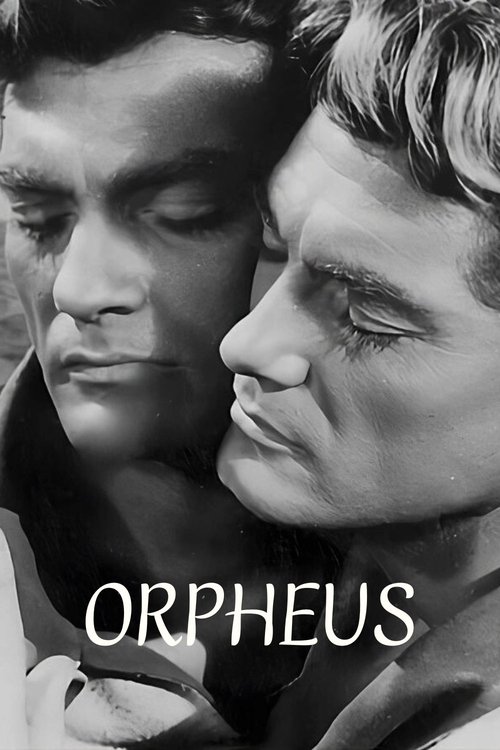
Orpheus
1950 · Jean Cocteau
For a late night when you want enchantment — something strange and beautiful to fall into rather than follow. A film to watch alone, lights off, when ordinary movies feel too ordinary.
What it's about
In postwar Paris, a famous poet — sneered at by the young Left Bank crowd — witnesses a strange accident and falls under the spell of a mysterious, black-gloved Princess who travels with leather-clad motorcycle outriders. As cryptic messages pour from a car radio and mirrors stop behaving like mirrors, he's pulled between his devoted wife Eurydice and an obsession that leads out of the world of the living altogether. It's the Greek myth of Orpheus, replayed in cafés and bombed-out ruins.
The experience
Dreamlike but never vague — the supernatural arrives with total matter-of-fact confidence, which makes it eerier and more romantic than any effects spectacle. It casts a slow, hypnotic spell; you come out feeling like you've been somewhere.
Performances
María Casares is unforgettable as the Princess — imperious, severe, and heartbreaking, she makes death itself a tragic romantic lead.
The craft
Jean Cocteau conjures the uncanny from almost nothing: mirrors that ripple into doorways, reversed film, a Rolls-Royce radio chanting nonsense verse — poet's tricks rather than studio machinery. Seventy years on, the mirror crossings still produce a genuine shiver, and the film's mix of ordinary streets and impossible events is its whole magic.
Why it matters
The centerpiece of Cocteau's Orphic Trilogy and a cornerstone of fantasy cinema — proof that myth could live in modern dress, with an influence running through generations of dream-logic filmmaking.
Snapshot
Orphée transplants the Greek myth of the poet who descends to the underworld to reclaim his dead wife into the cafés, boulevards, and bombed-out ruins of immediately postwar Paris. Jean Cocteau—poet, playwright, draughtsman, and by 1950 a veteran filmmaker—took his own 1926 stage tragedy and rebuilt it as cinema, fusing a mundane contemporary setting with frank supernatural machinery: mirrors that liquefy into doorways, a black Rolls-Royce whose radio chants nonsense verse, leather-clad motorcyclist outriders who serve as Death's executioners, and a Princess (María Casares) who is Death herself and who commits the cardinal transgression of falling in love with her quarry. It is the central panel of what Cocteau retrospectively called his "Orphic Trilogy," bracketed by the experimental Le Sang d'un poète (1930) and the valedictory Le Testament d'Orphée (1960). More than a fantasy, the film is Cocteau's most sustained meditation on the artist's relationship to death, fame, inspiration, and the act of crossing thresholds—made with a craftsman's relish for the in-camera trick and a mythographer's seriousness about its imagery.
Industry & production
Orphée was a French production of the early Fourth Republic, made within the artisanal, producer-driven studio economy of postwar France. It was mounted through Cocteau's association with producer André Paulvé and his company (Films du Palais Royal / André Paulvé), the same orbit that had supported Cocteau's lavish La Belle et la Bête (1946). Studio interiors were shot at the Saint-Maurice studios outside Paris, while location work exploited two distinct kinds of real space: the Left Bank café-and-boulevard milieu of Saint-Germain-des-Prés, and—crucially—the ruined Saint-Cyr military academy, gutted by wartime bombing, which Cocteau pressed into service as "the Zone," the limbo through which the dead pass. Using genuine rubble rather than built sets gave the underworld a documentary desolation that no soundstage could fake and that anchored the film's mythology in the lived memory of the Occupation and the war.
The picture sits at the confident center of Cocteau's filmmaking career, after the popular success of La Belle et la Bête had proved he could command an audience as well as the avant-garde. The casting reflected both his personal world and the cultural moment: Jean Marais, Cocteau's longtime muse and partner, took the title role; the Spanish-born stage actress María Casares brought tragic gravity to the Princess; and Juliette Gréco, then emblematic of existentialist Saint-Germain, appeared as Aglaonice, knotting the film to the very Left Bank youth culture it depicts. Precise budget and box-office figures are not something I can responsibly cite here; what the record establishes is that the film was a prestige production by a nationally famous artist and that it circulated internationally and was critically lauded soon after release.
Technology
Orphée is a textbook of late-classical, pre-optical-printer trick cinema: nearly all its marvels are achieved in the camera, on the set, or through simple lab work, not through traveling mattes or elaborate compositing. The signature effect—passing through a mirror—was staged practically. For the "soft" mirror that yields to a hand, the production used a vat or tray of liquid (mercury is the technique traditionally associated with these shots) shot so that a hand pressing into it reads as a hand sinking into a vertical reflective surface. For full-body passages, Cocteau and his team built doubled, mirror-image sets so an actor could appear to step "into" a mirror that was in fact an open frame leading to an identical room beyond, often combined with a horizontal floor disguised as a vertical wall.
The film leans heavily on reverse-motion and undercranked/overcranked photography: objects that fly back into the hand, figures who rise unnaturally, the gliding, weightless movement of the dead. Heurtebise's apparent levitation and the dreamlike traversals of the Zone were produced with concealed supports, wires, and clever camera placement rather than effects added in post. Rubber gloves donned in a single reverse-motion take let Orpheus "put on" the gloves needed to pass through mirrors. The result is a supernatural that feels handmade and tactile—an aesthetic choice as much as a technological one, since Cocteau prized the poetry of the visible trick over seamless illusion.
Technique
Cinematography
The black-and-white photography is credited to Nicolas Hayer, whose hard, high-contrast lighting gives the film its distinctive look: glossy blacks, sculpted faces, and the deep, theatrical shadow that the underworld sequences demand. Hayer's images move between two registers—the relatively naturalistic daylight of the café and the suburban villa, and the chiaroscuro abstraction of the mirror passages and the Zone, where ruined walls, raking light, and slow tracking shots produce a space that is recognizably real yet unmistakably oneiric. The camera frequently isolates the reflective surface of the mirror in the frame so that the audience is made conscious of looking, of surfaces and thresholds, in keeping with the film's obsession with crossing over.
Editing
The cutting is built to serve the in-camera effects: reverse-motion shots, match-cuts on movement through mirrors, and the rhythmic alternation between the banal and the marvelous all depend on precise editorial timing rather than ostentatious montage. Transitions in and out of the Zone are handled to preserve spatial disorientation—the viewer is rarely given a clean establishing geography of the underworld, which keeps it dreamlike. I am not fully certain of the editor's screen credit and will not guess at a name; what can be said with confidence is that the editing is disciplined and effect-driven, subordinating display to the smooth functioning of Cocteau's illusions.
Mise-en-scène / staging
Mise-en-scène is where the film's theatrical origins and Cocteau's painterly eye converge. The everyday Paris settings—the Café des Poètes, the boulevard, the bourgeois villa with its garden and garage—are staged with deliberate ordinariness so that the eruptions of the uncanny land harder. Against this, the underworld is conjured almost entirely through architecture and bodies: the rubble of the Zone, the bare tribunal room where Death's bureaucratic court convenes, the costuming of the motorcyclists in funereal leather. Cocteau treats props as ritual objects—the car radio, the mirrors, the rubber gloves—charging banal modern objects with mythic function, a strategy that gives the film its peculiar charge of the sacred-in-the-mundane.
Sound
The sound design is among the film's most original contributions. The car radio's transmissions—fragmentary, oracular phrases that Orpheus obsessively transcribes as poetry—directly evoke the coded messages broadcast to the French Resistance over Radio Londres during the Occupation, turning a recent traumatic memory into a metaphor for inspiration arriving from an unknown, possibly deadly, source. Georges Auric's score and the careful deployment of silence and amplified ambient sound (footsteps, the hum of the Zone) reinforce the shifts between worlds. The radio device makes hearing, not just seeing, a channel between the living and the dead.
Performance
Performance balances stylization and restraint. Jean Marais plays Orpheus as a vain, self-absorbed celebrity-poet—less a romantic hero than a man flattered by his own myth—which sharpens the film's irony about fame. María Casares is the film's gravitational center: her Princess is austere, imperious, and finally tragic, her stillness conveying both the authority of Death and the forbidden tenderness that dooms her. François Périer's Heurtebise, the chauffeur who loves Eurydice, supplies melancholy and decency, forming a quiet emotional counterweight; the parallel of two impossible loves—Death for Orpheus, Heurtebise for Eurydice—gives the supernatural plot its human ache. Marie Déa's Eurydice is deliberately ordinary, the domestic life Orpheus undervalues.
Narrative & dramatic mode
The film operates as mythic fantasy grounded in contemporary realism—a "modern legend." Its dramatic mode fuses melodrama (two thwarted love triangles), supernatural quest (the descent and the prohibition against looking back), and a strain of dry, almost bureaucratic irony in the underworld's tribunal, where Death must answer to a higher law for acting on her own desire. Cocteau retains the load-bearing beats of the Orpheus myth—the lost wife, the journey to the dead, the fatal backward glance—but reroutes their meaning. Eurydice's return imposes the rule that Orpheus must never look at her, generating domestic farce and dread in equal measure, while the true tragic axis becomes the love between Orpheus and the Princess. The ending grants a melancholy restoration to the living world purchased by the self-sacrifice of the immortals, an inversion that makes the film as much about Death's renunciation as about the poet's loss.
Genre & cycle
Orphée belongs to the lineage of poetic fantasy and the cinéma fantastique, but it resists the conventions of genre horror or special-effects spectacle. Within Cocteau's own work it is the keystone of the Orphic Trilogy, dialoguing backward with the abstract, silent-era poetics of Le Sang d'un poète and forward with the self-reflexive Le Testament d'Orphée, in which Cocteau himself wanders his own mythology. It also extends the fairy-tale enchantment of La Belle et la Bête into adult, metaphysical territory. As a 1950 art film engaging the supernatural through everyday modernity, it stands somewhat apart from contemporaneous French commercial cinema and prefigures a more personal, author-driven mode of fantasy.
Authorship & method
Orphée is among the purest examples of total authorship in midcentury cinema. Cocteau wrote it (adapting his own 1926 play), directed it, conceived its visual effects, and supervised its design, drawing on a lifetime's work as poet, dramatist, and visual artist; the film's imagery extends preoccupations visible across his drawings and writings. He worked, characteristically, with a trusted circle. Composer Georges Auric, a member of Les Six and Cocteau's collaborator across multiple films, supplied the score. Cinematographer Nicolas Hayer realized the high-contrast monochrome look. Jean Marais, Cocteau's partner and recurrent leading man, embodied the poet, continuing a creative relationship that ran through much of Cocteau's cinema. The film's method privileges the practical, in-camera trick—reverse motion, doubled sets, liquid mirrors—reflecting Cocteau's belief that the poetry of cinema lay in transforming the visible rather than concealing the mechanism. (I have left the editor uncredited above rather than risk a misattribution.)
Movement / national cinema
The film is a product of postwar French cinema and carries the imprint of Surrealism and the interwar avant-garde in which Cocteau came of age, though Cocteau always insisted on his independence from the organized Surrealist movement. It is steeped in the specific cultural geography of late-1940s Saint-Germain-des-Prés—the existentialist café scene, its poets and disdainful youth—which the film both depicts and gently satirizes through the figure of the established poet scorned by the young. Made in the years just before the critics at Cahiers du cinéma would formulate the politique des auteurs, Orphée reads in retrospect as an exemplary auteur work and a bridge between the poetic French cinema of the 1930s and the personal cinema that the New Wave would champion.
Era / period
Orphée is inseparable from its precise historical moment: France five years after Liberation, its cities still bearing the physical scars of war. The ruined Saint-Cyr standing in for the Zone, the radio transmissions echoing clandestine wartime broadcasts, and the pervasive presence of death and tribunals all register the recent trauma of Occupation and reconstruction. At the same time the film captures a flowering cultural present—the Left Bank intellectual milieu at its peak—so that the era reads simultaneously as mourning and as renewal, the poet caught between a dead past and a youth that no longer needs him.
Themes
The film's governing theme is the artist's traffic with death as the source of inspiration: Orpheus is drawn to the underworld not only to recover Eurydice but because the Princess and her oracular broadcasts represent the unknown from which poetry comes. Around this cluster several others. Mirrors and thresholds: Cocteau's famous conceit that mirrors are the doors through which death comes and goes makes self-reflection literal and lethal, and turns every crossing into a confrontation with mortality. Vanity and fame: Orpheus's self-regard and anxiety about his reputation expose the poet as a flawed, even ridiculous, celebrity. Forbidden love and sacrifice: the symmetrical impossible loves of the Princess and Heurtebise dramatize desire across the boundary of life and death, resolved only by renunciation. The prohibition of the gaze: the rule against looking at Eurydice reworks the myth's central image into a study of attention, neglect, and domestic failure. Underneath runs Cocteau's lifelong meditation on the poet as a figure who must repeatedly die and return.
Reception, canon & influence
Orphée was received as a major work by France's most famous living poet-filmmaker and circulated widely on the international art-cinema and festival circuit shortly after its 1950 release; it has remained one of the most admired French films of its era and a fixture of the canon of poetic and fantasy cinema. (I am avoiding citing specific prizes or grosses I cannot verify.)
Influences on the film (backward). The deepest source is the Greek Orpheus myth itself, filtered through Cocteau's 1926 stage play. Beyond that, the film draws on the interwar avant-garde and Surrealist fascination with dreams, mirrors, and the uncanny; on the legacy of German silent cinema's expressive shadow and fantastical imagery; and on Cocteau's own prior films—the abstract poetics of Le Sang d'un poète and the enchanted craft of La Belle et la Bête. The contemporary texture owes much to lived experience: the Occupation-era Resistance broadcasts behind the radio device, and the Saint-Germain café world Cocteau inhabited.
Legacy and what it shaped (forward). Orphée became a touchstone for the directors of the French New Wave and the broader European art cinema, admired for its fusion of the personal, the mythic, and the everyday and for its model of the director as total author. Its imagery—mirrors as portals, Death personified as an elegant woman, the leather-clad messengers of mortality, the threshold between worlds—has reverberated widely through subsequent fantasy and art cinema, and the conceit of the radio as a channel to the beyond has had a long afterlife. The Orphic motifs Cocteau crystallized here recur in later French cinema's romances with death and myth and in countless homages across film and music culture. Cocteau himself completed the arc a decade later with Le Testament d'Orphée (1960), and the trilogy as a whole stands as one of cinema's most coherent personal mythologies. Where claims about specific later filmmakers' debts are sometimes asserted more confidently than the documentary record supports, the safest summary is that Orphée's influence has been broad, durable, and most visible in the imagery of the threshold it made unforgettable.
A Deleuzian reading
Put on the rubber gloves and push your hands into the mirror.
The full Deleuzian reading of Orpheus →
Reception
Embraced on release as the rare avant-garde film that worked as a proper movie, it never needed rescuing — it went more or less straight into the art-house canon and has stayed the standard reference point for poetic cinema ever since.
How Orpheus was received, from release to now →
Influences: the films it descends from and the films it influenced
- The Blood of a Poet (1930) — First realization of the mirror dissolving into liquid as a walkable passage and reverse-motion as resurrection — the exact in-camera prototype Orphée refines.
- Beauty and the Beast (1946) — Practical in-camera enchantment — disembodied living arms, reverse-motion magic, and a castle staged as a porous dream-threshold rather than a special-effects illusion to be hidden.
- The Cabinet of Dr. Caligari (1920) — Expressionist high-contrast shadow and somnambulist dream-logic that underwrite Nicolas Hayer's chiaroscuro and the film's waking-dream register.
- Nosferatu (1922) — Reverse and undercranked footage to render supernatural locomotion uncanny (the phantom coach) — the manipulated-motion ancestor of Orphée's threshold travel.
- Faust (1926) — Chiaroscuro conjuring of the supernatural and the figure of an elegant emissary of darkness who courts a mortal, prefiguring Casarès's courtly Death.
- Vampyr (1932) — The death-POV camera shot from inside the coffin and detached, autonomous shadows — a porous membrane between living and dead realized through in-camera trickery.
- Un Chien Andalou (1929) — Surrealist free-associative image-grammar that licenses Orphée's collage of myth into the mundane, where dream logic governs cuts and space.
- Le Testament d'Orphée (1960) — Closes the Orphic trilogy with the same in-camera reverse-motion resurrections and director-as-mythic-author self-portraiture.
- Black Orpheus (1959) — Transposes the Orphic descent into modern Rio, retaining the backward-glance prohibition and the underworld rendered as drab bureaucracy rather than fantasy.
- The Seventh Seal (1957) — Death personified as a courtly interlocutor who converses and bargains with the living, extending Casarès's Death-as-character into a dialectical figure.
- Carnival of Souls (1962) — A protagonist drawn across the threshold by silent emissaries of the dead, moving through a liminal zone whose physics betray she already belongs to the other side.
- Last Year at Marienbad (1961) — Inherits the mirror-and-corridor dream architecture and dislocated, non-linear time as an art-cinema language of the threshold.
- Mulholland Drive (2001) — Mirrors, doubles, and elegant otherworldly emissaries within a porous dream-corridor — Lynch's acknowledged debt to Cocteau's surface-as-passage.
- Stalker (1979) — A ruined liminal Zone with its own laws and prohibitions, descendant of Orphée's interzone staged as decayed, sacred-in-the-mundane terrain.
- Pan's Labyrinth (2006) — Practical-effects passage into an underworld governed by ritual prohibitions, extending Cocteau's principle of magic transformed in-camera rather than concealed.
- Women on the Verge of a Nervous Breakdown (1988) — Cocteau's radio-of-the-dead transmits disembodied voices that compel desire and drive the entire plot — the structural precedent for Almodóvar's answering machine, where a pre-recorded male voice orchestrates the narrative without the body ever appearing; the device is secularized but the mechanics are identical.
- Portrait of a Lady on Fire (2019) — Cocteau's Orphée centers cinema's first sustained reckoning with the myth's core prohibition — the impossibility of looking at what you love without destroying it — as a governing formal problem; Sciamma's climactic orpheus-revision directly inverts Cocteau's conclusion, making mutual witness a feminist counter-grammar to his legend of male looking.
- Tenet (2020) — Cocteau's reverse-footage technique—actors filmed walking backward through a mercury-bath set, the footage then inverted in the cut to simulate mirror-world passage—is the direct cinematographic ancestor of Tenet's practical inversion photography, applying the same reversal logic at action-sequence scale.
- The Hourglass Sanatorium (1973) — Built poetic thresholds between the living and the dead using mirrors and doorways as passages and practical in-camera tricks, modeling the crossing into a realm where the deceased persist that Sanatorium literalizes.
- Les Enfants Terribles (1950) — Cocteau-scripted companion that transposes his hermetic poet's mythology and oracular voice-over narration into a contemporary chamber drama.
Similar films
- Beauty and the Beast (1946) — influence & lineage · same viewing thread
- Testament of Orpheus (1960) — influence & lineage
- Black Orpheus (1959) — influence & lineage
- Faust (1926) — influence & lineage
- Last Year at Marienbad (1961) — influence & lineage
- Nosferatu (1922) — influence & lineage
- The Strange Ones (1950) — influence & lineage
- Eyes Without a Face (1960) — same viewing thread
All the films related to Orpheus →
Watch it with: curated runs of related films
- Haunted Castles and Restless Ghosts — A run of enchanted ruins, restless dead, and grief that won't stay buried — watch these when you want dread and reverie sharing the same frame.