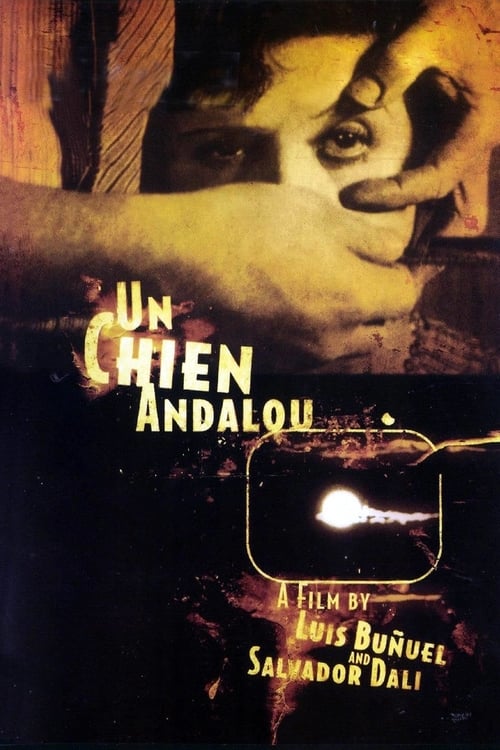
Un Chien Andalou
1929 · Luis Buñuel
For when you want your brain scrambled in under twenty minutes — a jolt, not a comfort watch. Perfect as a dare with friends or a palate cleanser before something longer.
What it's about
Sixteen minutes of pure dream, made by Luis Buñuel with the painter Salvador Dalí: a razor and an eye, ants crawling from a hand, a piano dragged across a room, lovers and priests and death, none of it connected by anything you could call a plot. The title cards promise a story — 'once upon a time,' 'eight years later' — and the film gleefully refuses to deliver one.
The experience
Startling, funny, and genuinely disturbing all at once, sometimes within the same cut. It moves fast, hits hard, and leaves you with images you cannot shake or explain — which is exactly the point.
The craft
The whole method was to keep only images that resisted rational explanation, and the editing stitches them together with a dream's confidence, so each cut feels both inevitable and impossible. Nearly a century on, the opening shock still works on a first-time viewer like almost nothing else in cinema.
Why it matters
The founding work of surrealist film, and one of the most influential shorts ever made — its dream logic and shock cuts echo through horror, art film, and music videos to this day.
Snapshot
Un Chien Andalou ("An Andalusian Dog") is a sixteen-minute silent film made in Paris in 1929 by the Spanish director Luis Buñuel in collaboration with the painter Salvador Dalí. It is the foundational work of cinematic Surrealism and one of the most influential short films ever made — a sequence of violent, irrational, erotically charged images that famously opens with a woman's eye being slit by a razor. The film has no plot in any conventional sense; it proceeds through abrupt jumps in time ("Once upon a time," "Eight years later," "Around three in the morning") that deliberately refuse to organize the images into a story. Buñuel's stated method, recounted in his memoir My Last Sigh and in numerous interviews, was that he and Dalí accepted only images that surprised them and rejected anything that admitted of rational, psychological, or cultural explanation. The result is a compact detonation that announced Surrealism's arrival in cinema, launched Buñuel's career, and established a vocabulary of dream-logic montage that filmmakers, artists, and music-video directors have drawn on ever since.
Industry & production
Un Chien Andalou was made entirely outside the commercial industry, as an independent art object financed privately. By the well-established account in Buñuel's memoirs, the film was paid for by his mother, who gave him money that he used partly for the production (and, by his own admission, partly squandered in Montparnasse cafés before completing the shoot). It was filmed over roughly two weeks in early 1929, with the bulk of shooting in studio facilities at Billancourt outside Paris and some exteriors. The budget was tiny by any measure and the production correspondingly informal — a small crew, a handful of performers, and locations of convenience.
Buñuel had come to Paris from Spain in the mid-1920s, where he had moved among the artistic avant-garde alongside Dalí and Federico García Lorca during their student years in Madrid. He apprenticed in film by assisting the French director Jean Epstein, an experience that gave him practical command of a camera and editing bench before he directed. Un Chien Andalou premiered in Paris in 1929 at the Studio des Ursulines (some accounts cite Studio 28), the small art cinemas that screened avant-garde work. Buñuel later wrote that he attended the premiere with stones in his pockets, expecting a riot from a hostile audience; instead the film was received with enthusiasm — an embrace that, in his telling, dismayed him, since he had intended an assault on bourgeois taste. The Surrealist group led by André Breton subsequently welcomed Buñuel and Dalí into its ranks, and the film's scenario was published in the Surrealist-aligned journal La Révolution surréaliste.
Technology
The film was made with the standard silent-era technology of the late 1920s: a hand-cranked or motor-driven 35mm camera, panchromatic black-and-white stock, and conventional studio and location lighting. It carried no synchronized soundtrack at production. Buñuel chose the accompanying music himself — by his account a combination of an Argentine tango and excerpts from Wagner's Tristan und Isolde — which he played on a phonograph alongside early screenings. (A synchronized sound version supervised by Buñuel was prepared in the early 1960s, fixing this music to the image; this is the form in which the film is now most often seen.) Technologically the film is unremarkable for its date; its radicalism lies entirely in how the ordinary tools were used. The one element requiring a special effect — the slit eyeball — was achieved practically by substituting the eye of a dead animal (commonly identified as a calf) for the human actor's in the cutaway, a simple but startlingly convincing in-camera deception.
Technique
Cinematography
The photography, by Albert Duverger, is clean, legible, and largely unstylized — and this restraint is essential to the film's effect. Rather than signaling "dream" through soft focus, distortion, or expressionist lighting (the devices a German contemporary might have used), Buñuel and Duverger render impossible events in the plain, well-lit, matter-of-fact idiom of ordinary narrative cinema. The prologue's eye-slitting is built cinematographically: a man (played by Buñuel himself) sharpens a razor, a thin cloud is seen drawing across the moon, and then the blade crosses the eye — the cloud/moon image functioning as a visual rhyme that primes the horizontal cut. The camera observes hands, faces, and objects in tight detail when the action demands, and otherwise frames its actors squarely. This deadpan photographic neutrality is precisely what makes the irrational content disturbing.
Editing
Editing is the film's true medium and its most influential contribution. Buñuel cut the film to violate continuity systematically: space and time do not cohere from shot to shot. A man falls in a room and lands in a meadow; a door opens onto an impossible adjacent space; the same character appears doubled. The intertitles — "Once upon a time," "Eight years later," "Around three in the morning," "Sixteen years before" — parody the temporal signposting of conventional narrative while marking transitions that lead nowhere logically. Buñuel also pioneers a kind of associative match-cutting in which images are joined by visual or metaphoric resemblance rather than story logic: the celebrated series linking a hole in a hand crawling with ants, an armpit, a sea urchin, and an androgynous figure poking a severed hand in the street is a montage of graphic and thematic rhymes. The cutting is the engine that converts a string of tableaux into the experience of a dream.
Mise-en-scène / staging
The staging favors charged objects and grotesque juxtapositions arranged within everyday Parisian interiors and streets. The most famous set piece is the image of the man dragging two grand pianos, atop which lie the rotting carcasses of donkeys and two live priests roped to the burden — an absurd composite of religion, death, and high culture hauled across a room. Striped boxes, a severed hand in the street, books that become revolvers, a mouth that erases into bare skin: the mise-en-scène repeatedly transforms props mid-scene, so that staging itself behaves with the instability of a dream. The settings are deliberately mundane, which throws the eruptions of the irrational into relief.
Sound
The film was silent in production. Its "sound" is the musical accompaniment Buñuel selected — tango and Tristan und Isolde — later affixed as a synchronized track in the 1960s restoration he oversaw. The Wagner, with its yearning, unresolved harmonies, lends the erotic passages a tone of romantic intensity that is simultaneously sincere and ironized by the surrounding absurdity. There is no dialogue and the intertitles carry no spoken content; meaning is generated entirely through image, cutting, and music.
Performance
The performances, principally by Pierre Batcheff and Simone Mareuil as the central man and woman, are pitched in the broad, gestural register of silent melodrama, but bent toward the uncanny. Batcheff's roles — he plays multiple aspects of a single shifting male figure — modulate between desire, menace, and abjection without psychological throughline. Mareuil registers fear, defiance, and erotic provocation in turn. Buñuel and Dalí themselves appear (Buñuel as the razor-wielding man of the prologue; both are sometimes identified among the priests dragged with the pianos, though specific attributions in the dragging scene should be treated with caution). The acting does not build character; it supplies emotional intensities for the images to exploit.
Narrative & dramatic mode
The film is anti-narrative by design. It adopts the surface furniture of storytelling — title cards announcing time, recurring characters, a man and a woman in something like a romantic-erotic relation — only to frustrate every expectation those elements set up. There is no causality, no goal, no resolution; events neither motivate nor follow from one another. Buñuel's governing principle, repeatedly stated, was the logic of dreams and the Surrealist practice of automatism: images were chosen for their irrational charge and their resistance to interpretation. The dramatic mode is therefore closer to a sustained provocation or a poem than to a play. Critics and viewers have nonetheless found psychoanalytic, erotic, and anticlerical currents running through it — the eruption of repressed desire, the violence of the gaze, hostility to the Church — but the film resists being decoded into a single allegory, and that resistance is its point.
Genre & cycle
Generically the film belongs to the avant-garde and experimental cinema of 1920s Europe, and specifically inaugurates Surrealist film as a distinct mode. It sits beside the broader French cinéma pur and impressionist experiments of the decade while breaking sharply from their lyrical and formalist concerns toward shock and the unconscious. As a "cycle," its most direct continuation is Buñuel and Dalí's own follow-up, L'Âge d'or (1930), a longer and more explicitly blasphemous and socially aggressive work whose scandalous reception led to its suppression for decades. Together the two films constitute the brief, incandescent core of orthodox Surrealist cinema. The "fantasy" label applied in catalog metadata is a loose modern convenience; the film is better understood as Surrealist provocation than as genre fantasy.
Authorship & method
The film is the product of a genuine collaboration. Buñuel directed, edited, produced, and performed; Dalí co-wrote the scenario. By the standard account, the screenplay grew from two dreams the men exchanged — Buñuel's of a cloud slicing the moon and a razor slicing an eye, Dalí's of a hand crawling with ants — which they elaborated together over a few days in Dalí's home at Figueres, applying the rule that no image admitting rational or psychological explanation would be retained. The exact division of creative labor is debated, and Buñuel in later life tended to foreground his own authorship as the partnership with Dalí soured over politics and the painter's celebrity; readers should treat precise apportionment of individual images with caution. Key collaborators include cinematographer Albert Duverger, whose neutral, lucid photography is integral to the design; the principal performers Pierre Batcheff and Simone Mareuil; and the technical and studio personnel at Billancourt. There was no original composer — the music was selected, not written, by Buñuel. The method — dream sources, automatist selection, and montage that obeys association rather than continuity — became as influential as any single image.
Movement / national cinema
Un Chien Andalou is the central cinematic document of Surrealism, the movement led in literature and art by André Breton, whose group adopted Buñuel and Dalí after the film's release. Though made by two Spaniards, it is a product of the cosmopolitan Parisian avant-garde rather than of Spanish national cinema; its milieu is the same Montparnasse-and-gallery world that produced Surrealist painting, poetry, and photography. It thus belongs at once to the history of French avant-garde film and to the transnational Surrealist movement, and it stands at the head of a Spanish-exile lineage — Buñuel's — that would later flower in Mexican and French production across the mid-twentieth century. Within the broader 1920s European experimental landscape it is distinguished by its commitment to content (desire, violence, the unconscious) over the formal abstraction that occupied many of its contemporaries.
Era / period
The film arrives at the close of the silent era and at the high tide of the historical avant-gardes — Dada having given way to Surrealism, with Breton's first Surrealist Manifesto (1924) only five years past. It belongs to the brief window before sound, economic depression, and the political polarization of the 1930s reshaped European cinema. Made in 1929, it captures a moment of maximal artistic license in interwar Paris; its companion L'Âge d'or (1930) would, within a year, run into the censorship and right-wing agitation that signaled how quickly that license was closing. The film is thus both a culmination of 1920s avant-garde freedom and a threshold work pointing toward the more overtly political and embattled Surrealism of the following decade.
Themes
The film's persistent concerns, insofar as such anti-rational material yields themes, include: the violence of vision and the gaze, announced literally by the slit eye; erotic desire as compulsive, frustrated, and entangled with aggression; the instability of identity, figured in the protagonist's doublings and transformations; death and decay, embodied in the rotting donkeys; and a corrosive anticlericalism, with priests literally weighing down and impeding desire in the piano-dragging scene — a hostility to the Catholic Church that runs throughout Buñuel's entire career. Above these specific motifs sits the film's largest theme: the assertion that the irrational, the unconscious, and the dream are legitimate and even superior subjects for art, and that bourgeois rationality is a target to be assaulted rather than served.
Reception, canon & influence
Un Chien Andalou was, against Buñuel's expectations, a success with its avant-garde Paris audience and enjoyed an unusually long initial run for an experimental short; it secured Buñuel's and Dalí's entry into Breton's Surrealist circle and made Buñuel's name. Over the following decades it passed from succès de scandale to established classic, becoming one of the most written-about and most frequently screened short films in the history of the medium and a fixture of film-school curricula and museum programs worldwide. Specific contemporary box-office figures are not reliably documented and should not be invented; what is securely attested is its rapid canonization within avant-garde and then mainstream film history.
The influences on the film are clear: the Surrealist and Dada movements; Freudian theories of dreams and the unconscious then circulating in avant-garde Paris; the practice of automatism; and Buñuel's apprenticeship under Jean Epstein and his immersion in 1920s experimental cinema. Its influence forward is vast and ongoing. It established dream-logic editing and associative montage as enduring tools, drawn on by directors from David Lynch to Maya Deren and the broader tradition of experimental and underground film. Its imagery has been endlessly cited, parodied, and homaged — the sliced eye is among the most quoted shots in cinema. Its DNA runs visibly through the music-video form and through any number of advertising, fashion, and pop-cultural appropriations of Surrealist shock. Within Buñuel's own filmography it inaugurated a six-decade career of subversive, dream-inflected, anticlerical cinema that would culminate in late masterpieces like Belle de Jour and The Discreet Charm of the Bourgeoisie. Few films of any length have exerted an influence so disproportionate to their running time.
A Deleuzian reading
The razor opens the eye.
The full Deleuzian reading of Un Chien Andalou →
Reception
Buñuel expected the 1929 Paris premiere to end in a riot — instead the surrealist avant-garde embraced it, to his reported dismay, and a century later this 16-minute provocation is unassailable canon: the most famous experimental film ever made.
How Un Chien Andalou was received, from release to now →
Influences: the films it descends from and the films it influenced
- Eraserhead (1977) — Sustains dream-logic editing and deadpan-neutral framing of grotesque transforming objects, treating the irrational image as self-justifying exactly per the no-rational-explanation rule.
- The Discreet Charm of the Bourgeoisie (1972) — Structures itself as nested dreams interrupting bourgeois ritual, extending the automatist anti-narrative and anticlerical satire inaugurated by the seed film.
- Blood of a Poet (1930) — Contemporary surrealist sibling using transforming props (mirrors, living statues, the mouth in the hand) and dream-passage editing parallel to Buñuel's automatist tableaux.
- Willy Wonka & the Chocolate Factory (1971) — The tunnel sequence's rapid-cut shock inserts — centipede, eye-crawl, chicken decapitation — deploy Buñuel's surrealist associative montage grammar, intercutting clinically photographed disturbing imagery against a reciting figure to produce psychological unease without delivering narrative information.
- Mulholland Drive (2001) — Establishes the precedent for dream-logic editing — cuts motivated by emotional association and unconscious rhyme rather than causality — that Lynch uses as his primary structural principle across the film's first two-thirds.
- Blue Velvet (1986) — The severed eye opening Buñuel's film establishes the surrealist grammar of bodily violation as dream-portal that Lynch literalizes with the severed ear: a wound in the world's surface that opens into a narrative organized by unconscious association rather than causal logic.
- The Exterminating Angel (1962) — Established Buñuel's grammar of withheld causal explanation — imagery proceeds by dream logic without justification, refusing the viewer any interpretive foothold — which The Exterminating Angel inherits wholesale for its central narrative device.
- Eyes Without a Face (1960) — Buñuel's method of presenting bodily violation — the eye-slitting, the severed hand — without narrative explanation or moral commentary is the direct model for how Franju films the face-removal surgery as an observed clinical fact rather than a staged horror set piece; the viewer must supply the ethical weight the film refuses to furnish.
- Spellbound (1945) — Dalí's Surrealist vocabulary of cut eyes, melting perspective and dream-logic juxtaposition is directly imported into Spellbound's painted dream sequence by the same artist.
- The Young and the Damned (1950) — Supplies the splattered-lens, raw-meat shock image and the dream-logic cut that Buñuel detonates inside Los Olvidados' realism — the same Surrealist montage grammar, now harnessed to narrative.
- Orpheus (1950) — Surrealist free-associative image-grammar that licenses Orphée's collage of myth into the mundane, where dream logic governs cuts and space.
- Viridiana (1962) — Establishes the surrealist shock-cut and dream-logic editing that Viridiana smuggles intact (the somnambulant night visit, the fetish trunk of shoes) into an otherwise classically continuous narrative.
- The Seashell and the Clergyman (1928) — Earlier French surrealist film whose dream-logic associative editing and Freudian image-chains (from an Artaud scenario) directly precede Buñuel's automatist montage rejecting rational continuity.
- Entr'acte (1924) — Dada/surrealist short whose absurdist non-narrative gags and irrational visual juxtapositions modeled the anti-narrative, association-driven structure Buñuel extended.
- Ballet Mécanique (1924) — Avant-garde montage built on rhythmic visual rhyme and the repetition of isolated body parts and objects, anticipating Buñuel's match-cuts between unlike forms.
- La Coquille et le Clergyman (1926) — As Buñuel's mentor, Epstein's Impressionist use of close-up, superimposition and subjective optical effect trained the deadpan-yet-uncanny photographic technique deployed by Duverger.
- The Fall of the House of Usher (1928) — Epstein's slow-motion, dilated-time poetic horror, made with Buñuel as assistant director, schooled him in atmosphere built through camera and editing rather than plot.
- L'Âge d'Or (1930) — Buñuel and Dalí's immediate sequel that scales the dream-logic provocation and anticlerical violence-of-the-gaze of the short into a feature-length surrealist scandal.
- Meshes of the Afternoon (1943) — American trance film that inherits the looping dream-logic and associative match-cut, using domestic objects (key, knife) as transforming surrealist props as Buñuel did the razor and ants.
- Dreams That Money Can Buy (1947) — Anthology of artist-authored dream sequences directly extending the surrealist automatist method of generating imagery from the unconscious without narrative justification.
- Fireworks (1947) — Underground film whose oneiric, taboo-breaking imagery and free associative editing carry forward Buñuel's montage-of-the-unconscious into queer avant-garde cinema.
- Belle de Jour (1967) — Late Buñuel masterpiece that interleaves fantasy and reality with the same refusal to flag dream from waking, descending directly from the short's seamless oneiric montage.
- Un Chant d'Amour (1950) — Silent, associative-montage erotic short that inherits Buñuel's wordless surrealist provocation and rhythmic cutting between desire and violence.
- Begotten (1989) — Wordless, high-contrast ritual nightmare that revives the silent surrealist mode, building meaning through visual rhyme and transformation rather than narrative.
Similar films
- L'Âge d'or (1930) — influence & lineage · often watched together
- The Discreet Charm of the Bourgeoisie (1972) — influence & lineage · often watched together
- Belle de Jour (1967) — influence & lineage
- Viridiana (1962) — often watched together
- The Young and the Damned (1950) — often watched together
- La Jetée (1962) — often watched together
- Weekend (1967) — often watched together
- The Hypothesis of the Stolen Painting (1978) — often watched together
All the films related to Un Chien Andalou →