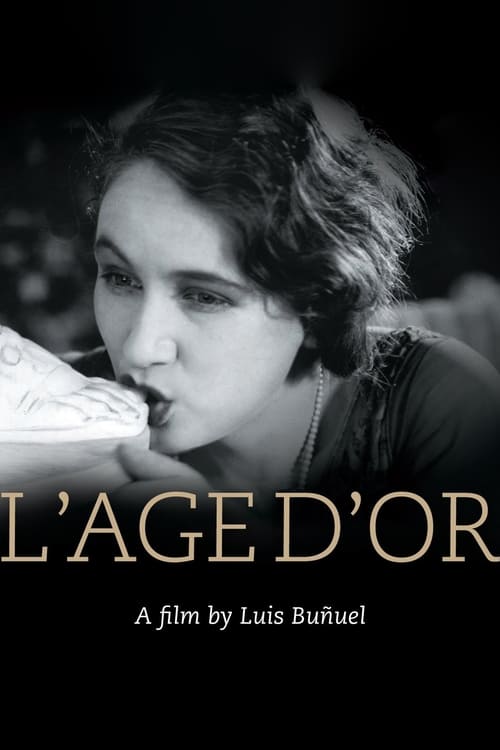
L'Âge d'or
1930 · Luis Buñuel
For when you want cinema at its most untamed — something strange, transgressive, and blackly funny that plays by no rules at all. This is a challenge, not a comfort watch, best met with curiosity and a sense of humor.
What it's about
A man and a woman are wildly, physically in love, and everything around them — their families, high society, the Church, polite ceremony itself — keeps prying them apart. Buñuel strings this thwarted passion through a chain of dreamlike, loosely connected episodes, from a rocky beach to an aristocratic garden party, each one a fresh ambush on the couple's desire. It's less a plot than a sustained act of sabotage against respectability, staged as comedy, romance, and provocation at once.
The experience
Watching it feels like being pleasantly assaulted: absurd gags land next to genuinely shocking images, and the logic keeps slipping out from under you. It's short, fast, funny, and deliberately outrageous — nearly a century old and still capable of making a room gasp.
Performances
Gaston Modot plays the lover as a man in a permanent state of frustrated fury — kicking dogs, slapping matrons, storming through drawing rooms — and his deadpan commitment is what makes the outrages land as comedy. Lya Lys matches him with a desire so frank it was scandalous for 1930.
The craft
Buñuel treats film grammar itself as a toy: documentary footage of scorpions collides with society melodrama, sound and image argue with each other, and images arrive with no obligation to explain themselves. Conceived with Salvador Dalí and funded by an aristocratic patron, it's dream logic executed with total confidence, and its black-and-white images have a blunt, tactile strangeness that still feels modern.
Why it matters
The film caused an immediate scandal — riots, censorship, decades of suppression — and became the defining feature-length work of Surrealist cinema, a permanent reference point for every filmmaker who has wanted to weaponize the irrational against polite society.
Snapshot
L'Âge d'or is the second film by Luis Buñuel and the most fully achieved work of cinematic Surrealism — a roughly hour-long succession of loosely linked episodes organized around the thwarted, escalating desire of a man (Gaston Modot) and a woman (Lya Lys) whose attempts to consummate their love are perpetually interrupted by family, ceremony, the Church, and the whole apparatus of bourgeois propriety. Conceived in collaboration with Salvador Dalí (though the partnership effectively collapsed during writing) and bankrolled by the aristocratic patron the Vicomte Charles de Noailles, it extended the assault of Buñuel and Dalí's Un chien andalou (1929) from the scale of the short to that of a feature, and added what the earlier film had largely withheld: an explicit ideological target. Where Un chien andalou prided itself on meaning nothing, L'Âge d'or means a great deal — it is a sustained insult to the Church, the family, the patrie, and the entire moral economy of the European bourgeoisie, mounted in the name of l'amour fou, the absolute and destructive demand of desire. It became one of the most notorious scandals in film history: after right-wing and Catholic groups rioted at its Paris exhibition in December 1930, the Prefect of Police banned it, and it remained effectively unseeable in public for roughly half a century. It survives as the canonical example of Surrealist cinema and as a foundational document of Buñuel's lifelong campaign against religion and respectability.
Industry & production
The film exists because of private aristocratic patronage rather than any commercial film industry. The Vicomte Charles de Noailles and his wife Marie-Laure, wealthy patrons of the Parisian avant-garde, commissioned the film as a gift — by one well-known account, a birthday present for Marie-Laure — and financed it directly, also underwriting work by other artists in the same period (they would shortly fund Jean Cocteau's Le Sang d'un poète, a parallel patronage that the two filmmakers later treated as a kind of rivalry). This funding model freed Buñuel almost entirely from market and censorship pressures during production, which is precisely why the finished film could be so uncompromising. It was made in 1930, with studio work reportedly at the Billancourt studios outside Paris and location shooting in and around the city and on the Mediterranean coast. The production was professional rather than amateur — Buñuel by this point had industry experience, having assisted Jean Epstein — but small. The reckoning came not in production but in exhibition: following the riot at Studio 28 in Montmartre, where vandals attacked the screen and Surrealist paintings displayed in the lobby, the film was suppressed. The de Noailles paid a real social price; Charles was, by widely repeated accounts, threatened with expulsion from the Jockey Club and faced pressure from Catholic circles, and the family long kept the film out of circulation. Buñuel himself, in his memoir Mon dernier soupir, recounted the scandal as a defining episode. The suppression means that the film had essentially no commercial "release" in the ordinary sense; its history is one of banning, private screenings, and eventual rediscovery.
Technology
L'Âge d'or is an early sound film, and its technology is best understood as transitional. It was made at the very moment the European industry was converting to synchronized sound, and Buñuel uses the new capability selectively and deliberately rather than as a vehicle for naturalistic dialogue. Much of the film behaves like a silent picture with an added soundtrack: there is relatively sparse synchronized speech, intertitles still appear, and a great deal of the meaning is carried by image, gesture, and a near-continuous musical and effects track. The film was shot on 35mm black-and-white stock by the standard photochemical means of its day. Its technological interest lies less in apparatus than in Buñuel's intuition — shared with few of his contemporaries — that sound could be used contrapuntally and absurdly rather than illustratively: a barking dog, liturgical and orchestral music, the lowing of cattle in a drawing room, the noise of a flushing cistern cut against an image, the disjunction of voice and body. In this he anticipated arguments about the creative, non-redundant use of sound that theorists were only beginning to formulate.
Technique
Cinematography
The photography is credited to Albert Duverger, who had also shot Un chien andalou. The visual style is, by the standards of avant-garde cinema, restrained and legible: Buñuel generally photographs his outrages plainly, in clear, evenly lit, classically composed shots, so that the most transgressive content arrives with documentary matter-of-factness. This deadpan clarity is itself a strategy — the scandalous and the dreamlike are rendered with the same unblinking neutrality as the ordinary, which heightens their disturbance. The film opens, startlingly, with documentary footage of scorpions (drawn from an existing natural-history film), establishing a pseudo-scientific register before the fiction proper begins. Throughout, Buñuel favors a sober découpage over the rapid, disorienting montage of much 1920s experimental film; the surrealism is in the content of the images and their juxtaposition, not in optical trickery. There are touches of trick and effect — the famous shot in which the heroine, in erotic reverie, sees a toilet bowl gushing, or the substitutions and impossible appearances — but these are integrated into an otherwise plain visual grammar.
Editing
The editing, by Buñuel himself, is the film's true Surrealist engine, inherited directly from the method of Un chien andalou: the cut as an instrument of free association and provocation. Buñuel and Dalí had built the earlier film on a principle of admitting only images that could not be rationally explained, joined by cuts that defy continuity logic; L'Âge d'or applies a looser version of this across a longer, episodic structure. Scenes connect by displacement, irony, and shock rather than causality — a society reception proceeds while a cart of drunken peasants trundles through the salon unremarked, a gamekeeper shoots his own son almost as an aside, a grand party absorbs a fire and a murder without breaking decorum. The cutting repeatedly juxtaposes the sacred and the scatological, the romantic and the violent, so that meaning is generated in the gaps. The episodic architecture — scorpion prologue, the founding-of-Rome material, the central love story, the climactic orgiastic Château de Selliny coda lifted from Sade — is held together by associative rather than narrative logic.
Mise-en-scène / staging
Buñuel stages bourgeois ritual with merciless precision and then violates it. The film's signature method is the intrusion of the unspeakable into the impeccably maintained: the formal garden party at which catastrophe is serenely ignored, the drawing room invaded by a cow on a bed and by a horse-drawn cart, the diplomatic and clerical decorum punctured by lust and aggression. Props and tableaux carry the satire — a Catholic Mass conducted over skeletal bishops on the rocks, a statue's toe sucked in displaced eroticism, a giant agricultural implement and a burning tree thrown from a window in the lovers' frenzy. The staging insists on the coexistence of the genteel surface and the violent, desiring substrate beneath it, the central Surrealist (and Buñuelian) proposition rendered as blocking and décor.
Sound
The soundtrack is one of the film's most forward-looking elements. Buñuel scored it with a montage of music — Wagner (notably the Liebestod from Tristan und Isolde, the apotheosis of Romantic amour-mort), Mendelssohn, Beethoven, Mozart, Debussy and other concert-hall staples — deployed ironically against the action, plus drumrolls and a percussive, almost ceremonial use of noise. Diegetic and non-diegetic sound are mixed with deliberate incongruity (the lovers' tryst is accompanied by orchestral grandeur that the action undercuts). Dialogue is sparse and often beside the point; sound effects — barking, mooing, wind, a flushing toilet — are used for shock and absurdist counterpoint. The result is an early, sophisticated demonstration of asynchronous, anti-illustrative sound, achieved at the very dawn of the talkies.
Performance
The performances are pitched to the film's flat-affect surrealism. Gaston Modot, as the protagonist consumed by desire, plays with a fixed, obsessive intensity — his eruptions of frustration (kicking a dog, slapping a society matron, hurling objects from a window) delivered as the eruptions of a man for whom love is an absolute and antisocial imperative. Lya Lys, as the beloved, embodies a languorous, dreamlike eroticism. The supporting players enact the bourgeoisie and clergy with a straight-faced solemnity that the film exists to demolish. Notably, the orgiastic finale presents the Duc de Blangis — the Sadean libertine emerging from the Château de Selliny — in the iconographic guise of Christ, a piece of casting-as-blasphemy that did as much as anything to provoke the film's banning.
Narrative & dramatic mode
The film's mode is anti-narrative in the orthodox sense: it proceeds not by a causally linked plot but by a chain of associative episodes unified thematically rather than dramatically. A thread of story does run through it — the lovers' recurring, repeatedly frustrated attempts to come together — but it is suspended, interrupted, and finally abandoned rather than resolved. Around this spine Buñuel arranges materials of wildly different registers: a documentary on scorpions, a mock-historical pageant of the founding of imperial Rome, a high-society reception, and a coda drawn from Sade's 120 Days of Sodom. The dramatic engine is l'amour fou — desire as a force so absolute it is incompatible with civilization, so that the narrative "obstacle" is not a rival or a misunderstanding but society itself, in toto. The mode is satirical, blasphemous, and dreamlike at once, governed by the logic of the unconscious and of provocation rather than of storytelling.
Genre & cycle
L'Âge d'or is the central feature of the Surrealist film cycle and, with Un chien andalou before it and (more obliquely) Cocteau's Le Sang d'un poète alongside it, one of the very small number of films produced from within the organized Surrealist movement. It belongs to the French avant-garde of the 1920s–30s but stands apart from the more formalist, "pure cinema" and Impressionist strands (Epstein, Dulac, Léger, Clair's early work) by virtue of its explicit political and anti-clerical aggression. Generically it is a hybrid impossible to classify by ordinary categories — part dream-film, part satire, part erotic melodrama, part pamphlet — which is why its TMDB billing as "Romance, Comedy, Drama" registers as almost comically inadequate. Within Buñuel's own filmography it inaugurates the cycle of anti-bourgeois, anti-clerical works that he would resume decades later in Mexico and France.
Authorship & method
The film is, by Buñuel's own later account, essentially his — but its authorship is genuinely vexed. The screenplay is credited to Luis Buñuel and Salvador Dalí, continuing the partnership of Un chien andalou, but the two had largely fallen out during the writing, and Buñuel maintained that the finished film was overwhelmingly his conception, with Dalí contributing ideas (and grievances) but little to the execution. Dalí himself was reportedly dissatisfied with the result. The method the pair had pioneered — admitting only irrational images, refusing explanation, mining dreams and free association — remains the film's compositional principle even as Buñuel bent it toward ideological attack. Buñuel directed and edited, the two operations through which the film's meaning is most decisively shaped. Albert Duverger photographed it, carrying over the plain, lucid look of Un chien andalou. There is no original composer in the modern sense; Buñuel built the musical track himself from the Romantic and classical repertoire, an authorial act of selection and ironic juxtaposition. The patrons Charles and Marie-Laure de Noailles are part of the authorship of the film's very existence, having made it possible and then suffered for it. The collaboration with the broader Surrealist group around André Breton is also material: the movement embraced and defended the film, and it functioned as a quasi-official Surrealist production.
Movement / national cinema
L'Âge d'or is the paradigmatic work of cinematic Surrealism and a product of the Parisian avant-garde, made by a Spanish émigré (Buñuel, from Aragon) working in France with a Spanish collaborator (Dalí, from Catalonia) under French aristocratic patronage. It thus sits at the intersection of French and Spanish cultural histories: it is French in its production, its milieu, and its scandal, but its sensibility — the ferocious anti-clericalism, the fixation on Catholic ritual and repression, the eroticized blasphemy — is unmistakably rooted in Buñuel's Spanish, Jesuit-educated formation, the same wellspring he would tap again in Viridiana, Nazarín, and Simon of the Desert. The film belongs to the brief moment when the literary Surrealist movement, organized around Breton, attempted to colonize the cinema, and it remains the fullest realization of that attempt.
Era / period
The film is a document of late Weimar-era European modernism and of the convulsive turn of the decade, 1929–1930: the global economic crisis, the rise of the European right, and a Surrealist movement increasingly drawn toward revolutionary politics and the Communist orbit. Its anti-bourgeois, anti-Church animus reads directly out of this moment of polarization, and the violence of the reaction against it — the Montmartre riot was led by right-wing and anti-Semitic leagues, who also attacked the Surrealist paintings on display — is itself a period symptom of the radicalizing 1930s. The film's banning prefigures the censorship and political extremity that would shortly engulf Europe; Buñuel's own subsequent trajectory (Spain, the Civil War, exile to the United States and then Mexico) is part of the same history. That the film could not be publicly shown again until the 1970s–80s makes it, in its suppression, a marker of the entire mid-century era of European authoritarian and clerical control.
Themes
The film's master theme is desire against civilization: l'amour fou, the absolute and asocial demand of erotic love, set in irreconcilable conflict with every institution — Church, family, state, class, manners — that exists to regulate it. From this flows a sustained anti-clericalism and blasphemy (the bishops on the rocks, the Mass parodied, Christ figured as a Sadean debauchee) that would remain Buñuel's signature for forty years. Bourgeois hypocrisy and the violence beneath decorum is the satirical core — the serene society that ignores murder, drunkenness, and a cow in the bedroom dramatizes the repression that "civilization" depends on. Repression and the return of the repressed, the Freudian substrate of all Surrealism, governs the film's dream-logic and its eruptions of aggression. Subsidiary motifs — scorpions and predation as a model of social relations, the corruption of Rome and empire, the Sadean pursuit of pleasure to its annihilating limit — extend the indictment. Underlying all of it is the Surrealist conviction that liberated desire is a revolutionary force, and that to defend l'amour fou is to declare war on the existing order.
Reception, canon & influence
Backward — influences on the film. L'Âge d'or descends most directly from Un chien andalou and from the theory and practice of the Surrealist movement around André Breton, with its program of dreams, automatism, and the irrational. Behind it stands the Marquis de Sade, whose 120 Days of Sodom furnishes the closing Château de Selliny episode and whose libertine philosophy underwrites the film's equation of desire with revolt — Buñuel and the Surrealists revered Sade as a precursor. The Romantic cult of fatal love, crystallized in Wagner's Tristan, supplies the film's ironized musical and emotional register. Buñuel's Jesuit Spanish upbringing supplies the intimate knowledge of Catholic ritual that the film desecrates.
Initial reception. The film's public life was brief and violent. After private screenings and a run at Studio 28 in late 1930, members of right-wing leagues attacked the cinema, slashing the screen and the artworks in the lobby; in the aftermath the Paris police banned the film. It became one of the great succès de scandale of cinema, championed by the Surrealists (who issued a defending tract) and reviled by the right and the Church. It then effectively vanished from public exhibition for decades, surviving in restricted and clandestine screenings; its wider authorized re-release came only much later, generally dated to the 1970s and 1980s.
Forward — legacy and influence. Despite — indeed because of — its suppression, L'Âge d'or became canonical as the Surrealist feature and a touchstone of avant-garde and anti-establishment cinema. Its most important legacy is Buñuel's own career: the film established the themes and the tone (anti-clericalism, anti-bourgeois satire, eroticism, dream logic, deadpan transgression) that he would carry through Las Hurdes, the great Mexican films, and the late French masterpieces Belle de jour, The Discreet Charm of the Bourgeoisie, and The Phantom of Liberty, the last of which returns explicitly to the loose, episodic, association-driven structure pioneered here. Beyond Buñuel, the film stands as a permanent reference point for politically provocative and Surrealist-influenced cinema, invoked by later avant-gardists, underground filmmakers, and the tradition of cinema designed to scandalize. Its use of music and sound as ironic counterpoint, and its method of staging the monstrous with documentary calm, have been widely studied and absorbed. The historical record on certain points — the exact division of authorial labor between Buñuel and Dalí, and the precise chronology and terms of its long suppression — is genuinely contested and rests substantially on Buñuel's own retrospective testimony, which should be read as an interested account. What is not in doubt is the film's standing: it is the single most important Surrealist film and one of the most consequential scandals in the medium's history.
A Deleuzian reading
A woman kneels in a garden, takes the stone toe of a marble statue into her mouth, and sucks it.
The full Deleuzian reading of L'Âge d'or →
Reception
It premiered in Paris in 1930 to an actual riot — right-wing leagues trashed the cinema — and was banned by the police within days, then kept out of public circulation for nearly fifty years. When it finally resurfaced around 1979–80, it walked straight into the canon as a founding masterpiece of surrealist cinema.
How L'Âge d'or was received, from release to now →
Influences: the films it descends from and the films it influenced
- Viridiana (1961) — Buñuel's mature anti-clericalism: the beggars' Last Supper tableau scored ironically to Handel's Messiah, the same blasphemous counterpoint of sacred music against profane image pioneered here.
- The Phantom of Liberty (1974) — Explicit return to L'Âge d'or's chained, free-association episodic form, where one scene hands off to the next by tangent rather than plot.
- The Holy Mountain (1973) — Surrealist succès de scandale built on anti-clerical sacrilege and episodic shock tableaux, descending from L'Âge d'or's project of a feature designed to outrage Church and bourgeoisie.
- The Young and the Damned (1950) — Establishes Buñuel's rendering of desire and aggression through irrational object-fetish images, the method behind Pedro's slow-motion dream of the floating mother and raw meat.
- Diary of a Chambermaid (1964) — Seeds the anticlerical bourgeois provocation and the toe/foot fetish (the statue's toe), and is literally invoked when the fascist crowd cries 'Vive Chiappe!' — settling the score for that film's banning.
- Melancholia (2011) — Deploys Wagner's Tristan music to charge erotic-morbid yearning, the same liebestod strategy by which von Trier fuses love, death and longing through the Tristan prelude instead of a composed cue.
- The Lovers on the Bridge (1991) — Supplies the Surrealists' amour fou — obsessive passion that is socially destructive and anti-bourgeois — as the film's narrative engine.
- The Young One (1960) — Establishes the authorial signature of subverting a conventional narrative from within its own moral logic — the ethical detonation, here relocated from surrealist form to plain social realism.
- The Criminal Life of Archibaldo de la Cruz (1955) — Codifies the eroticized fetish object and the toe/foot displacement of desire that Archibaldo restages as the wax effigy and the covetous handling of women as inert things.
- Él (1953) — Establishes Buñuel's deadpan method of presenting amour fou and anticlerical outrage with an unemphatic straight face, the tonal restraint Él uses to expose Francisco's delirium.
- Black God, White Devil (1964) — Bequeaths the surrealist, blasphemous assault on Church authority — sacrament turned to violence — echoed in the massacre at Monte Santo and the desecration of religious icons.
- City of Pirates (1984) — Buñuel's deadpan continuity cutting applied to outrages (a cow in a bed, a man kicking a blind beggar) teaches the film its governing tone: shot scale, eyeline and match-cut all behave normally while the content refuses to.
- Un chien andalou (1929) — Direct predecessor whose method of admitting only irrational images joined by free-association cuts — and Albert Duverger's plain, lucid photography — is carried over wholesale as L'Âge d'or's compositional grammar.
- Entr'acte (1924) — Dada/Surrealist non-narrative built from absurdist visual non sequiturs and rhythmic associative montage, the avant-garde editing logic Buñuel inherits and weaponizes.
- The Seashell and the Clergyman (1928) — Earlier Surrealist dream-film whose anti-clerical eroticism and unmotivated dream-logic transitions prefigure the cleric-and-desire imagery and oneiric cutting here.
- Les Vampires (1915) — The serials the Surrealists revered for staging the marvelous and criminal with deadpan documentary calm inside ordinary bourgeois interiors — the matter-of-fact register Buñuel adopts for monstrous events.
- October (1928) — Intellectual montage that produces meaning by colliding unrelated images (the god-idols sequence skewering religion) — the associative, anti-clerical editing rhetoric Buñuel redeploys.
- Le Sang d'un poète (1930) — Sibling Surrealist feature commissioned by the very same patron, the Vicomte Charles de Noailles, and conceived in parallel — an independent test of poetic dream-cinema bankrolled by the same aristocratic experiment.
- À propos de Nice (1930) — Contemporaneous 'point de vue documenté' that turns documentary observation into satire of bourgeois leisure, sibling to Buñuel's method of indicting a class through coolly recorded ritual.
- Land Without Bread (1933) — Buñuel's immediate next step: ironic counterpoint between Brahms on the soundtrack and images of misery, extending L'Âge d'or's contrapuntal use of classical music as savage commentary.
- Zéro de conduite (1933) — Anarchic anti-authoritarian revolt staged with surreal disruptions of institutional order, descending from L'Âge d'or's transgression of clerical and bourgeois ceremony.
- Meshes of the Afternoon (1943) — Postwar avant-garde dream-film built on associative repetition and oneiric spatial logic, extending the Surrealist editing inheritance into American experimental cinema.
- The Exterminating Angel (1962) — A bourgeois dinner party that cannot end becomes the ritual-violated setpiece in pure form — descendant of L'Âge d'or's interrupted reception, with the monstrous staged in deadpan drawing-room calm.
- Daisies (1966) — Anarchic, anti-narrative assault on bourgeois decorum through free-associative collage editing and gleeful destruction of a banquet, extending Surrealist montage into the New Wave.
Similar films
- The Discreet Charm of the Bourgeoisie (1972) — influence & lineage · same viewing thread · often watched together
- The Exterminating Angel (1962) — influence & lineage · same viewing thread
- The Phantom of Liberty (1974) — influence & lineage · same viewing thread
- Belle de Jour (1967) — influence & lineage · same viewing thread
- Un Chien Andalou (1929) — influence & lineage · often watched together
- Viridiana (1962) — same viewing thread · often watched together
- Theorem (1968) — same viewing thread · often watched together
- Diary of a Chambermaid (1964) — same viewing thread
All the films related to L'Âge d'or →
Watch it with: curated runs of related films
- Buñuel and the Bourgeoisie — A run of surrealist provocations where every dinner, prayer, and marriage bed hides an appetite polite society can't admit — watch them together for the way Buñuel (and Pasolini's Theorem) keep pulling the tablecloth out from under the well-heeled.