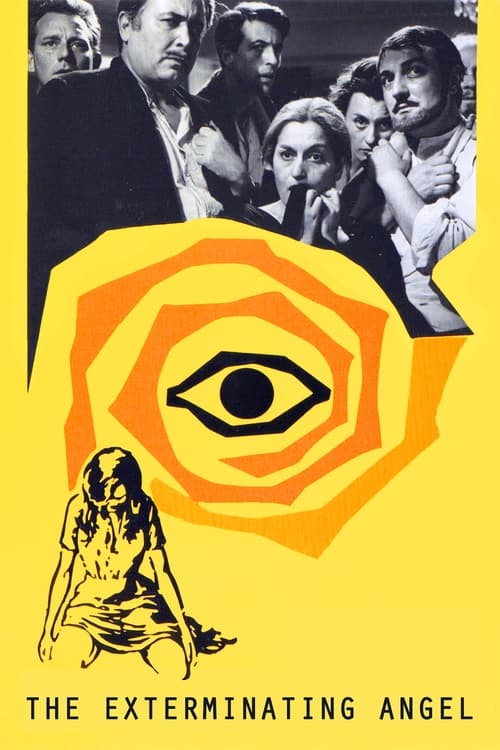
The Exterminating Angel
1962 · Luis Buñuel
For when you're in the mood for something wicked and strange — a smart, mean, funny puzzle for a late night, ideally with someone to argue about it with afterward. Firmly a challenge, and a delicious one.
What it's about
After an elegant dinner party at a Mexico City mansion, the guests discover they cannot leave the drawing room. Nothing physical stops them — no locked door, no captor — yet night after night they stay, and as food, water, and patience run out, the perfumed manners of the upper class peel away to reveal something much more animal underneath.
The experience
Deadpan, absurd, and increasingly claustrophobic — it plays like a joke that keeps escalating until it becomes a nightmare, and you laugh right up to the point where you stop. The refusal to ever explain itself is exactly what makes it stick.
The craft
Buñuel stages the impossible with a totally straight face: crisp black-and-white images, scenes and lines that quietly repeat as if reality itself is stuttering, and sheep wandering through a grand salon without anyone blinking. The matter-of-fact style is the engine — the weirder it gets, the calmer the film stays.
Why it matters
One of the defining works of surrealism on film and a permanent reference point for any story about polite society trapped and unmasked; its central image — guests who simply cannot leave — has been borrowed, homaged, and even turned into an opera.
Snapshot
Luis Buñuel's The Exterminating Angel is a surrealist fable of bourgeois entrapment: after a lavish dinner party at a Mexico City mansion, the guests discover that they are incapable of leaving the drawing room. No visible barrier detains them, no coercion compels their stay — only some unnamed, inexplicable force of inertia. Over the following days, social niceties dissolve, hidden desires surface, a morphine addict reveals herself, a pair of young lovers die in a closet, and sheep wander through the grand salon. The film operates simultaneously as satire, nightmare, and riddle, offering no solution and demanding none. Among Buñuel's richest and most formally audacious works, it stands as one of the essential films of the 1960s and a cornerstone of world cinema's sustained critique of bourgeois civilization.
Industry & production
The film was a Mexican production, financed by Gustavo Alatriste, a producer-entrepreneur who was at the time married to the film's lead actress, Silvia Pinal. Alatriste gave Buñuel an unusual degree of creative autonomy, a relationship that also produced Viridiana (1961) — shot in Spain on the eve of its Cannes triumph — and Simón del desierto (1965). The Exterminating Angel was shot primarily on studio interiors in Mexico City designed to approximate an aristocratic residence, and represents the productive apex of Buñuel's long Mexican period, which had begun in 1946 after his years of displacement from Spain following the Civil War.
The screenplay was co-written by Buñuel and Luis Alcoriza, the Spanish-born writer who had been among Buñuel's closest collaborators since the late 1940s and who shared co-writing credit on many of the Mexican films. The film's conceptual seed has been attributed to an unproduced play by the exiled Spanish poet and playwright José Bergamín, Los náufragos de la Calle de la Providencia (The Castaways of Providence Street), though the precise nature of Bergamín's contribution became a matter of public dispute: Buñuel acknowledged an initial idea from Bergamín but maintained that the final screenplay was his own invention. The film acknowledges "an idea by José Bergamín," and scholars have continued to disagree on how heavily the unproduced play shaped what reached the screen.
The cast was drawn from Mexico's established film industry alongside the Spanish exile community. Silvia Pinal, already well-known in Mexican commercial cinema and fresh from Viridiana, plays Leticia — known to the guests as "la Valquiria," the Valkyrie — the woman who ultimately identifies the means of escape. The ensemble also includes Enrique Rambal as the host Edmundo Nobile, and Claudio Brook as the socially over-conscientious maître d' who sets the film's social comedy in motion when the domestic staff, inexplicably, begins deserting the house before the party ends.
Technology
The Exterminating Angel was shot in black and white on standard 35mm, in keeping with Buñuel's habitual and declared preference for monochrome photography during this period. Buñuel was famously skeptical of color, associating it with commercial artifice and sentimental manipulation; the gray tones suit the film's clinical dissection of social ritual and its slow slide into physical squalor. The production was neither technically lavish nor underfunded by the standards of Mexican art cinema; Alatriste's backing allowed professional resources without the constraints of a studio system.
Technique
Cinematography
Gabriel Figueroa — the greatest cinematographer of Mexican cinema's golden age and one of the foremost black-and-white cinematographers in world film history — served as director of photography. Figueroa had worked with John Ford (The Fugitive, 1947), Emilio Fernández, and extensively with Buñuel throughout the Mexican period, including Nazarín (1959) and later Simón del desierto. His collaboration with Buñuel was characterized by a deliberate suppression of the operatic grandeur Figueroa brought to his other work: Buñuel consistently pushed him toward restraint, flat lighting, and an unglamorous objectivity that refused the gorgeous deep shadows of classical Mexican cinematography. The Exterminating Angel exemplifies this disciplined tension. The mansion interiors are lit with cool, even illumination; there is little chiaroscuro drama. The camera observes the guests with the detachment of an anthropologist documenting a specimen population, and Figueroa's framing underscores rather than poeticizes their progressive degradation.
Editing
The cutting rhythm is notably unhurried, befitting the film's premise of paralysis — the editing maintains an almost bureaucratic composure as conditions worsen. The film's most discussed formal device is a structural one that straddles editing and screenplay: certain sequences are repeated almost verbatim, most famously the initial arrival of the guests, which is shown twice from slightly different angles with identical dialogue and staging. Buñuel spoke of this repetition as something he arrived at instinctively, a kind of structural joke whose implications exceeded his initial intentions. It functions as a formal enactment of the film's thematic content: the bourgeoisie's compulsive repetition of its own rituals, the inability of social form to escape itself. The device was genuinely unprecedented, and critics at the time were divided on whether to read it as error, Brechtian distanciation, or pure surrealist provocation — likely all three simultaneously, which is characteristically Buñuelian. The editor on the production is documented as Carlos Savage Jr., who worked on a number of Buñuel's Mexican productions.
Mise-en-scène / staging
The confined space of a single room — or a few adjoining rooms, as the characters eventually colonize closets and alcoves — creates a theatrical pressure that Buñuel exploits without ever allowing the film to become stagy. The mise-en-scène is governed by the logic of the ensemble: no single character is privileged for long, and the camera moves among them with a restless impartiality. The intrusions of surrealist imagery — sheep wandering through the salon, a bear glimpsed in the corridors — are handled with Buñuel's characteristic deadpan, inserted without fanfare and treated by the camera with the same matter-of-fact gaze it directs at the decor. This refusal to signal the uncanny with horror-film lighting or reaction-shot emphasis is central to the film's effect: the supernatural and the social are rendered equivalent, equally inexplicable, equally real.
Sound
The film uses classical music both non-diegetically and diegetically with typical Buñuelian calculation. A soprano performance amid the assembled guests early in the film provides a framing contrast with the chaos that follows; the music belongs to the world of bourgeois cultivation, and its subsequent absence is felt. The score draws on existing classical repertoire — including pieces attributed to Domenico Scarlatti and Pietro Domenico Paradisi — rather than a commissioned score, consistent with Buñuel's tendency in this period to prefer appropriated classical music. Sound design is otherwise spare: the mansion's silences become increasingly oppressive as social noise — conversation, ritual, performance — exhausts itself, leaving only the biological sounds of hunger, illness, and dispute.
Performance
The ensemble acting is calibrated to a narrow and precise register: the actors must convey patrician self-possession slowly ceding to animality, without tipping into parody or melodrama. Buñuel was not, by his own account, much interested in the technique of acting; he gave actors behavioral instructions and preferred naturalism over theatrical over-articulation that would undercut the film's satiric intelligence. Silvia Pinal anchors the proceedings with a composed authority that makes Leticia's eventual role as the ensemble's deliverer both plausible and faintly absurd. The deterioration of the group — territorial squabbling, physical illness, sexual despair, the revelation of morphine addiction — is played for the most part without hysteria, which is precisely what makes it disturbing.
Narrative & dramatic mode
The narrative is structured as a slow catastrophe in a confined space, a form that belongs partly to the tradition of theatrical siege drama and partly to the surrealist habit of taking a premise to its logical extreme without apology or explanation. There is no restoring resolution: the film ends with another ironic trap, as the characters who have finally escaped the mansion find themselves unable to leave the church where they have gathered in thanksgiving, while a flock of sheep files in through the cathedral doors. The narrative loop is the point — entrapment is not an interruption of bourgeois life but its essential condition.
The film withholds any rational account of why the characters cannot leave. This refusal of explanation is not a narrative weakness but a philosophic position. Buñuel and Alcoriza conspicuously avoid both supernatural mechanics and psychological motivation; the force that detains the guests has no name because naming it would diminish it. What the film invites us to infer — that social convention is itself a kind of imprisonment, that the bourgeoisie are captive to their own codes — is an inference the viewer performs, not a thesis the film states.
Genre & cycle
The Exterminating Angel is a surrealist comedy-drama with elements of horror that resolutely refuses horror's conventions. It belongs to no commercial genre cycle; it is more productively understood as part of Buñuel's sustained satirical project — spanning from L'Age d'Or (1930) through The Discreet Charm of the Bourgeoisie (1972) and That Obscure Object of Desire (1977) — directed against the hypocrisies and self-deceptions of the European and Latin American upper-middle class. It has structural affinities with absurdist theater (Ionesco, Beckett, and Sartre's Huis clos, which shares the basic conceit of voluntary entrapment among social equals) though Buñuel's Marxist-Freudian disposition gives the absurdism a more explicitly polemical edge than either.
Authorship & method
Luis Buñuel (1900–1983) is among the handful of indispensable directors in cinema history, and The Exterminating Angel falls near the center of his mature Mexican period. After his initial surrealist provocations in Paris (Un Chien Andalou, 1929; L'Age d'Or, 1930), a decade of relative creative silence, and a commercial Mexican apprenticeship in the late 1940s, Buñuel found from Los olvidados (1950) onward a mode — socially precise, formally economical, philosophically corrosive — that he refined for the rest of his career.
His method was famously undramatic on set: brief preparation, rapid shooting schedules, minimal fuss over takes. He co-wrote all his major films and treated the screenplay as the primary act of creation, regarding the shoot as execution rather than discovery. His partnership with Luis Alcoriza ran from the late 1940s through the early 1960s and was perhaps the most generative of his Mexican collaborations; Alcoriza subsequently became a director in his own right. After their collaboration ended, Buñuel would work with Jean-Claude Carrière on all his French productions.
Gabriel Figueroa's contribution to the film's look is real but purposefully contained. Their aesthetics were in productive tension: Figueroa's instinct was for grandeur, Buñuel's for severity. The film's visual plainness is the result of a deliberate and ongoing negotiation between two masters pulling in opposite directions.
Movement / national cinema
The film is a product of Mexican cinema's distinctive capacity to harbor a major auteur in exile, but it is not in any simple sense a "Mexican" film thematically: its world is the haute bourgeoisie of a generically European, Spanish-inflected social milieu, and its critique is directed at a class culture with roots on the other side of the Atlantic. Buñuel spent nearly two decades in Mexico and made some of his greatest films there, but he remained culturally Spanish — a Spaniard in exile with a French surrealist formation, working within a Mexican industry that granted him a freedom few national cinemas anywhere would have afforded. The Exterminating Angel belongs simultaneously to Mexican cinema's golden-age production infrastructure and to the international art cinema of the 1960s that was canonizing Bergman, Fellini, Antonioni, and Resnais alongside Buñuel.
Era / period
The film arrives in 1962 at a moment of maximum creative confidence for the international art cinema. The French New Wave had established itself; Bergman was producing his chamber masterworks; Italian cinema was generating La dolce vita (1960), L'avventura (1960), and 8½ (1963). Buñuel's own late-career reputational peak came slightly later — with Belle de jour (1967) and the Academy Award for The Discreet Charm of the Bourgeoisie (1972) — but The Exterminating Angel was already recognized in 1962 by serious critics as the work of a first-rank master operating at the height of his powers.
Themes
The central and inexhaustible theme is the bourgeoisie's self-imprisonment: the proposition that the social codes, rituals, and hierarchies of the educated upper class constitute not a framework for freedom but a cage whose bars are invisible precisely because they are internalized. The characters cannot leave because they are already, in every meaningful sense, incapable of leaving — their identities are constituted by the social forms the party represents, and outside those forms they have nothing to be. The film extends this analysis to include the Catholic Church in its closing scene, equating religious ritual with social ritual as parallel mechanisms of constraint and mass passivity — the sheep that file into the church are an image that compresses ecclesiastical and class critique into a single shot.
Sexuality, repression, and their return under pressure are characteristic Buñuelian preoccupations present throughout. The film maps the guests' erotic energies as they are stripped of social management: the couple who make love in a closet, the morphine addict whose dependency surfaces as supplies run out, the young lovers who cannot survive outside the social world that formed them. Death is treated without sentimentality; Buñuel regards it as one more datum of the social experiment, not a tragedy demanding emotional processing.
The collapse of class performance under material pressure — hunger, thirst, illness — is rendered with a precision that anticipates, without necessarily informing, the sociological dramaturgical theory of Erving Goffman: once the stage conditions fail, the performance fails, and what remains is biology.
Reception, canon & influence
The Exterminating Angel was screened at the Cannes Film Festival in 1962, where it received the FIPRESCI Prize from the International Federation of Film Critics — a significant validation from the critical establishment at the height of its prestige. Critical reception was enthusiastic among art-cinema audiences, though the film's resolute refusal of explanation frustrated more literal-minded viewers. Buñuel was already championed by a generation of French critics, particularly those associated with Cahiers du cinéma.
The film's antecedents include Buñuel's own L'Age d'Or (1930), which similarly subjected bourgeois erotic and social life to surrealist demolition, and the theatrical tradition of absurdist entrapment — Sartre's Huis clos (1944) shares the conceit of confinement among social antagonists without any suggestion of direct derivation. Ionesco's theater of the absurd, particularly La Cantatrice chauve (1950), offers another parallel: the repetition of social formulas revealed as meaningless through their own automatism — a structural kinship Buñuel literalizes with his doubled arrival sequence.
Its forward influence is most directly traceable within Buñuel's own filmography: The Discreet Charm of the Bourgeoisie (1972) inverts the central mechanism — bourgeois characters repeatedly attempt to eat but are frustrated — and is best understood as this film's companion piece and ironic mirror, together forming a diptych on bourgeois social life as an endless performance interrupted by forces beyond rational control.
Beyond Buñuel, the film's influence is diffuse but real. Its premise of inexplicable entrapment in a social setting has reappeared, consciously or not, across subsequent decades: in Michael Haneke's formalist dissections of bourgeois crisis, in the slow-burn social allegories of Yorgos Lanthimos (The Lobster, 2015; The Killing of a Sacred Deer, 2017), and in various films that deploy the sealed social space as a lens for class anatomy. The Exterminating Angel regularly appears on major critics' surveys of the greatest films ever made, where it typically figures alongside Viridiana and The Discreet Charm of the Bourgeoisie as the defining works of Buñuel's mature period — films that are, each in their own register, impossible to account for and impossible to forget.
A Deleuzian reading
The host says goodnight.
The full Deleuzian reading of The Exterminating Angel →
Reception
Baffled some at its 1962 Cannes premiere — Buñuel himself grumbled it needed a bigger budget and 'real luxury' to land properly — but it's since been fully canonized as one of the great surrealist films, a fixture of Buñuel top-fives and Criterion shelves.
How The Exterminating Angel was received, from release to now →
Influences: the films it descends from and the films it influenced
- Un Chien Andalou (1929) — Established Buñuel's grammar of withheld causal explanation — imagery proceeds by dream logic without justification, refusing the viewer any interpretive foothold — which The Exterminating Angel inherits wholesale for its central narrative device.
- L'Age d'Or (1930) — Established the deadpan staging of bourgeois social violation as surrealist comedy — treating the outrageous as mundane — which Exterminating Angel refines into a sustained single-location trap with the same flat tonal register.
- Rules of the Game (1939) — Renoir's deep-focus ensemble staging of a bourgeois country-house party, where social performance barely masks underlying crisis, is the realist substrate that Exterminating Angel literalizes into surrealist paralysis.
- Los Olvidados (1950) — Established the anthropological camera detachment of Buñuel's Mexican period — flat, uninflected observation of social behavior without moral commentary — carried directly into Exterminating Angel's visual severity.
- Viridiana (1961) — The beggars' Last Supper tableau, shot the year before, established the staging device of a social ensemble in patrician-degradation mode observed with impartial camera that refuses to editorialize on the spectacle.
- The Skeleton of Mrs. Morales (1960) — Alcoriza co-scripts again to trap the respectable bourgeoisie and strip their manners to reveal savagery beneath, advancing the same anatomy of bourgeois respectability.
- The Young One (1960) — The dossier's own forward line: the sealed-island moral laboratory becomes the trapped dinner party, the microcosm-drama device pushed from social realism into overt allegory.
- The Criminal Life of Archibaldo de la Cruz (1955) — Carries forward the signature staging of a single impossible surreal premise erupting inside a meticulously realist bourgeois interior.
- Belle de Jour (1967) — Carries forward the technique developed in Exterminating Angel of presenting fantasy intrusion as narratively indistinguishable from reality, using the same flat-lit deadpan staging in which the irrational is admitted without comment.
- The Discreet Charm of the Bourgeoisie (1972) — Buñuel's acknowledged companion piece: inverts Exterminating Angel's central mechanism by substituting frustrated dinner attempts for frustrated departures, deploying identical ensemble impartiality and withheld causal explanation.
- The Phantom of Liberty (1974) — Extends the circular interrupted narrative structure into an episodic chain where no thread resolves, replacing single-room confinement with a succession of bourgeois social traps, each as inexplicably sustained as Exterminating Angel's central one.
- The Seventh Continent (1989) — Haneke's flat, uninflected camera observes bourgeois domestic ritual within a single household with the same anthropological detachment Buñuel applies to his trapped party — refusing editorial affect while the social surface disintegrates.
- Funny Games (1997) — Bourgeois domestic space invaded by an inexplicable force; Haneke withholds psychological explanation for the intruders and refuses catharsis with the same systematic cold withholding as Buñuel's refusal to explain the guests' paralysis.
- Dogtooth (2009) — Sealed domestic space with arbitrarily imposed behavioral codes enforced without explanation; Lanthimos's flat deadpan ensemble performance style — refusing psychological interiority — directly extends Buñuel's staging of social ritual as irrational compulsion.
- Force Majeure (2014) — Confined Alpine resort setting used for anthropological dissection of bourgeois family performance under duress; deadpan ensemble observation of social codes collapsing in real time mirrors Exterminating Angel's sustained exposure of social pretense.
- The Lobster (2015) — Confined institution with inexplicable coercive codes, deadpan ensemble performance refusing emotional commentary — Lanthimos replicates Buñuel's entrapment structure wherein the social prison is enforced by no visible authority and escaped by no visible means.
- Triangle of Sadness (2022) — Ensemble of bourgeois social types whose class hierarchy inverts through progressive confinement and physical degradation; Östlund's impartial camera matches Exterminating Angel's ensemble-impartiality staging of patrician collapse without satirical underlining.
- Dr. Strangelove or: How I Learned to Stop Worrying and Love the Bomb (1964) — Buñuel's structural principle of a social group trapped by invisible systemic forces in an irreversible escalation — the mechanism of entrapment never explained, the comedy deriving from watching the system execute its own logic — directly provided Strangelove's narrative architecture: once Ripper launches the bombers, the institutional system cannot retrieve them.
- Satyricon (1969) — Buñuel's editing strategy of scenes that follow associative rather than causal logic — with social ritual collapse unexplained, episodes refusing to bridge into one another — is the direct structural model for Satyricon's lacunary grammar, and the explicitly cited Buñuel influence in Fellini's interviews points specifically here.
- Even Dwarfs Started Small (1971) — Buñuel stages a captive social group whose ritual behavior degrades through compulsive repetition with a deadpan camera that refuses to editorialize — this formal stance of institutional collapse observed without commentary is the direct model for Even Dwarfs' anti-climactic structure and its refusal to assign satirical meaning to destruction.
- Last Year at Marienbad (1961) — Contemporary film sharing the formal device of deliberate narrative repetition and circular time structure, both films withholding resolution and deploying repetition as an instrument that destabilizes causal logic rather than advances it.
- The Servant (1963) — Class inversion within a confined domestic space where behavioral codes erode and social roles reverse — Exterminating Angel's surrealist conceit recast in naturalist terms, with the same impartial observation of bourgeois ritual collapsing.
- The Silence (1963) — Buñuel's device of characters trapped inside a bourgeois enclosure by a force they cannot name or escape enacts the same Kafkaesque confinement that Bergman builds into Timoka, both films denying character and viewer any rational exit from the space of crisis.
- L'Âge d'or (1930) — A bourgeois dinner party that cannot end becomes the ritual-violated setpiece in pure form — descendant of L'Âge d'or's interrupted reception, with the monstrous staged in deadpan drawing-room calm.
- Diary of a Chambermaid (1964) — Deadpan surrealist entrapment of the bourgeoisie staged with neutral framing and no underlining — the same cool satirical mode applied to a single household.
- Simon of the Desert (1965) — The same Alatriste/Silvia-Pinal/Figueroa production unit staging a deadpan surreal parable of figures trapped by an inexplicable metaphysical rule.
Similar films
- The Discreet Charm of the Bourgeoisie (1972) — influence & lineage · same viewing thread
- The Phantom of Liberty (1974) — influence & lineage · same viewing thread
- Belle de Jour (1967) — influence & lineage · same viewing thread
- Un Chien Andalou (1929) — influence & lineage
- The Young and the Damned (1950) — influence & lineage
- The Lobster (2015) — influence & lineage
- Viridiana (1962) — same viewing thread
- L'Âge d'or (1930) — same viewing thread
All the films related to The Exterminating Angel →
Watch it with: curated runs of related films
- Buñuel and the Bourgeoisie — A run of surrealist provocations where every dinner, prayer, and marriage bed hides an appetite polite society can't admit — watch them together for the way Buñuel (and Pasolini's Theorem) keep pulling the tablecloth out from under the well-heeled.