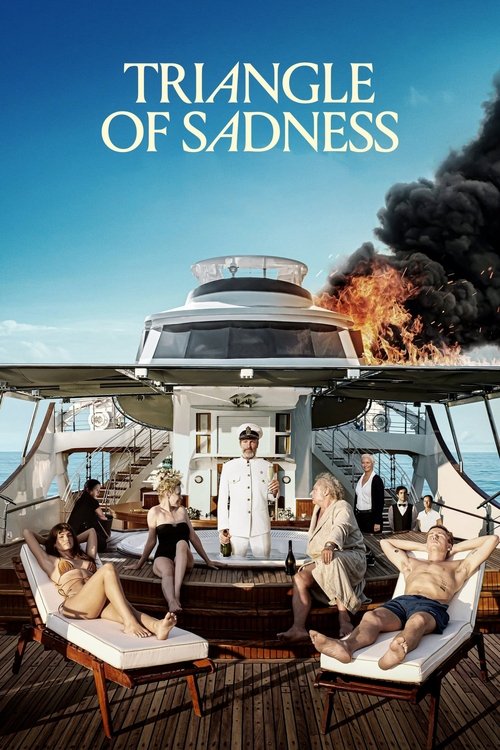
Triangle of Sadness
2022 · Ruben Östlund
Two-time Palme d'Or winner (The Square, Triangle of Sadness) whose eat-the-rich satires get accused of being smug about smugness; the vomiting-yacht sequence became a cultural shorthand. Loved and resented in roughly equal measure — which is the point.
For when you're in the mood for something wicked — a watch-with-friends film that leaves everyone arguing about class and power afterward. Bring a strong stomach and a taste for cringe.
What it's about
A celebrity model couple — Carl and influencer Yaya — join a luxury cruise for the obscenely rich, staffed by a crew trained to never say no and captained by a drunk with opinions about capitalism. When the voyage goes catastrophically wrong, the survivors wash up on an island where the old hierarchy suddenly counts for nothing, and whoever can actually catch a fish holds the power.
The experience
A slow-circling satire that erupts into some of the most gleefully grotesque comedy in recent memory — one storm-tossed dinner sequence is already infamous. It makes you laugh, squirm, and take sides, often in the same scene.
Performances
Harris Dickinson finds real vulnerability in a male model losing every status game he plays, and Dolly de Leon quietly steals the film's final act as a cleaning woman whose skills suddenly matter.
The craft
Östlund builds each scene like a social experiment, holding shots long past comfort until the power dynamics curdle on screen. The three-chapter structure keeps resetting the rules of the game, and the yacht-in-a-storm sequence is a feat of escalating physical comedy staging.
Why it matters
It won the Palme d'Or at Cannes in 2022 — Östlund's second — and became the flagship of the 'eat the rich' satire wave in contemporary cinema, carrying Dolly de Leon to an unexpected international breakout.
Snapshot
A three-chapter satirical comedy in which a celebrity couple—male model Carl (Harris Dickinson) and influencer Yaya (Charlbi Dean)—board a luxury superyacht crewed by the servile and staffed by the invisible, before a catastrophic storm strips everyone of the social scaffolding that kept hierarchy legible. The film's Palme d'Or at Cannes 2022 made Östlund only the third director (after Haneke and Coppola) to win the prize twice—The Square had taken it in 2017—and confirmed him as the foremost exponent of a particular strain of European satirical cinema: formally controlled, conceptually blunt, designed to produce discomfort and laughter in roughly equal measure. The title is industry argot for the vertical furrow between the eyebrows that betrays unhappiness; beauty labor, the film insists, begins with the erasure of legible feeling.
Industry & Production
Triangle of Sadness is a Swedish-led international co-production whose financing map reflects the transnational character of contemporary European art cinema. The core producing entities were Plattform Produktion (Östlund's own company, Stockholm), Erik Hemmendorff, and an array of co-producers from France, Germany, Greece, and the United Kingdom, with significant support from the Swedish Film Institute and Eurimages. The scale—extended shooting aboard an actual luxury superyacht, plus a purpose-selected Aegean island location for the third act—required the logistical infrastructure that comes with multi-territory funding. Domestic theatrical release in the Nordic territories was followed by Neon's North American distribution deal, which positioned the film as a prestige platform title ahead of its awards run.
Production was interrupted by COVID-19: the original shoot had been scheduled earlier, and delays pushed it into a period when access to a working luxury vessel required significant coordination. The superyacht sequences were filmed aboard a real charter yacht, the Hoburgen or similar, rather than a studio tank, a decision that imposed practical constraints on camera placement but gave the seasickness and chaos scenes an authentic material texture. Charlbi Dean, who plays Yaya, died in August 2022 at age thirty-two from a sudden illness shortly after the film's Cannes triumph; she did not live to see the full scope of its release or her own recognition within it, a biographical fact that retrospectively shades how her performance is received.
Technology
The film was shot digitally, consistent with Östlund's practice since Force Majeure (2014), using the ARRI ALEXA platform that had become standard for high-end European co-productions. Östlund and his cinematographer Fredrik Wenzel favor a clean, high-fidelity image without heavy filtration: the digital sharpness suits the satirical project, refusing the romanticism that grain or shallow depth of field might lend to the wealthy characters and their environments. Visual effects are minimal and functional; the vomiting, defecating, and flooding sequences in Act II were achieved largely through practical effects and prop work rather than digital augmentation, which contributes to the queasy physicality that made those scenes the film's most-discussed.
Technique
Cinematography
Fredrik Wenzel, who has shot all of Östlund's films from Play (2011) onward, brings a signature compositional philosophy that might be called formal impassivity: the camera observes but rarely editorializes through movement. Long focal lengths flatten social space; characters are caught in middle distance, often framed by doorways or corridors that impose institutional geometry on intimate encounters. In the yacht's dining room and corridors, the lens registers the strict spatial hierarchies—staff moving against walls, guests occupying centers—as a documentary might, without recourse to expressionist angles that would tip the material toward caricature before Östlund is ready. The island sequences contrast this with a more diffuse, naturalistic light: Wenzel works with available Aegean sun to give the survival scenes a bleached, unmediated quality that strips away the controlled luxury of the earlier sections.
Editing
Östlund is closely involved in the editing of his films; Triangle of Sadness was cut by Mikel Cee Karlsson in collaboration with the director. The structural logic is architectural: each of the three chapters has a different rhythm, moving from the brittle staccato of the modeling-industry opening (rapid cuts between near-identical postures, the assembly-line of desirability) through the sustained, grotesque set piece of the dinner storm, where the editing refuses to look away, insisting that the viewer remain in the space of humiliation as long as social reality would. The island act relaxes further, allowing longer takes that let power dynamics accumulate without punctuation. The film's final cut is abrupt—a deliberate refusal of resolution that belongs to a tradition of open endings in European art cinema.
Mise-en-scène / Staging
Östlund's staging is theater-derived in the sense that he rehearses extensively and designs scenes around behavioral encounter rather than camera movement. He places characters in situations where social script and physical reality are brought into collision, and then films the collision in a near-continuous plane. The infamous dinner sequence—where a rough sea causes the ultra-wealthy guests to vomit and lose bodily control while staff continue to serve—works because the staging maintains the spatial logic of the formal dinner even as its contents become grotesque. Staff corridors and guest decks are choreographed as distinct territorial zones; the transgressions of bodily fluid across those zones read as social transgression made literal. The island's hierarchy inversion, in which Abigail (Dolly De Leon), a toilet cleaner, becomes leader because she can fish and make fire, is staged with similar plainness: there is no triumphant music, no soft light on her face. Power simply redistributes.
Sound
The sound design is functional and pointed rather than atmospheric. Östlund uses diegetic sound to anchor scenes in material reality—the slap of waves against the hull, the machinery of a luxury galley, the low ambient throb of diesel engines—and withholds non-diegetic underscoring at moments when another film would deploy it for emotional guidance. The dining-room sequence is scored primarily by the sounds of retching and the continued, absurd attempts at formal service: the clink of tableware persists. Music is used selectively; where it appears, it tends toward ironic juxtaposition—classical or pop material that underlines the gap between aspiration and reality.
Performance
Östlund is known for directing non-professional or mixed-experience casts through extended improvisation and behavioral repetition before he fixes dialogue, and Triangle of Sadness continues this practice at an international scale. Harris Dickinson plays Carl with an almost architectural beauty that the script treats as both his currency and his cage; his passivity in the face of Yaya's social fluency is performed with an exactness that avoids sympathy without tipping into caricature. Charlbi Dean matches him in a register of knowing self-presentation: Yaya understands precisely what social performance is and performs it anyway, a consciousness the film requires the actress to hold in view without allowing it to become meta-theatrical. Woody Harrelson as the Marxist-quoting, alcoholic captain operates in a broader comic register—his long scene reading aloud from Das Kapital while the dining room descends into chaos is performed as genuine ideological sincerity, which is funnier than irony would be. Dolly De Leon's Abigail is the film's most carefully modulated performance: she plays the character's calculation close to the chest, allowing her acquisition of power to read as pragmatic rather than villainous, which is what the inversion requires to land as critique rather than revenge fantasy.
Narrative & Dramatic Mode
The film is structured in three titled chapters. The first—Carl and Yaya—establishes the couple's economic and social dynamics through the prism of a disagreement over who pays for dinner, a scene-level enactment of the larger argument about gender, beauty, and financial power the film will prosecute. The second—The Yacht—introduces the ensemble of the ultra-wealthy and their servants, building to the extended storm sequence as comic apocalypse. The third—The Island—inverts the hierarchy established in the second chapter and sits with the consequences. The dramatic mode is satirical fable: events proceed according to a design that is legible as argument, which has led critics to describe the film as schematic or over-determined. Östlund accepts this charge implicitly; his films operate as controlled thought experiments whose rigor is part of the aesthetic, not a flaw in it.
The film's narrative withholding is strategic: we never learn whether Carl will find Abigail's deal acceptable, what the long-term political economy of the island will look like, or whether rescue is coming. The ending cuts at the moment of decision, insisting that the questions the film has raised—who deserves power? what is beauty worth when stripped of its market?—are not answered by the plot because they are not answered by the world.
Genre & Cycle
Triangle of Sadness belongs to a recognizable genre of class-satire disaster comedy with roots in European art cinema, and to a more recent international cycle of films preoccupied with wealth, service, and the violence latent in economic hierarchy. The cycle includes Bong Joon-ho's Parasite (2019), Mark Mylod's The Menu (2022), and, at a longer remove, films like Yorgos Lanthimos's early work. What distinguishes the Östlund variant is its insistence on duration and its preference for comic humiliation over horror or thriller conventions. The film also participates in a tradition of shipwreck-as-social-laboratory narrative that runs from Defoe through Conrad, here updated with a contemporary politics of visibility and influencer culture.
The Fashion World opening connects the film to a sub-genre of industry-critique work—Robert Altman's Prêt-à-Porter (1994) is an ancestor—in which the internal logic of an image economy is exposed by depicting it with documentary patience.
Authorship & Method
Ruben Östlund, born 1974 in Gothenburg, trained at the Gothenburg Film School. His career trajectory from ski films and Nordic social realism (Involuntary, 2008; Play, 2011) through the international breakthrough of Force Majeure (2014) and The Square (2017) follows a consistent methodological arc: the selection of a social anxiety or hypocrisy (masculinity, class guilt, liberal vanity, status performance), its placement in an extreme situation that makes it visible, and its examination through a formal discipline that refuses the moral comfort of resolution. Östlund writes his own scripts and edits closely with his collaborators, treating the film as an argument whose every formal element—frame rate, shot duration, cutting rhythm—is in the service of the proposition.
Fredrik Wenzel's cinematography is integral to the method: his refusal of expressive camera movement means that the images do not tell us how to feel, which forces the discomfort to remain in the viewer's body rather than being discharged through conventional cinematic empathy. The collaboration with Mikel Cee Karlsson in the editing room extended Östlund's ongoing practice of structural precision. The ensemble casting—drawing on British, American, Swedish, Filipino, and German actors, some with limited screen experience—is consistent with Östlund's interest in behavioral authenticity over technical polish.
Movement / National Cinema
Östlund is a Swedish filmmaker operating in the tradition of Swedish social cinema, but Triangle of Sadness is more accurately located within the broader movement of post-national European art cinema: its financing, cast, locations, and subject matter are all transnational, and its distributor in North America is American. The film registers a Swedish sensibility most clearly in its unsentimental attitude toward social performance and its formal restraint, qualities that can be traced to Bergman without reducing the film to mere inheritance. The Scandinavian art-house tradition—particularly its interrogation of bourgeois social codes—is present in the architectonics; the specific satirical target (global wealth, the influencer economy, luxury tourism) is entirely contemporary and international.
Era / Period
The film is a product of the early 2020s moment in which economic inequality, the social media attention economy, and the politics of visibility had become central preoccupations of prestige cultural production. The Parasite cycle had established that international audiences and award bodies were prepared to reward films that made class their explicit subject. Östlund's film arrives in that context but refuses the genre pleasures (Parasite's thriller mechanics, The Menu's horror) that made others in the cycle more immediately accessible, insisting instead on comedy as the primary register—a comedy whose laughter tends to stick in the throat.
Themes
The film's central argument is that social hierarchy is a technology, not a natural order: it operates through agreed-upon fictions (beauty, money, politeness) that a sufficiently radical disruption can reset. The beauty industry frame establishes that the most intimate dimensions of human appearance are subject to economic valuation; the cruise ship establishes that extreme wealth purchases the simulation of autonomy while depending absolutely on invisible labor; the island inverts the dependency to reveal its arbitrariness. Abigail's power derives not from any quality the previous social order valued but from practical competence in conditions the previous order never anticipated. This is not presented as justice—the film is careful to show Abigail pursuing the same logic of personal advantage that the wealthy practiced—but as structural analysis.
Gender and sexuality run alongside class throughout: Carl's position as a male model, dependent on Yaya's social connections and earning less than she does, inverts conventional gender-economic assumptions in ways the film tracks with sardonic precision. The restaurant argument in the first chapter—Carl's discomfort with Yaya paying, his attempt to negotiate around it through oblique emotional pressure—establishes a dynamic that the island will replicate at a different power register when Abigail takes Carl as a sexual partner in exchange for food and protection.
Reception, Canon & Influence
Backward influences: The most significant ancestor is Luis Buñuel, specifically The Exterminating Angel (1962)—in which the bourgeoisie find themselves inexplicably unable to leave a dinner party and revert to primal behavior—and The Discreet Charm of the Bourgeoisie (1972). The dinner-as-ordeal, the stranded ensemble, the class revelation: Östlund has acknowledged this lineage. Marco Ferreri's La Grande Bouffe (1973), in which wealthy men eat themselves to death, supplies a precedent for using appetitive excess as class critique. Robert Altman's ensemble films, particularly Gosford Park (2001), offer a template for reading upstairs-downstairs dynamics through attentive behavioral observation. The shipwreck-as-social-experiment lineage runs from Lord of the Flies adaptations back to Defoe. Within Östlund's own career, Force Majeure is the direct precursor in method: both films select a social compact (masculinity; class deference) and expose it through a single extreme event.
Critical reception: The film received enthusiastic reviews at Cannes and was broadly praised as the most accomplished and entertaining of Östlund's films to date—a judgment enabled partly by its greater generic accessibility relative to Play or Involuntary. Some critics, including those writing from the political left, found the satire too comfortable in its diagnosis: the film shows that class is arbitrary without proposing anything beyond that recognition, and its targets (Russian oligarchs, arms dealers, tech-money couples) are not difficult to lampoon. The objection that the film is schematic—that its argument precedes its characters—was countered by defenders who argued that schematism is precisely the point, that Östlund's films are deliberate thought experiments rather than psychological novels. The film was nominated for three Academy Awards (Best Picture, Best Director, Best Original Screenplay), a remarkable achievement for a non-English-language satirical comedy, and won the BAFTA for Original Screenplay.
Forward influence: The film's impact on what followed is still being established, but it clearly reinforced the market viability of class-satire narratives in prestige international cinema and in streaming acquisition strategy. Its influence on Östlund himself remains to be seen; having now won the Palme d'Or twice, he occupies an unusual position of critical authority that may liberate or constrain the work to come. The performance of Dolly De Leon—a Filipino actress previously little known outside Philippine cinema—and the enthusiasm of international critics for her work may have implications for how non-Western service-industry characters are cast in European and American prestige productions, though such structural effects are slow to materialize. Charlbi Dean's death before the film's wide release gave her performance an elegiac weight it was not designed to carry; how her work will be remembered—as a star performance cut short, or as an instance of a specific kind of contemporary beauty labor rendered on screen—remains an open question for future reception history.
A Deleuzian reading
The tableware keeps clinking.
The full Deleuzian reading of Triangle of Sadness →
Reception
It split Cannes right down the middle in 2022 — booed and cheered at the same screening — then won the Palme d'Or anyway and rode the wave to three Oscar nominations including Best Picture; today it's settled in as the era's defining (and still divisive) 'eat the rich' satire.
How Triangle of Sadness was received, from release to now →
Influences: the films it descends from and the films it influenced
- The Exterminating Angel (1962) — The stranded-ensemble mechanism: removing one social exit forces the bourgeoisie to perform their own behavioral collapse, the structural blueprint for both the yacht chapter and Östlund's island survival hierarchy.
- The Discreet Charm of the Bourgeoisie (1972) — The repeatedly interrupted meal as primary satirical device: bourgeois ritual staged only to be ruptured by bodily or social malfunction, the direct template for Östlund's vomiting-at-the-captain's-table sequence.
- La Grande Bouffe (1973) — Appetitive excess and bodily function—eating, vomiting, excretion—deployed as the mechanism of class deconstruction; Östlund's extended sick-on-the-yacht chapter is this tradition's most recent term.
- The Rules of the Game (1939) — The spatially organized upstairs-downstairs ensemble in which servant and master classes are revealed as mirror performances of one another; the island chapter's inversion when Abigail ascends to master replicates this mirroring exactly.
- Gosford Park (2001) — The behavioral-observation ensemble method: staging characters in overlapping action across multiple spatial registers so that class hierarchy emerges from blocking and eyeline rather than expository dialogue.
- The Servant (1963) — The class-hierarchy inversion plot in which a service-class figure acquires dominance over their employer through behavioral mimicry and strategic compliance; the structural template for Abigail's island ascent.
- Force Majeure (2014) — The thought-experiment screenplay method: a single extreme event exposes a social compact through extended behavioral-encounter sequences shot with formal-impassive long-lens cinematography by Fredrik Wenzel—the method Triangle of Sadness inherits wholesale.
- The Square (2017) — Shares the three-chapter satirical-fable architecture, Fredrik Wenzel's long-focal-length formal-impassivity, and the method of staging a liberal-class protagonist's hypocrisy through escalating social-experiment set pieces.
- Caché (2005) — The formally impassive static camera used as an ethical instrument that refuses to editorialize or assign viewer sympathy, forcing the audience to be present with class behavior without directorial absolution.
- Dogtooth (2009) — Behavioral-encounter long takes in which characters navigate invented social rules, shot with a dispassionate fixed camera that refuses psychological commentary; the formal-impassivity method applied to a social-experiment premise.
- Parasite (2019) — The genre-hybrid three-part structure that shifts registers—domestic comedy to survival thriller to class-war violence—to defamiliarize hierarchy; Östlund's three-chapter organization performs the same genre-contamination strategy.
- Wild Tales (2014) — Traps class antagonists in a confined vessel and escalates until the social order collapses into grotesque chaos — Wild Tales' wedding-finale logic stretched to feature length.
- Saltburn (2023) — Develops Abigail's island-ascent strand into a full genre film: the class interloper enters an aristocratic enclave, reads its behavioral codes precisely, and systematically occupies the hierarchy from within through mimicry and manufactured vulnerability.
- The Lobster (2015) — The satirical-fable thought-experiment mode: a single absurd social rule enforced with deadpan literalness to reveal the arbitrary nature of social contract, performed by a mixed-affect ensemble that refuses psychological interiority.
- The Menu (2022) — The confined luxury-service space as the arena in which service workers reverse class hierarchy over captive wealthy guests, structured as a chapter-segmented unmasking in which each course strips another layer of the guests' status performance.
- Glass Onion: A Knives Out Mystery (2022) — A private-island ensemble of wealthy archetype characters—tech billionaire, arms dealer, celebrity—deployed as a class-satire mechanism with a chapter architecture that progressively strips the performative basis of elite status to reveal it as pure theater.
- Yes (2025) — Deploys body-as-commodity and carnivalesque bodily excess as class indictment, the grotesque escalated to physical revulsion as political comedy.
- No Other Choice (2025) — Builds class satire from tonal whiplash and mounting bourgeois discomfort, the same strategy of using formal control and comedy to expose the savagery beneath provision.
- Don't Look Up (2021) — Östlund deploys the luxury vessel as satirical container for class critique through multi-strand ensemble staging with formal asymmetry between dramatic register and comic incident — the same genre-host-as-political-allegory structure Don't Look Up uses with the disaster film, and with the same programmatic refusal of consolation at the close.
- Bugonia (2025) — Anthropological wide framing and deadpan ensemble performance sustaining satirical class observation without moral closure; genre hybridization for corporate critique in the same contemporaneous register as Bugonia, sharing Östlund's ethnographic staging methodology.
- The Invite (2026) — Stages the wealthy at a captive shipboard dinner until decorum collapses into farce, extending the arthouse-satire mode of social hypocrisy exposed through ritual eating.
- Blink Twice (2024) — Eat-the-rich satire staged on an isolated luxury locale where the class hierarchy is inverted through escalating catastrophe — sibling in the wealth-and-power cycle.
- Send Help (2026) — Its castaway-island act literalizes the eat-the-rich power inversion — survival strips class rank and elevates the servant into command, the same reversal two-hander Send Help stages.
- The Drama (2026) — The escalating-premise structure that pushes one scenario toward grotesque literal extremes as class-and-couple satire, the same engine Borgli favors.
Similar films
- The Square (2017) — influence & lineage · same viewing thread
- Force Majeure (2014) — influence & lineage · same viewing thread
- The Menu (2022) — influence & lineage
- The Lobster (2015) — influence & lineage
- No Other Choice (2025) — influence & lineage
- Saltburn (2023) — influence & lineage
- Glass Onion: A Knives Out Mystery (2022) — influence & lineage
- The Celebration (1998) — same viewing thread
All the films related to Triangle of Sadness →
Watch it with: curated runs of related films
- When Everyone Finally Snaps — A run of films where an ordinary scene — a birthday dinner, a small town, a quiet house, a man at the end of his patience — gets pushed past its breaking point until the whole social order detonates.