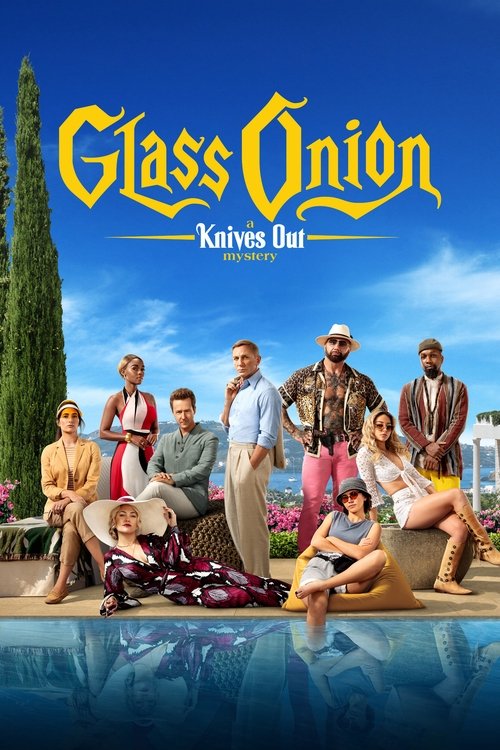
Glass Onion: A Knives Out Mystery
2022 · Rian Johnson
For a fun night in with friends when you want to play armchair detective — comfort viewing with a wicked streak, perfect when you'd rather grin than grip the couch.
What it's about
Detective Benoit Blanc lands on a tech billionaire's private Greek island, where Miles Bron has gathered his old friends — a senator, a scientist, a fashion mogul, a streamer, and one guest nobody expected — for a murder-mystery party. The game curdles fast, and Blanc finds himself untangling not just a crime but the web of favors, debts, and lies that keeps this glittering circle orbiting its billionaire sun.
The experience
Playful, fizzy, and fast — a comedy first and a puzzle second, stacked with sight gags, needle-sharp one-liners, and a structure that keeps folding back on itself to show you what you missed. It's the rare mystery that makes you laugh out loud while you're busy suspecting everyone.
Performances
Daniel Craig is having the time of his life as Blanc, all Southern drawl and theatrical exasperation, while Janelle Monáe does quietly remarkable work in a role that keeps revealing new depths; Edward Norton makes his tech-guru insufferable in exactly the right way.
The craft
Rian Johnson's script is the star: a clockwork whodunit that hides its tricks in plain sight and doubles as a gleeful roast of Silicon Valley genius-worship. The sun-drenched island production design — all glass, sculpture, and absurd billionaire toys — pops on a big screen, and the editing lands every reveal with a snap.
Why it matters
Its blockbuster Netflix debut after a one-week theatrical run reignited the industry fight over streaming release windows, and it cemented the Benoit Blanc films as the franchise that brought the star-studded whodunit roaring back.
Snapshot
A standalone sequel to Knives Out (2019), Glass Onion transplants detective Benoit Blanc to a private Greek island for a murder-mystery weekend hosted by tech billionaire Miles Bron, only to subvert the whodunit form by revealing that the puzzle was never as intricate as it appeared. Written and directed by Rian Johnson, the film doubles as social satire: it skewers the mythology of the Silicon Valley "disruptor" and the complicit social circles that sustain such figures. Released theatrically for a single week in November 2022 before moving to Netflix, it generated as much industry conversation about streaming release windows as it did critical discussion of its considerable formal pleasures. The title is the film's central thesis delivered as metaphor — something that looks layered and opaque is, once you see through it, perfectly transparent and hollow.
Industry & Production
Glass Onion emerged from one of the most discussed streaming acquisitions of the early 2020s. Following the commercial and critical success of Knives Out, Netflix acquired the rights to two sequels through a reported deal worth approximately $469 million — a figure widely circulated in trade press at the time of the 2021 announcement and representing one of the largest single-filmmaker streaming commitments to that point. The arrangement allowed Johnson and his production company T-Street Productions, co-founded with producer Ram Bergman, to retain substantial creative autonomy while Netflix underwrote the budget and secured global distribution rights.
The production shot on location primarily on the Greek island of Spetses, a car-free island in the Saronic Gulf whose architectural character and coastal topography provided the visual grammar of Bron's compound. Working on an actual island rather than a studio backlot gave the film a textural specificity — the quality of Mediterranean light, the weight of stone architecture, the particular blue of the Aegean — that informed Yedlin's cinematographic choices. Interior work was supplemented with stage shooting.
The ensemble cast — Daniel Craig, Edward Norton, Janelle Monáe, Kate Hudson, Leslie Odom Jr., Dave Bautista, Kathryn Hahn, and Jessica Henwick — was assembled under conditions that reportedly included tight logistical coordination arising from the COVID-era production environment; the film shot in 2021 under applicable health protocols. Securing the loan of the actual Mona Lisa from the Louvre for on-screen use — a remarkable institutional arrangement, given the painting's cultural status — required negotiations with French cultural authorities; the painting appears briefly but pivotally in the film's climax, and its presence functions as a satirical index of Bron's access and hubris. (Whether the painting seen on screen is the original or a reproduction during certain shots is a question of practical production logistics not definitively addressed in public production materials.)
The film's theatrical run — approximately one week across roughly six hundred screens beginning November 23, 2022 — was structured as a qualifying run for awards eligibility rather than a commercial theatrical release. Several major theater chains declined to participate given the abbreviated window. Netflix subsequently released the film on its platform December 23, 2022. This hybrid approach reopened debates about the theatrical model, streaming economics, and what constitutes a "theatrical release" in an industry still recalibrating post-pandemic. The limited box office figures that resulted from the brief theatrical window were not representative of the film's actual audience, which was substantial on Netflix.
Technology
Steve Yedlin, Johnson's cinematographer across their entire collaborative filmography, shot Glass Onion digitally. Yedlin has been publicly vocal about his views on digital cinematography and has published technical essays arguing that properly executed digital capture, with thoughtful color science, can achieve perceptual equivalence with film stocks — a position that positions him as a thoughtful proponent of digital's expressive potential rather than a default practitioner. The specific camera package used on Glass Onion has not been exhaustively documented in public production materials, but the film's visual rendering — its handling of the saturated blues and whites of the Greek setting, and the warmer, more amber interiors of Bron's compound — reflects deliberate colorimetric choices consistent with Yedlin's practice of treating digital capture as raw material for sophisticated color grading.
No publicly documented use of virtual production volumes or AI-assisted visual effects techniques is associated with the film. The production's visual effects work is modest by contemporary blockbuster standards, consistent with a film grounded in physical locations and practical performance.
Technique
Cinematography
Yedlin's work on Glass Onion has a painterly quality calibrated to the film's tonal registers: the exterior scenes on Bron's island are saturated and almost artificially beautiful, a visual approximation of the performed luxury that the narrative punctures. Wide lenses emphasize the architecture and spatial relationships of the compound, grounding the audience in a geography they will need to navigate conceptually as the plot cycles back to reexamine itself. The film uses a warm-cool contrast to distinguish the retrospective sequences — the "real" history of Andi Brand and Miles Bron — from the present-tense scenes on the island, giving the structural rewind a perceptible visual key without underlining it didactically.
Editing
Bob Ducsay, who also edited Knives Out, returned for Glass Onion, and the editorial collaboration with Johnson is central to the film's formal achievement. The film's most ambitious structural move — a prolonged mid-film sequence that restarts and reexamines the first act from Helen Brand's point of view — requires an editor capable of managing audience memory and recalibrating information without losing propulsive momentum. Ducsay's approach keeps the rewind from feeling punitive or repetitive by revealing new valences in material the audience has already seen, a technique that demands precise selection of what to re-show, how long to linger, and what to omit. The pacing of the film's first act, which establishes the ensemble through a brisk, almost screwball accumulation of introductions, contrasts with the slower, more emotionally weighted rhythms of the retrospective material.
Mise-en-scène / Staging
Johnson, trained as a filmmaker with a strong sense of spatial and visual composition developed across his independent features, uses the island compound as a controlled environment in a Christiean sense — a closed world whose geography becomes meaningful as the plot tightens. The glass house aesthetic of Bron's compound — transparent walls, reflective surfaces, a paradoxical openness that offers no privacy — externalizes the film's central metaphor. The staging frequently uses architectural frames within the frame: doorways, windows, the curved geometry of the glass structure itself. The use of a puzzle-box mechanism as the film's literal opening conceit (Bron sends his guests an elaborate puzzle to unlock an invitation) sets a visual vocabulary for the film's relationship to apparent complexity — intricate surfaces concealing simple contents.
Sound
Nathan Johnson's score operates within his established practice with Rian Johnson: a tonal restlessness that refuses a single generic key, moving between whimsical comedy-of-manners gestures, tension-building strings, and occasional moments of genuine pathos when the film's more affecting human stakes surface. The score deploys a kind of ironic lightness over scenes of exposition and social comedy, then shifts register for the emotional reckoning in the film's second half. Licensed music, including period-specific cues, is used to anchor the ensemble's cultural references and comic characterizations. The film's sound design is not a prominent subject of critical discussion, which is consistent with its theatrical rather than formal priorities.
Performance
Daniel Craig's Benoit Blanc is the film's tonal keystone, and his performance here is more comedic and more physically committed than in Knives Out. Craig plays Blanc as a man slightly at sea for much of the film — genuinely wrong-footed by a mystery that turns out to have been visible from the beginning — and the comedy of his bewilderment is carefully calibrated not to diminish his intelligence but to dramatize the film's argument that genius can be blinded by the expectation of complexity. Janelle Monáe carries the film's emotional center in a dual role requiring her to modulate between grief, fury, and performance; her work in the retrospective sequences, particularly as the film's stakes become apparent, is the performance most frequently cited in critical discussion. Edward Norton's Miles Bron is recognizably a caricature but Norton shades him with just enough vanity and wounded narcissism to prevent the character from collapsing into sketch. The ensemble — Hudson, Bautista, Hahn, Odom Jr., Henwick — is deployed primarily for comedic and satirical purposes, each character a legible archetype within Bron's sphere of influence.
Narrative & Dramatic Mode
Glass Onion operates as a structural whodunit that interrogates its own genre machinery. The film's narrative architecture — a gathering of suspects, a closed environment, an eccentric detective — follows Christie's established grammar, then uses the mid-film rewind to reveal that the mystery was never genuinely mysterious: the audience, like Blanc, was looking for hidden complexity where only simple greed and cowardice resided. This is the "glass onion" thesis: that certain apparent puzzles are transparent if you abandon the assumption of cleverness.
The film functions simultaneously as a comedy of manners in the Altman tradition — the ensemble is stratified by various forms of complicity and self-delusion — and as a pointed satire of early 2020s tech-billionaire culture, its rhetoric of disruption, and the courtier class of influencers, politicians, scientists, and celebrities who sustain such figures in exchange for proximity to power. The satirical register does not quite reach the sustained acidity of classic Hollywood political satire; Johnson is more interested in the mechanics of charisma and complicity than in systemic critique. The emotional payoff is reserved for the relationship between Andi Brand and her sister Helen, a register of genuine grief and loyalty that the film's satirical machinery opens space for but only fully inhabits in its final act.
Genre & Cycle
Glass Onion is the most prominent American entry in a notable early-2020s revival of the theatrical whodunit as prestige entertainment. This cycle includes Kenneth Branagh's Murder on the Orient Express (2017) and Death on the Nile (2022), adapting Christie directly; the Benoit Blanc series itself; and various television adaptations of Golden Age detective fiction. The revival reflects both nostalgia for a legible generic pleasure and a cultural appetite — particularly post-2016 — for narratives in which deception and hidden motive are eventually unmasked by careful observation. Johnson's contribution to the cycle is distinctive for its willingness to critique the whodunit form from within: Glass Onion is as much a film about the whodunit's assumptions as it is a whodunit.
The film also participates in a cycle of anti-billionaire satire prominent in roughly 2019–2023, including Parasite (2019), The Menu (2022), and Triangle of Sadness (2022), which collectively register a cultural reckoning with extreme wealth and its social costs.
Authorship & Method
Rian Johnson writes and directs all his features, a practice that gives his filmography unusual consistency of voice across wildly different generic registers: the neo-noir of Brick (2005), the con-artist tragicomedy of The Brothers Bloom (2008), the science-fiction of Looper (2012), the franchise intervention of Star Wars: The Last Jedi (2017), and the Benoit Blanc series. His screenwriting is characteristically precise about plot mechanics — he is one of the few contemporary American filmmakers for whom the intricacies of narrative construction are a genuine aesthetic value — and his dialogue tends toward the stylized and self-aware without tipping into parody.
His principal collaborators across his career have remained stable. Steve Yedlin has shot every Johnson feature, a partnership originating at USC film school and constituting one of the more sustained director-cinematographer relationships in contemporary American independent cinema. Nathan Johnson (Rian's cousin) has composed every Johnson score, developing an approach to genre pastiche that gives each film its tonal texture. Bob Ducsay, who began collaborating with Johnson on Knives Out, edited Glass Onion. Ram Bergman, Johnson's producing partner since The Brothers Bloom, produced the film through T-Street.
Johnson's method on set is described in available interview material as highly prepared in terms of shot design — he works extensively with storyboards — while remaining collaborative with actors within the parameters he establishes. His practice of staging is influenced by his admiration for filmmakers who use classical shot grammar rather than kinetic editing to convey information, a preference visible in Glass Onion's patience with sustained two-shots and ensemble compositions.
Movement / National Cinema
Glass Onion is an American studio-adjacent production in the sense of its budget scale and talent profile, but it is more precisely a product of the Netflix era's reorganization of production geography — shot in Greece, financed by a streaming platform with global distribution, with no meaningful attachment to a physical production ecosystem. It belongs to a loose category of prestige streaming originals that operate outside the traditional studio system while inheriting many of its aesthetic and industrial conventions. Within American cinema, the film's closest genealogical connections are to the tradition of the Hollywood ensemble film (Altman, Lubitsch, Sturges) rather than to any regionally specific movement.
Era / Period
Glass Onion is legibly a product of 2021–2022, not merely because its satire targets a recognizable figure from that cultural moment — the Tesla-era tech billionaire — but because its production conditions reflect the pandemic-era reorganization of the industry. The streaming acquisition that made the film possible, the abbreviated theatrical window, the location shoot abroad during a period of complex international production logistics: these are markers of a specific industrial conjuncture. The film also arrives at a moment when the satire of disruptor mythology had become culturally available in a way that might not have been true even five years earlier.
Themes
The film's organizing metaphor is transparency mistaken for opacity: a glass onion looks as if it should have layers, but every layer is visible from the outside if you look clearly. This is applied to Miles Bron, whose genius, the film argues, was always a performance that his courtiers chose to believe because belief served their interests. The film is concerned with complicity and its mechanisms — how intelligent people sustain proximity to frauds — and with the particular seductiveness of disruption rhetoric, which makes the rejection of established norms legible as a form of vision.
Secondary themes include friendship and its betrayal as the constitutive wound of the narrative; the gendering of who gets credited for ideas and who gets erased; and the relationship between spectacle and truth. The Mona Lisa functions as a multivalent symbol: an object of incomprehensible cultural value reduced to a prop in a billionaire's performance of access, and ultimately destroyed in an act that the film frames as clarifying rather than tragic — sometimes, the film argues, destruction is the only legible truth-telling available to the powerless.
Reception, Canon & Influence
Influences on the film (backward): Glass Onion's primary literary ancestor is Agatha Christie, specifically the device of the closed, island-bound gathering in And Then There Were None (1939) and the figure of the eccentric foreign detective, most obviously Hercule Poirot. The film's structural willingness to rewind and reexamine draws on a tradition of theatrical whodunits that deceive the audience through selective presentation — Anthony Shaffer's Sleuth and its adaptations are a relevant precedent. Johnson has cited his admiration for Preston Sturges as an influence on his comedic dialogue and ensemble construction. Robert Altman's Gosford Park (2001), which deploys the English country-house murder mystery as class satire, is the most proximate cinematic ancestor in terms of the combination of ensemble comedy and social critique. The Christiean pastiche comedy Clue (1985) is a visible antecedent in its treatment of the ensemble whodunit as broad comedic material. Johnson's own Knives Out is also an explicit predecessor the film is in conversation with: it establishes Blanc as a figure, introduces the structural inversion device, and constitutes the generic expectations the sequel can then complicate.
Critical reception: The film was widely praised by critics, with most reviews singling out Johnson's structural ingenuity, Craig's comedic performance, and Monáe's dramatic work. Dissenting criticism argued that the satire was too comfortable — that a film attacking the cultural mythology of the disruptor was being distributed by a streaming platform whose own industrial model was built on disruption rhetoric — and that the targets were too legible to require the elaboration the film gives them. Discussion of its awards position was complicated by the hybrid release strategy; it received significant awards-circuit recognition but the question of its eligibility status under various bodies' rules was contested.
Legacy and forward influence (tentative): It is too early to make confident claims about Glass Onion's lasting influence on American filmmaking. Its most immediate forward effect may be industrial rather than aesthetic: the terms of the Netflix deal and the debate about the theatrical window contributed to ongoing industry discussions about what streaming companies owe to the theatrical model. Within the Benoit Blanc series, it establishes Johnson's willingness to fully reinvent the formal and social context of each installment rather than repeating the template. As a piece of anti-billionaire satire, it became more resonant in the months following its release as cultural discussion of specific tech-billionaire figures intensified; commentators noted that the portrait of Miles Bron acquired additional satirical precision from events that occurred after the film's production. A third Blanc film is in development as of the time of writing, and the shape of that project may ultimately define the series' canonical place more than any single installment.
A Deleuzian reading
Look at the house first.
The full Deleuzian reading of Glass Onion: A Knives Out Mystery →
Reception
Landed in late 2022 as a crowd-pleaser with rave reviews and one of Netflix's biggest film debuts ever — and its tech-billionaire satire only got more discussed as Elon Musk's chaotic Twitter takeover unfolded in the exact same news cycle, making the film feel less like parody and more like reporting.
How Glass Onion: A Knives Out Mystery was received, from release to now →
Influences: the films it descends from and the films it influenced
- Gosford Park (2001) — Altman deploys the country-house murder mystery as a vehicle for class-stratified ensemble comedy, where overlapping dialogue and split-screen social geography expose hierarchy through group staging rather than individual close-up — the direct structural model Johnson adapts for the tech-billionaire island gathering.
- Knives Out (2019) — Johnson's own film establishes both the mid-film structural inversion device — the apparent solution revealed early to reframe what the actual mystery is — and Blanc's rhetorical mode of performative confession-extraction; Glass Onion explicitly complicates this inherited template with different class targets.
- Rashomon (1950) — Kurosawa's formal device of re-presenting already-witnessed events from a different vantage to revise their meaning is the structural model for Glass Onion's second-half rewind, which replays earlier scenes with Andi's presence restored to recalibrate audience memory.
- Stage Fright (1950) — Hitchcock presents a character's fabricated account as objective-reality footage, establishing the formal device of lying visual presentation — the camera as active deceiver rather than neutral observer — that Glass Onion's mid-film rewind weaponizes against the audience.
- Sleuth (1972) — Mankiewicz's theatrical two-hander withholds a character's true identity from both the on-screen detective and the audience through costume and performance, establishing the lying mise-en-scène of sealed-room deception that Glass Onion's structural rewind and Monáe's dual-role concealment inherit.
- And Then There Were None (1945) — Clair's Christie adaptation codifies the sealed-island structure — a defined cast assembled in an inescapable location, its geography used to constrain movement and stage revelation — the direct spatial template for Glass Onion's island compound as narrative machine.
- The Last of Sheila (1973) — Sondheim and Perkins's yacht-bound whodunit assembles a sealed wealthy-guest cast in a luxury closed setting, exposing each guest's concealed vice as both game mechanic and genuine crime; a direct ancestor of Glass Onion's island-compound structure and its use of the closed luxury space as anti-wealth satirical arena.
- Murder on the Orient Express (1974) — Finney's Poirot establishes the Christie-derived eccentric detective's climactic theatrical revelation — gathering the full cast in a single room to perform a spoken reconstruction — as cinematic set-piece; Craig's Blanc inherits this specific rhetorical mode in the poolside monologue.
- The Palm Beach Story (1942) — Sturges's rapid-fire ensemble comedic dialogue, where class-aware wordplay and social performance collide in overlapping group scenes, is Johnson's cited influence for Blanc's verbal style and the broader comedic rhythm of the Benoit Blanc series.
- Nashville (1975) — Altman's multi-strand ensemble construction, where characters' social performances constitute the satirical text rather than subplot texture, is the structural ancestor of Gosford Park's model that Glass Onion inherits: the ensemble as instrument of class critique rather than mystery machinery.
- Clue (1985) — Lynn's treatment of the Christie ensemble as broad physical comedy with a rotating-revelation structure — multiple competing endings playing the same murder differently — establishes the tonal register of Christie pastiche as American broad comedy that Glass Onion inherits and updates for a streaming audience.
- The Lady Vanishes (1938) — Hitchcock's sealed-transport mystery, in which an apparent solution is overturned by the revelation that a central figure has been disguised throughout, establishes the genre template of Christie-adjacent closed-environment puzzle with identity concealment that Glass Onion works within and against.
- The Hateful Eight (2015) — Tarantino uses specific architectural geography — the haberdashery's floor plan — as a narrative constraint in a sealed-cast whodunit, staging revelation through spatial logic; Glass Onion similarly deploys the island compound's geography as both dramatic device and production-design spectacle requiring the audience to map the space.
- Triangle of Sadness (2022) — Östlund uses a sealed luxury environment — yacht and island — to expose class performance under duress as satirical mechanism against ultra-wealthy subjects; a near-concurrent formal sibling to Glass Onion in using enforced proximity in closed spaces as the anti-billionaire satirical instrument.
- See How They Run (2022) — George's contemporaneous meta-whodunit deploys self-reflexive genre awareness and a closed theatrical environment with a direct-address narrator who names the genre conventions being used; shares Glass Onion's tonal register of comedy-mystery pastiche built on genre self-consciousness.
- Bodies Bodies Bodies (2022) — Reijn's closed-environment murder mystery set among ultra-wealthy young people uses genre mechanics to satirize a specific demographic's social performance under pressure; shares Glass Onion's sealed-location structure and anti-privilege satirical register applied to the same contemporary tech-adjacent ruling-class subject.
Similar films
- Knives Out (2019) — influence & lineage · same viewing thread
- Triangle of Sadness (2022) — influence & lineage
- Wake Up Dead Man: A Knives Out Mystery (2025) — same viewing thread
- The Menu (2022) — same viewing thread
- Ocean's Eight (2018) — shared sensibility
- Tenet (2020) — shared sensibility
- Detective Conan: The Phantom of Baker Street (2002) — shared sensibility
- They Cloned Tyrone (2023) — shared sensibility
All the films related to Glass Onion: A Knives Out Mystery →
Watch it with: curated runs of related films
- Locked In With the Powerful — A run of elegant, twisty chamber pieces where the rich and the powerful gather in one sealed world — an island restaurant, a Greek estate, a gothic mansion, the sealed Vatican — and the social order gets carved up in front of you.