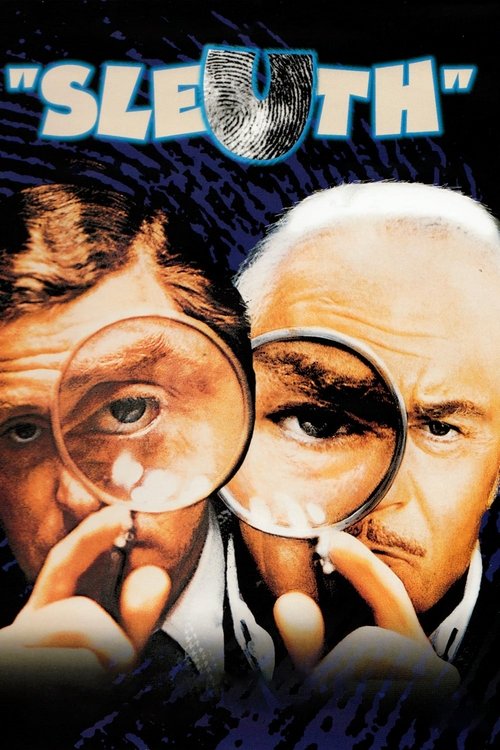
Sleuth
1972 · Joseph L. Mankiewicz
For when you want a battle of wits — a puzzle-box evening where the pleasure is dialogue, gamesmanship, and watching two great actors try to eat each other alive. Cozy in setting, nasty in spirit.
What it's about
A wealthy, aging detective novelist who adores games invites a younger man to his gadget-stuffed country house. The visitor is his wife's lover, and what starts as a civilized conversation about the affair turns into an elaborate proposition — and then a duel of humiliation, class resentment, and one-upmanship where the stakes keep climbing and neither man will be the first to blink.
The experience
A cat-and-mouse chamber piece that's talky in the best way: witty, cruel, and increasingly claustrophobic, with the ground shifting under you every twenty minutes. You spend the whole film trying to guess who's really holding the cards, and enjoying being wrong.
Performances
Laurence Olivier and Michael Caine go head to head for two hours and both were nominated for the Best Actor Oscar for it — Olivier all theatrical, patrician malice, Caine matching him with wounded working-class steel. It's essentially a two-man show, and the two men are extraordinary.
The craft
Anthony Shaffer adapted his own hit stage play, and Joseph L. Mankiewicz — in his final film — turns one house into a whole world, its automata, puzzles, and props practically becoming a third character. The staging keeps a stage-bound premise visually alive, and the script is a machine of traps and reversals built to be experienced cold.
Why it matters
It became the template for the modern twisty two-hander and a touchstone for every locked-room battle of wits since, while sending off Mankiewicz's career with a flourish.
Snapshot
Sleuth is a two-character chamber thriller in which an aging, affluent detective novelist lures his wife's younger lover into an escalating series of cruel games inside a country house crammed with automata, puzzles, and theatrical props. Adapted by Anthony Shaffer from his own hit 1970 stage play, and directed by Joseph L. Mankiewicz in what proved to be his final film, it pits Laurence Olivier's patrician Andrew Wyke against Michael Caine's working-class Milo Tindle in a duel that is at once a whodunit, a class allegory, and a sustained meta-commentary on the English detective story itself. The film is unusual in the annals of awards history: both of its credited leads were nominated for the Academy Award for Best Actor for the same picture, and the production deliberately concealed the true size of its cast to protect a central twist. Talky by design and proudly artificial, it is a showcase for two virtuoso performances and for a screenplay built almost entirely out of reversals.
Industry & production
Sleuth arrived as a prestige transatlantic property. Shaffer's play had been a major commercial success in London and on Broadway, and the screen rights carried the cachet of a proven, plot-driven crowd-pleaser. The film was produced as a British production with American distribution; it was released in the United States by 20th Century-Fox. The casting of Olivier — the most garlanded English stage actor of his generation — opposite Caine, by then an established international star with a distinctly contemporary, classless screen persona, gave the project both gravitas and box-office reach.
A defining production decision was the elaborate ruse surrounding the cast. To preserve the film's surprise, the credits and publicity listed several performers — among them an "Inspector Doppler" played by "Alec Cawthorne," plus named players for Marguerite Wyke, a mistress, and police officers — who do not in fact exist or never appear on screen. In reality only Olivier and Caine perform; the unseen characters are spoken of but never shown. This invented ensemble was carried into the marketing and even, for a time, into reference listings, an audacious gambit that has become part of the film's lore.
The picture was shot largely on a single elaborate interior set with location exteriors at an English country estate (commonly identified as Athelhampton House in Dorset, though production records on such details are thinner than for the studio work). The decision to retain the play's essentially single-location structure — rather than "open it up" cinematically — was central to the film's identity and its economics: a contained, dialogue-heavy production whose value lay in performance, design, and writing rather than spectacle.
Technology
Technologically, Sleuth is a conventional early-1970s 35mm color production, and it does not foreground innovation; its ambitions lie in performance and design rather than in the apparatus. The relevant "technology," in a sense internal to the film, is the array of mechanical devices that populate Andrew Wyke's house — clockwork automata, games, and gadgets, most memorably a laughing sailor automaton whose grotesque mechanical mirth becomes a recurring punctuation. These props function as a thematic technology of artifice: machines built to simulate human feeling, mirroring the men's own performances of emotion. The film's craft is otherwise classical, relying on lighting, lenses, and editing rather than on optical or photographic novelty.
Technique
Cinematography
The cinematography is by Oswald Morris, one of the most accomplished British cameramen of the era (his credits include Oliver! and Fiddler on the Roof). Confronted with the inherent challenge of a long film set almost entirely in one house, Morris and Mankiewicz use the camera to keep a static premise alive: prowling through the cluttered rooms, isolating faces in the warm, lamplit interiors, and exploiting the verticality and clutter of Ken Adam's set to frame the two men among watching objects. The look is rich and slightly theatrical, with the games and automata frequently sharing the frame with the actors so that the décor seems to spectate. Rather than disguising the staginess, the photography aestheticizes the enclosure, turning the house into a pressurized arena.
Editing
Edited by Richard Marden, the film's cutting is in service of dialogue and performance rhythm — the timing of a reversal, the beat before a line lands, the cutaway to a reacting face or a leering mechanical figure. The principal editorial task is sustaining tension across a very long running time (around 138 minutes) with minimal action, and the film leans on reaction shots and on holding two-shots that let the actors' shifting power dynamics play out within a single frame. The pacing is deliberately measured, accumulating menace through accretion rather than through propulsive cutting.
Mise-en-scène / staging
This is the film's signal achievement, and it belongs substantially to production designer Ken Adam — celebrated for his James Bond sets and for Dr. Strangelove. Adam fills Andrew Wyke's home with games, puzzles, costumes, nautical automata, and the bric-à-brac of a man who has made play his life's work. The mise-en-scène externalizes character: the house is the mind of a manipulative gamesman, a labyrinth in which Milo is to be hunted. Staging exploits levels, doorways, and the dense object-field so that bodies move through a landscape of toys that are also instruments of humiliation. The famous burglary sequence, in which Andrew costumes Milo and choreographs a faux break-in, makes the staging literal — the house becomes a theater and Andrew the director within the fiction.
Sound
John Addison's score — Addison was an Oscar winner for Tom Jones — supplies a wry, playful character appropriate to a film about games, leaning into mischief rather than conventional thriller dread. Diegetic sound is central: the mechanical laughter of the sailor automaton, the clicks and chimes of clocks and games, and above all the human voice. Sleuth is a film of talk, and its sound design privileges the precise articulation of Shaffer's dialogue, with the automata's noises functioning as an ironic chorus.
Performance
Performance is the film's reason for being. Olivier plays Andrew Wyke with relish — a grandiloquent, sneering aristocrat-by-affectation whose cruelty is wrapped in wit and whose theatricality is the point. Caine's Milo begins as the wary outsider and undergoes a transformation over the film's reversals, including a disguised central passage that the production worked hard to conceal. The two performances are calibrated against each other as a contest of styles — Olivier's florid classicism versus Caine's grounded modernity — which doubles the film's class theme at the level of acting tradition. Both men received Academy Award nominations for Best Actor, an extraordinary recognition for a two-hander.
Narrative & dramatic mode
Sleuth is structured as a series of traps and counter-traps, each act inverting the power relation established by the last. Andrew first proposes that Milo stage a jewel robbery — ostensibly so both men can profit — only to reveal the scheme as an elaborate exercise in humiliation. Subsequent movements bring an apparent investigation into Milo's fate and further claims of murder, each engineered to terrorize the other man into believing his life or liberty is forfeit. The dramatic mode is overtly theatrical and self-aware: characters perform roles, adopt disguises, and stage scenes for one another, so that the audience is never allowed to forget it is watching a contrivance. Crucially, Andrew is a writer of cozy detective fiction, and the narrative is shot through with self-referential commentary on the conventions of the genre — the gentleman sleuth, the locked-room puzzle, the tidy reveal — which the film both exploits and skewers. The result is a thriller that is also a sustained argument about thrillers.
Genre & cycle
The film sits at the intersection of the drawing-room mystery, the psychological thriller, and the "battle-of-wits" two-hander. It belongs to a tradition of stage-to-screen suspense pieces (the lineage of Dial M for Murder and similar single-set thrillers) and to a small cycle of self-conscious deconstructions of the English whodunit. Its closest generic kin is the gamesmanship thriller, in which plot mechanics — the twist, the double-cross, the unreliable performance — are foregrounded as the very subject. By 1972 the classical English mystery had long been a target for parody and revision, and Sleuth participates in that revisionism even as it delivers the pleasures of the form. Shaffer himself was a connoisseur and critic of the genre, and the film reads as both homage and demolition.
Authorship & method
Two authorial signatures dominate. The first is Anthony Shaffer, who adapted his own play and whose fingerprints — the elaborate plotting, the love of misdirection, the literate cruelty — define the material. Shaffer (twin brother of playwright Peter Shaffer) wrote in the same period the screenplay for The Wicker Man, and his fascination with ritual, performance, and the trap is evident here. The second is Joseph L. Mankiewicz, the writer-director of All About Eve and A Letter to Three Wives, a filmmaker famous for dialogue, theatricality, and verbally dueling characters. Sleuth was a fitting capstone: a film entirely about two articulate people talking each other into corners, directed by Hollywood's great connoisseur of literate combat. Mankiewicz did not write this screenplay, but its sensibility — civilized surfaces over savage gamesmanship — is deeply continuous with his body of work, and the film is widely treated as his valedictory statement.
Key collaborators shape the rest: cinematographer Oswald Morris, production designer Ken Adam, composer John Addison, and editor Richard Marden. Adam's design is arguably co-authorial, since the film's meaning is so thoroughly embedded in its objects and rooms.
Movement / national cinema
Sleuth is a product of British cinema and of the long British tradition of theatrically rooted, performance-driven filmmaking — the prestige adaptation of a successful West End play, mounted with the country's leading stage knight in the lead. It stands somewhat apart from the social-realist currents that had marked British film in the preceding decade and from the contemporaneous American New Hollywood; it is consciously classical and literary rather than countercultural. Its Englishness is also its subject: the film anatomizes a particularly British apparatus of class, manners, and snobbery, making national cinema and national theme inseparable.
Era / period
Released in 1972, the film occupies a transitional moment. Hollywood was in the throes of the New Hollywood upheaval, and Mankiewicz, a figure of the classical studio era, was making his last picture in a register defiantly out of step with the period's gritty naturalism. Sleuth looks backward — to the well-made play, to the gentleman's mystery, to a theater of wit — even as the world around it changed. That tension between an old order and an encroaching new one is also dramatized inside the film, where Andrew embodies a fading establishment and Milo a more mobile, less deferential modernity. The picture thus reads partly as an elegy for, and partly as an indictment of, a passing English world.
Themes
The film's central themes are class and humiliation: Andrew, the entitled, mannered insider, sets out to degrade Milo, the son of an immigrant, treating snobbery as sport. Closely linked is the theatricality of identity — the idea that selfhood is a performance, that disguise and role-play can remake a man, and that cruelty is often staged. Games and reality form a third axis: the house's automata and puzzles literalize a worldview in which human beings are pieces to be moved, and in which the line between play and lethal earnest keeps dissolving. The film is also about masculine rivalry and sexual jealousy, the unseen woman serving as the pretext for a contest between two men. Finally, Sleuth is reflexive about fiction itself: through Andrew the detective novelist, it interrogates the comforting tidiness of the whodunit and exposes the ugliness — the condescension and violence — beneath the genre's gentility.
Reception, canon & influence
Critically, Sleuth was received as a superior, intelligent entertainment and above all as an acting showcase; the twin Best Actor nominations for Olivier and Caine became its most cited distinction, alongside a Best Director nomination for Mankiewicz and a nomination for John Addison's score (the film won no Oscars, in a year dominated by The Godfather and Cabaret). Some critics then and since have noted the inevitable staginess and the strain of sustaining a single conceit at feature length, but the consensus has held that the performances and the writing carry it. (Precise contemporary box-office figures are not something I can responsibly quote here.)
Looking backward, the film draws on the English drawing-room mystery and the locked-room tradition, on the stage thriller as perfected for screen by Hitchcock and others, and on Shaffer's own deep, ambivalent immersion in detective fiction. Looking forward, its legacy is twofold. As a template, it helped sustain the two-hander gamesmanship thriller and the vogue for twist-driven, reversal-heavy plotting. Most concretely, it was remade in 2007 by director Kenneth Branagh from a screenplay by Harold Pinter, with Michael Caine — now graduated to the Andrew Wyke role — opposite Jude Law, a rare instance of an actor crossing from the younger to the older part in a remake of his own film. That self-conscious doubling is itself a fitting tribute to a film obsessed with role-play, disguise, and the long game.
A Deleuzian reading
Start with the laughing sailor.
The full Deleuzian reading of Sleuth →
Reception
A hit on release — four Oscar nominations, including Best Actor for both of its stars — and it's never really fallen out of favour; if anything, the Knives Out-era whodunit revival has pushed a new generation toward it as the granddaddy of the battle-of-wits chamber piece.
How Sleuth was received, from release to now →
Influences: the films it descends from and the films it influenced
- Rope (1948) — Establishes the single-set, near-real-time stage thriller with a prowling camera that turns one apartment into a pressurized arena — Sleuth's confined manor and roving lens inherit that enclosure technique directly.
- Dial M for Murder (1954) — The screen template for the 'perfect murder' engineered as a chess problem within a single drawing room, where plot mechanics and household objects (latchkey, scissors, telephone) carry the suspense — the object-field staging Ken Adam elaborates in Sleuth.
- All About Eve (1950) — Mankiewicz's own founding model of articulate antagonists talking each other into corners, with identity treated as performance and theater as a battlefield — the literate-combat sensibility he brings whole to Sleuth.
- Witness for the Prosecution (1957) — Adapts a stage thriller's late-breaking reversal so the audience's certainty is detonated by a final disguise-and-deception reveal — the reversal-structure engine Shaffer reloads in Sleuth.
- Les Diaboliques (1955) — Builds its shock on a victim being elaborately staged and gaslit by a conspiracy he cannot see, then pulls the rug — the cruelty of the rigged-game plot that Sleuth's humiliation scheme echoes.
- Gaslight (1944) — The domestic two-hander of psychological humiliation, where one party methodically degrades another inside a single house — the manipulator/victim power duel Sleuth weaponizes between Wyke and Tindle.
- The Servant (1963) — A class-inversion master/servant duel staged in one house with a prowling, encircling camera, scripted by Harold Pinter — a direct authorial bridge to Pinter's 2007 Sleuth screenplay and to Sleuth's class-and-humiliation core.
- Who's Afraid of Virginia Woolf? (1966) — Turns a single-location two-hander (-plus) into rule-governed verbal blood sport, where 'games' with stated names structure the night — the articulate-combat-as-game design Sleuth formalizes.
- Deathtrap (1982) — The most direct heir: a single-location two-hander thriller about a playwright, structured around successive trap-and-reversal twists where the murder is itself theater — Sleuth's gamesmanship template transposed almost wholesale.
- Sleuth (2007) — A direct remake from a Harold Pinter screenplay in which Michael Caine crosses from the younger Tindle to the elder Wyke — a self-conscious doubling that literalizes the original's obsession with role-play and disguise.
- Funny Games (1997) — Stages sadistic, rule-announced gamesmanship that humiliates its victims inside a single bourgeois home while breaking frame to implicate the genre and audience — the reflexive cruelty-as-game inherited from Sleuth, stripped of comfort.
- Oleanna (1994) — A two-hander power-and-class duel confined to one room, escalating through verbal reversals until the educated party is humiliated and overturned — Sleuth's articulate-combat structure carried into pure dialogue warfare.
- Knives Out (2019) — Revives the reversal-driven whodunit with clue-bearing object-field mise-en-scène and knowing meta-genre reflexivity about detective fiction's conventions — the twist-plotting and detective-fiction self-awareness Sleuth helped keep alive.
- Blue Moon (2025) — A two-hander of chamber gamesmanship staged within one set, structured entirely around dueling virtuoso performances rather than locations.
- The Prestige (2006) — Mankiewicz's two-hander chamber film stages identity deception as theatrical combat — costume, disguise, and performance as moral weapons between antagonists in a closed space — and its twist that an apparent stranger was a concealed figure all along directly anticipates The Prestige's dramatic architecture.
- Ex Machina (2015) — Mankiewicz and playwright Anthony Shaffer constructed a two-hander in which each act reverses who holds power, with the confined country house as the board on which dominance is contested; Ex Machina replicates this scene-grammar exactly — Nathan and Caleb's initial power differential, Ava's apparent vulnerability, and the final reversal in which the third party reveals she has been playing the other two from the beginning.
- Glass Onion: A Knives Out Mystery (2022) — Mankiewicz's theatrical two-hander withholds a character's true identity from both the on-screen detective and the audience through costume and performance, establishing the lying mise-en-scène of sealed-room deception that Glass Onion's structural rewind and Monáe's dual-role concealment inherit.
- The Outfit (2022) — Mankiewicz's two-hander adaptation systematically manipulates audience allegiance through staged identity reversals and privileged disclosure followed by retroactive reframing — the exact structural inheritance Moore deploys across his act-as-tailoring-stage architecture.
- Black Bag (2025) — Shaffer's stage play is adapted as a pure dialogue-combat film in which theatrical blocking — characters repositioned around a single enclosed space to mark each power reversal — carries all the dramatic information; the parlour-mystery structure where every revelation retroactively reframes prior scenes is the formal architecture Black Bag's ensemble-suspect dinner scenes replicate.
- House of Games (1987) — A two-hander of theatrical gamesmanship and one-upmanship that springs a constructed trap, foregrounding artifice and performance-as-deception over realism.
- Frenzy (1972) — Scripted the same year by Anthony Shaffer, it showcases his signature misdirection plotting and relish for the wrong-man trap — the same authorial hand and love of the literate snare as Sleuth.
- The Wicker Man (1973) — Shaffer's other masterwork built on ritual, performance, and an elaborate long-con trap whose victim is the last to understand the game — the Shaffer architecture of the sprung trap shared with Sleuth.
- The Last of Sheila (1973) — An elaborate parlor-game murder puzzle (devised by inveterate game-makers Sondheim and Perkins) driven by nested reversals and players assuming roles — the puzzle-as-plot reflexivity that runs parallel to Sleuth.
- Murder by Death (1976) — Sends up the very locked-room/drawing-room detective tradition Sleuth reveres, foregrounding the genre's machinery — the meta-genre detective reflexivity that Sleuth plays straight and this film plays for parody.
- Equus (1977) — Anthony Shaffer (Peter's twin) adapting his own theatrical two-hander to film, sharing the Shaffer signature of an intellectual gamesman whose elaborate rationality is the play's real subject.
- The Invisible Guest (2017) — Two-hander confined to interior rooms where power flips through escalating verbal gamesmanship and disguise, the locked-room duel dynamic Paulo compresses into a single hotel-suite interview.
Similar films
- Witness for the Prosecution (1957) — influence & lineage
- Who's Afraid of Virginia Woolf? (1966) — influence & lineage
- Frenzy (1972) — influence & lineage
- Hamlet (1948) — shared sensibility
- The Prestige (2006) — shared sensibility
- House of Games (1987) — shared sensibility
- The Maltese Falcon (1941) — shared sensibility
- Double Indemnity (1944) — shared sensibility