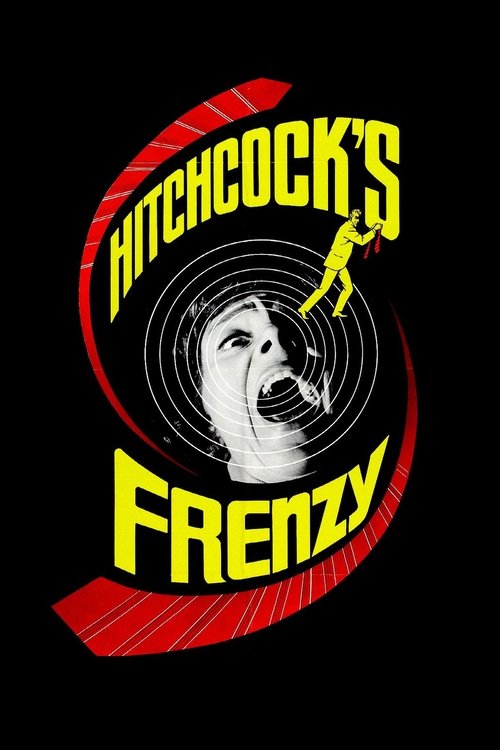
Frenzy
1972 · Alfred Hitchcock
For when you want a classic thriller with real bite rather than a cozy one — something elegant and mean at the same time. Fair warning: this is the roughest thing Hitchcock ever made, not a rainy-Sunday comfort watch.
What it's about
London is being terrorized by a strangler the press calls the Necktie Murderer. Richard Blaney — broke, bitter, freshly fired — has the bad luck to be connected to the victims, and when his ex-wife is killed the police decide he's their man. He goes on the run through pubs, markets, and cheap hotels, trying to prove his innocence while the real killer moves freely through the same streets.
The experience
Nasty, blackly funny, and deliberately uncomfortable — Hitchcock with the gloves off, alternating genuine dread with gallows comedy that makes you laugh and feel bad about it. The suspense comes from knowing more than the characters do, which is its own kind of torture.
Performances
Alec McCowen's dry, food-tormented inspector — enduring his wife's experimental gourmet dinners while puzzling out the case — gives the film its slyest running joke.
The craft
The set pieces are legendary craft: a camera that pointedly retreats down a staircase and out into the street rather than watch what happens upstairs, and an extended black-comic struggle with a corpse in a potato truck. Shot on location in and around Covent Garden, it has a grubby, tactile London texture unlike anything in his Hollywood work.
Why it matters
Made in his early seventies, it restored critical faith in Hitchcock after a fallow stretch and stands as the last full demonstration of his powers — proof the old master could out-shock the new generation.
Snapshot
Hitchcock's penultimate feature is his most graphically violent film and, by wide critical consensus, his most sustained creative achievement of his final decade. Returning to London after nearly thirty years based in Hollywood, he made a serial-killer thriller that dispenses with the decorum his earlier work had carefully maintained — showing a rape-murder at length, staging black comedy around a corpse in a potato sack — while retaining the formal intelligence and structural irony that define his best work. The film's coarse surface and classical architecture exist in deliberate tension, producing something neither purely exploitative nor safely respectable. It restored critical confidence in Hitchcock after a late-career slump and remains a troubling, technically formidable piece of cinema.
Industry & production
By the late 1960s, Hitchcock's commercial and critical standing had eroded. Torn Curtain (1966) and Topaz (1969) were received as laborious and impersonal; the director, then in his late sixties, was increasingly described as a relic of an earlier filmmaking culture. The collapse of the Production Code and the MPAA's adoption of the ratings system in 1968 had transformed the commercial landscape, and explicit violence and sexuality, long withheld from mainstream Hollywood product, were now permissible and commercially viable.
Hitchcock optioned Arthur La Bern's 1966 novel Goodbye Piccadilly, Farewell Leicester Square, a grimly realistic London thriller drawing on the atmosphere of England's postwar serial murder cases (most notably the Christie murders of the 1950s), and engaged playwright Anthony Shaffer to adapt it. The choice of Shaffer — whose Sleuth would appear in the same year — signaled an interest in a writer capable of sardonic, theatrically pointed dialogue. Universal Pictures backed the production, Hitchcock's home studio since 1962, and the budget, while not lavish, allowed for location work in London.
Shooting took place primarily in and around Covent Garden market — then still functioning as London's central wholesale fruit and vegetable market, a use it had held for centuries — as well as the Strand, Bow Street, and other central London locations. The market's closure and redevelopment came in 1974, giving the film an inadvertent documentary record of a vanishing urban environment. Hitchcock shot at the actual market stalls, in the pub across from it, and at surrounding streets, anchoring the film in a social texture conspicuously absent from his Hollywood work. Frenzy was produced and released in 1972, receiving an R rating in the United States and an X certificate in Britain.
Technology
Cinematographer Gilbert Taylor, who had worked extensively in British television and film before his association with Hitchcock, shot the film in Technicolor. Taylor's approach — influenced by the naturalistic lighting practices of British social realism — suited Hitchcock's desire for a gritty, unvarnished visual register very different from the controlled studio gloss of Rear Window or Vertigo. The Covent Garden sequences in particular capture available-light conditions with the texture of a documentary, an effect Hitchcock deployed strategically to ground the horror in an entirely mundane world.
The film was among the first of Hitchcock's productions to take serious advantage of post-Code latitude — nudity and graphic violence are presented without the intercutting evasions that had shaped his earlier approach to intimacy and killing. The technical means were conventional for 1972 British production, but the deployment was not: Hitchcock insisted on a handheld freedom in certain sequences that was at odds with his reputation for rigorously pre-planned, storyboarded shooting.
Technique
Cinematography
Taylor's work alternates between two registers almost programmatically. Wide exterior shots of Covent Garden — the crowds, the barrows, the permanent low-level bustle of a working market — establish a world of dense social reality in which private violence is invisible. The interiors shift register entirely: Rusk's flat is close, dim, slightly squalid. Taylor frames the rape and murder of Brenda Blaney in a static, unflinching medium shot that refuses the viewer the escape of cutting, while the subsequent treatment of Babs Milligan's death deploys one of Hitchcock's most discussed single shots.
That shot — the camera following Rusk and Babs up the stairs of his building, pausing at the door to his flat, then slowly retreating back down the staircase and out through the street entrance into the noise and indifference of the market — is a formal statement about visibility, knowledge, and complicity. The audience has already seen what happens behind that door; the camera's withdrawal does not spare us but simply relocates our horror. The street carries on. The contrast between the explicit (Brenda's death) and the elided (Babs's) is not mercy but formal intelligence: Hitchcock had made his point once and saw no need to repeat it.
Editing
Editor John Jympson cut the film with a rhythm that sustains dramatic irony across the full length of the narrative. Because the audience identifies Rusk as the killer early — we watch him commit the first murder — the intercut sequences of Blaney being hunted and arrested generate suspense of a purely Hitchcockian kind: we know what the police do not. Jympson's cutting in the potato truck sequence — perhaps the film's most darkly comic passage — extends the time Rusk spends contorting among the sacks to retrieve his monogrammed tie pin from a rigid corpse with a broken hand, the editing calibrated to produce something between horror and farce.
Mise-en-scène / staging
The staging throughout reflects Hitchcock's adaptation to a looser, more socially embedded filmmaking style while preserving his instinct for the precisely choreographed moment. The Covent Garden pub where Blaney and Babs spend their final evening together is staged with an anthropological accuracy — the sticky tables, the particular social geography of a London pub — that functions as an alibi for the thriller mechanics operating within it. Hitchcock places Rusk almost constantly in plain sight, visible to other characters who have no reason to see what the audience sees. The dinner scenes at Inspector Oxford's flat, where the Inspector endures his wife's adventurous and indigestible cooking, are staged as a sustained running gag that Hitchcock uses to frame police procedural information without deadening it.
Sound
Ron Goodwin's score moves between a main theme of period-appropriate jaunty Britishness — evoking both tourism board imagery and its ironic subversion — and darker, more angular textures for the murder sequences. The score's tonal range is deliberately wide, reinforcing the film's tonal instability. Hitchcock, as throughout his career, attended carefully to the relationship between diegetic and non-diegetic sound: the market's ambient noise (shouts, lorry engines, the particular percussion of a fruit market at work) functions as a counterpoint to the film's violence, the sound of ordinary life proceeding regardless.
Performance
Jon Finch's Blaney is deliberately difficult to like — resentful, self-pitying, quick to anger — which is a considered choice rather than miscasting. Hitchcock had made charming wrong-men before (Cary Grant in North by Northwest, Henry Fonda in The Wrong Man); Blaney's abrasiveness makes the wrongful-accusation plot both more socially realistic and more morally unsettling. Barry Foster's Rusk, by contrast, is warm, gregarious, visibly likeable — a portrait of predatory normalcy that the film's social setting makes possible. The contrast carries the film's most explicit argument: the man who looks guilty isn't; the man everyone trusts is. Alec McCowen's Oxford provides much of the film's humor, playing a decent, methodical detective hemmed in by circumstantial evidence and his wife's cooking.
Narrative & dramatic mode
Frenzy works within the wrong-man structure Hitchcock had exploited across four decades, but with the added dimension of an early disclosure: the audience is told the killer's identity within the film's first half-hour and watches the remainder with this knowledge. This produces a specific form of dramatic irony in which almost every scene involving Blaney's investigation and arrest is shadowed by our awareness of Rusk's guilt and freedom. The film does not withhold information for surprise; it withholds it from characters to generate suspense. The procedural strand — Oxford's patient, methodical reconstruction — runs in parallel and converges with the thriller strand in a final scene of compressed dark comedy.
The rape-murder of Brenda is the scene around which the film's moral reputation has most fully gathered. Shot at length and without the intercutting evasions that Hitchcock had previously used to suggest rather than depict, it is genuinely distressing in a way that is difficult to argue is purely exploitative: the camera remains on Brenda's face, and the scene's horror is as much her specific humanity as its violence. That the film follows this with the potato-truck comedy is characteristic of Hitchcock's tonal recklessness throughout.
Genre & cycle
Frenzy belongs to the serial killer thriller, a mode that would become a dominant cycle of American and British cinema through the following decades. It sits contemporaneously with the early 1970s wave of graphic crime films — Dirty Harry (1971), The French Connection (1971) — while drawing more specifically on a British tradition of the criminal procedural with roots in true-crime journalism and the public fascination with cases such as Christie and Haigh. The film predates the American slasher cycle by several years, and its influence on that cycle — particularly its staging of female victimhood, its killer-identified camera movements, its black humor — has been noted repeatedly. It is also legible as a late entry in the British social realist tradition, or at least in deliberate dialogue with it: the Covent Garden setting and the pub culture depicted borrow the visual register of that tradition while turning it to generic ends.
Authorship & method
Anthony Shaffer's contribution to Frenzy is more substantial than a merely functional adaptation. His sense of the grotesque, his ear for class-inflected British dialogue, and his interest in the theatrical mechanics of revelation and concealment (evident in Sleuth and The Wicker Man) shaped the screenplay's structure and its tonal range. The film is in productive tension between Shaffer's sardonic literary sensibility and Hitchcock's visual grammar.
Gilbert Taylor, working with Hitchcock for the first time, navigated the director's pre-planned storyboard method while introducing a naturalistic flexibility suited to location shooting. Taylor's later career — he shot Star Wars (1977) among many other major productions — demonstrates the range of his technical competence; on Frenzy he was asked to subordinate flash to authenticity while preserving the precision of Hitchcock's set-pieces.
Hitchcock's own method at this stage was partly liberated and partly constrained by his age and health. He had always maintained that the actual shooting of a film was the least interesting part of the process; by 1972 this was more pronounced, and some accounts note that he delegated more to collaborators than had been his habit. The film nevertheless bears his preoccupations at every level.
Movement / national cinema
Frenzy is Hitchcock's return to British cinema after an absence of approximately twenty-two years (his last British production had been Stage Fright in 1950). The return is marked: the film is steeped in a London that his Hollywood work had no occasion to represent, and his engagement with the city is not nostalgic but observational. The Covent Garden of 1972 — working-class, commercial, crowded, existing in the shadow of redevelopment — is a very different London from the theatrical and genteel cityscape of his 1930s films. The film participates in, and complicates, the British thriller tradition while maintaining Hitchcock's trans-Atlantic position as a filmmaker whose identity exceeds any single national cinema.
Era / period
The early 1970s context is essential to understanding the film's formal choices. The Production Code's abolition had made possible — and commercially incentivized — the explicit depiction of sex and violence that Frenzy delivers. The film is partly a response to this landscape: Hitchcock demonstrating that he could operate within the new dispensation without abandoning the structural intelligence that had always distinguished his work. The period also saw a wider cultural preoccupation with serial violence in Britain and America, fed by high-profile cases and the emergence of criminal psychology as a public discourse. Frenzy's Rusk is a figure of his moment: not a Gothic monster but a socially integrated predator, comprehensible within the emerging vocabulary of the serial killer as social type.
Themes
The film's thematic concerns are characteristic Hitchcock but radicalized by the post-Code context. The wrong man — a figure simultaneously guilty (of something, in spirit) and innocent (of this charge) — is present in Blaney, whose genuine resentment and volatility make him a plausible suspect without making him a killer. The relationship between surface respectability and private violence is the film's most insistent argument: Rusk is popular, socially functional, apparently generous, and the film's London does not distinguish him from the harmless. The visibility of violence, and the way a society distributes knowledge and suspicion, preoccupies the procedural strand: Oxford is a good detective working correctly from wrong evidence.
The film's treatment of women has generated extended and unresolved critical discussion. That it depicts violence against women graphically, and that it does so from within the conventions of a genre in which female victimhood is structural, is not in dispute. Whether it interrogates or reproduces these conventions — whether Brenda's individualized portrayal within the rape scene constitutes a form of witness or simply a more disturbing form of spectacle — remains a genuine critical question to which the film offers no easy answer.
Reception, canon & influence
Frenzy was well received on its initial release, with critics noting it as a return to form after the perceived failures of Torn Curtain and Topaz. Roger Ebert praised it as a vigorous and technically assured work; British critics were more divided, some finding the violence excessive and others welcoming its refusal of Hitchcock's more mannered late style. It was commercially successful in both the United States and Britain.
The film's backward influences include Hitchcock's own 1930s British thrillers — The Lodger (1927) looms behind it structurally, with its portrait of a boarding-house community organized around suspicion of a plausible monster — as well as the wrong-man cycle he had sustained across his American career. The decision to base the story in a realistic, contemporary London draws on the British social realist cinema of the 1960s (the kitchen sink cycle, the Woodfall productions) while refusing its political commitments.
Its forward influence has been extensive if often unacknowledged. The slasher cycle that emerged with Halloween (1978) and Friday the 13th (1980) owes structural debts to Frenzy's combination of disclosed killer identity, extended victim suffering, and procedural investigation; the film's specific staging choices — the killer-aligned camera movements, the domestic settings of violence, the dark comedy counterpoint — became genre conventions. The serial killer procedural, from Manhunter (1986) through The Silence of the Lambs (1991) and into television, recapitulates the duality of Frenzy's double narrative strand — the hunted innocent and the investigating detective — in dozens of variations.
In the Hitchcock canon, Frenzy is typically positioned as a late masterwork: compromised in ways that reward rather than merely excuse critical attention, unresolved in its moral posture toward its own violence, and formally assured in a way that distinguishes it from work that is merely transgressive. It is one of his last films and arguably the last in which his central preoccupations are fully and fiercely engaged.
A Deleuzian reading
The camera does something close to unforgivable.
The full Deleuzian reading of Frenzy →
Reception
Hailed in 1972 as Hitchcock's 'return to form' after the back-to-back stumbles of Torn Curtain and Topaz, it premiered at Cannes to raves. Today the reception is thornier — still often called his last great film, but its brutality gets a much harder look than it did then.
How Frenzy was received, from release to now →
Influences: the films it descends from and the films it influenced
- The Lodger: A Story of the London Fog (1927) — Hitchcock's originating London serial-killer wrong-man template—the innocent suspect hunted by a crowd while the real killer circulates freely in the city—establishes the ironic narrative architecture Frenzy consciously reprises forty-five years later, now with post-Code latitude to show what the silent film could only imply.
- M (1931) — Lang invented the serial-killer dramatic-irony structure—audience identifies the killer's face before the authorities do, then watches cross-cut scenes of wrong-man pursuit alongside the killer's free movement—the exact editorial architecture John Jympson replicates in Frenzy.
- The Trouble with Harry (1955) — Hitchcock's only sustained experiment in horror-farce tonal calibration—treating a corpse as a recurring comic inconvenience requiring repeated concealment—directly rehearses the register of Frenzy's potato-truck sequence, where the difficulty of managing Babs's rigid body produces the same tonal mixture of physical revulsion and dark comedy.
- Peeping Tom (1960) — Powell's British film established the predatory-normalcy performance register (Carl Boehm's seamless social surface concealing compulsive killing) and the formal position of viewer complicity—camera as murder weapon—that conditions Hitchcock's staging of Rusk's bonhomie and the withdrawal shot's deliberate implication of the audience in Babs's death.
- Psycho (1960) — Hitchcock's earlier film establishes early killer-disclosure as a structural device—we witness the murder, then watch the investigation pursue the wrong lead—providing the dramatic-irony engine Frenzy runs more explicitly and at greater duration, sustaining audience-ahead-of-police irony across the full investigation arc.
- Repulsion (1965) — Polanski demonstrated that graphic sexual violence could be staged in static, unflinching medium shot within a British social-realist visual register without intercutting evasions—the formal and geographic precedent for Hitchcock's static-take treatment of Brenda's rape-murder in Rusk's flat.
- 10 Rillington Place (1971) — Drawn from the same postwar British serial murder cases that inform La Bern's source novel, Fleischer's docudrama establishes both the predatory-normalcy performance template (Attenborough's Christie as neighborly killer) and the naturalistic working-class London location-shooting register that Gilbert Taylor directly inherits in Frenzy one year later.
- Halloween (1978) — Carpenter directly inherits Frenzy's early-killer-disclosure irony structure: Myers is identified for the audience in the opening sequence, converting all subsequent suspense from whodunit mystery into the dramatic irony of the audience knowing while characters do not—Hitchcock's engine running at slasher scale.
- Dressed to Kill (1980) — De Palma replicates Frenzy's specific formal combination—explicit sexual violence in static unflinching take, early victim death, killer's seamless social integration in plain sight, wrong-man framing of an innocent male under investigation—most precisely in the museum stalking sequence and the elevator murder's held, uncut duration.
- Henry: Portrait of a Serial Killer (1986) — McNaughton radicalizes Frenzy's static-unflinching-take approach, stripping away Hitchcock's ironic score and classical editing architecture to produce a raw documentary register—but the foundational formal decision to hold the camera on the act without cutaway escape is the technique Hitchcock established with Brenda's murder.
- Manhunter (1986) — Mann extends Frenzy's predatory-normalcy staging—Dollarhyde as socially functional, even empathetic, actor—and runs Hitchcock's dramatic-irony structure at procedural length, with the FBI's investigative knowledge permanently lagging behind what the audience is shown of the killer's interior life.
- The Silence of the Lambs (1991) — Demme formalizes Frenzy's audience-complicity strategy through direct-address camera: Lecter's unbroken eye contact positions the viewer as interlocutor and potential prey, extending the complicit-viewer position Hitchcock established with the withdrawal shot that watches Babs cross the threshold into Rusk's flat.
- American Psycho (2000) — Harron inherits Frenzy's predatory-normalcy performance register (the killer as socially exemplary figure) and its ironic-score strategy—pop music counterpointing murder to produce horror-farce tonal calibration—applying Hitchcock's black-comedy architecture to a satirical register Frenzy itself approached in the potato-truck sequence.
- Zodiac (2007) — Fincher runs Frenzy's dramatic-irony engine at procedural length: partial killer disclosure gives the audience epistemological advantage over the investigators, and the film's sustained irony—we know more, or differently, than the police—derives from the early-killer-disclosure editing structure Hitchcock and Jympson developed.
- Mother (2009) — Class position determining legal credibility regardless of evidence — the respectable man believed over the disreputable one — supplies the social logic Mother applies to rural Korean hierarchy, where cognitive disability and poverty make a man structurally unbelievable to the state.
- Blow-Up (1966) — Antonioni uses a specific, recognizable London location as both social document and crime scene, with the community's obliviousness to hidden violence as formal subject—the same Covent Garden strategy Hitchcock deploys, where the market's quotidian bustle carries on indifferently around murder visible only to the audience.
- Klute (1971) — Pakula discloses the killer's identity in the opening sequence and runs suspense entirely through the audience's knowledge gap—the same irony engine as Frenzy—while deploying diegetic sound recordings (the killer's taped voice) as the central dramatic-irony instrument, a structural parallel to Hitchcock's diegetic-ambient counterpoint.
- Sleuth (1972) — Scripted the same year by Anthony Shaffer, it showcases his signature misdirection plotting and relish for the wrong-man trap — the same authorial hand and love of the literate snare as Sleuth.
- High Anxiety (1977) — Late-Hitchcock sibling source for the explicit-violence-as-suspense register and the bravura retreating-camera move that Brooks's roving Hitchcockian dolly-through-glass gags echo.
Similar films
- Blow-Up (1966) — influence & lineage
- Peeping Tom (1960) — influence & lineage
- Psycho (1960) — influence & lineage
- The 39 Steps (1935) — shared sensibility
- Rear Window (1954) — shared sensibility
- Marnie (1964) — shared sensibility
- Rope (1948) — shared sensibility
- Chinatown (1974) — shared sensibility