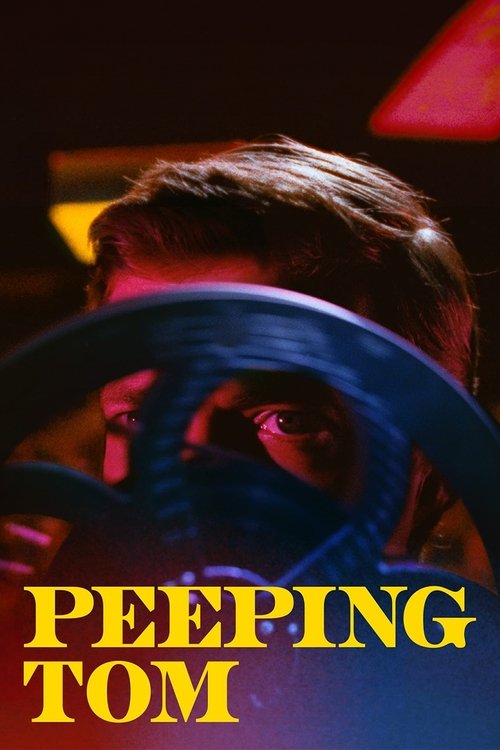
Peeping Tom
1960 · Michael Powell
For when you want a horror film that unsettles rather than startles — one you'll be arguing about afterwards. Firmly a challenge, not a comfort watch, and not the pick for a squeamish night.
What it's about
A shy young cameraman at a London film studio moonlights taking racy photos above a newsagent — and, in secret, is making a film of his own: he murders women while recording the terror on their faces. When Helen, the warm, curious daughter of the family downstairs, befriends him, his sealed-off life begins to crack open. It's a serial-killer story told from inside the killer's head, set in a city of boarding houses and back rooms.
The experience
Queasy and intimate — you keep seeing through his viewfinder, and the film keeps making you complicit in the looking. The dread coils slowly instead of jumping out; sympathy and revulsion sit in your stomach at the same time.
Performances
Carl Boehm plays Mark with a soft voice and wounded politeness that makes him more disturbing, not less, while Anna Massey's open, unguarded Helen keeps the film painfully human.
The craft
Michael Powell stages murder as filmmaking itself — viewfinder shots, the whirr of a projector, a camera that doubles as the weapon — in lurid, feverish Eastmancolor that makes London glow like a wound. Restored, it's stunning on a big screen, all reds and shadow.
Why it matters
British critics were so revolted on release that the film effectively ended Powell's mainstream career; decades later it was rehabilitated as a founding text of psychological horror and a touchstone for every movie about why we watch. Its 1960 arrival, weeks before the year's other great shocker, now looks like a turning point for the whole genre.
Snapshot
Peeping Tom is a British psychological horror film in which the serial killer is also the audience surrogate — a young man named Mark Lewis who murders women with a blade concealed in his camera tripod while filming their dying terror. Released in April 1960, it arrived in British cinemas a matter of weeks before Alfred Hitchcock's Psycho and shared with that film a diagnostic interest in the psychopathology of the voyeur. Where Psycho displaced its horror onto genre machinery and Norman Bates's camp theatricality, Peeping Tom refused all such distance: it implicated the cinema itself, the camera as weapon, and the audience's own appetite for looking. British critics responded with revulsion and outright denunciation, effectively ending Michael Powell's mainstream career. Over the following two decades the film was largely suppressed, before a slow rehabilitation — accelerated by Martin Scorsese's passionate advocacy — installed it as one of the most theoretically charged films in the English-language canon.
Industry & production
By 1960 Powell was operating without his creative partner Emeric Pressburger. The Archers partnership that had produced A Matter of Life and Death (1946), Black Narcissus (1947), and The Red Shoes (1948) had formally dissolved in 1957, and Powell was navigating an independent path through a British film industry undergoing structural contraction. He produced Peeping Tom through his own company, Michael Powell (Theater) Ltd, with distribution handled by Anglo-Amalgamated — a company associated primarily with the Carry On series and other commercially modest British product. The pairing was an uneasy fit: Anglo-Amalgamated had no framework for what Powell delivered. After the film's catastrophic press reception, the distributor moved rapidly to pull it from wide release and limit its circulation. The project had been brought to Powell by screenwriter Leo Marks, the wartime cryptographer and SOE code-maker who pitched the idea as a psychological study of a man conditioned into compulsive filming by an abusive scientist father. Marks's script was unconventional — dense with Freudian implication and structured around the logic of spectatorship rather than conventional thriller plotting. Powell, reportedly attracted immediately to the material's self-reflexive audacity, proceeded with minimal studio support. The film was shot at Pinewood Studios and on location in London, including streets around Soho, at a modest budget; precise production cost figures do not appear in standard published accounts, and the record on this is thin.
Technology
The film was photographed in Eastmancolor, a process that Rank and British producers had been adopting through the mid-to-late 1950s as Technicolor's three-strip dye-transfer process became commercially prohibitive. Eastmancolor offered a single-strip negative with a wider latitude but somewhat less saturated palette than three-strip Technicolor. In the context of British horror — still largely associated with the more lurid Hammer palette — Powell and cinematographer Otto Heller made deliberate use of color's capacity for everyday warmth, giving the film's domestic interiors a misleading normality that registers ironically against its content. The camera-within-the-camera at the center of the narrative is a 16mm Bolex-type handheld, fitted with a concealed spike in the tripod leg and, crucially, a convex mirror mounted alongside the lens so that victims see their own distorted, terrified faces as they die. This diegetic camera required the production to design and construct a practical prop that could be convincingly operated by Carl Boehm while maintaining the illusion of functional filmmaking equipment. The optical distortion of the mirror's image — showing the victim to herself — is rendered with straightforward in-camera means rather than optical printing. The POV shots from Mark's camera are distinguishable from conventional POV by their slightly different lens characteristics and framing, a device Powell and Heller used selectively to sustain ambiguity about when we are seeing through Mark's eyes and when we are occupying a position only provisionally distinct from his.
Technique
Cinematography
Otto Heller, a Czech-born cinematographer who had worked extensively in British cinema since the 1940s, lit Peeping Tom with a compositional intelligence that resists both the expressionist chiaroscuro of classical horror and the flat naturalism of British social realism. His frames are frequently beautiful in ways that feel vaguely inappropriate: the boarding house is airy and populated by warm color; London locations retain their quotidian texture. The effect is that horror arrives without the conventional telegraphing of darkness. Heller and Powell make pointed use of depth of field, placing Mark and his victims in shared planes that emphasize his control of their space. The handheld sequences representing Mark's own footage are rougher, slightly shaky, integrating into the film's style a palpable difference in register that codes his filmmaking as compulsive and documentary rather than aesthetic.
Editing
The editing by Noreen Ackland maintains an unusually long-form rhythm by genre standards. Peeping Tom does not cut quickly for shock; instead, scenes develop in something closer to real time, which means that dread accumulates through duration rather than montage jolts. The sequences in which Mark reviews his own footage — watching his kills on a small home-cinema screen — are structured so that the audience watches him watching, a mise en abyme of spectatorship that the editing underlines by holding on his face as much as on the screen within the screen.
Mise-en-scène / staging
Powell's staging consistently makes space, framing, and sight lines active dramatic elements. Mark's attic flat, where he both lives and projects his footage, is an architectural expression of his interior life: a darkroom that doubles as a cinema. Helen's access to this space — and his gradual revelation of his films to her — is staged as a cautious opening, which makes the spatial dynamic between them unusually tender for what is nominally a horror film. The camera is never neutral furniture; Powell frames it as an extension of Mark's body and psychology, so that shots in which the camera appears are compositionally weighted in ways that equate looking with control.
Sound
Brian Easdale's score — Easdale had composed the Oscar-winning music for The Red Shoes — is restrained by horror conventions of the period. It underscores rather than overwhelms, and the film's most unsettling sonic effects are diegetic: the whirr of film through a camera gate, the sound of Mark's own recordings played back. The decision to make filmmaking sounds prominent in the mix gives the film an almost clinical texture, as though the audience is attending a demonstration rather than watching a thriller.
Performance
Carl Boehm (the Austrian actor, billed as Karlheinz Böhm) brings to Mark Lewis a quality of gentle, socially anxious politeness that refuses to render him simply monstrous. His affect is that of someone perpetually translating between an inner world of compulsion and the social surface he must perform — the performance makes this laborious passage visible without rendering it grotesque. Anna Massey as Helen is warm and emotionally direct, and the scenes between them carry a genuine, if doomed, romantic register. Moira Shearer, in a brief role as a film extra killed early, brings a recognizable persona (she was famous from The Red Shoes) into the film's logic of looking and destruction, a casting choice that has been read as deliberately self-referential. Powell himself appears in the home-movie sequences as Mark's father — a documentary-inflected casting that fuses the film's autobiographical dimension to its diegesis, implicating the director in the father's abuse of vision.
Narrative & dramatic mode
The film is structured as a case study before that term becomes clinical — it operates with the architecture of a psychological portrait, allowing us close proximity to Mark's perspective without endorsing it. The narrative employs classical dramatic irony throughout: we know what Mark does, and the dramatic tension resides not in mystery but in the question of when and whether Helen will comprehend the full horror of what she has encountered. The ending, in which Mark turns his apparatus on himself, closes the self-reflexive circuit with a literalism that is more philosophical than melodramatic — he becomes both director and subject of his final film, watched by Helen and, through her, by us.
Genre & cycle
Peeping Tom arrives at a pivotal moment in the history of British and international horror. Hammer Film Productions had since 1957 been producing lavish Gothic horror in full color — Curse of Frankenstein (1957), Dracula (1958) — reestablishing British horror as a viable commercial genre with international reach. Peeping Tom participates in this color-horror moment while refusing Hammer's period-Gothic framework entirely; its horror is metropolitan, contemporary, and rooted in psychology rather than the supernatural. In this it anticipates what would become — after Psycho's enormous commercial success — the dominant mode of Anglo-American horror in the 1960s: the serial killer as damaged ordinary person, horror as symptomatic expression of domestic and familial dysfunction. The film also inaugurates, or at least crystallizes, a set of conventions later identified with the slasher genre: the killer-POV shot, the camera as instrument of violence, the victim's experience of being watched before being killed. Whether Peeping Tom constitutes a causal origin of these conventions or a parallel discovery of them is a question the scholarship has not definitively settled.
Authorship & method
Powell's career had been defined by his two-decade collaboration with Pressburger, a partnership so integral that attributing specific elements to one partner over the other is frequently impossible and arguably misconceived. Peeping Tom represents Powell working alone with a script not of his devising — his first major solo directorial credit under these conditions. The film reveals continuities with the Archers work, particularly the willingness to treat color and composition as expressive registers rather than neutral vehicles, and the interest in artists and obsessives as protagonists (A Canterbury Tale, The Red Shoes). Leo Marks as screenwriter brings a structural sophistication rooted in his cryptographic background — the film's narrative logic has something of the code-problem about it, elements concealed whose revelation changes the meaning of what preceded. Otto Heller's partnership with Powell was close and productive; how much of the film's cinematographic strategy originated with Heller versus being directed by Powell in detail is not clearly documented. Brian Easdale's relatively spare score represents a different relationship than the maximalist orchestration of The Red Shoes; he appears to have understood that the film's subject required a lighter authorial hand in the music.
Movement / national cinema
The film sits awkwardly within British cinema of its moment. The British New Wave — the kitchen-sink realism of Room at the Top (1959), Saturday Night and Sunday Morning (1960), A Taste of Honey (1961) — was reorienting British production toward working-class northern settings, documentary texture, and social critique. Peeping Tom shares the New Wave's London-as-location authenticity and its interest in damaged masculinity, but its concerns are altogether different: reflexive, Freudian, formally ambitious in a European art-cinema register rather than a documentary one. Powell had always been an anomalous figure in British cinema — too visually extravagant, too interested in interiority and myth, too collaborative with émigré talent (Pressburger, Heller, Easdale) to slot easily into national categories. Peeping Tom extends that anomalousness into territory that British critical culture of 1960 was simply unprepared to assimilate.
Era / period
1960 represents a hinge year: the old studio hierarchies in both Britain and America were visibly weakening; censorship codes were under pressure on both sides of the Atlantic; and the moral consensus that had governed representations of violence and sexuality in mainstream cinema was fracturing. Peeping Tom arrived before the culture had fully processed these shifts and was received within a framework of moral standards it was already in the process of dissolving. The film's institutional timing was poor in a way that its later vindication makes legible in retrospect.
Themes
The film's central preoccupation is the violence latent in the act of looking — the relationship between spectatorship, control, and desire that it frames as both pathological and, uncomfortably, structural to cinema itself. Mark's condition was manufactured by his father's compulsive filming of his childhood, a traumatic origin that explicitly links the damage done to the child with the medium that caused it. The film thus implicates not just Mark but the technology — cinema — and extends the implication to the audience as participants in a system of voyeuristic pleasure. This argument was largely invisible to contemporary British critics; it became central to the film's academic reputation after Laura Mulvey's 1975 essay "Visual Pleasure and Narrative Cinema" theorized the male gaze in Hollywood cinema, providing a vocabulary that made Peeping Tom newly legible as a systematic interrogation of its own apparatus. The film also examines fear as spectacle: Mark's father was a scientist who studied fear by staging and filming its onset in the child; Mark continues this project in his killings. Fear becomes both content and product, and the film asks what relationship the audience bears to that production.
Reception, canon & influence
The British critical response to Peeping Tom's release in April 1960 was among the most savage in postwar British film history. Critics competed in their expressions of disgust; several described the film as squalid, depraved, or obscene. C.A. Lejeune of The Observer, one of the most influential British film critics of the era, reviewed it with intense hostility — she retired from criticism shortly afterward, and the connection to Peeping Tom is often cited, though whether the film was determinative in her decision is not fully documented. The reviews had an immediate commercial effect: the film was pulled from wide release by Anglo-Amalgamated, and Powell found himself effectively blacklisted from major British productions. He relocated eventually to Australia, where he made a small number of films before the period of his rehabilitation began. The critical reassessment came slowly and from unexpected quarters. Martin Scorsese, who had encountered the film as a young filmmaker, became its most prominent advocate; he was instrumental in securing a restored rerelease in the United States in the late 1970s and early 1980s and spoke and wrote publicly about its importance. This advocacy brought it to the attention of a generation of American filmmakers and critics. By the time of its gradual critical reconsideration in Britain, the film's status had already been secured internationally. It is now routinely listed among the essential films of British cinema, a canonical text in film studies courses dealing with spectatorship, the gaze, and horror, and a touchstone for virtually any serious discussion of the camera as an instrument of power and desire. Its legacy runs in multiple directions: the slasher genre's formal vocabulary of killer-POV and the weaponization of looking; the academic discourse around cinematic spectatorship initiated (if not caused) by its posthumous encounter with 1970s feminist film theory; and the tradition of self-reflexive horror that would extend through Michael Haneke's Funny Games (1997) and beyond. Films as different as Brian De Palma's Body Double (1984), with its explicit citational relationship to both Peeping Tom and Hitchcock, and the found-footage genre's foundational texts register its influence. The record of direct citations by filmmakers is reasonably well documented; the broader diffusion of its formal ideas into the grammar of horror is harder to trace precisely, but substantial.
A Deleuzian reading
Begin with the small mirror.
The full Deleuzian reading of Peeping Tom →
Reception
Savaged so viciously by British critics in 1960 (one famously suggested flushing it down the nearest sewer) that it effectively ended Michael Powell's British directing career — then rehabilitated in the late '70s, with Martin Scorsese championing its re-release, into acknowledged-masterpiece status.
How Peeping Tom was received, from release to now →
Influences: the films it descends from and the films it influenced
- Rear Window (1954) — Hitchcock's systematic use of optical apparatus (telephoto lens, binoculars) as body-extension and desire, structuring the entire film through a POV architecture that implicates the audience as co-voyeur — the formal grammar Powell inherits and radicalizes by making the apparatus lethal.
- M (1931) — Lang constructs the compulsive killer as audience surrogate via sustained dramatic irony, positioning viewers to know the murderer's identity before all other characters and thus to identify rather than simply condemn — Powell's direct precursor for the implication strategy.
- The Red Shoes (1948) — Powell's own casting of Moira Shearer as a dancer whose artistic compulsion ends in destruction; Peeping Tom reactivates her persona by having her character watch her own earlier performance on film, collapsing performer identity into the film's self-reflexive apparatus.
- Man with a Movie Camera (1929) — Vertov integrates the camera operator's body into the film's own image and makes the editing apparatus visible within the film itself, establishing the reflexive self-consciousness about the act of filming that Powell inherits as a structural — not merely thematic — principle.
- Vertigo (1958) — Hitchcock's cinematographic embodiment of scopophilic obsession — the dolly-zoom physically enacts psychological compulsion, and the protagonist's gaze is structurally implicated in the heroine's destruction — the logic Powell extends to its literal terminus by replacing the gaze with a blade.
- Strangers on a Train (1951) — Powell's killer forces victims to see their own terror reflected in a mirror mounted on his camera at the moment of death — the reflected-murder device Hitchcock established in Miriam's spectacles expanded into a structural principle, making the mediated image of violence the film's explicit subject rather than its most disturbing single technique.
- Dark Passage (1947) — Powell literalizes what Dark Passage's subjective camera leaves implicit: Mark's camera-tripod kills by the act of filming, making the audience's identification with a camera-eye — the formal device Daves deploys — an explicit ethical charge rather than a stylistic conceit.
- The Queen of Spades (1949) — Otto Heller's own continuation — the same restless subjective camera and hard-edged pools of practical light, now attached to a compulsion the film refuses to cut away from, inverting Queen of Spades' elision into unblinking implication.
- Blow-Up (1966) — Antonioni extends Powell's camera-as-evidence-of-crime: the photographer's enlargements that may reveal a murder use the photographic apparatus as the film's epistemological hinge, inheriting Powell's argument that the camera's relationship to violence is never merely documentary.
- The Conversation (1974) — Coppola transposes Powell's visual voyeurism into its aural equivalent; Harry Caul's compulsive replaying of his own surveillance recording to extract hidden meaning replicates Mark Lewis's mise-en-abyme structure — the recording apparatus implicating its operator — transposed into the sonic register.
- Halloween (1978) — Carpenter's opening Steadicam POV — the sustained killer's-eye view that makes the audience occupy the murderer's visual field before the identity reversal — formalizes Powell's killer-POV invention as the defining grammar of the slasher genre.
- Videodrome (1983) — Cronenberg literalizes Powell's metaphor of camera-as-body-extension: the flesh-technology merger where the videocassette slot opens in Max's torso enacts grotesquely what Peeping Tom implies — that the apparatus is not wielded by the body but continuous with it.
- Henry: Portrait of a Serial Killer (1986) — McNaughton's sequence in which Henry and Otis watch a video recording of their own murders directly inherits Powell's spectatorship structure — the killer watching himself killing as a device that forces the film's audience into the same position as the killer-spectator.
- Man Bites Dog (1992) — The film crew's progressive complicity in Benoît's murders extends Powell's argument that filming violence implicates the camera operator; the handheld documentary aesthetic makes the ethical contamination of the apparatus — and by extension the audience — structurally explicit rather than subterranean.
- Strange Days (1995) — The SQUID device recording and playing back first-person sensory experience is a direct technological extrapolation of Powell's diegetic-camera-as-body-extension; the killer who records his crimes for voyeuristic replay literalizes Peeping Tom's logic that the recording apparatus and the violence it captures are formally continuous.
- Caché (2005) — Haneke's anonymous surveillance footage positions Georges — and the film's audience — in the same structural role as Mark Lewis: implicated observers who cannot locate themselves outside the footage they are watching; the diegetic videocassettes function as Peeping Tom's camera apparatus displaced into the thriller form, with guilt distributed to the spectator.
- A Clockwork Orange (1971) — Powell built an entire film on subjective POV cinematography that makes the viewer occupy the killer's perspective so consistently that complicity becomes structurally unavoidable — the direct formal model for Alcott's first-person wide-angle framing of Alex's assaults, which denies the viewer the moral distance of an observing camera.
- Frenzy (1972) — Powell's British film established the predatory-normalcy performance register (Carl Boehm's seamless social surface concealing compulsive killing) and the formal position of viewer complicity—camera as murder weapon—that conditions Hitchcock's staging of Rusk's bonhomie and the withdrawal shot's deliberate implication of the audience in Babs's death.
- Funny Games (2008) — Powell's central conceit — a killer who photographs his victims as they die, fusing camera, audience gaze, and homicidal act into a single apparatus — is the direct craft ancestor of Paul's fourth-wall address; both films use the viewing apparatus itself as the instrument of indictment, making the spectator's act of watching formally equivalent to participation in the violence.
- The Vanishing (1988) — Powell's device of placing the audience inside the killer's perspectival apparatus and forcing the viewer into the position of collaborative witness is the technique Sluizer extends by presenting Raymond's dry runs with objective, non-judgmental cinematography that implicates the spectator through sustained neutral observation.
- Psycho (1960) — Both films inaugurate the proto-slasher's formal problem of placing the killer at the subject-position; where Powell uses sustained long-take duration to hold the audience in the murderer's POV, Hitchcock solves the same problem through rapid-cut montage that fragments consciousness — contrasting editing solutions to identical implication strategies.
- Eyes Without a Face (1960) — Franju's clinical refusal of generic distancing in the observation of surgical violence, released the same year with the same strategy of implicating the viewer through aestheticized horror that caused both films' critical scandals — the detached observational gaze deployed as moral provocation.
- Funny Games (1997) — Implicates the spectator's gaze in the act of filmed murder by fusing camera and weapon; Haneke extends this into accusation, making the audience's continued watching the film's true subject.
- Capote (2005) — Foundational study of predatory authorship: the artist who consumes his subjects through his own medium, the craft-level template for Capote's moral self-implication of the writer.
- Scream (1996) — The urtext of horror-about-spectatorship, indicting the viewer's complicity in watching violence — the intellectual seed of Scream's 'why we watch' thesis and Stu/Billy's movie-fed motive.
- The Criminal Life of Archibaldo de la Cruz (1955) — Independently fuses sexual desire with the mechanics of killing via a fetish apparatus, sharing Archibaldo's conceit of eros consummated only through a death-instrument.
- Él (1953) — Uses subjective-camera identification with a pathological fetishist and the respectable-genre surface to disguise and thereby expose monstrosity, Él's central strategy.
- The Butcher (1970) — Powell ties his killer's compulsion to childhood trauma and forces the viewer into the murderer's watching eye — the same implication-of-the-observer and pathologized, pitiable killer working the sympathetic-killer strand in parallel.
- Cairo Station (1958) — Independently arrives at making a sexual murderer the film's organizing consciousness by routing the audience through his own apparatus of looking, implicating the filmmaker in the act — convergence with Chahine's director-as-killer casting, not influence.
Similar films
- M (1931) — influence & lineage · same viewing thread
- Psycho (1960) — influence & lineage
- Blow-Up (1966) — influence & lineage
- Henry: Portrait of a Serial Killer (1986) — influence & lineage
- Halloween (1978) — influence & lineage
- Manhunter (1986) — same viewing thread
- The Prowler (1951) — same viewing thread
- Kiss Me Deadly (1955) — same viewing thread
All the films related to Peeping Tom →
Watch it with: curated runs of related films
- The Long Shadow of M — A run from Lang's Weimar crime films through their noir and neo-noir children — killers, con men, masterminds, and manhunts — where you can watch expressionist menace mutate step by step into the modern thriller.
Film essays and courses that include it
- From Riot to Trial: A Century of Banned Cinema
- The Unreliable Eye: Cinema's First Person
- Shadow, Psyche, Flesh: The Formal Breakthroughs of Horror Cinema
- The Fractured Mind: Twelve Landmarks of the Psychological Thriller
- Portrait of the Killer: Serial Murder from Lang to Fincher
- Portrait of a Killer: How Cinema Learned to Inhabit the Monster
- Premeditated: Cinema's Century of the Kill
- The Interior Eye: Cinema's Search for Lives Felt From Within
- The Celluloid Mirror: A Century of Metacinema
- The Film That Watches You Back