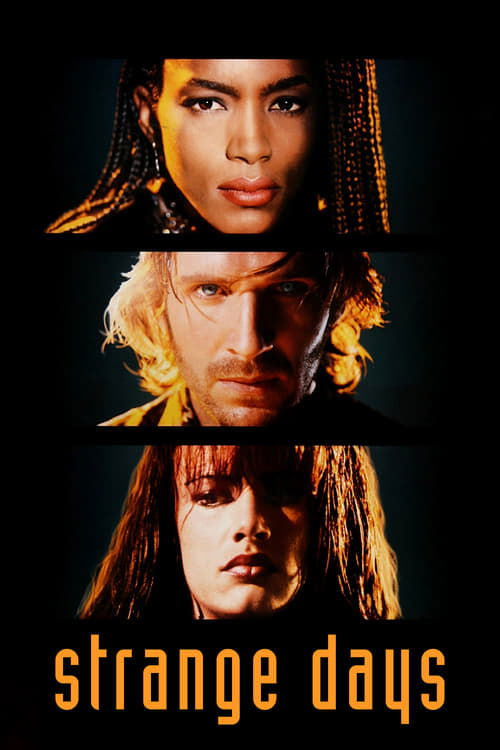
Strange Days
1995 · Kathryn Bigelow
For when you're craving something intense and idea-driven — a dark, propulsive night where the thrills come with a queasy aftertaste worth chewing on. Fair warning: it goes to genuinely upsetting places; this is challenge viewing that pays off.
What it's about
Los Angeles, the last two days of 1999: the city is a powder keg of street riots, police checkpoints, and millennium panic. Lenny Nero, a disgraced ex-cop, deals in the ultimate black-market product — recordings of other people's experiences, taped straight off the brain, replayable in full sensory detail inside your own head. When a disc arrives containing a murder recorded from the killer's point of view, Lenny and his fiercely loyal bodyguard friend Mace are dragged into a conspiracy that reaches into the LAPD, with the clock running out on the century itself.
The experience
Feverish and immersive — the first-person memory sequences put you inside other people's skin in a way that's exhilarating and sometimes genuinely disturbing. It's a headlong, sweaty, sensory-overload thriller that builds to a massive New Year's Eve crescendo.
Performances
Ralph Fiennes plays Lenny as a twitchy, silver-tongued addict of his own merchandise, and Angela Bassett is the film's moral and physical center — ferocious, grounded, and quietly heartbreaking. She walks away with the movie.
The craft
Kathryn Bigelow stages the memory-clip sequences as unbroken first-person plunges — technically audacious camerawork that still feels ahead of its time — and drives the whole film with her signature kinetic energy, from a script conceived and co-written by James Cameron. The dense, riot-lit street scenes and pounding club soundtrack make it a movie for the biggest screen and loudest speakers you can manage.
Why it matters
A commercial flop that became a cult prophecy — its questions about recorded experience, police violence caught on camera, and voyeurism as entertainment have only grown sharper, and it stands as one of Bigelow's boldest films.
Snapshot
Strange Days is Kathryn Bigelow's millennial noir — a science-fiction thriller set in the final forty-eight hours of 1999, when Los Angeles teeters between apocalyptic dread and New Year's revelry. Its premise is a single, potent conceit: a black-market technology called SQUID records human experience directly off the cerebral cortex, so that memories can be replayed, whole and sensory, inside another person's skull. Ralph Fiennes plays Lenny Nero, a disgraced ex-cop who peddles these "clips" like a back-alley pharmacist of stolen sensation, until a disc arrives containing the first-person murder of a young woman and pulls him into a conspiracy that reaches into the LAPD. Conceived and co-written by James Cameron, directed by Bigelow with her characteristic kinesis, the film married a high-concept genre engine to a raw, riot-haunted vision of a city on the edge. It failed commercially and divided critics on release, but it has since become one of the most reappraised American films of the 1990s — a work whose anxieties about surveillance, recorded violence, and the addictive replay of trauma read now as uncannily prescient.
Industry & production
Strange Days was a Lightstorm Entertainment production released by 20th Century Fox, with James Cameron and Steven-Charles Jaffe producing. The project originated with Cameron, who developed the SQUID premise and the millennial setting and wrote the original story; the screenplay is credited to Cameron and Jay Cocks (the critic-turned-screenwriter known for The Age of Innocence and later Gangs of New York). Cameron and Bigelow had been married earlier in the decade and divorced before the film was made, but their professional collaboration continued, with Cameron's commercial clout helping anchor a difficult, expensive picture and Bigelow taking full directorial authorship.
The production was large and logistically demanding for what was, at heart, a hard-edged genre film: an ambitious, effects-driven shoot built around its first-person sequences, plus a climactic New Year's Eve set piece staged with a massive crowd in downtown Los Angeles around the Westin Bonaventure Hotel. The film carried a substantial budget — reported in the low-to-mid forties of millions of dollars — and it became a notorious box-office disappointment, recovering only a fraction of its cost in North American release. The reasons usually cited are a mid-October opening that buried a New Year's-set film months out of season, a long running time, an unfamiliar lead in Fiennes (then known for Schindler's List and Quiz Show rather than action), and marketing that struggled to communicate an idea-dense, tonally abrasive picture. The commercial verdict shadowed its reputation for years; its critical rehabilitation came later and largely independent of its theatrical fortunes.
Technology
The film's diegetic technology is its thematic spine. SQUID — the name borrows from the real "Superconducting Quantum Interference Device," a genuine instrument for measuring minute magnetic fields, here repurposed as fiction — is a wire-rig worn beneath the hair that records the full sensorium of an experience and writes it to a MiniDisc-like "clip." Played back, the clip delivers another person's sight, sound, touch, and adrenaline as if lived first-hand. Originally developed, the film tells us, as law-enforcement surveillance hardware, the technology has leaked into a street economy where Lenny brokers everything from harmless thrills to "blackjack" snuff recordings of real death. The conceit lets Bigelow literalize cinema's own promise — total vicarious experience — and then interrogate its ethics.
As a piece of production technology, the film is remembered above all for how it filmed those POV clips. The playback sequences are shot as unbroken or near-unbroken first-person passages, the camera standing in for a character's eyes, complete with the body's lurches, falls, and panic. The opening — a robbery that goes lethally wrong, experienced entirely through the perpetrator's gaze including a rooftop leap — required custom lightweight camera rigs and specialized operators to achieve a fluid, embodied subjectivity well beyond the conventional shaky handheld of the era. These sequences anticipate, by years, the aesthetics of GoPro footage, virtual reality, and helmet- and body-camera video; the film essentially prototyped a visual grammar that consumer technology would later make ubiquitous.
Technique
Cinematography
Matthew F. Leonetti, a versatile studio cinematographer, shot the bulk of the film, lending the "real-world" Los Angeles a grimy, neon-soaked nocturnal palette appropriate to a near-future noir — wet streets, sodium light, the queasy glow of a city under permanent threat. The decisive cinematographic achievement, however, is the bifurcation of looking. The film maintains two distinct visual registers: the third-person "objective" world Lenny moves through, and the first-person "subjective" clips, which are flagged by their seamless, embodied POV. The contrast is the film's central formal idea — the difference between watching and being inside, between spectatorship and possession. The POV work was executed with purpose-built rigs and choreographed at length so that the camera could move with a body's full weight, sprinting, climbing, falling. The result is some of the most committed first-person cinematography in mainstream American film of its decade.
Editing
Cut by Howard E. Smith (with the scale of the production demanding extensive assembly), the film sustains a long, propulsive build across its near-two-and-a-half hours, intercutting the procedural thriller with the immersive clips. The editing's hardest task is rhythmic juxtaposition: the long, unbroken charge of a POV sequence set against the faster, fragmented coverage of Lenny's waking investigation. The most discussed editorial decision is the handling of the central murder clip, which the film withholds, dispenses, and finally forces its protagonist (and audience) to endure — implicating the act of watching itself. The climax cross-cuts the surging Bonaventure crowd, the conspiracy's exposure, and the ticking countdown to 2000, escalating multiple lines of action toward a single midnight.
Mise-en-scène / staging
Production designer Lilly Kilvert renders a 1999 that is recognizably our world tipped a few degrees toward collapse — not a chrome future but a degraded present of barricaded streets, riot police, burning cars, and apocalyptic street preachers, all wrapped in tinsel for the millennium. The film's costume design (Ellen Mirojnick) makes Lenny a figure of frayed flamboyance, the loud suits of a hustler clinging to a former self. The New Year's Eve climax is staged as genuine spectacle — a vast confetti-choked crowd through which the drama is funneled — counterpointing private violence against mass euphoria. Throughout, mise-en-scène insists on a city of hard divisions: the racially charged geography of policing, the vertical separation of penthouse power from street-level desperation.
Sound
Sound is doubly important here because the SQUID conceit is fundamentally about total sensory immersion, and the soundtrack does the work of selling embodied experience — breath, impact, the rush of motion in the POV passages. Graeme Revell composed the score, but the film leans heavily on source music to build its end-of-the-world atmosphere, with an aggressive mid-'90s soundtrack of alternative and electronic acts; Juliette Lewis's character performs on stage, and PJ Harvey's "Hardly Wait" features among the covered and original songs. The music situates the film firmly in its cultural moment while feeding its mood of decadent foreboding.
Performance
Ralph Fiennes plays against type as Lenny — sweaty, voluble, self-deceiving, a romantic clinging to replayed memories of a lost lover (Faith, played by Juliette Lewis). It is a deliberately unheroic turn, the protagonist as addict and voyeur. The film's moral and physical center is Angela Bassett as Lornette "Mace" Mason — a single mother, security driver, and bodyguard who, crucially, refuses to use playback at all; she lives in reality, and Bassett gives her a grounded force and dignity that anchor the film's ethics and supply its most genuinely heroic action. Tom Sizemore is the slippery friend Max; Michael Wincott, Vincent D'Onofrio, and William Fichtner fill out a gallery of menace, with Glenn Plummer as the murdered, politically charged rap artist Jeriko One. Bassett's performance, in particular, has aged into the film's most celebrated element.
Narrative & dramatic mode
The film operates as a detective story crossed with a paranoid conspiracy thriller, organized around the classic noir engine of a man who receives evidence of a crime and cannot let it go. Its dramatic mode is investigative and accumulative — Lenny chases the meaning of the murder clip while his own romantic obsession destabilizes his judgment. Layered onto the procedural is a ticking clock (the literal countdown to midnight, 2000) and a metafictional layer about spectatorship: the clips make the audience complicit, repeatedly placing us inside acts of violence and asking what it costs to watch. The murder of Jeriko One supplies a political subplot — a police killing of a Black artist and activist whose recorded evidence could ignite the city — that turns the personal mystery into a referendum on systemic violence. The mode is finally tragic-romantic beneath its thriller mechanics: Lenny must learn to stop replaying the past and meet the present, embodied by Mace.
Genre & cycle
Strange Days sits at the convergence of several genres — science fiction, neo-noir, the conspiracy thriller, and the crime film — and belongs recognizably to the 1990s "tech-noir" and pre-millennial cycle. It shares the decade's preoccupation with simulated and mediated reality alongside films like The Lawnmower Man, Johnny Mnemonic, Virtuosity, and, soon after, The Matrix and eXistenZ; its specific obsession with recorded memory and surveillance links it backward to Brainstorm and forward to Minority Report. As pre-millennial cinema it joins a wave of fin-de-siècle anxiety films clustering around the year 2000. Yet it resists the clean futurism of much cyberpunk, keeping its world grounded in the textures of contemporary Los Angeles, which aligns it as much with the post–Rodney King social thriller as with science fiction proper.
Authorship & method
This is unmistakably a Kathryn Bigelow film, and it crystallizes her career-long method: taking genre forms built for visceral spectacle and using them to interrogate violence, the gaze, and the gendered body. From Near Dark (1987) through Blue Steel (1990) and Point Break (1991), Bigelow had developed a cinema of kinetic, physically immersive action wedded to a critical intelligence about who looks and who is looked at; Strange Days makes that interrogation literal by turning the camera into a recording device for stolen experience. Her recurring concern with women who act rather than are acted upon finds its fullest 1990s expression in Mace.
The authorship is genuinely collaborative at the conceptual level: James Cameron supplied the premise, the millennial frame, and (with Jay Cocks) the screenplay, bringing his appetite for high-concept hardware and large-scale set pieces. Bigelow translated that material into something tonally darker, more ambivalent, and more politically charged than Cameron's own filmmaking, foregrounding race, voyeurism, and addiction. Key collaborators include cinematographer Matthew F. Leonetti, composer Graeme Revell, editor Howard E. Smith, and production designer Lilly Kilvert. The film's lasting authorial signature is its fusion of immersive technique with moral discomfort — the refusal to let the thrill of the POV clip go ethically unexamined.
Movement / national cinema
The film is a product of 1990s Hollywood — specifically the high-budget, auteur-inflected genre filmmaking that major studios still financed before the full consolidation of the franchise era. It is not affiliated with a formal movement, but it can be read within American "tech-noir" and within a strand of socially conscious Los Angeles cinema that processed the trauma of the 1992 uprising. Its national-cinema identity is thoroughly American and thoroughly Angeleno: the city is not a backdrop but the film's subject, its fault lines of policing, race, and class supplying the real apocalypse beneath the millennial one.
Era / period
Made in 1995 and set at the close of 1999, the film is doubly a period piece now — a mid-'90s artifact imagining a near future that has since become the past. Its moment is saturated with specific anxieties: the aftermath of the Rodney King beating and the 1992 Los Angeles riots, the early public reckoning with the camcorder as an instrument that could capture police violence, and the broader fin-de-siècle unease (including Y2K) that attached to the year 2000. The film channels all of these. The amateur video of King's beating is the clear real-world antecedent for its plot engine — the idea that a recording of violence could be both evidence and detonator — and the picture is, in a real sense, a direct cinematic response to that early-'90s rupture.
Themes
The film's governing theme is mediated experience and its corruptions: the SQUID clip externalizes the human craving to relive sensation, and the film treats that craving as an addiction with Lenny as its junkie, hooked on replays of a love that is gone. From this flow its other concerns. Voyeurism and complicity — the clips implicate the watcher, asking whether to witness recorded atrocity is to consume it. Surveillance and the recorded image as power — who controls the recording controls the truth, and a single clip can topple or protect the state. Race and police violence — the Jeriko One subplot makes the film an explicit meditation on systemic brutality and the volatility of its documentation. Memory, grief, and the refusal to live in the present, set against Mace's insistence on reality. And millennial dread — the sense of a civilization partying on the lip of its own collapse. Bigelow weaves these into a single argument about looking: that the act of watching is never innocent.
Reception, canon & influence
On release the film met a divided press and an indifferent public. Critics admired its ambition, technique, and Angela Bassett's performance while many found it overlong, lurid, or punishing — the immersive rape-murder clip at its center was, and remains, a flashpoint for debate about whether the film critiques or indulges the violence it stages. Commercially it was a clear failure, recovering only a fraction of its large budget, and that result long defined its public profile.
Its influences run backward to several distinct sources. The Rodney King video and the 1992 riots are its essential real-world template. Brainstorm (1983) is a clear forebear in its recorded-experience premise; the film also draws on the noir tradition of the compromised investigator and on cyberpunk's interest in jacked-in consciousness. Cameron's high-concept science fiction supplies the hardware, while Bigelow's own action cinema supplies the immersive body-camera grammar.
Forward, the film's reputation has steadily risen, and it is now widely regarded as prescient and as one of Bigelow's most important works. Its first-person POV aesthetic anticipated GoPro, body cams, and VR; its central anxiety — that recorded video of police violence is at once damning evidence and social tinder — has only grown more legible in the era of smartphone footage and viral recordings of real killings. Critics returning to the film have credited it with foreseeing a culture of compulsive replay and mediated trauma. Within Bigelow's career it stands as the most fully realized 1990s statement of the themes she would later carry to mainstream and Academy recognition with The Hurt Locker and Zero Dark Thirty, and Mace endures as one of the decade's landmark roles for a Black actress in genre cinema. Once a famous flop, Strange Days now reads as a cult classic and a genuine work of anticipatory vision — a film whose audience, in a sense, arrived two decades after it did.
A Deleuzian reading
You don't watch the opening of *Strange Days*.
The full Deleuzian reading of Strange Days →
Reception
A famous flop in 1995 — costing around $42 million and barely scraping $8 million domestic — it's since been fully reappraised as one of the decade's most prescient films, with its POV-video culture and caught-on-tape police violence looking more current every year.
How Strange Days was received, from release to now →
Influences: the films it descends from and the films it influenced
- Brainstorm (1983) — Established the recorded-sensory-experience premise — POV footage shot to be physically 're-lived' by a wearer through a head rig — the direct conceptual template for the SQUID playback.
- Peeping Tom (1960) — Pioneered the first-person camera as murder weapon that implicates the spectator in the killing, the formal and ethical ancestor of the withheld POV rape-murder clip and its voyeurism-complicity.
- Lady in the Lake (1947) — Sustained an unbroken first-person subjective camera standing in for a character's literal eyeline, the early formal experiment Bigelow's custom POV rigs extend into immersive action.
- Blow Out (1981) — Built a procedural around an investigator obsessively replaying a recorded media fragment to reconstruct a concealed murder — the replay-to-truth structure of Lenny's clip investigation.
- The Conversation (1974) — Modeled the surveillance recording as both damning evidence and moral trap, with the technician made complicit through compulsive replay of captured trauma.
- Blade Runner (1982) — Codified the rain-slick neon future-noir palette and tech-noir mise-en-scène that Leonetti's degraded-millennium Los Angeles inherits.
- Videodrome (1983) — Framed recorded media as an addictive, body-invading signal that rewires perception — the mediated-experience addiction central to clip-jacking.
- Until the End of the World (1991) — Dramatized characters becoming addicted to replaying recorded subjective images of their own experience, a parallel anxiety about mediated-image dependency.
- The Matrix (1999) — Extended the jacked-in-consciousness cyberpunk grammar of neural playback into a mainstream blockbuster, vindicating Strange Days' tech-noir premise.
- eXistenZ (1999) — Carried forward the bio-port jacked-in mediated reality, blurring recorded experience and lived perception through a body-plugged interface.
- The Hurt Locker (2008) — Brought her immersive embodied procedural — multi-camera handheld realism that puts the viewer inside the body under threat — to Academy recognition.
- Enter the Void (2009) — Pushed the sustained first-person subjective camera to its limit, including POV through death, extending the embodied-experience-as-cinema device.
- Hardcore Henry (2015) — Realized a feature-length GoPro first-person action film, the literal fulfillment of the body-cam POV aesthetic Strange Days prefigured two decades early.
- Possessor (2020) — First-person recorded-sensorium technology shot as long subjective POV, treating another person's lived experience as a harvested commodity, prefiguring Possessor's POV instability.
- Blue Steel (1990) — Bigelow's own interrogation of the gendered gaze and the armed woman who acts rather than is acted upon, the authorial precursor to Mace.
- Point Break (1991) — Developed Bigelow's handheld first-person foot-chase grammar — camera bolted to the running body — that hardens into the SQUID body-cam aesthetic.
- Near Dark (1987) — Established her method of repurposing visceral genre spectacle to interrogate violence and the looking body, the throughline that makes Strange Days a critique rather than an indulgence.
- Total Recall (1990) — Strange Days' SQUID technology — first-person sensory memories recorded and sold as a commercial commodity — extends Total Recall's Rekall premise to its logical market endpoint, and Bigelow applies the same POV-anchored editing discipline to destabilize whose lived experience the audience is inhabiting, preserving an identical epistemological instability around recorded versus real consciousness.
- Minority Report (2002) — Near-future noir built on recorded/replayed subjective POV as forensic evidence and voyeuristic technology — kin to Agatha's previsions and the playback-of-vision interface as both plot device and surveillance critique.
- The End of Violence (1997) — Shares the pre-millennial preoccupation with recorded violence as commodity and evidence, implicating the viewer in the consumption of captured atrocity.
- Johnny Mnemonic (1995) — Same-year cyberpunk that treats recorded memory and lived experience as black-market data, shot in the identical neon-noir urban register.
Similar films
- The Matrix (1999) — influence & lineage
- Videodrome (1983) — influence & lineage
- The Hurt Locker (2008) — influence & lineage
- Until the End of the World (1991) — influence & lineage
- Black Bag (2025) — often watched together
- Dark City (1998) — shared sensibility
- Memories of Murder (2003) — shared sensibility
- Oldboy (2003) — shared sensibility