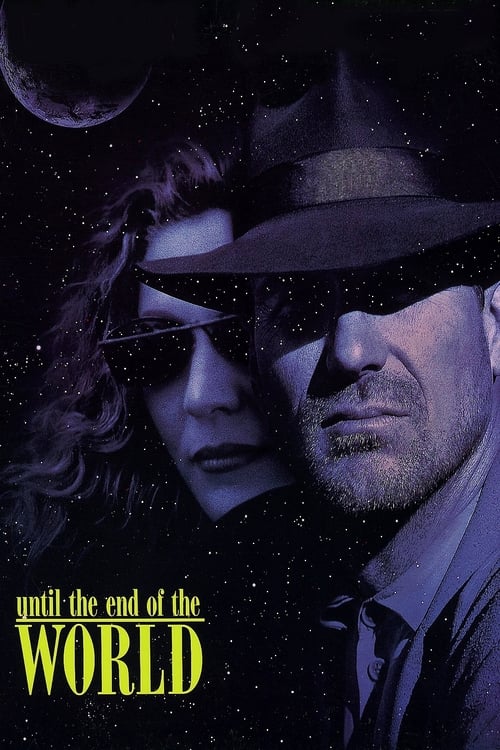
Until the End of the World
1991 · Wim Wenders
For when you want to get lost in something — a long, strange odyssey to sink into over a slow evening, not a tight plot to follow. Best for adventurous viewers in a wandering, contemplative frame of mind.
What it's about
On the eve of the year 2000, with a rogue nuclear satellite threatening to fall from the sky, a restless woman named Claire crosses paths with bank robbers, their money, and a mysterious American fugitive carrying an extraordinary device — a camera that can record what a person sees and give it to the blind. She follows him across continents, from Europe to Asia to the Australian outback, where the invention reveals a stranger and more dangerous possibility: recording dreams themselves.
The experience
Dreamy, sprawling, and hypnotic — half globe-trotting caper, half melancholy meditation on why we can't stop looking at screens. It meanders on purpose, and if you give in to its rhythm it casts a genuine spell.
The craft
Shot across multiple continents over years of preparation, it's a road movie of genuinely global scale, with early-90s visions of video screens and dream imagery that still look uncanny. The soundtrack is legendary — Wenders commissioned new songs from a murderers' row of artists imagining the music of 1999 — and it rewards good speakers as much as any film of its era. The longer director's cut is widely considered the way to see it.
Why it matters
A famously ambitious project released in a truncated form that baffled audiences in 1991, it has been rehabilitated by its restored director's cut and now looks prophetic about image addiction and life lived through devices. Its soundtrack became a cultural object in its own right.
Snapshot
Until the End of the World is Wim Wenders' most ambitious and most compromised film: a globe-spanning science-fiction road movie set on the eve of the year 2000, conceived over more than a decade and shot on multiple continents, only to be released theatrically in a truncated form that satisfied almost no one. Its premise braids two anxieties Wenders would return to across his career — the fear of a world ending and the fear of a world drowning in its own images. A wandering woman, Claire (Solveig Dommartin), chases a mysterious American, Sam Farber (William Hurt), who is carrying a camera that can record human sight and transmit it to the blind. Behind them a rogue nuclear satellite threatens catastrophe; ahead of them lies a laboratory in the Australian outback where seeing becomes an addiction. The film's long-suppressed director's cut — running roughly five hours and restored decades later — is now widely regarded as the version Wenders intended and the one on which any serious assessment must rest. It is a work whose reputation has inverted over thirty years, from expensive folly to prophetic essay on screen dependence.
Industry & production
The production was among the largest and most complicated undertakings in European art cinema of its era, an international co-production drawing German, French, and Australian financing (the roster of companies included Wenders' own Road Movies and Argos Films, among others). Wenders had nurtured the project for years; by his own account the idea originated in the early 1980s, and elements of it circulated through his other work before this film consolidated them. The shoot itself became legendary for its logistics — locations across Europe, Japan, the United States, and Australia, culminating in the Aboriginal lands and desert interiors of the outback. Precise budget and box-office figures should be treated cautiously, but the film was widely reported at the time as one of the most expensive independent European productions yet mounted, and it did not recover that investment on release.
The defining industrial fact of Until the End of the World is the gulf between what Wenders made and what audiences first saw. His assembly ran many hours; contractual and distribution pressures forced a theatrical cut of roughly two and a half hours (commonly cited near 158 minutes). Wenders regarded this version as a mutilation — a plot skeleton stripped of the film's true subject. Over the following years he restored and re-edited the work into a director's cut of about 287 minutes, released in three parts. That long version's eventual home-video and restoration release (notably through the Criterion Collection) reframed the film as a coherent, deliberately structured epic rather than a bloated failure, and it is the basis for the film's critical rehabilitation.
Technology
Technology is not merely a subject of the film but a condition of its making. The central MacGuffin — a device that records what the eye sees and plays it back so that a blind person (Sam's mother, Edith) might perceive her loved ones — required Wenders to visualize a mode of image-making that did not exist. To render these "seen" recordings and, later, the recorded dreams, he turned to then-cutting-edge high-definition video and early digital image processing, manipulating footage to produce grainy, saturated, hallucinatory pictures distinct from the film's photographic register. This makes the picture an unusual artifact: a movie about a fictional imaging technology that pressed real, nascent electronic-imaging tools into service to imagine it. The pre-millennial setting also let Wenders sketch a near-future of car navigation screens, videophones, and ubiquitous surveillance that reads, in hindsight, as strikingly anticipatory of a networked, screen-saturated world.
Technique
Cinematography
The photography is credited to Robby Müller, Wenders' most important cinematographic collaborator, whose work on Kings of the Road, The American Friend, and Paris, Texas had already defined the director's visual voice. Müller's contribution here is the tension between two image systems: the widescreen, location-rich, naturalistically colored photography of the road-movie sections — deserts, cities, highways rendered with his characteristic feeling for available light and landscape — and the degraded, electronically processed imagery of the recorded-sight and dream sequences. The film's beauty lies partly in that contrast, the photographic world set against the pixelated, feverish images the characters become addicted to watching.
Editing
Editing was handled by Peter Przygodda, Wenders' long-standing editor and one of the most consequential figures in his filmmaking. The editing history is inseparable from the film's identity: the theatrical cut's failures were, in Wenders' framing, failures of compression, and the restored long version's success is largely an editorial vindication. In the five-hour cut the film's tripartite architecture becomes legible — a first movement of pursuit and flight across the globe, a middle of convergence, and a long final movement that slows almost to stillness in the outback laboratory, where the rhythm shifts from travel to interiority.
Mise-en-scène / staging
The staging is organized around movement and then, decisively, around stasis. For much of its length the film is a chase told through the grammar of transit — airports, cars, hotel rooms, border crossings — with the world itself as set. The final act reverses this, confining the characters to the desert lab where the dream machine turns them inward and immobile, hunched over small screens. This spatial logic dramatizes the theme: the world's vastness collapses into the private prison of the self-regarding image.
Sound
The soundtrack is one of the film's most celebrated achievements and a genuine cultural artifact. Wenders famously asked an array of contemporary musicians to imagine what they would be making in 1999, the film's near-future setting, yielding original contributions from artists including U2 (whose title song became the best-known), Talking Heads, R.E.M., Depeche Mode, Nick Cave and the Bad Seeds, Elvis Costello, Lou Reed, Patti Smith, k.d. lang, and Julee Cruise, among others. The result functions as both diegetic near-future pop and an authorial gesture: a curated vision of the end of the millennium's sound. The orchestral score is credited to Graeme Revell. The album is often regarded as superior to, and more enduring than, the theatrical film that first carried it.
Performance
Solveig Dommartin, who had starred in Wenders' Wings of Desire and co-conceived this story with him, anchors the film as Claire — restless, searching, ultimately consumed by image-addiction. William Hurt plays Sam/Trevor with a wary, fugitive melancholy. Sam Neill plays Eugene, Claire's former lover and the film's writer-narrator, whose voice frames the story and whose novel becomes, thematically, the counter-force to the tyranny of the image. The elder generation is embodied by two icons of European cinema: Max von Sydow as Henry Farber, the obsessive inventor-father, and Jeanne Moreau as Edith, the blind mother whose longing to see initiates the whole tragic apparatus. Rüdiger Vogler, a recurring Wenders presence, appears as well. The performances tilt toward the emblematic rather than the naturalistic, in keeping with the film's essayistic ambitions.
Narrative & dramatic mode
The film moves through modes as it moves through geography. It begins as a thriller-inflected chase — stolen money, a fugitive, pursuing agents — then opens into the picaresque, episodic drift of the road movie, and finally contracts into a meditative, almost science-fictional chamber drama about dreams and addiction. Crucially, the narration belongs to Eugene the novelist, and the film ultimately proposes storytelling — the word — as the redemptive alternative to the narcotic image. That framing device turns the whole picture into an argument about representation: the moving image seduces and imprisons; the written story, spoken aloud, restores meaning and rescues Claire from her narcissistic captivity. The dramatic mode is therefore double: a genre entertainment on the surface, an essay-film about images beneath.
Genre & cycle
Until the End of the World is the maximalist culmination of the road movie, the genre most identified with Wenders. Where his earlier Kings of the Road confined itself to the West German border and Paris, Texas to the American Southwest, this film literalizes the form's utopian ambition by making the road the entire planet. It is simultaneously a near-future science fiction, a pre-millennial "end of the world" narrative, and, in its final act, an interior drama of technological addiction. It belongs to the small cycle of ambitious European art-cinema science fiction that uses genre as a vehicle for philosophical inquiry rather than spectacle, and it sits within the broader wave of pre-2000 millennial-anxiety films.
Authorship & method
The film is a near-total expression of Wenders' preoccupations, and its authorship is inseparable from its collaborators. The screenplay is credited to Wenders and the Australian novelist Peter Carey, working from a story developed by Wenders and Solveig Dommartin — a collaboration that grounds the film's literary self-consciousness, including its faith in the novelist-narrator. Robby Müller's cinematography, Peter Przygodda's editing, and Graeme Revell's score complete the core authorial team, with the curated soundtrack functioning as an extension of Wenders' own sensibility as a lifelong music devotee. Wenders' method here was accretive and improvisatory at scale: a long-gestated concept, a shoot that followed the world's map, and a willingness to let running time expand to match the ambition — a method that collided head-on with commercial constraints and produced the film's fractured release history.
Movement / national cinema
Wenders is a central figure of the New German Cinema, the generation — alongside Fassbinder, Herzog, and Schlöndorff — that revitalized West German filmmaking from the late 1960s onward. By 1991 that movement had dispersed, and Until the End of the World reflects its late, internationalized phase: a German auteur working with pan-European and Australian money, an English-speaking cast, and a deliberately borderless canvas. The film thus stands at the threshold between the national-cinema identity of New German Cinema and the transnational art-cinema economy that would define much of Wenders' later career. Its financing and co-production structure are as emblematic of that transition as its content.
Era / period
Made in 1990–91 and set in 1999, the film is doubly a period piece: a document of the anxieties of the immediate post–Cold War, pre-millennial moment, and a speculative projection of the century's final year. The specter of a nuclear satellite falling to Earth channels lingering Cold War dread even as the geopolitical order that produced it was dissolving. Its imagined 1999 — of screens, mobility, and image-saturation — now reads as a period document of how the early 1990s pictured the near future, and the film's reputation has benefited from how closely some of those projections resemble the connected present.
Themes
The film's governing theme is the seduction and danger of the image. What begins as a humane wish — to let a blind woman see her family — mutates into a machine that lets people watch their own dreams, and that capacity becomes an addiction so total it reduces the characters to solitary, self-absorbed spectators of themselves. Against this Wenders sets a cluster of counter-values: the redemptive power of language and storytelling, love, human connection, and the wide physical world that the addicts abandon for tiny screens. Secondary themes include apocalypse and millennial dread; travel and exile as spiritual conditions; blindness and sight as metaphors for knowledge and desire; and the recurring Wenders concern with America, memory, and the fate of images in modern life. The film is, finally, a self-critique — a cinema warning about the intoxication of pictures, made by a filmmaker who loves them.
Reception, canon & influence
On its 1991 release, in its truncated theatrical form, the film met a largely disappointed and divided critical response and commercial underperformance; even sympathetic viewers found the shortened version narratively thin and structurally lopsided, an expensive road movie that seemed to lose its purpose in the final act. The soundtrack, by contrast, was an immediate and lasting success, and for years the album kept the film's memory alive more than the picture itself did. The record was thin enough in its theatrical form that the film risked being remembered as a noble failure.
Its rehabilitation came with the restored director's cut of roughly 287 minutes, which recontextualized every apparent flaw. In the long version the outback laboratory sequences — the very material the theatrical cut had gutted — emerge as the film's true subject, and critics reappraised the work as prophetic: an essay on image-addiction, surveillance, and screen dependence that anticipated the smartphone-and-feed condition of the twenty-first century. The Criterion Collection's release cemented this reappraisal, and the film now enjoys a serious critical standing it never had on release.
Looking backward, the film's influences are Wenders' own lineage — the road movie he had spent two decades refining, the New German Cinema's essayistic ambitions, his abiding dialogue with American culture and imagery, and a science-fiction tradition (the philosophically inclined European strain more than the spectacular Hollywood one) concerned with perception and technology. Looking forward, its most quantifiable legacy is musical: the soundtrack's "imagine the music of 1999" conceit and its roster of era-defining artists made it a touchstone compilation. Its thematic legacy — the warning about a culture addicted to watching its own recorded images — has grown more resonant with time, and the film is increasingly cited as an early, unusually prescient reckoning with the screen-saturated world it forecast. Any tracing of specific later films directly influenced by it should be made cautiously; the more secure claim is that Until the End of the World has moved, over three decades, from cautionary tale about a filmmaker's overreach to cautionary tale about the medium itself.
A Deleuzian reading
A blind woman sits in a dark room while a machine shows her what her son's eyes saw.
The full Deleuzian reading of Until the End of the World →
Reception
In 1991 it landed as a butchered 158-minute studio cut and flopped, widely dismissed as Wenders' bloated folly. The nearly five-hour director's cut — crowned by a 2019 Criterion release — flipped the narrative, and it's now hailed as a prophetic sci-fi epic that saw screen addiction coming a decade early.
How Until the End of the World was received, from release to now →
How to watch Until the End of the World: what to notice on a first viewing
- Notice when the picture turns grainy and smeared with color. Robby Müller shoots the travel scenes in wide, natural light, then the recorded-sight footage turns degraded and pixelated, an entirely different kind of image inside the same film. You are watching two different definitions of an image argue with each other.
- Track how many countries the characters pass through. Wenders strings together Europe, Japan, America, and the Australian outback, so the route itself, rather than a single goal, holds the film together. The trip is the story. Where they end up matters less than the ground they cover.
- Listen for a different song at nearly every stop. Wenders commissioned musicians like U2, Talking Heads, and Nick Cave to imagine their own 1999 music, so the soundtrack changes with the geography almost like another character. The music maps the journey as much as any shot of a road does.
- Listen for Eugene's voice narrating events you are watching. Sam Neill plays Eugene, a novelist whose spoken narration frames the whole story, so you hear the tale being told even as you watch it happen. The film keeps reminding you that a voice, not just a picture, is telling this story.
- Notice how often the story is set in airports and hotels. The world becomes a set built for transit: airports, cars, hotel rooms, and border crossings recur constantly as Claire chases Sam across continents. You are watching a chase that treats the whole planet as one hallway.
The whole guide to watching Until the End of the World, with the keys for a rewatch →
Influences: the films it descends from and the films it influenced
- Alice in the Cities (1974) — Establishes the Wenders/Müller road-movie template Until the End of the World inflates to planetary scale — a drifting protagonist and the recurring Polaroid, which makes the recorded image itself the object of contemplation rather than a prop.
- Kings of the Road (1976) — Robby Müller's monochrome long-take landscape shooting and Peter Przygodda's patient episodic cutting model the accretive, improvisatory structure that later let the seed film's running time balloon to fit the itinerary rather than a plot.
- The American Friend (1977) — Introduces Wenders' method of emblematic casting — filling roles with fellow filmmakers and cultural icons (Nicholas Ray, Sam Fuller) so the faces carry cinephile freight, exactly the logic behind the seed film's international ensemble.
- Paris, Texas (1984) — Perfects Müller's available-light American-landscape palette paired with a single curated musical voice (Ry Cooder's slide guitar) as authorial signature, and the road-movie-into-stasis arc the seed film repeats when motion collapses into the outback lab.
- La Jetée (1962) — Founds the European philosophical-SF strain the dossier names — science fiction built from still images and voiceover about memory recorded and replayed, the direct forebear of the brain-imaging 'dream' footage.
- Sans Soleil (1983) — Its essay-film form — a novelistic voiceover threading a global travelogue of images into a meditation on how we consume the recorded world — is the essayistic and narration mode the seed film adopts through its writer-narrator.
- Alphaville (1965) — Demonstrates the near-future built with available light from the present-day city instead of designed spectacle, the same anti-production-design approach that lets Wenders shoot '1999' in the real world of 1990.
- Solaris (1972) — The philosophically-inclined European SF of perception — technology that materializes and reproduces images of loved ones — over Hollywood spectacle, the tradition Wenders cites as an influence on the image-machine plot.
- Strange Days (1995) — Extends the recorded-subjective-image-as-narcotic device — a headset (SQUID) that plays back first-person memories until users are addicted to watching their own footage — the exact craft-and-theme apparatus of the outback lab sequences.
- Chungking Express (1994) — Carries forward the curated-pop-soundtrack-as-authorial-voice and Doyle's available-light urban cinematography, the Müller/Wenders sensibility Wong openly absorbed.
- Minority Report (2002) — Realizes the seed film's prophetic screen-culture design as production craft — gestural interfaces and imagery personalized to the watcher — literalizing the surveillance-and-screen-dependence Wenders forecast.
- The Congress (2013) — Builds on the electronic-imaging critique — performers scanned into synthetic images and a populace lost in a hallucinated image-feed — the same warning about a culture addicted to manufactured pictures.
- Her (2013) — Fulfills the prophetic-screen-culture strand as intimate craft — a soft-lit near-future assembled from present-day textures where emotional life is mediated by a personal device, the smartphone condition the seed film anticipated.
- Code 46 (2003) — Organizes a globe-trotting near-future around a memory-recording/playback technology shot across real international cities — the model for distributing the future unevenly across actual locations.
- Videodrome (1983) — Anticipates the seed film's screen-addiction thesis as physical craft — the cathode image as an addictive, body-invading technology — dramatizing 'seduction of the image' a decade before the outback lab does.
- Wings of Desire (1987) — Shares the Handke-style literary voiceover as structuring spine, extending the same faith in the poet/novelist-narrator that gives the seed film its essayistic frame.
- Notebook on Cities and Clothes (1989) — Wenders' hands-on experiments degrading and manipulating early electronic/video imagery directly feed the low-resolution, hand-tinted look of the seed film's electronically-generated dream images.
- Faraway, So Close! (1993) — Sibling: the immediately preceding Wenders sprawl that shares the overplotted, globe- and tech-anxious ambition and the saturation in a curated contemporary pop-rock soundtrack as structuring device.
Similar films
- Paris, Texas (1984) — influence & lineage
- Solaris (1972) — influence & lineage
- Sans Soleil (1983) — influence & lineage
- Run Lola Run (1998) — shared sensibility
- Buena Vista Social Club (1999) — shared sensibility
- Night on Earth (1991) — shared sensibility
- The Double Life of Véronique (1991) — shared sensibility
- Millennium Mambo (2001) — shared sensibility