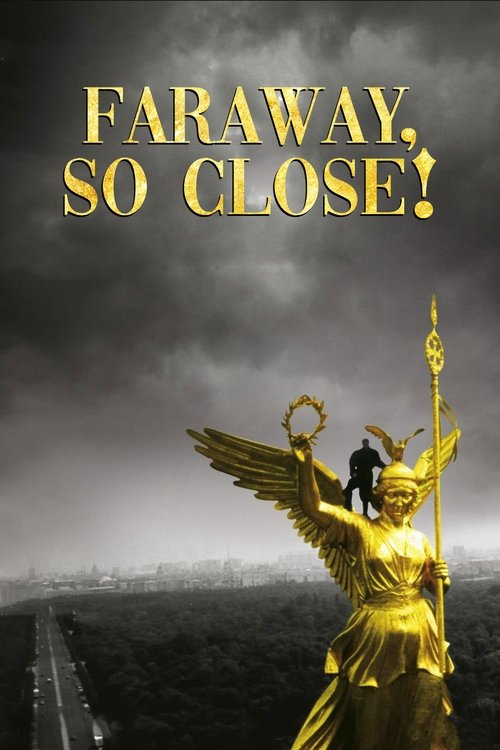
Faraway, So Close!
1993 · Wim Wenders
For a contemplative late night when you want something soulful and strange — a wanderer's film to sink into, not a tight story to follow. Comfort for the melancholic; a challenge if you need momentum.
What it's about
Angels drift over Berlin, listening in on human thoughts, aching for the taste and weight of real life. This time the story follows Cassiel, the angel who stayed behind when his companion chose mortality — until an act of rescue tumbles him into a human body of his own. What he finds in newly reunified Berlin isn't paradise: it's money trouble, drink, shady deals, and a city still figuring out what it has become.
The experience
Dreamy and melancholy, drifting between whispered meditation and, surprisingly, a crime story — it's a film of moods and faces more than plot. Patient viewers get moments of real grace; it asks you to slow down to its rhythm.
Performances
Otto Sander gives Cassiel a beautiful hangdog tenderness — an eternal observer heartbreakingly unprepared for being human — with Bruno Ganz returning in warm support.
The craft
Wim Wenders shoots the angels' world in luminous black-and-white and lets color flood in with mortality, turning post-Wall Berlin itself into the film's main character. The floating camerawork and murmured inner voices create a texture few films even attempt — this one rewards a quiet room and good speakers.
Why it matters
The sequel to one of the most beloved European films of the 1980s, it won the Grand Prix at Cannes and stands as Wenders's elegy for Berlin at the exact hinge of reunification.
Snapshot
Faraway, So Close! (In weiter Ferne, so nah!) is Wim Wenders's sequel to Wings of Desire (Der Himmel über Berlin, 1987), returning to the same conceit of angels who hover over Berlin, eavesdropping on human thought, longing for the weight and warmth of embodied life. Where the first film followed Damiel (Bruno Ganz) into mortality, the sequel shifts its attention to his former companion Cassiel (Otto Sander), the angel who stayed behind. Cassiel falls to earth almost by accident — catching a child tumbling from a balcony — and discovers that the human condition he coveted is, in reunified Berlin, a maze of drink, crime, arms-trafficking, and disappointment. The film is at once a metaphysical meditation, a melancholy state-of-the-nation portrait of post-Wall Germany, and, in its back half, an improbable crime thriller. It won the Grand Prix (Grand Prize of the Jury) at the 1993 Cannes Film Festival, yet it has long lived in the shadow of its luminous predecessor, widely regarded as the more ambitious but less coherent of the pair. It is also a film of valedictions: it features the final screen appearance of the beloved German star Heinz Rühmann.
Industry & production
The film was produced through Wenders's own Berlin-based company, Road Movies Filmproduktion, the outfit that had anchored most of his German work since the late 1970s, in the customary European co-production framework that supported auteur cinema of this scale. It arrived at a particular moment in Wenders's career: after the international success of Wings of Desire and the sprawling, troubled production of Until the End of the World (1991), the director returned to the milieu that had given him his greatest critical triumph. Returning to Berlin's angels was both a homecoming and a commercial calculation — a way to reconnect with the audience and the iconography that had defined him.
The reunification of Germany (the Wall fell in November 1989, formal reunification in October 1990) reshaped the very subject of the film. The Berlin of Wings of Desire was a divided city whose no-man's-land and walled emptiness were inseparable from the film's spiritual geography. By 1993 that landscape had been transformed, and Wenders built the sequel explicitly around the new, anxious, capital-in-waiting — a Berlin "unified in name," as the premise has it, but overrun by the appetites and corruptions that the West had carried in. The production thus had to grapple with a city in physical flux, its symbolic center reopened. The precise budget and box-office figures are not something I will assert with confidence; the film was a prestige release that performed modestly and did not replicate the crossover success of its predecessor.
Technology
Faraway, So Close! was shot photochemically on 35mm in the early-1990s tradition of European art cinema, before digital intermediate workflows. Its most conspicuous technical signature is inherited from Wings of Desire: the alternation between monochrome and color. The angels' perception of the world is rendered in a desaturated black-and-white (here often a cooler, more silvery register), while the human, embodied world blooms into color at the moment of incarnation. This is achieved in-camera and in the laboratory rather than through digital grading, and the film belongs to the last generation of features to handle such transitions purely on film stock. Beyond this, the production relied on conventional cinematographic technology of its day; the "special effect" of the angels is overwhelmingly a matter of camera movement, sound design, and editing rather than optical or early-digital trickery.
Technique
Cinematography
The director of photography was Jürgen Jürges, taking over from Henri Alekan, the legendary octogenarian cinematographer of Wings of Desire who had since retired (and to whom the first film paid homage by naming its circus after him). Jürges had to honor a celebrated visual grammar while making it his own. The film preserves the floating, unmoored camera that expresses the angelic point of view — long, gliding movements that drift through interiors and over the city as if weightless, untethered from any human vantage. The monochrome passages are softer and more diffuse than ordinary location work, evoking a consciousness that perceives without quite touching. When Cassiel becomes human, the palette shifts to color and the camera grows more grounded, more subject to gravity and to the grime of the streets. Critics have generally found Jürges's images accomplished but have noted that the sequel lacks the singular, hand-crafted radiance Alekan brought to the original.
Editing
Editing was handled by Peter Przygodda, Wenders's long-standing collaborator and one of the defining editorial voices of the New German Cinema, who cut the majority of the director's features. Przygodda's task here was unusually difficult: the film yokes together a contemplative, essayistic first movement — drifting angelic observation, interior monologue, tableaux of Berlin life — with a plot-driven thriller in its second half. Much of the critical disappointment with Faraway, So Close! centers on this structural seam, the sense that the film's reflective and generic impulses never fully reconcile. The editing must also manage the monochrome/color logic, timing the conversions to the dramatic beats of incarnation and grace.
Mise-en-scène / staging
The staging is built around the contrast between elevation and the street: angels perched on rooftops, monuments, and high vantage points, gazing down, versus the cluttered, fallen human spaces — bars, cars, warehouses, the underworld of arms dealing and pornography into which Cassiel descends. Berlin itself is the principal set, its post-reunification construction sites and historically loaded locations carrying the film's themes of memory and rupture. Wenders populates the frame with a deliberately heterogeneous gallery: aged Berliners carrying the freight of the twentieth century, criminals trading in the new lawlessness, and a roster of figures playing versions of themselves. The staging frequently has the quality of a procession or pageant rather than tight dramatic scene-building, which suits the angelic perspective but contributes to the diffuseness some viewers register.
Sound
Sound is, as in the first film, central to the angelic conceit: the angels hear the inner voices of the living, and the soundtrack layers whispered thought, ambient city noise, and music into a continuous, porous texture. The score is credited to Laurent Petitgand, and the film is saturated with contemporary popular music — a Wenders hallmark. It is closely associated with U2's song "Stay (Faraway, So Close!)," released on the band's 1993 album Zooropa; Wenders directed the song's music video, which drew on the film's angelic imagery, cementing a cross-promotional link between film and record. Lou Reed appears performing within the film, and the soundtrack gathers a roster of the alternative and art-rock musicians Wenders favored. Music functions less as underscore than as another stratum of the world the angels perceive.
Performance
Otto Sander carries the film as Cassiel, shifting from serene angelic watchfulness to the bewildered, increasingly dissolute condition of a man unequipped for human life; his performance is the film's emotional spine. Bruno Ganz returns as Damiel, now contentedly mortal, and Solveig Dommartin reprises Marion. The cast is studded with notable presences: Nastassja Kinski as the angel Raphaela; Heinz Rühmann, the great star of German cinema, in his final role as the elderly Konrad; Horst Buchholz as the criminal Tony Baker; and Willem Dafoe as the enigmatic Emit Flesti — "Time Itself" spelled backwards — a figure who shadows Cassiel's mortal span. Peter Falk again appears in his persona from the first film, and Mikhail Gorbachev appears as himself, a startling piece of casting that ties the metaphysics to the actual political dissolution of the Cold War order. The ensemble's eclecticism is part of the film's meaning and part of its unevenness.
Narrative & dramatic mode
The film's dramatic mode is bifurcated, and deliberately so. It opens in the lyrical, essayistic register of its predecessor — episodic, observational, governed by interior monologue and the angels' yearning — then hardens, after Cassiel's fall, into a more conventional plot involving a criminal network dealing in weapons and pornography, a kidnapping, and a redemptive act of sacrifice. Cassiel, ill-suited to embodiment, sinks into alcohol and aimlessness before the thriller machinery pulls him toward a climactic rescue in which he gives his life — and is, in the film's logic, restored to the angelic order. The movement is from contemplation to action, from grace to fallenness and back to grace. Many critics found the narrative overstuffed and the tonal shift jarring, the genre plot an awkward vehicle for the film's spiritual concerns; others read the very messiness as faithful to the chaos of the human world Cassiel has chosen to enter.
Genre & cycle
The film sits at the intersection of several modes: the metaphysical or "angel" fantasy, the art-house drama of ideas, the city symphony, and — unexpectedly — the crime thriller. It belongs most directly to a cycle of two: it is the sequel to Wings of Desire, and the pair form a diptych on Berlin, embodiment, and time. More broadly it participates in the early-1990s wave of films reckoning with German reunification and the end of the Cold War, and in Wenders's lifelong genre of the spiritual road movie — the wanderer in search of belonging. Its angel-among-mortals premise resonates with a small transnational tradition (the conceit was famously transplanted to Hollywood in City of Angels, 1998, a loose remake of Wings of Desire), but the sequel itself is too idiosyncratic to be claimed neatly by any single cycle.
Authorship & method
Faraway, So Close! is unmistakably a Wenders film: the divided city, the angelic gaze, the saturation in popular music, the road-movie restlessness, the elegiac attention to age and memory, and the recurring tension between American pop culture and European spiritual longing. Wenders directed and is credited as a writer; the screenplay was developed with collaborators including Ulrich Zieber and Richard Reitinger (the latter among the writers of Wings of Desire). One frequently noted difference from the first film is the diminished presence of the poet Peter Handke, whose monologues — above all the "Song of Childhood" — gave Wings of Desire much of its incantatory power; the sequel's verbal texture is more Wenders's own, and several critics felt the absence of Handke's distinctive voice. Among the key collaborators, cinematographer Jürgen Jürges, editor Peter Przygodda, and composer Laurent Petitgand shaped the film's look and rhythm, while the conspicuous casting of real figures (Gorbachev, Lou Reed) reflects Wenders's documentary instinct to let the actual world intrude on the fable.
Movement / national cinema
Wenders is one of the central figures of the New German Cinema, the movement of the late 1960s through the 1980s that included Rainer Werner Fassbinder, Werner Herzog, and Volker Schlöndorff, and that rebuilt a serious German art cinema in the long shadow of the Nazi past and the postwar "Papas Kino." By 1993 that movement had largely dispersed, and Faraway, So Close! can be read as a late, self-conscious extension of its preoccupations — national memory, the burden of German history, the search for a usable identity — now applied to the unprecedented circumstance of reunification. The casting of Heinz Rühmann, a star whose career stretched back to the Weimar and Nazi eras, deliberately threads the whole twentieth century of German cinema and history through the film.
Era / period
The film is inseparable from its precise historical moment: Berlin in the immediate aftermath of reunification, before the city had settled into its role as restored capital. The euphoria of 1989 had curdled into a more ambivalent reckoning — with crime, profiteering, and the rush of Western consumer capitalism into the former East, with the "Americanization" the premise foregrounds, and with unresolved questions of guilt and memory reaching back through the Wall to the war. Gorbachev's cameo locates the film at the hinge of the Cold War's end. It is a work made in the brief, uncertain interval when the old order had collapsed and the new one had not yet hardened — and that interval is its true subject.
Themes
At its core the film meditates on time and mortality: Emit Flesti — Time, reversed — is the embodied threat that incarnation brings, the price of leaving eternity. It is about the gap between spirit and flesh, the angelic longing to touch the world and the discovery that embodiment means not only love and coffee and warmth but drink, despair, and complicity in human evil. It is about Berlin and German history — the weight of the twentieth century, the disappointments of reunification, the seductions and corruptions of consumer capitalism and American culture. It is about loneliness, witness, and grace: the angel as the figure who watches and cannot intervene, and the meaning of the choice to descend into a world one cannot redeem from above. Threading through is the theme of memory and reconciliation, embodied in the elderly characters who carry the war's separations toward a late, fragile peace.
Reception, canon & influence
Critical reception was decidedly mixed, and this is the dominant fact of the film's afterlife. Reviewers consistently measured it against Wings of Desire and found it wanting — more ambitious in scope, but diffuse, overplotted, and tonally unstable, its turn toward a crime-thriller climax widely judged a misstep that betrayed the contemplative spirit of the original. At the same time it won the Grand Prix at the 1993 Cannes Film Festival, a significant institutional endorsement, and admirers defended its sprawl as a sincere attempt to confront the disorder of the reunified present rather than retreat into the safer lyricism of the first film.
Looking backward, the film draws on the imagery of Rainer Maria Rilke's angels (an acknowledged touchstone for the diptych), on the city-symphony tradition of Walter Ruttmann's Berlin: Symphony of a Great City, and above all on Wings of Desire itself — it is a self-citation as much as a sequel. Looking forward, its influence is bound up with that of its predecessor: the pair together established the modern "watching angel" iconography that fed into later cinema and music video, including the Hollywood remake City of Angels. The film's most durable cultural trace may in fact be musical — its symbiosis with U2's "Stay (Faraway, So Close!)" and Wenders's accompanying video — rather than cinematic. Within Wenders's own oeuvre it stands as a flawed, fascinating coda to his greatest creation: a film whose reach exceeded its grasp, and whose reckoning with a city and a century in transition remains, for all its unevenness, one of the more searching responses cinema offered to the strange interregnum of the early 1990s.
A Deleuzian reading
Start with the thing the camera does before anyone speaks.
The full Deleuzian reading of Faraway, So Close! →
Reception
It won the Grand Prix at Cannes in 1993, yet critics almost immediately filed it as the unnecessary sequel to Wings of Desire, and that shadow has never fully lifted — though it's since gained defenders who value it as a time capsule of just-reunified Berlin.
How Faraway, So Close! was received, from release to now →
Influences: the films it descends from and the films it influenced
- Wings of Desire (1987) — Direct ancestor and self-citation: re-uses Henri Alekan's invented monochrome-to-color angel-vision grammar, the floating overhead camera passing through walls, and the layered eavesdropped inner-voice soundtrack that this sequel literally continues with the same angel Cassiel/Otto Sander.
- Berlin: Symphony of a Great City (1927) — Ancestor in the city-symphony method: the rhythmic montage of a metropolis observed from above and in fragments, which Wenders converts into the angel's panoptic survey of post-Wall Berlin streets, rooftops, and crowds.
- The American Friend (1977) — Sibling within Wenders's oeuvre supplying the crime-thriller machinery — smuggling, a hesitant man pulled into violence — that the second half grafts onto the fable, the tonal bifurcation critics flagged.
- Paris, Texas (1984) — Sibling: establishes Wenders's elegiac road-movie restlessness and the use of an American pop/rock score (Ry Cooder there, U2 here) as emotional connective tissue over wandering, searching characters.
- Alice in the Cities (1974) — Ancestor of method: the documentary instinct to let the real, unstaged world and real locations intrude on the fiction — the same impulse behind casting Gorbachev and Lou Reed as themselves here.
- Ordet (1955) — Ancestor in staging the supernatural with sober realism: the unembellished, patiently held depiction of a miracle/resurrection among ordinary people, the gravity Wenders borrows for an angel made flesh.
- It's a Wonderful Life (1946) — Ancestor of the benevolent-supernatural-intercessor structure: a celestial figure descending into a man's earthly crisis, the redemptive-guardian template the angel diptych secularizes.
- A Matter of Life and Death (1946) — Ancestor of the monochrome/color coding of the metaphysical: heaven rendered in one palette and earth in another, the formal device Wenders inverts (gray for the angels' realm, color for incarnate life).
- City of Angels (1998) — Direct descendant: the Hollywood remake of the diptych that lifts the watching-angel-who-falls-for-mortality premise and the overhead-gaze imagery, smoothing them into mainstream melodrama.
- Until the End of the World (1991) — Sibling: the immediately preceding Wenders sprawl that shares the overplotted, globe- and tech-anxious ambition and the saturation in a curated contemporary pop-rock soundtrack as structuring device.
- Lisbon Story (1994) — Sibling/descendant: continues the same period's method of building a film around sound, music (Madredeus), and the act of attentive listening to a European city in transition.
- The Heart of the World (2000) — Descendant of the resurrected silent-city-symphony aesthetic: frantic monochrome montage reviving Ruttmann-era expressionist Berlin imagery that the angel films had recently re-canonized.
Similar films
- Wings of Desire (1987) — influence & lineage
- The American Friend (1977) — influence & lineage
- Until the End of the World (1991) — influence & lineage
- Paris, Texas (1984) — influence & lineage
- Alice in the Cities (1974) — influence & lineage
- The Double Life of Véronique (1991) — shared sensibility
- Fallen Angels (1995) — shared sensibility
- Perfect Days (2023) — shared sensibility