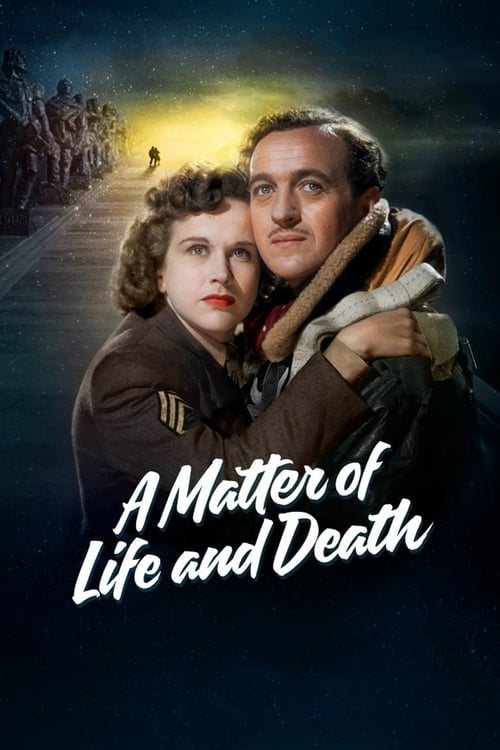
A Matter of Life and Death
1946 · Michael Powell
For a night when you want to fall in love with the movies again — romantic, clever, and gently profound, perfect to share with someone. Pure uplift, zero cynicism, and it earns every bit of it.
What it's about
A British bomber pilot in the last days of World War II jumps from his burning plane without a parachute — after falling in love, over the radio, with the American radio operator who takes his final call. Through a heavenly clerical error he survives, finds her, and their romance begins in earnest; then the Other World comes to collect its overdue soul, and he must argue for his life before a vast celestial court, with love as his defense.
The experience
Witty, warm, and visually astonishing — it skips between an earthbound world in glowing Technicolor and a monochrome afterlife run like a vast bureaucracy, and the whole thing plays as a grand romantic argument rather than a tearjerker. It leaves you buoyant.
Performances
David Niven is at his most charming as the doomed-but-defiant pilot, and Roger Livesey brings enormous warmth as the village doctor who takes up his case. Kim Hunter makes the radio-born romance feel instantly real.
The craft
Powell and Pressburger's central visual joke is one of cinema's best: Earth blazes in Technicolor while heaven is pearly monochrome — 'one is starved for Technicolor up there,' a character sighs. The production design, from a colossal escalator between worlds to a frozen-in-time table-tennis match, is endlessly inventive, and it's a feast on a big screen.
Why it matters
Made partly to warm postwar Anglo-American relations, it has grown into one of the most beloved British films ever made, regularly topping polls of national favorites. Its images — the stairway between worlds above all — echo through decades of fantasy and romance filmmaking.
Snapshot
A Matter of Life and Death is the most cosmically ambitious of the films made by Michael Powell and Emeric Pressburger under their Archers banner: a wartime romance that stages a literal argument between earthly love and heavenly bureaucracy. Squadron Leader Peter Carter (David Niven) bails out of a burning bomber without a parachute after a final radio exchange with an American WAC, June (Kim Hunter). By a clerical error in the "Other World," his death is not collected on schedule; he washes ashore alive, meets June in the flesh, and falls in love — whereupon the celestial administration sends an emissary to correct the mistake and claim him. Peter appeals, and his case becomes a trial: the price of his continued life is a debate before a vast cosmic court. Running roughly 104 minutes and released in the United States as Stairway to Heaven, the film is famous for its central formal conceit — Earth rendered in luminous Technicolor, the afterlife in a pearly monochrome — and for its refusal to say whether the heaven we see is real or the neurological hallucination of a concussed, brain-injured airman. It is at once state-commissioned goodwill picture, metaphysical fantasy, and one of the most self-aware romances in British cinema.
Industry & production
The film originated in a commission. The British Ministry of Information, anxious about frictions between British civilians and the large American forces stationed in Britain, approached Powell and Pressburger for a film that might improve Anglo-American relations. The Archers, then operating with a remarkable degree of autonomy through their partnership with J. Arthur Rank's independent production arm (Independent Producers / The Rank Organisation), took the propaganda brief and inflated it to metaphysical scale, turning a request for diplomacy into a trial of the two nations before the universe. This freedom — Powell and Pressburger shared a single "written, produced and directed by" credit and answered to Rank rather than to a Hollywood-style front office — is central to understanding how so unusual a picture got made at all.
Production ran into 1946, with interiors at Denham Studios and the celestial architecture built as full-scale sets. The most expensive and conspicuous of these was the enormous moving stairway that carries the newly dead to the Other World, an engineering feat requiring its own motor and dominating the studio floor. The Technicolor apparatus itself was a logistical constraint: the three-strip cameras were bulky, few in number, and supervised under the licensing regime associated with Technicolor's American parent, whose color "consultant" Natalie Kalmus is credited (as she was on most Technicolor productions of the period). The film was selected as the first Royal Command Film Performance, screened in the presence of the royal family in November 1946 — a mark of official prestige, and evidence that the goodwill commission had, at minimum, achieved respectability.
Technology
The picture is a landmark in the creative use of three-strip Technicolor, but its real technological wit lies in what it does against color. Where most Technicolor films of the 1940s treated the process as an unbroken selling point, Powell and Pressburger reserved full color for the earthly world and shot the afterlife in a monochrome — a silvery, pearlescent gray achieved within the Technicolor system rather than in ordinary black-and-white stock, so that the two realms could dissolve into one another and be graded as a continuous image. The joke is made explicit in dialogue when the celestial messenger, arriving on Earth, remarks that "one is starved for Technicolor up there." The transitions between worlds are among the film's signature effects: color bleeding into a monochrome frame, or the reverse, so that the medium itself dramatizes the passage between life and death. The production also exploited large-format matte and glass work, in-camera effects, and the sheer physical scale of its sets rather than relying on optical trickery alone, in keeping with Powell's preference for effects the actors could see and inhabit.
Technique
Cinematography
The film marked a decisive step for Jack Cardiff, who here worked as director of photography on a feature after years inside the Technicolor system as an operator and technician (he had operated on the Archers' The Life and Death of Colonel Blimp). Cardiff's earthbound images are saturated and painterly — he openly drew on Old Master painting and on Technicolor's own vocabulary — while the Other World is lit for a cool, even, statuary calm. The camera is unusually mobile and unusually subjective: Peter's point of view is repeatedly foregrounded, most memorably in the operating-theater sequence, where an eyelid appears to close over the lens (a pink membrane sliding across the frame) as the anesthetic takes hold. Cardiff would win the Academy Award for cinematography the following year on the Archers' Black Narcissus; A Matter of Life and Death is where that partnership between his eye and Powell's ambition announced itself.
Editing
Reginald Mills, the Archers' regular cutter, structures the film around the oscillation between two worlds and two color regimes, and much of the picture's meaning is carried in the cut or the dissolve between them. The most celebrated device is temporal: when the celestial Conductor 71 stops time on Earth, the film freezes the living — a table-tennis ball hangs, figures hold their poses — so that a private conversation between Peter and his emissary can proceed inside a suspended world. These sequences depend on precise coordination between performance and cutting, the "living" actors holding absolute stillness while the two mobile figures move through them.
Mise-en-scène / staging
Production designer Alfred Junge — trained in the German studio system and a decisive influence on the Archers' visual grandeur — supplies the film's architecture of the beyond: the immense escalator flanked by statues of the historic great, the amphitheatre of the cosmic court filled with ranked multitudes, the reception hall where the dead are processed like arrivals at a vast terminus. Junge's designs give the afterlife the impersonal monumentality of bureaucracy rather than the softness of cloud-and-harp convention, a choice that sharpens the film's central joke that heaven is an administration. On Earth, by contrast, the staging is intimate and English: the camera obscura in Doctor Reeves' house (which lets him survey the village as a living image) becomes a rhyme for cinema itself and for the film's theme of vision and perspective.
Sound
The film opens with a virtuoso audio set-piece: Peter's radio conversation with June as his aircraft burns, a scene played almost entirely on voices, in which a dying man recites poetry and flirts with a stranger he will never expect to meet. The soundtrack manages the transitions between worlds partly through acoustic shifts, and the score by Allan Gray underpins the movement between romance and cosmic scale. The documentary record on the film's sound design is thinner than on its images, and it would overstate the case to claim specific innovations beyond the conspicuous opening and the general precision of the mix.
Performance
David Niven gives one of his finest performances as Peter — charming, articulate, and quietly desperate — anchoring the fantasy in a recognizable, likeable Englishman. Kim Hunter, an American actress, plays June with a directness that makes the Anglo-American romance credible rather than diplomatic. Roger Livesey, a favorite of the Archers, brings warmth and gravity as Doctor Frank Reeves, the neurologist who is both Peter's earthly advocate and, after his own death, his defender in the celestial court. Marius Goring is a source of much of the film's wit as Conductor 71, the executed French aristocrat charged with collecting Peter, and Raymond Massey plays the prosecutor Abraham Farlan — presented as the first American killed by a British bullet in the Revolutionary War — with a bristling anti-British fervor that gives the trial its political charge.
Narrative & dramatic mode
The film's dramatic engine is the courtroom, but its deepest structural gamble is ambiguity. Everything supernatural can be read as the hallucination of a man with a brain injury: Reeves diagnoses Peter with adhesions on the brain producing vivid, organized visions, and the trial in heaven is intercut with a real operation on Earth, so that the verdict and the surgery reach their crises together. Powell and Pressburger keep both readings alive to the end — the fantasy is neither confirmed as literal nor dismissed as delirium — and the film's famous title card insists it is "a story of two worlds, the one we know and another which exists only in the mind." The mode is thus double: a heightened romantic fantasy and a rationalist medical drama occupying the same running time, each refusing to cancel the other.
Genre & cycle
The picture belongs to a distinct 1940s cycle of "celestial" or afterlife fantasies — films in which the recently or nearly dead negotiate with heavenly officials — whose Hollywood exemplars include Here Comes Mr. Jordan (1941), the Spencer Tracy vehicle A Guy Named Joe (1943), and Heaven Can Wait (1943). Its deeper theatrical ancestor is Sutton Vane's play Outward Bound, with its passengers discovering they are dead. What distinguishes the Archers' contribution is the grafting of this fantasy cycle onto wartime romance and onto an explicit geopolitical argument, and the tonal breadth — the film moves between comedy, romance, courtroom drama and metaphysical spectacle without settling into any one of them.
Authorship & method
This is a signature Archers production, and the authorship is genuinely shared. Emeric Pressburger's screenplay supplies the conceptual audacity — the clerical error, the trial, the doubling of nations — and the literate, argumentative dialogue; Michael Powell supplies the visual imagination and the willingness to spend on scale. Their method of a single combined credit reflected a real collaboration in which writing, producing, and direction were treated as one act. Around them the film assembles the core Archers craft team of the period: cinematographer Jack Cardiff, production designer Alfred Junge, composer Allan Gray, and editor Reginald Mills. The result bears the unmistakable Powell-Pressburger fingerprint — emotional excess held in ironic check, Englishness examined rather than merely celebrated, and a delight in cinema's own machinery of illusion.
Movement / national cinema
The film is a monument of a particular flowering of British cinema in the 1940s, when the Rank-backed independence of producers like the Archers allowed a national cinema of unusual artistic confidence to emerge alongside the realist tradition of documentary and the Ealing comedies. Yet its visual DNA is continental as much as British: Junge and the studio-built expressionism of the afterlife carry the imprint of the German industry, while Powell's romanticism sets the Archers apart from the sober naturalism often taken as the "English" default. The film is thus both intensely national in subject — it is, after all, about what Britain is and how it is seen by others — and cosmopolitan in craft.
Era / period
Released in 1946, the film sits exactly on the seam between war and peace. It was conceived to address a live wartime problem (Anglo-American friction) but arrives after victory, when the argument it stages — can two very different nations be reconciled? — has shifted from military necessity to the shape of the postwar world. Its imagery of mass death processed by an efficient afterlife bureaucracy is unmistakably a product of a period that had counted its dead in millions, and its insistence on the claims of a single life against that machinery reads as a direct answer to the war's arithmetic.
Themes
At its center is the contest between love and the cosmos — the proposition that a single human attachment, formed in a matter of hours, can be weighed against the ordered administration of the universe and win. Around this the film organizes several linked concerns: Anglo-American relations, dramatized as a literal trial in which old grievances (the American Revolution, colonial resentments) are aired and set aside in favour of a common future; reason versus imagination, held in permanent suspension by the film's refusal to resolve whether heaven is real or neurological; vision and perspective, figured in the camera obscura, the operating-theater eyelid, and the two-color scheme itself; and the meaning of Englishness, defended and gently mocked in the same breath. Poetry — Peter is a poet, and quotes it — runs throughout as the film's emblem of what a civilization is worth defending for.
Reception, canon & influence
The film was honored on release with selection as the first Royal Command Film Performance, and it found a substantial audience, though some contemporary reactions were wary: the frank staging of American resentment toward Britain unsettled parts of the establishment, and American distributors changed the title to Stairway to Heaven, reportedly reluctant to place the word "Death" on a marquee so soon after the war. As with much of Powell and Pressburger's work, full critical canonization came later. The Archers fell out of fashion in the 1950s and 1960s; their reputation was substantially rebuilt from the late 1970s and 1980s, with Martin Scorsese among the most prominent champions of Powell's work, and A Matter of Life and Death is now routinely ranked among the greatest of all British films and periodically revived and restored.
Looking backward, the film draws on the theatrical afterlife tradition of Outward Bound and the Hollywood celestial-fantasy cycle of Here Comes Mr. Jordan and its kin, on the continental studio expressionism that Junge and Powell both knew, and on Powell's own prewar apprenticeship in spectacle. Looking forward, its influence is diffuse but real: it stands as a touchstone for filmmakers drawn to bureaucratized, architectural visions of the afterlife and to romances that hinge on metaphysical negotiation, and its two-world color scheme and its ambiguity between vision and pathology have been widely admired and echoed. Its most concrete legacy is arguably its role in the durable critical rehabilitation of the Archers themselves, for whom it now serves — alongside The Red Shoes and Black Narcissus — as a defining statement of what British cinema could be at its most imaginatively unbounded.
A Deleuzian reading
Watch the operating theater again and notice the eyelid.
The full Deleuzian reading of A Matter of Life and Death →
Reception
Commissioned to soothe fraying Anglo-American relations after the war, it got a mixed reception from sniffy British critics who found it fanciful — yet in 2017 a Time Out poll of film industry figures voted it the greatest British film ever made.
How A Matter of Life and Death was received, from release to now →
How to watch A Matter of Life and Death: what to notice on a first viewing
- Notice Earth is in color and the afterlife is not. Earth is shot in full saturated Technicolor while the celestial scenes run in a silvery, pearl-toned monochrome, both achieved within the same color process. You always know which realm you are in before a single line confirms it.
- Watch the pink membrane slide over the lens like an eyelid. As the anesthetic takes hold, the camera itself appears to blink shut, telling you without a word that what follows happens behind this one eye. The film tells you, visually, that everything ahead might be happening inside one man's head.
- Notice the enormous escalator and statues in the afterlife. Junge's design gives the beyond the scale and order of a vast terminus, ranked statues and multitudes, rather than any soft cloud-and-harp convention. Heaven here looks like an efficient administration, not a paradise, and the joke is entirely visual.
- Listen to how much of the opening is built on voices alone. Peter's radio conversation with June, recited as his aircraft burns, plays almost entirely on sound, a dying man reciting poetry to a stranger he expects never to meet. You fall for these two people through voices in the dark before you ever see either face.
The whole guide to watching A Matter of Life and Death, with the keys for a rewatch →
Influences: the films it descends from and the films it influenced
- Outward Bound (1930) — Supplies the afterlife-in-transit conceit Pressburger reworks — the recently dead processed by a genial celestial official aboard a waystation, a theatrical staging of death as bureaucratic passage rather than damnation.
- Here Comes Mr. Jordan (1941) — Gives the film its exact plot engine: a heavenly messenger collects a soul before its appointed time, and the clerical error must be litigated with the celestial hierarchy to win the man his life back.
- The Wizard of Oz (1939) — Establishes the bifurcated palette Powell inverts — monochrome for one ontological realm and full Technicolor for the other — using the seam between color systems to mark a crossing between worlds.
- The Thief of Bagdad (1940) — Powell's own prewar apprenticeship in large-scale three-strip Technicolor fantasy effects and matte-built spectacle, the technical confidence he then spends on the escalator to the Other World.
- Death Takes a Holiday (1934) — Models the romance-as-metaphysical-negotiation structure in which love becomes the argument that suspends or reverses a personified death's claim on a life.
- Metropolis (1927) — The continental studio expressionism Alfred Junge carried from German soundstages — monumental architecture and the vast moving stairway rendered as an overwhelming machine-space, here the Stairway to Heaven itself.
- A Guy Named Joe (1943) — The dead-aviator premise filtered through the war: a flyer's death opens directly onto a celestial framing device, the pilot's fate narrated from beyond as wartime consolation.
- Napoléon (1927) — Pioneers the mobile, radically subjective camera as psychological instrument that Cardiff extends into the film's first-person passages, including the shot taken from inside the closing eyelid.
- The Life and Death of Colonel Blimp (1943) — Reuses Roger Livesey as the reasonable Englishman and stages a literal debate on national character, switching Technicolor and monochrome as an expressive device — the same dialectical, color-conscious method.
- Heaven Can Wait (1943) — Escalates the celestial tribunal into full forensic argument over one man's earthly record, and, like Lubitsch, makes the color scheme itself the dramaturgy — Technicolor earth against monochrome heaven.
- The Red Shoes (1948) — The Archers again make cinema's own machinery of illusion the subject, using Technicolor, in-camera trickery and design to stage a fantasy that blurs performance, vision and reality.
- Wings of Desire (1987) — Inherits the two-world palette directly, coding the angelic/eternal realm in monochrome and human mortal life in color, and treating the crossing between them as a change of film stock.
- Heaven Can Wait (1978) — Restages the celestial-clerical-error romance (via the Mr. Jordan lineage they share), keeping the premise of a life wrongly collected and a bargain negotiated with heaven's administrators.
- Defending Your Life (1991) — Extends the bureaucratized-afterlife trial: a dead man's worthiness is argued in a celestial courtroom with prosecutors, judges and evidence, the metaphysical case Powell stages made comic.
- Beetlejuice (1988) — Imagines the afterlife as absurdist bureaucracy — waiting rooms, caseworkers and processing queues — descending from the film's vision of eternity as a vast administrative architecture.
- What Dreams May Come (1998) — Builds a painterly, architecturally-conceived afterlife governed by a two-world color logic, where a lover must literally argue and journey to reverse a death, echoing the trial-and-reunion structure.
- Brazil (1985) — Turns the single clerical error into the engine of an entire fantasy of bureaucratic machinery, extending Powell's delight in a cosmos run by paperwork, ledgers and administrative apparatus.
- High and Low (1963) — Powell and Pressburger's structural use of deliberate chromatic shift between narrative registers — Technicolor earth, monochrome heaven — establishes selective color as a grammar of narrative meaning rather than decoration, the conceptual precedent for Kurosawa's colored-smoke insert as a narrative device.
- The Adjustment Bureau (2011) — A celestial bureaucracy that adjudicates a man's love against a cosmic ledger, dispatching formally-dressed emissaries to correct a clerical 'error' in a life — the bureaucratized-providence frame Nolfi adopts wholesale.
- Enter the Void (2010) — Stages the afterlife as a literal threshold the dying consciousness crosses, the fantasy-of-passage template Noé reworks into a Tokyo bardo.
- Meet Joe Black (1998) — Pioneers the emissary-from-beyond romance whose two realms are distinguished by palette, establishing the color-coding-of-mortality grammar (eternity vs. flesh rendered as distinct light) that Lubezki echoes in the film's amber/cool divisions.
- Time Bandits (1981) — Powell-Pressburger's vision of the cosmos as a vast staged bureaucracy is the model for the Supreme Being as a tweed-suited celestial administrator auditing his own creation.
- Black Narcissus (1947) — Jack Cardiff's emotionally-coded Technicolor and subjective color built with the same Archers craft team, extending the idea that hue itself can register a character's interior and pathological states.
- Faraway, So Close! (1993) — Ancestor of the monochrome/color coding of the metaphysical: heaven rendered in one palette and earth in another, the formal device Wenders inverts (gray for the angels' realm, color for incarnate life).
- A Canterbury Tale (1944) — Same Archers unit deploying an audacious editing/optical conceit (the falcon-Spitfire cut's cousin) in which a formal device carries the metaphysical argument.
- I Know Where I'm Going! (1945) — Allan Gray again scores, and the same Archers device of a supernatural/predestined order pressing on lovers is deployed — here the threshold between worlds literalized as a staircase, there as the ferry-crossing to Kiloran.
- The Ghost and Mrs. Muir (1947) — Contemporaneous entry in the same early-postwar cycle of love straddling the mortal boundary, sharing the impulse to render passage between life and death as a courtly, wistful romance rather than horror.
Similar films
- The Red Shoes (1948) — influence & lineage
- The Thief of Bagdad (1940) — influence & lineage
- The Life and Death of Colonel Blimp (1943) — shared sensibility
- A Canterbury Tale (1944) — shared sensibility
- 49th Parallel (1941) — shared sensibility
- Casablanca (1943) — shared sensibility
- It's a Wonderful Life (1946) — shared sensibility
- The English Patient (1996) — shared sensibility