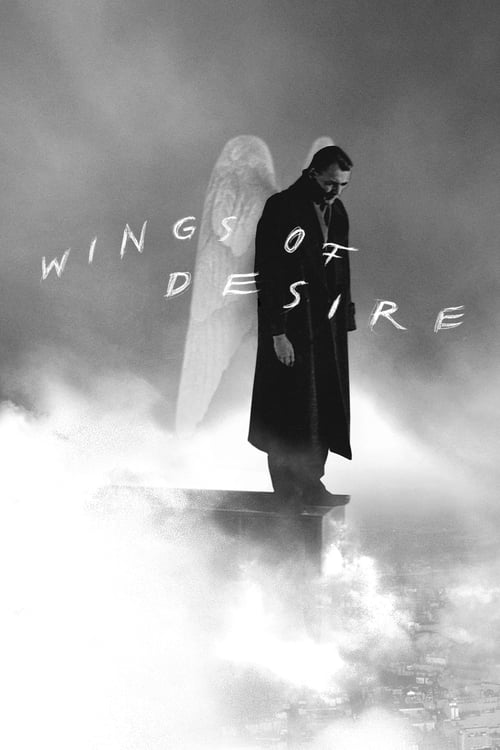
Wings of Desire
1987 · Wim Wenders
For a contemplative late night when you want to fall back in love with ordinary life — coffee, weather, other people. Meditative rather than gripping; bring your full attention.
What it's about
Two angels drift invisibly through divided 1980s Berlin — libraries, apartments, the shadow of the Wall — listening in on the private thoughts of ordinary people they can comfort but never touch. When one of them, Damiel, falls for a lonely trapeze artist in a struggling circus, he begins to wonder what it would cost to give up eternity for a cup of coffee, cold hands, and a single human life.
The experience
Dreamy, melancholy, and quietly rapturous — less a plot than a slow flood of overheard thoughts and city images that sneaks up on you emotionally. It rewards patience with one of cinema's most moving arguments for being alive.
Performances
Bruno Ganz gives Damiel a gentleness that makes an angel's longing completely believable, and Peter Falk — playing himself — is a wonderful, wry surprise, grounding all the poetry in rumpled human warmth.
The craft
The angels' world is shot in luminous, silvery black and white that bursts into color when life intrudes — a simple device with enormous emotional payoff. The camera floats through Berlin like a spirit, and the murmuring soundscape of inner voices is half the experience; see it big, hear it well.
Why it matters
One of the defining European films of the 1980s and an indelible portrait of Berlin just before the Wall fell; it won Wim Wenders the directing prize at Cannes and inspired a Hollywood remake, but the original's spell has never been matched.
Snapshot
A pair of angels, Damiel (Bruno Ganz) and Cassiel (Otto Sander), drift unseen through divided West Berlin — through libraries, apartment blocks, the shadow of the Wall — overhearing the interior monologues of ordinary people. The film is rendered in luminous black and white when seen from the angels' perspective, fragmentary and intimate, a city-wide act of witness. When Damiel falls in love with Marion (Solveig Dommartin), a French trapeze artist performing in a threadbare circus, he chooses incarnation over eternity: the screen floods with color. Peter Falk, playing himself on location for a WWII film, serves as guide and sign — a former angel who made the same choice. Wenders and co-writer Peter Handke construct not a plot but a meditation: on longing, embodiment, memory, and the weight of German history visible in every cracked façade and sandy strip of no-man's-land.
Industry & production
Wings of Desire (Der Himmel über Berlin, literally "The Sky Over Berlin") was produced by Road Movies Filmproduktion, Wenders's own company, in co-production with Argos Films of France. This West German–French partnership was typical of prestige European art cinema in the 1980s, allowing a project with limited commercial logic to attract financing on the strength of Wenders's international reputation, consolidated by Paris, Texas (Palme d'Or, 1984). The production was modest in scale; no significant public box-office data exists in the historical record for its original release run. Shooting took place in West Berlin in 1986–87, with the city itself functioning as a co-producer of meaning: the Wall, the Staatsbibliothek, the bombed-out Potsdamer Platz, the circus tent on its sandy lot are not sets but found locations whose specific historical resonance is irreplaceable.
The French actress and Wenders's companion Solveig Dommartin was cast as Marion partly because she learned circus trapeze work for the role, grounding the performance in bodily labor rather than artifice. Peter Falk appears as himself, his participation giving the film a peculiar ontological shimmer: the rumpled, affable Columbo actor plays an ex-angel who shed his wings for the pleasure of coffee, cold hands, and human friction.
Technology
Henri Alekan, the great French cinematographer then in his late seventies, shot the film in 35mm, dividing the visual world between two registers. The angel sequences are black and white — silver, porous, slightly diffused — achieved through Alekan's use of a filtration technique involving a stretched silk or stocking material placed over the lens, softening contrast and giving the image a quality of antique reverie without the harshness of high-contrast noir. This was consistent with Alekan's lifelong interest in controlled light diffusion, developed over a career stretching from Jean Cocteau's La Belle et la Bête (1946) onward. The human sequences (and the concluding stretch of the film after Damiel's fall into mortality) are rendered in saturated color. The transition is accomplished in-camera and through laboratory printing choices, not through any digital intermediary — digital post-production of this kind was not yet available — which means the shift from monochrome to color retains an analog warmth and grain rather than the surgical precision of later era color correction.
Technique
Cinematography
Alekan's black-and-white work treats available ambient light as a collaborator. His camera moves with the angels in long, gliding Steadicam passes through the Staatsbibliothek, through apartment corridors, overhead in circus tents — movement that communicates the angels' frictionless traversal of space while registering every surface texture: book spines, the grain of skin, the poured concrete of the Wall. When the film switches to color upon Damiel's incarnation, the palette is neither garish nor hyper-real but heightened — a world that has been waiting to be felt. The cinematography enacts the film's philosophical argument: embodiment is not a loss but an arrival.
Editing
Peter Przygodda, Wenders's long-term editor and collaborator across many films of the 1970s and 80s, builds the film's rhythm from accumulation rather than causality. Scenes do not follow from prior scenes in conventional narrative logic; they accrue. Interior monologues overlap; the camera lingers past the expected cut point. The editorial mode is contemplative, even liturgical, aligned with the angels' temporal experience in which chronology is not urgent. The later sequences, after Damiel's fall, are cut more tightly, more conventionally — the editing grammar of mortal time closing in.
Mise-en-scène / staging
Wenders stages the film's human world as a series of self-contained, intensely observed vignettes: a man on a ledge; a motorcyclist dying beside a road; an old man (Homer, played by Curt Bois) searching futilely for the vanished Potsdamer Platz. Each interior monologue is a miniature chamber piece. The circus serves as the film's mythic center — a space already given to performance, to hovering between earth and air. The division of the city is registered not through explicit political argument but through the persistent presence of empty lots, wire, and gravel: the built evidence of violence. The Staatsbibliothek sequence, in which dozens of readers sit in a vast hall while angels move silently among them absorbing thought, is staged as though Berlin's collective interior life were itself a kind of temple.
Sound
The sound design moves between the ambient textures of the city — wind, traffic, the echo of a library — and the whispered, overlapping stream of human interior thought that the angels (and the audience) overhear. Jürgen Knieper's orchestral score provides elusive harmonic support, while the inclusion of live rock performance from Nick Cave and the Bad Seeds and Crime and the City Solution at the Esplanade concert venue gives the film a pulse of carnal, physical sound against which the angels' ethereal perspective can be measured. The contrast between Knieper's strings and the raw voltage of Cave's performance is not accidental: it anchors Marion's world, and by extension Damiel's longing, in something irreducibly alive.
Performance
Bruno Ganz gives a performance that is almost entirely interior — thought, attention, the fine gradations of watching. His Damiel registers feeling through stillness, through the quality of looking. Ganz was already established on German stages and in films such as The Marquise of O (Rohmer, 1976) and Nosferatu the Vampyre (Herzog, 1979), and his theatrical background supports the sustained interiority the role demands. Otto Sander as Cassiel carries more of the film's historical weight — Cassiel is the Benjaminian angel of history, unable to intervene, watching with something closer to grief. Solveig Dommartin's performance is grounded in physical discipline; her trapeze work is real, and Marion's loneliness is rendered as something lived in the body, not the mind. Curt Bois, born in 1901 and a survivor of both the Weimar film industry and American exile (he appears briefly in Casablanca, 1942), brings irreplaceable historical reality to Homer — his presence creates a living link to pre-Nazi Berlin that no younger actor could provide. Peter Falk plays against his television persona just enough: more deliberate, warmer, carrying an enigmatic knowingness that the film refuses to fully explain.
Narrative & dramatic mode
The film operates in the mode of the prose poem or the philosophical lyric essay rather than conventional narrative. For its first hour, it is structurally closer to Walter Ruttmann's Berlin: Symphony of a Metropolis (1927) — a city portrait assembled from fragment and observation — than to any story film. The love plot, when it solidifies, functions less as genre machinery than as the film's argument made concrete: that the desire for particular, perishable, sensory experience is the ground of meaning. The interior monologues, scripted largely by Peter Handke, are not expository; they capture the texture of consciousness without supplying narrative information. Wenders has described the film's structure as loosely emerging from improvisation and location discovery during production, and the work retains the quality of something found rather than constructed.
Genre & cycle
Wings of Desire belongs to no clean genre. It touches the philosophical fantasy (it shares the premise of angels among mortals with a lineage of stage and screen works), but it empties that premise of sentimentality and genre comfort. It shares the meditative, observational city-film mode of European art cinema in the 1980s (Chris Marker, Agnès Varda, Chantal Akerman) without those filmmakers' documentary rigor. It is a love story that arrives at its conventional romantic resolution by dismantling every convention of how romantic resolution is supposed to feel. The film is perhaps most usefully situated within the art-cinema tradition as Wenders consolidated it: a synthesis of the European auteur inheritance and the American road-movie and genre forms that he had absorbed through his New German Cinema years.
Authorship & method
Wenders came to Wings of Desire having spent much of the early 1980s working in the United States (Hammett, 1982; Paris, Texas, 1984). The Berlin film was in part a return — to Germany, to German questions, to German space — and the process of making it was notably improvisational. The screenplay was developed collaboratively with Peter Handke, whose influence is most felt in the inner-monologue passages: Handke's lifelong preoccupation with the act of language itself, with how speech does and does not reach experience, runs through the film's texture. Henri Alekan was brought in — at an age when many cinematographers would have retired — as a deliberate gesture toward the deep history of European cinema craft. Peter Przygodda's long collaboration with Wenders (stretching back to Alice in the Cities, 1974) gave the editing relationship the fluency of long partnership. Jürgen Knieper, also a recurring Wenders collaborator, built a score designed to recede into atmosphere rather than to comment.
Movement / national cinema
The film is a key late document of New German Cinema — the movement associated with Fassbinder, Herzog, Schlöndorff, and von Trotta that had dominated West German filmmaking from the late 1960s through the early 1980s. By 1987, with Fassbinder dead (1982) and the movement's institutional structures under pressure, Wings of Desire arrives as both a summa and an elegy. It is also distinctly post-national: the French co-production, the French actress at its center, the Austrian co-writer, the dialogue shifting among German, French, and English all register Wenders's discomfort with any pure German cinema identity. The Wall, as the film's central material fact, makes the question of German identity inescapable while the film's transnational construction refuses to settle it.
Era / period
The film belongs to the final years of divided Germany and of Cold War Berlin specifically. Shooting concluded in 1987; the Wall fell in November 1989. This gives Wings of Desire an unintentional but absolute historical weight: it is the record of a Berlin that no longer exists by the time the film had completed its international run. The Potsdamer Platz that Homer searches for — bombed out, bisected, wasteland — would within a decade be rebuilt as a glass-and-steel commercial district. The film documents a moment of stasis that history was about to break open.
Themes
Embodiment and longing are the film's twin axes. The angels are complete, timeless, and experientially impoverished; the humans are mortal, hurting, and capable of tasting coffee. The film argues, quietly and without sentimentality, for the priority of the particular and perishable over the eternal and abstract. History and memory run as secondary but insistent themes: Cassiel's inability to intervene as an angel echoes Walter Benjamin's "angel of history," blown backward into the future while catastrophe piles at its feet. Homer's wandering quest for the vanished prewar Berlin figures memory as both duty and impossibility. The act of storytelling — what Homer calls the work of the poet — is offered as a fragile but real means of continuity across historical rupture. Marion's trapeze work figures the in-between state: suspended, neither earth nor air, which is also where longing lives.
Reception, canon & influence
Critical reception and prizes. Wings of Desire won the Best Director prize (Prix de la mise en scène) at the 1987 Cannes Film Festival — the Palme d'Or that year went to Maurice Pialat's Sous le soleil de Satan. The film received strong critical attention across European and North American art-cinema contexts and has maintained its reputation as one of the central works of 1980s European cinema. It appears regularly on critical lists of major postwar world cinema.
Influences on the film (backward). Rilke's Duino Elegies (1923), with their address to the angels as figures of longing and intermediacy, inform the film's conceptual architecture at every level. Benjamin's "Theses on the Philosophy of History" (1940) and the image of the Angelus Novus underwrite Cassiel's function. The German Expressionist cinema and the city-symphony tradition (Ruttmann) provide visual and structural precedents. Jean Vigo's L'Atalante (1934) and its treatment of romantic longing as something metaphysical is a touchstone Wenders has acknowledged. Henri Alekan's own deep engagement with Cocteau, specifically La Belle et la Bête, brings an aesthetic genealogy of the uncanny and the beautiful into the cinematography. Ozu's films — whose contemplative duration and camera placement Wenders had studied closely and written about — inflect the meditative observation of daily life.
Legacy and influence (forward). The film's most direct successor is Wenders's own Faraway, So Close! (In weiter Ferne, so nah!, 1993), which follows Cassiel's trajectory and won the Grand Prix at Cannes, though it is generally regarded as a lesser achievement. The American remake City of Angels (Brad Silberling, 1998), with Nicolas Cage and Meg Ryan, transplanted the premise to Los Angeles and achieved commercial success while largely shedding the philosophical and historical dimensions of the original. The color-transition device — monochrome experience giving way to color upon contact with human life — became an influential formal gesture in subsequent cinema, though rarely with equivalent conceptual motivation. More diffusely, the film's mode of patient urban observation, its use of interior monologue, and its treatment of the city as a site of layered historical memory have been absorbed into the broader vocabulary of European art cinema. The casting of musicians (Nick Cave) in semi-documentary live performance contexts within a fiction film anticipated later practices in films by directors including Todd Haynes and Jim Jarmusch. Wings of Desire remains, in the scholarly and critical literature, one of the definitive statements of what European art cinema could do in its final decade of dominance before the consolidation of global multiplexes and digital production transformed the landscape.
A Deleuzian reading
Start in the library.
The full Deleuzian reading of Wings of Desire →
Reception
No flop-to-classic arc needed here — it won Wenders Best Director at Cannes in 1987 and was an arthouse event from day one. If anything it's grown more monumental since, as the definitive cinematic portrait of a walled Berlin that vanished two years after the film came out.
How Wings of Desire was received, from release to now →
Influences: the films it descends from and the films it influenced
- La Belle et la Bête (1946) — Alekan developed his stocking-filter lens-diffusion technique on this film; Wenders re-engaged him at 76 and reprised the exact material-over-lens method to produce the angels' luminously soft, silvered monochrome passes through Berlin.
- A Matter of Life and Death (1946) — Powell and Pressburger established the formal convention of B&W for the supernatural plane and color for mortal Earth; Wings of Desire inherits this ontological color-coding directly, assigning B&W to angelic perception and color to the moment of embodied mortality arrived at.
- Germany Year Zero (1948) — Rossellini shot in the actual rubble of postwar Berlin, treating the destroyed city as irreplaceable historical document rather than reconstructable set; Wenders applies this neorealist insistence to Cold War West Berlin, making the Wall, bombed Potsdamer Platz, and the Staatsbibliothek non-substitutable evidence of German division.
- Hiroshima Mon Amour (1959) — Resnais braids whispered interior monologue against found documentary images of historical atrocity, making subjective memory and historical site mutually inscribed; Wenders and Handke extend this grammar to the angels' overlapping overhearing of Berliners' inner voices layered over the divided city's topography.
- Andrei Rublev (1966) — Tarkovsky's B&W meditation on suffering resolves in a color finale of icon paintings — color as spiritual consummation, not realism — while accumulative editing builds meaning through contemplative juxtaposition rather than causation; Wings of Desire inherits both the transitional device and the non-causal rhythmic structure.
- The Mirror (1975) — Tarkovsky's lyric-essay form — interior voice-over, memory images, newsreel, and present-tense vignette layered without linear causality — is the direct structural model for Wenders and Handke's non-narrative accumulation of Berlin interior monologues and historical observation.
- News from Home (1977) — Akerman holds long observational shots on New York's found street surfaces while reading personal letters as voice-over, constructing city portrait as lyric text; Wings of Desire scales this grammar through Steadicam glide and Handke's overlapping whispered voices to treat all of Berlin as a collective interior.
- Sans Soleil (1983) — Marker's essay-film treats found city footage as philosophical meditation through a narrator's letters, establishing the city as temporal palimpsest and voice-over-over-image as the essay-film's structural grammar; Wings of Desire directly inherits this form, applying it to Berlin as an accumulation of historical layers.
- Tokyo Story (1953) — The patient observational mode — camera stationed at near-head level, still or barely moving, watching figures in public space without reverse-cut — and the elliptical subtraction of connective narrative tissue reflect Wenders's sustained engagement with Ozu's grammar, transposed to Berlin.
- It's a Wonderful Life (1946) — Inverts and deepens the Clarence conceit — angels who observe, envy, and finally choose mortal ordinary life — extending the film's angel's-eye argument for the sensory worth of the everyday.
- Portrait of Jennie (1948) — Henri Alekan's silk-diffused monochrome breaks into color at the instant the immortal enters mortal time, reproducing Jennie's tint-to-Technicolor logic in which a change of film surface, not of plot, announces the crossing.
- In the Mood for Love (2000) — Wong's slow-motion Steadicam glide through corridor and stairwell spaces and accumulative editing rhythm that builds feeling through repetition rather than narrative causation are formal descendants of Alekan and Wenders's cinematographic approach, as is the treatment of saturated color as emotional register rather than realist record.
- Millennium Mambo (2001) — Hou deploys future-tense retrospective voice-over over long Steadicam tracks through a Taipei club, using temporal dissonance between narration and image as structural principle — a descendant of Wings of Desire's exploitation of the gap between the angels' eternal perspective and mortal present-tense interiority.
- Russian Ark (2002) — Sokurov extends Wings of Desire's Staatsbibliothek Steadicam conceit — continuous glide through a found historical interior as traversal of accumulated time — to its formal extreme: a single 96-minute uncut shot through the Hermitage in which each room embodies a different historical era.
- The Tree of Life (2011) — Malick scales Wings of Desire's lyric-essay form to cosmic scope: whispered interior voice-over addressed to absent presences, Steadicam drift through domestic space, accumulative non-narrative editing, and color treated as the texture of felt experience rather than realist record are all direct formal inheritances.
- Paterson (2016) — Jarmusch builds a city portrait from daily lyric accumulation in found industrial locations with no causal plot — only the accrual of vignettes expressing an interior poetic life — extending Wings of Desire's formal argument that interiority and found urban space can be the sole subjects of narrative cinema.
- Lost in Translation (2003) — Frames lonely, observing figures drifting through an alien metropolis as melancholic urban poetry, the mood-forward 'stranger in the city' atmosphere LiT relocates to Tokyo.
- The Adjustment Bureau (2011) — Overcoated, unseen watchers perched above the city quietly attending to human lives, and a love that pulls one of them out of the immortal order to choose the human.
- Dogma (1999) — The fallen/longing-angel premise — celestial beings who covet human embodiment — that Dogma secularizes into Bartleby and Loki's exile and their ache to re-enter Heaven.
- The End of Violence (1997) — Builds the trope of invisible observers surveying a city from above with benevolent detachment; The End of Violence secularizes that overseeing gaze into the surveillance operative in his observatory.
- The Fisher King (1991) — Mobile crane-borne camera following a transcendent compassionate presence through a wounded modern city, the divine intervening in mundane urban suffering — the visual rhetoric of the Red Knight pursuit.
- Run Lola Run (1998) — Maps Berlin as an expressive, traversable cinematic geography — the precedent for Lola's treatment of the city as a continuous game-board route to run across.
- Chocolat (1988) — As AD on this shoot Denis practiced the drifting observational camera that treats the lens as a patient, unjudging witness moving through inhabited space rather than chasing plot — her template for the bungalow's watchful stillness.
- Vagabond (1985) — Varda's lyric-accumulation portrait gathers testimonial fragments from found winter landscapes, building character through non-causal vignette juxtaposition and treating found locations as historically-charged surfaces — the same structural logic by which Wenders assembles Berlin through its marginal figures and interior monologues.
- Mauvais Sang (1986) — Carax and cinematographer Jean-Yves Escoffier deploy extended Steadicam glides through nocturnal Paris as the primary grammar of heightened interiority, while Denis Lavant's sustained sprint to 'Modern Love' establishes performance physicality as cinematic argument — a direct formal parallel to Bruno Ganz's labor of embodied descent.
- Paris, Texas (1984) — Wenders extends the same anamorphic widescreen enclosure-vs-open-space staging to a divided city, with Przygodda editing and extended-duration pacing; the film continues the emotional grammar of Paris, Texas with a figure watching human connection from outside it.
- Nostalgia (1983) — Wenders and Henri Alekan simultaneously develop acoustic bilingualism — angels move between German, French, and English as an ontological rather than dramatic device — in direct parallel to Gorchakov's acoustic entrapment between Russian and Italian; the black-and-white / color register alternation functions as an ontological rather than temporal marker, another parallel solution to Nostalgia's chromatic-duality.
- The Sacrifice (1986) — Henri Alekan's B&W cinematography as the register of spiritual perception (angels see in B&W, mortals in color) parallels Tarkovsky's B&W inserts as incursions of memory and sacred truth into the color present; both films treat a Cold War northern European city-in-exile as eschatological landscape requiring the same liturgical slowness.
- Faraway, So Close! (1993) — Direct ancestor and self-citation: re-uses Henri Alekan's invented monochrome-to-color angel-vision grammar, the floating overhead camera passing through walls, and the layered eavesdropped inner-voice soundtrack that this sequel literally continues with the same angel Cassiel/Otto Sander.
- Perfect Days (2023) — Wenders' observational, angel's-eye drift that dignifies small anonymous urban lives; the same compassionate, eavesdropping attention to strangers organizes Hirayama's city.
- Man Facing Southeast (1987) — Contemporary variant of the compassionate otherworldly observer who listens to human loneliness, shot in a muted, cool register with the empathetic outsider isolated within urban geometry.
- The Man Who Sleeps (1974) — Descendant use of drifting interior monologue — near-second-person, poetic voiceover — floated over a black-and-white urban field of overheard solitudes, the human figure dissolved into the city's texture.
- Until the End of the World (1991) — Shares the Handke-style literary voiceover as structuring spine, extending the same faith in the poet/novelist-narrator that gives the seed film its essayistic frame.
Similar films
- In the Mood for Love (2000) — influence & lineage
- Faraway, So Close! (1993) — shared sensibility
- White Nights (1957) — shared sensibility
- The Lives of Others (2006) — shared sensibility
- The Double Life of Véronique (1991) — shared sensibility
- Paris, Texas (1984) — shared sensibility
- Fallen Angels (1995) — shared sensibility
- Phoenix (2014) — shared sensibility
All the films related to Wings of Desire →