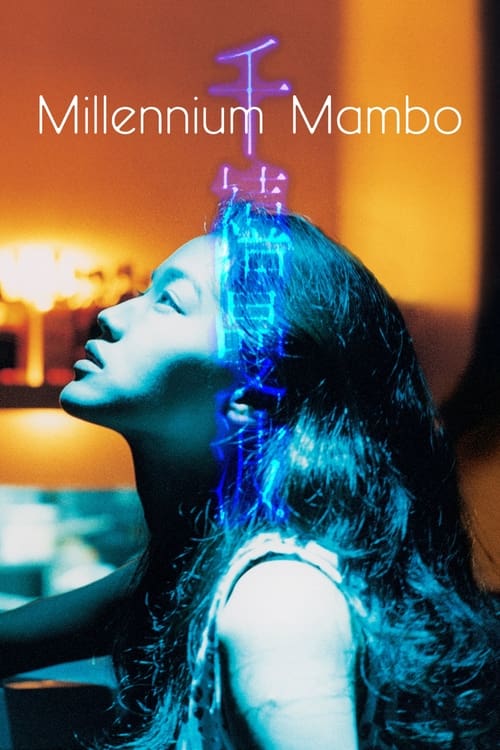
Millennium Mambo
2001 · Hou Hsiao-hsien
For a late night alone when you want to sink into pure atmosphere and let a film wash over you — a moody, meditative drift, not a plot to follow. Comfort for some, a test of patience for others.
What it's about
Vicky is a young woman adrift in Taipei's club scene at the turn of the millennium, narrating her own life from ten years in the future. She drifts between Hao-Hao, a jealous, controlling boyfriend who DJs and burns through her money, and Jack, an older man on the fringes of the underworld whose kindness feels like shelter. Very little "happens" — the film is about the months themselves, the nights out, the time slipping past without being lived.
The experience
Hypnotic and melancholy, like remembering a party you're not sure you enjoyed. It moves to a techno pulse but at a dreamer's pace, all neon and cigarette smoke, and it leaves you with a wistful ache rather than a resolution.
Performances
Shu Qi carries the film almost wordlessly — she makes aimlessness magnetic, letting boredom, tenderness, and flashes of anger pass across her face without ever explaining herself.
The craft
The camera lingers in long, glowing takes, turning club light, smoke, and city neon into the film's real language; the throbbing electronic score does as much storytelling as the dialogue. It's a sensory piece through and through — the bigger the screen and the better the sound, the deeper you sink into it.
Why it matters
It marked Hou Hsiao-hsien's decisive pivot from historical epics to the contemporary moment, and it endures as one of the defining portraits of turn-of-the-millennium youth — beautiful, restless, and going nowhere in particular.
Snapshot
Millennium Mambo is Hou Hsiao-hsien's plunge into the present tense — a mood piece about a young woman adrift in Taipei's club culture at the turn of the millennium. Vicky (Shu Qi) recalls, in a third-person voiceover spoken from a vantage point a decade in the future, the months she spent oscillating between Hao-Hao, a possessive, jealous boyfriend who DJs and squanders her money, and Jack (Jack Kao), an older, gentler man on the fringes of the underworld who offers a kind of refuge. Plot is almost beside the point: the film is built from neon, smoke, techno, late nights, and the sensation of time being burned without being lived. It marked a decisive pivot for Hou away from the historical epics that had made his reputation, toward an atmospheric, near-abstract cinema of contemporary youth. It remains one of the defining objects of early-2000s art-house style — its imagery endlessly reproduced, its languor either celebrated as hypnotic or dismissed as empty, depending on the viewer.
Industry & production
By 2001 Hou Hsiao-hsien was the most internationally garlanded of Taiwanese directors, a fixture of Cannes and the festival circuit since A City of Sadness won the Golden Lion at Venice in 1989. Millennium Mambo was produced through Hou's own production structure (3H Films) in partnership with French and Japanese financing — a typical configuration for prestige Asian art cinema of the period, in which European co-production money (here including France's Paradis Films and Orly Films) underwrote films with limited domestic commercial prospects. This international financing base reflected the realities of the Taiwanese film industry at the time, which was severely depressed: local audiences overwhelmingly favored Hollywood and Hong Kong product, and the auteurs of the Taiwan New Cinema survived largely on festival prestige and foreign subsidy.
The film premiered in competition at the 2001 Cannes Film Festival. Its most concrete festival honor was technical: the film's sound and music team — long-time Hou collaborator Tu Duu-chih and the musician Lim Giong — were recognized by Cannes's Technical Grand Prize (the Commission Supérieure Technique award) for the film's sound design and score. The casting of Shu Qi was itself an industry event of sorts: a star who had emerged through glamour modeling and Hong Kong commercial cinema (including erotically charged early roles), she was here recast as the muse of Taiwan's most austere auteur, a repositioning that the film's promotion and reception both leaned upon.
Technology
Millennium Mambo was photographed on 35mm film, not digital video — a point worth underscoring, because its grainy, glowing nightworld is sometimes mistaken for a video aesthetic. The "look" derives instead from the exposure of film emulsion to mixed, low, colored light: the saturated reds, greens, and blues of club interiors and street neon, captured largely with available and practical light sources rather than conventional film lighting setups. The film belongs to a moment just before digital capture reshaped low-budget art cinema, and its imagery represents a high-water mark of what photochemical film could do with the colored darkness of urban nightlife. For the film's twentieth anniversary, a 4K digital restoration was produced and theatrically re-released (circa 2021–2022), which renewed circulation of the title and re-foregrounded the texture of its original cinematography for a new generation.
Technique
Cinematography
The cinematography is by Mark Lee Ping-bing (Lee Ping-bin), one of the great Asian cinematographers of the era and a frequent Hou collaborator, also celebrated for his work on Wong Kar-wai's In the Mood for Love. His images here favor long lenses, shallow focus, and a roving, often handheld camera that holds on faces and bodies in cramped, smoke-filled interiors. The palette is the film's signature: pools of artificial color, blooming highlights, blacks that swallow detail. The most famous single shot is the opening — a sustained tracking movement following Vicky from behind as she walks through a curving pedestrian overpass, glancing back at the camera, slowed and scored to Lim Giong's "A Pure Person," her voiceover narrating her own younger self as if already lost to memory. It is one of the most quoted images in twenty-first-century art cinema, a compression of the whole film's themes — flight, surveillance, nostalgia — into a single forward glide.
Editing
Editing, by Hou's long-standing collaborator Liao Ching-sung, is elliptical and loose. Scenes are allowed to run long and to drift; transitions skip across time without signposting; the film's structure mimics the disordered, repetitive rhythm of a life lived in nightclubs, where days blur and events recur. The retrospective frame — Vicky's voiceover from "ten years later" — licenses this associative, memory-like construction, in which incident matters less than residue. There is little conventional dramatic build; instead the film accumulates by repetition and variation, returning to the same apartments, the same quarrels, the same neon corridors.
Mise-en-scène / staging
Hou stages the film almost entirely in enclosed, atmospheric spaces: the apartment Vicky shares with Hao-Hao, nightclubs, bars, hotel rooms. The mise-en-scène is dense with the props of a particular subculture and moment — cigarettes, alcohol, DJ equipment, the constant glow of screens and signage. Against the claustrophobic Taipei interiors, the film sets a crucial counter-space: Yubari, a snowbound town in Hokkaido, Japan, associated with two Japanese friends and with the Yubari film festival. The sequence in which Vicky presses her face into the snow, leaving an imprint beside a wall of festival handprints, supplies the film's other iconic image and its central spatial contrast — cold white openness against hot colored enclosure, a momentary exhale from the airless city.
Sound
Sound is where the film is most radical and was officially honored at Cannes. Tu Duu-chih's design layers the persistent ambient hum of the city and the club — bass, chatter, traffic, the texture of rooms — into an enveloping sonic field, while Lim Giong's electronic score, anchored by the recurring "A Pure Person," fuses with that ambience rather than sitting above it as conventional underscore. The result is a film you inhabit aurally as much as visually; the music is not commentary but environment, the pulse of the world Vicky cannot leave.
Performance
The film rests almost entirely on Shu Qi, who is present in nearly every frame and who carries it through physical presence, gesture, and a kind of beautiful passivity rather than through dramatic dialogue. It was a transformative role for her, recasting a commercially typed star as a vessel for Hou's contemplative cinema, and it remains among her most acclaimed performances. Jack Kao, a recurring presence in Hou's films, brings a weathered tenderness to Jack; Tuan Chun-hao plays Hao-Hao with a volatile, suffocating jealousy. The performances are tuned to Hou's naturalistic, low-affect register: behavior observed rather than dramatized.
Narrative & dramatic mode
The film's dramatic mode is anti-dramatic by design. Its organizing device is a third-person retrospective voiceover: Vicky narrates her own past from 2011, referring to her younger self in the third person, as though watching a stranger. This produces a constant elegiac distance — everything we see is already remembered, already gone, framed as the recollection of someone who survived it. The actual story material is slight and cyclical: Vicky keeps leaving Hao-Hao and keeps returning; she drifts toward Jack; she travels to Japan; she keeps spending down a sum of money she had vowed would mark the end of the relationship. There is no climax and no resolution in the conventional sense, only the slow attrition of a young life and the implication, carried by the future-tense narration, of an eventual escape that the film never dramatizes. The mode is lyrical and atmospheric, closer to a tone poem than to plotted drama.
Genre & cycle
Nominally a drama, Millennium Mambo sits within a loose international cycle of turn-of-the-millennium "youth drift" or urban-malaise films — works about disaffected young people in contemporary cities, more interested in mood, texture, and time than in story. It belongs alongside the contemporary-set, atmosphere-forward art films of its moment, and shares clear affinities with Wong Kar-wai's romantic, neon-soaked urban cinema (a kinship reinforced by the shared cinematographer, Mark Lee Ping-bing). Within Hou's own filmography it inaugurated a turn toward present-day, youth-centered subjects that would continue, in different keys, in Café Lumière (2003) and Three Times (2005). It is also frequently invoked as a touchstone of "slow cinema," the loosely defined tendency toward duration, stillness, and contemplative pacing that critics increasingly named in this period.
Authorship & method
The film is a concentrated expression of Hou Hsiao-hsien's mature method and of his core collaborative ensemble — arguably one of the most stable author-teams in world cinema. The screenplay is credited to Chu T'ien-wen, the novelist and screenwriter who had scripted essentially all of Hou's major work; her sensibility, attuned to memory, feminine interiority, and the texture of everyday life, is inseparable from the film's elegiac frame. Cinematographer Mark Lee Ping-bing supplies the visual identity; editor Liao Ching-sung shapes its elliptical rhythm; sound designer Tu Duu-chih and composer Lim Giong build its enveloping aural world. Hou's working method is famously loose and observational — long takes, naturalistic performance, a preference for capturing atmosphere and behavior over executing a rigid script — and Millennium Mambo pushes that method toward near-plotlessness. Where his earlier films applied this patient, observational style to history and memory of the Taiwanese past, here he turns the same instrument on the immediate present, and on a single young woman's experience of it.
Movement / national cinema
Hou is the central figure of the Taiwan New Cinema (Taiwanese New Wave), the movement that emerged in the early 1980s and brought international recognition to Taiwanese film through realist, locally grounded, formally rigorous work — Hou alongside figures such as Edward Yang. Millennium Mambo arrives at the far end of that movement's arc: the New Cinema's founding moment was two decades past, and the film can be read as Hou extending the movement's commitments — observational realism, attention to Taiwanese social texture, formal patience — into a new century and a new, globalized, club-culture Taipei. It is a portrait of a specific national-urban moment: Taiwan's nocturnal youth culture at the millennium, with its imported electronic music, its consumerism, its drift. At the same time, through its Japanese sequences and co-production financing, it registers the transnational character of both its subject and its mode of production.
Era / period
The film is doubly dated by design. Its events are set around the year 2000 — the "millennium" of the title — and narrated from an imagined 2011, so that the contemporary moment is captured already as future-nostalgia. This gives it the quality of a time capsule: it preserves a particular early-2000s sensibility — the fashion, the music, the technology, the social rituals of Taipei nightlife — and simultaneously mourns it in advance. In hindsight the film reads as a near-perfect distillation of a turn-of-the-millennium structure of feeling: the sense of living in a present that is already slipping into memory, of youth being spent in a haze that one will later struggle to reconstruct.
Themes
The film's governing themes are memory, time, and drift. Vicky's future-tense narration makes the whole film an act of remembrance, suffused with the melancholy of a past one cannot re-enter. Entrapment is central: she is caught in a cycle with Hao-Hao she cannot break, in a city she cannot leave, in a life of repetition; the film's circularity is its argument. Against entrapment it sets fugitive moments of release — the snow at Yubari, the kindness of Jack — that promise escape without quite delivering it. Youth and its waste recur: the sense of a young life burned in clubs and quarrels, beautiful and squandered. And throughout there is a thematics of surface and sensation — the film privileges atmosphere, the felt texture of being alive in a particular place and time, over meaning or moral. It is a film about how a present moment feels, and about the impossibility of holding onto it.
Reception, canon & influence
Critical reception was admiring but divided, and that division has persisted. Many critics praised the film as ravishing — a sensory, hypnotic immersion, anchored by Shu Qi's luminous presence and Mark Lee's photography — while others found it slight, an exercise in style and mood without sufficient substance, the work of a major director coasting on atmosphere. Its official recognition came chiefly on the technical and aural side, with the Cannes Technical Grand Prize honoring its sound and music. Over time, the consensus has tilted toward appreciation: the film is now widely regarded as a key work of early-2000s art cinema and a landmark of the contemplative, atmosphere-driven mode.
Looking backward, the film's influences are clearest in Hou's own observational, long-take aesthetic and the Taiwan New Cinema realism he helped found, inflected by an evident kinship with the romantic urban cinema of Wong Kar-wai (with whom it shares cinematographer Mark Lee Ping-bing) and, more broadly, by the international vogue for mood-forward, contemporary-set art films at the millennium. Looking forward, its legacy is more aesthetic than narrative: its neon-and-smoke nightworld, its languorous female-centered drift, and above all its iconic opening tracking shot have become reference points reproduced across festival cinema, music video, fashion imagery, and online film culture. The 4K restoration and twentieth-anniversary re-release confirmed its canonization, presenting it to a new audience less as a difficult competition title than as a beloved object — the definitive cinematic image of turn-of-the-millennium urban youth, beautiful and already lost. Within Hou's career it stands as the hinge between the historical master of the 1980s and 1990s and the contemporary, transnational filmmaker of the 2000s, and it remains, for many viewers, their entry point into his work.
A Deleuzian reading
Vicky walks ahead of the camera down a curving pedestrian overpass, glancing back at us, slowed, while a voice narrates her — except the voice is hers, speaking from ten years on, calling the girl on the screen "she." The techno never breaks.
The full Deleuzian reading of Millennium Mambo →
Reception
Greeted as 'minor Hou' at Cannes 2001 — critics shrugged at the master doing club kids and neon — it has since flipped into one of his most beloved films, with the 2021 4K restoration cementing its rebirth as a moody Y2K touchstone for a new generation of cinephiles.
How Millennium Mambo was received, from release to now →
Influences: the films it descends from and the films it influenced
- Goodbye South, Goodbye (1996) — First turned Hou's observational long-take method onto aimless contemporary youth, with Lim Giong's electronic score and tracking shots trailing characters through transit — the present-tense template Mambo refines.
- Flowers of Shanghai (1998) — Mark Lee Ping-bing's available practical-lamp lighting and slowly drifting long takes inside enclosed interiors — the candlelit precursor to Mambo's neon-lit rooms.
- A City of Sadness (1989) — Established the static/long-take grammar and Liao Ching-sung's elliptical editing that Mambo inherits, here turned from historical memory onto the immediate present.
- L'Avventura (1960) — Pioneered the anti-dramatic, plotless structure built on dead time and a drifting female protagonist whose interiority replaces event.
- L'Eclisse (1962) — Rendered urban malaise through architecture and duration, expressing emotional entrapment as ambient environment rather than plot.
- Late Spring (1949) — Hou's avowed model for narrative ellipsis and patient observation — pillow-shot duration and behavioral attention privileged over dramatic incident.
- Pickpocket (1959) — The flattened, low-affect 'model' performance style that informs Shu Qi's naturalistic, behavioral, un-emphatic acting.
- Chungking Express (1994) — Urban youth malaise built from saturated nightscapes, pop-music drift, and retrospective first-person voiceover over a near-plotless structure.
- Wings of Desire (1987) — Hou deploys future-tense retrospective voice-over over long Steadicam tracks through a Taipei club, using temporal dissonance between narration and image as structural principle — a descendant of Wings of Desire's exploitation of the gap between the angels' eternal perspective and mortal present-tense interiority.
- Fallen Angels (1995) — The opening sequence — a young woman walking a neon-lit pedestrian corridor in step-printed slow motion while her retrospective female voiceover plays against the image — directly cites Fallen Angels' visual and narrative grammar, transplanting Doyle's strobing neon-corridor method to Taipei's nightclub spaces.
- Days of Being Wild (1990) — Voice-over narration identifying the action as already past ('In the year 2001, Vicky was twenty years old') while images unfold in present tense absorbs WKW's temporal inscription and retrospective melancholy, transposing it to Taipei club spaces with slow-motion duration in practical neon light.
- Lost in Translation (2003) — Imports the mood-forward, plotless urban-drift mode and neon nightworld, building atmosphere and ennui over narrative event.
- Norwegian Wood (2010) — Shot by Mark Lee Ping-bing, extending his available-light, long-lens shallow-focus naturalism into an elegiac, memory-framed romance.
- Enter the Void (2009) — Maximalist extension of the neon-smoke nightworld and immersive ambient-electronic sound envelope into a hallucinatory Tokyo clubscape.
- Long Day's Journey Into Night (2018) — Builds memory-and-time structure, retrospective drift, and neon-lit long-take immersion directly out of Hou's contemplative Chinese-language grammar.
- Burning (2018) — Slow-cinema youth malaise and entrapment rendered through elliptical, anti-dramatic duration and naturalistic low-affect performance.
- Last Life in the Universe (2003) — Hou's durational drift and Japan-inflected neon ennui supply the slow-cinema patience and ambient-mood pacing Ratanaruang adopts.
- Left-Handed Girl (2025) — Luminous handheld neon-nightlife cinematography (with Mark Lee Ping-bing) trailing a young woman through the after-dark city as sensory environment.
- In the Mood for Love (2000) — Shares cinematographer Mark Lee Ping-bing; the neon-and-smoke nightworld and slow, mood-forward romantic urban melancholy are a direct visual cousin.
- Vive L'Amour (1994) — Taiwan slow-cinema contemporary: Taipei anomie rendered through near-wordless long takes and plotless behavioral observation of drifting young bodies.
- Yi Yi (2000) — Taiwan New Cinema's present-tense urban observation — naturalistic performance and patient framing turned on contemporary Taipei life.
- Platform (2001) — Hou's contemporaneous continuation of the long-take chronicle of adrift youth, where wall-to-wall diegetic pop marks an era's texture — the same use of period music as a dating device Jia deploys with cassette-tape hits.
Similar films
- Flowers of Shanghai (1998) — influence & lineage · same viewing thread
- Yi Yi (2000) — influence & lineage · same viewing thread
- Long Day's Journey Into Night (2018) — influence & lineage · same viewing thread
- A City of Sadness (1989) — influence & lineage · same viewing thread
- In the Mood for Love (2000) — influence & lineage
- Burning (2018) — influence & lineage
- What Time Is It There? (2001) — same viewing thread
- 2046 (2004) — same viewing thread
All the films related to Millennium Mambo →
Watch it with: curated runs of related films
- Sinophone Slow Cinema — A run of Chinese-language films — Taiwan's New Wave and its mainland and Bi Gan heirs — where time pools and city, family, and memory recur; watch them near each other, from A Brighter Summer Day to An Elephant Sitting Still, for how they rhyme on drift and the weight of the past.