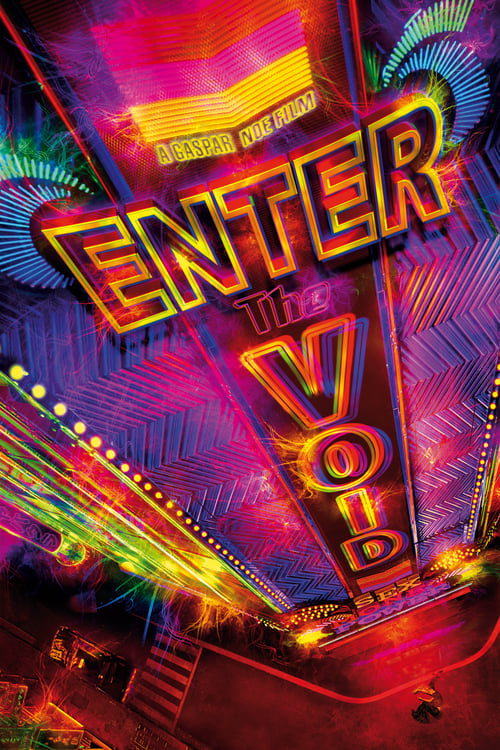
Enter the Void
2010 · Gaspar Noé
For when you want cinema as an altered state — a full-body trip to surrender to, not a story to relax with. This is challenge viewing; save it for a night you're feeling adventurous.
What it's about
Oscar is a young American dealing drugs in Tokyo, living with his sister Linda, to whom he's bound by a childhood promise never to separate. When a police raid on a bar goes wrong and Oscar is shot, the film follows his consciousness as it drifts loose — back through his memories, over the neon city, and into the lives of the people he leaves behind.
The experience
Overwhelming is the word: a strobing, floating, sometimes punishing sensory trip that runs from euphoric to queasy and back. It's less watched than undergone — hypnotic for long stretches, confrontational in others, and hard to shake afterward.
The craft
The entire film is built as one sustained point-of-view experiment — you see through Oscar's eyes, blinks and all, then float bodiless above Tokyo in impossibly gliding camera moves through corridors of neon. The pulsing sound design and hallucinatory light show make this one of the strongest cases anywhere for the biggest screen and loudest system you can find.
Why it matters
A divisive cult landmark that pushed how far a film could commit to pure subjective experience, and the fullest statement of Gaspar Noé's confrontational, sensation-first cinema.
Snapshot
Enter the Void is Gaspar Noé's first-person psychedelic odyssey through death, set in a hyper-neon Tokyo. Oscar, a young American drug dealer, is shot during a police raid on a bar called the Void; the film then follows the dissolution of his consciousness as it drifts back through memory and forward over the lives of those he leaves behind — chiefly his sister Linda, to whom he is bound by a childhood vow never to separate. Noé constructs the entire film as a sustained subjective camera: we see through Oscar's eyes while he lives (blinks included), float behind his head in flashback, and hover bodiless above the city after his death. It is at once a literal dramatization of the Tibetan Book of the Dead's stages of dying and rebirth, a melodrama of orphaned siblings, and a formalist provocation about what cinema can make a viewer inhabit. Long in gestation — Noé had described the project for years before it was made — it premiered in competition at the 2010 Cannes Film Festival, where it divided audiences, and remains one of the most technically audacious experiments in point-of-view filmmaking of its era.
Industry & production
Enter the Void was a European art-cinema co-production, predominantly French-financed and shot largely in studio-built Tokyo sets in France with location and second-unit work in Japan. The producers most associated with the project were Brahim Chioua and Vincent Maraval of Wild Bunch, alongside Noé's longtime collaborators; Wild Bunch handled international sales. The film's scale — extensive miniatures, motion-controlled aerial passages, elaborate digital compositing, and a months-long post-production — made it costly by the standards of auteur-driven European cinema, though precise budget figures should be treated cautiously and I will not assign a number to it. Its financing reflected the model that had sustained Noé's career: relatively modest but patient European money willing to underwrite formal extremity in exchange for festival prestige and a durable arthouse afterlife.
The production was notoriously protracted. Noé spent years developing the concept and securing finance, and the shoot and especially the post-production stretched far beyond conventional schedules because so many shots required bespoke visual-effects solutions. Two principal cuts circulated: a longer version premiered at Cannes (around 2 hours 40 minutes) and a shorter theatrical cut Noé prepared subsequently. This multiplicity of running times is itself characteristic — the film was as much an evolving experiment as a fixed object. Distribution was handled territory by territory through arthouse specialists (IFC Films released it in the United States), and the film's commercial life was always going to be limited by its length, its explicit content, and its punishing strobe-and-sex intensity.
Technology
The film is a landmark of analog-digital hybridity at the threshold of the 2010s. Shot on film and finished through extensive digital intermediate work, it leaned heavily on visual-effects compositing to stitch its apparently unbroken camera moves and to render Tokyo as a luminous circuit board of signage. The "flying" passages — the disembodied camera drifting over rooftops, diving into apartments through ceilings, threading through windows — combined motion-controlled photography, miniature sets, and digital set extension and morphing. Crucially, the famous transitions in which the camera plunges into a light source or a wound and emerges elsewhere were achieved through digital match-moving and compositing that hid cuts inside motion, a technique that anticipated the "invisible edit" long-take aesthetic later popularized in films like Birdman and Gravity.
The opening title sequence — a barrage of flashing credits in clashing typefaces and colors — and the recurring strobe and DMT-trip sequences pushed the limits of what could be rendered as pure light pattern. Noé and his team generated fractal, plasmatic abstractions to visualize the drug experience, drawing on a tradition of psychedelic and structural-film imagery but executed with contemporary digital tools. The result is a film that could only have been made when it was: too dependent on digital compositing for the analog era, yet still rooted in photochemical capture and the physicality of built sets and miniatures.
Technique
Cinematography
Benoît Debie, Noé's cinematographer of choice, is the film's essential co-author. The camera is the protagonist. In the first act we are locked into Oscar's eyeline, the frame blinking shut and reopening, the image swimming as he smokes DMT. After his death the camera detaches and becomes a free-floating consciousness, gliding in long, vertiginous movements that pass through walls and time. Debie renders Tokyo in saturated, sourceless neon — magentas, electric blues, acid greens — so that light itself becomes narcotic. The aerial and overhead shots (the camera frequently looks straight down, tracking figures from above) establish the bodiless vantage of a spirit untethered from gravity. Few films have so completely subordinated every compositional decision to a single conceptual conceit: the eye that cannot die.
Editing
The editing, credited to Noé with collaborators including Marc Boucrot and Jérôme Pesnel, is paradoxical: a film obsessed with the continuous shot is in fact one of the most heavily constructed in modern cinema. Cuts are disguised inside whip-pans, plunges into light, and dissolves through objects, producing the sensation of an unbroken stream of consciousness. Time is handled associatively rather than linearly — Oscar's spirit slides between past and present through visual rhymes (a lamp, a window, a flame). The flashback structure, with the camera floating behind the back of young Oscar's head, marks memory as distinct from both lived first-person experience and post-mortem drift. The rhythm is deliberately exhausting, mirroring the dilation and collapse of time the dying mind is meant to undergo.
Mise-en-scène / staging
Noé's Tokyo is a designed hallucination: the recurring miniature cityscape (a tabletop model of the neighborhood that appears as a motif), the cramped neon-soaked apartments, the strip club where Linda works, the abortion clinic, the love hotel. Staging repeatedly returns to a handful of charged spaces, restaged from new vantages as the spirit revisits them. The film's most discussed staging choices are its most transgressive — a flashing point-of-view of the parents' fatal car crash, the explicit sexual sequences in the love hotel rendered with thermal-like glowing genitalia, and the final, much-debated shot. Every set is keyed to the palette of intoxication.
Sound
The soundscape is immersive and disorienting by design. There is no conventional orchestral score; instead Noé builds an environment of drones, throbbing low-end, distorted club music, and abrupt sonic ruptures. The audio mix is locked to the subjective camera — muffled when Oscar is high, ringing and abstract at the moment of death. Noé's deployment of sound as a physical, almost assaultive force continues the strategy of his earlier work, where bass frequencies were used to induce bodily unease. The film's use of pop and electronic music is diegetic and atmospheric rather than emotional underscoring.
Performance
Performance is radically constrained by the conceit. As Oscar, Nathaniel Brown is for most of the film literally invisible — we occupy his eyes, then watch the back of his head — so his "performance" is voice, breath, and the rare reflected glimpse. Paz de la Huerta as Linda carries the film's emotional and physical exposure, delivering a raw, frequently nude, grief-stricken turn that became one of its most polarizing elements. Cyril Roy as Alex, Oscar's friend and the conduit for the film's Tibetan Book of the Dead exposition, functions partly as guide. The acting is naturalistic and improvisatory in texture, deliberately subordinated to the overwhelming formal apparatus.
Narrative & dramatic mode
The film operates in a subjective, experiential mode rather than a conventional dramatic one. Its narrative spine is a melodrama — orphaned siblings, a childhood pact, a betrayal of innocence, a death — but this story arrives obliquely, recovered in fragments by a drifting consciousness. Noé maps the structure onto the bardo states of the Tibetan Book of the Dead: the moment of death, the panoramic review of one's life, the witnessing of the world left behind, and the drift toward reincarnation. The result is a circular rather than linear dramaturgy; the film ends by looping back toward its own beginning and toward birth. Causality is replaced by association and recurrence. The emotional engine — Oscar's promise never to leave Linda — gives the formal pyrotechnics a tether, though many viewers find the experiential overwhelms the dramatic. It is best understood as a film that wants to be undergone rather than followed.
Genre & cycle
Enter the Void sits at the intersection of several traditions without comfortably belonging to any. It is a "trip film" in the lineage of psychedelic cinema (Kubrick's Star Gate sequence in 2001 is an explicit touchstone Noé has invoked). It is an afterlife fantasy, recalling the metaphysical melodramas of Powell and Pressburger's A Matter of Life and Death. It is part of the loose, much-debated "New French Extremity" — the turn-of-the-millennium cycle of transgressive French cinema (Noé, Catherine Breillat, Bruno Dumont, Claire Denis, Marina de Van) marked by explicit sex, violence, and bodily abjection. And in its relentless subjectivity it belongs to a small experimental cycle of first-person feature filmmaking that stretches back to Robert Montgomery's Lady in the Lake. Its true genre, finally, is the Noé film: a category of one defined by formal extremity as ethical-aesthetic confrontation.
Authorship & method
The film is the fullest expression of Gaspar Noé's authorial project. Argentine-born and Paris-based, Noé had established a signature of provocation with I Stand Alone (1998) and Irréversible (2002): reverse or disorienting chronology, punishing long takes, low-frequency sound, on-screen text as assault, and a fascination with mortality, sex, and the body. Enter the Void had long been his dream project, and he is credited with the story and direction and shares editing duties. His method is total environmental control — building Tokyo to be revisited from any angle — paired with improvisatory looseness in performance.
The authorship is genuinely collaborative in a few decisive partnerships. Cinematographer Benoît Debie is indispensable; the film is unthinkable without his rendering of light. The visual-effects supervision (a large team, with effects houses including BUF among contributors to the compositing and abstract imagery) is so central that the VFX artists function as co-cinematographers of the impossible. Rather than a conventional composer, Noé curated an electronic and sound-design-led sonic world. Co-writer Lucile Hadžihalilović — filmmaker in her own right and Noé's longtime creative partner — is credited on the screenplay, a collaboration that recurs across his career. The "auteur" here is really a tightly integrated unit organized around Noé's vision.
Movement / national cinema
Within French national cinema, Enter the Void exemplifies the state-supported, festival-oriented auteur tradition pushed to a transgressive extreme — the strand of French production that prizes singular directorial vision and is willing to fund formal risk. It is most often grouped with the New French Extremity, the critical label (coined in the Anglophone press) for the wave of confrontational French films of the late 1990s and 2000s. Yet the film is deliberately transnational: an Argentine-French director, an American protagonist, a Tokyo setting, English-language dialogue, and pan-European financing. It belongs to a globalized art cinema in which national categories blur, even as its production base and aesthetic sensibility remain unmistakably rooted in the French auteurist apparatus.
Era / period
The film is a creature of the late-2000s / early-2010s threshold, when digital intermediate finishing and affordable high-end compositing made previously impossible camera moves achievable for ambitious auteurs working outside the Hollywood blockbuster system. It arrived amid a broader vogue for the bravura long take and the "immersive" subjective image that would soon surface in mainstream prestige cinema. Culturally, it reflects a moment of fascination with altered states, near-death and out-of-body experience, and the cinematic rendering of consciousness. Premiering at Cannes in 2010, it stands as a high-water mark of pre-streaming arthouse maximalism — a film conceived for the overwhelming scale and darkness of theatrical projection.
Themes
Death and the persistence of consciousness are the central preoccupations: the film literalizes the question of what, if anything, the mind perceives as it dies and after. Reincarnation and the cyclical nature of existence give it its circular form, drawn directly from the Tibetan Book of the Dead. Bound up with these are the themes of the sibling bond and the trauma of separation — the orphaning car crash and the childhood promise structure every later choice. Sex and birth are treated as continuous with death, parts of a single biological cycle, which is why the film's most explicit imagery is also its most metaphysical. Addiction and the drug experience function both literally and as a model for the dissolution of the ego. And running beneath everything is voyeurism and the ethics of looking — Noé implicates the spectator in an unbroken, unblinking gaze that cannot turn away, making the act of watching itself the film's deepest subject.
Reception, canon & influence
Critical reception was sharply, even violently divided — the characteristic Noé effect. Admirers hailed it as a visionary, once-in-a-generation formal achievement, a genuine attempt to film the unfilmable; detractors found it empty, indulgent, pornographically excessive, and punishingly overlong. This polarization was evident from its Cannes premiere and persisted through its theatrical release. Over time a critical consensus has settled on respect for its technical audacity even among those unmoved by its emotional or philosophical payoff; it is now widely regarded as a major, if exhausting, achievement and a touchstone for discussions of subjective cinema.
The influences on the film are openly acknowledged and eclectic: Kubrick's 2001: A Space Odyssey (the Star Gate and the cosmic-rebirth ending), Robert Montgomery's first-person Lady in the Lake, Powell and Pressburger's afterlife fantasy A Matter of Life and Death, the structural and psychedelic experimental-film tradition, and the Tibetan Book of the Dead as a literary-spiritual blueprint. Noé's own Irréversible, with its plunging camera and temporal inversion, is the immediate precursor.
Its legacy forward is most visible in the subsequent mainstreaming of the disguised-cut long take and the immersive subjective camera — the "unbroken" aesthetic of films like Gravity and Birdman, the first-person experiments of Hardcore Henry, and a broad influence on music videos, advertising, and the visual language of immersive media and VR, where the disembodied floating viewpoint has become a familiar grammar. Within Noé's own career it set the template for the sensory-assault works that followed, Love and Climax. Enter the Void endures less as a film people claim to enjoy than as one filmmakers and critics return to — a benchmark for how far cinema can push pure point of view, and a reference point whenever the camera tries to become a mind.
A Deleuzian reading
The first thing *Enter the Void* teaches you is that you have eyelids.
The full Deleuzian reading of Enter the Void →
Reception
Booed and walked out on at its unfinished 2009 Cannes premiere and dismissed by many critics as an exhausting provocation, it has since become a fixture of the 'trip film' canon — the movie a generation of stoned cinephiles passed around like contraband.
How Enter the Void was received, from release to now →
Influences: the films it descends from and the films it influenced
- Lady in the Lake (1947) — Locks the camera to the protagonist's literal eyeline for the whole film, the hero visible only in mirrors — the sustained first-person POV grammar Noé revives for Oscar's living half.
- Meshes of the Afternoon (1943) — Builds a looping, dream-logic structure where a drifting subjective camera circles back on itself, prefiguring the associative-nonlinear, bardo-circular editing architecture.
- A Matter of Life and Death (1946) — Stages the afterlife as a literal threshold the dying consciousness crosses, the fantasy-of-passage template Noé reworks into a Tokyo bardo.
- Dog Star Man (1964) — Hand-worked superimposition and abstract pulsing light as direct figuration of consciousness — the structural/psychedelic experimental tradition behind the film's abstract VFX interludes.
- 2001: A Space Odyssey (1968) — The Star Gate's slit-scan abstraction and the fetal cosmic-rebirth coda are explicitly reverse-engineered for Oscar's reincarnation ending.
- Jacob's Ladder (1990) — Renders a dying mind's hallucinated descent as a coherent diegesis the viewer can't distinguish from reality — the perceptual-unreliability device driving the post-death passages.
- Russian Ark (2002) — Proves a feature-length unbroken floating Steadicam take as narrative engine, the disguised-continuity ambition Noé pushes into the invisible-edit ceiling shots.
- Irréversible (2002) — Noé's own immediate precursor: the plunging vertiginous camera, temporal inversion, and 28Hz low-frequency drone are the toolkit he scales up here.
- A Clockwork Orange (1971) — Noé and cinematographer Benoît Debie push ACO's subjective wide-angle strategy to its logical formal limit: an entire feature shot in strict first-person POV with fisheye distortion, making Alcott's 9.8mm technique — which occupied only certain sequences in ACO — the total and unrelenting grammar of the film's consciousness-camera.
- Requiem for a Dream (2000) — Noé extended Requiem's fiber-optic-POV logic to its limit by making the entire film a sustained first-person subjective experience, rendering drug states and out-of-body travel as pure optical phenomenology — a project made conceivable by Aronofsky's establishment of the device as a legitimate instrument for rendering consciousness.
- Fear and Loathing in Las Vegas (1998) — Noé sustains first-person gonzo-immersion camera for the film's entire duration — blinking eyelids and all — making drug-induced altered consciousness not a set-piece but the film's only optical register, extending Gilliam's principle that the viewer must inhabit the protagonist's compromised perception without reprieve or cutaway to objectivity.
- Eyes Wide Shut (1999) — Carries forward the neon-lit nocturnal dream-drift through a city of desire and ritual, dissolving the boundary between subjective vision and event.
- Gravity (2013) — Mainstreams the disguised-cut unbroken long take and weightless drifting POV, the floating-viewpoint grammar Noé helped normalize for immersive spectacle.
- Birdman (2014) — Engineers an entire feature as one seamless invisible-edit take, productionizing the hidden-cut long-take aesthetic into awards-circuit cinema.
- Hardcore Henry (2015) — Extends the locked first-person camera to feature length via GoPro rigs, the literalized POV experiment Noé reactivated.
- Love (2015) — Carries forward the neon-drenched, explicit-sex, electronic-scored sensory program — Noé's own continuation of the template Enter the Void set.
- Climax (2018) — Pushes the floating overhead long take, curated electronic soundscape over orchestral score, and designed-hallucination staging into a single-location bad-trip.
- Backrooms (2026) — Its untethered floating POV that drifts through and clips past solid architecture directly prefigures the 'noclip' roaming camera.
- Doctor Strange (2016) — The untethered, drifting subjective camera of Strange's out-of-body sequences borrows Noé's disembodied-consciousness POV that floats through and clips into solid architecture.
- Mandy (2018) — Its extended psychedelic light-passages and long dissolving transitions that render altered consciousness as pure color-and-motion abstraction feed Mandy's drug-trip sequences and dissolve-based editing.
- Waves (2019) — Pioneers the first-person/360-degree roving camera gliding through neon-saturated space, the disorienting subjective float Waves deploys in its party and driving sequences.
- Challengers (2024) — Pioneers the impossible-vantage subjective rig that plants the viewer inside the perceptual field of the action — the lineage behind Challengers' under-court angles and ball's-eye-view camera.
- Vortex (2021) — The black inter-title chapter cards and the structuring of the film as a descent through dissolving consciousness carry over wholesale, redirected from psychedelia to dementia.
- Spring Breakers (2012) — Benoît Debie carries his neon-saturated, candy-toxic light directly from this film's nightscapes into a contemporaneous register of the same palette.
- Lost River (2014) — Debie again supplies the underworld-neon photography, extending the Enter the Void light scheme into another director's dreamscape.
- Under the Skin (2013) — Uses abstract black-void spaces and an alien subjective optic to dissolve a body into pure perception, paralleling the consciousness-as-camera project.
- The Tree of Life (2011) — Deploys Douglas Trumbull's 2001-lineage cosmic effects and associative, time-unmoored editing to film birth-and-death on a metaphysical scale.
- Only God Forgives (2013) — Both films submit Tokyo and Bangkok respectively as neon-saturated underworld spaces to a rigorous non-kinetic formal discipline — the city's visual excess is made contemplative rather than kinetic; both share the deliberate arrest of conventional dramatic momentum through protracted duration and the treatment of transgression as aesthetic material requiring formal distance rather than moral coding.
- The World of Kanako (2014) — Subjective, neon-drenched first-person gaze and disorienting time structure that force the viewer inside a degraded consciousness — kin to Kanako's implicating, predatory point-of-view aesthetics.
- Petrov's Flu (2021) — A first-person floating camera renders a drug/death trip as continuous hallucinatory fever-dream, paralleling Petrov's subjective reality-dissolution.
- Possessor (2020) — Floating, disembodied first-person camera and strobing psychedelic abstraction render consciousness untethered from body, the same unstable-POV/abstraction toolkit Karim Hussain deploys.
- Gozu (2003) — Descendant in the oneiric-rebirth lineage — a picaresque drift through a neon-banal city culminating in literal rebirth from a woman's body, the same desire-death-rebirth bodily circuit Gozu closes on.
- Kotoko (2011) — Fully first-person subjective POV that dissolves the seam between what is seen and what is hallucinated, a maximalist cousin to Kotoko's interior-POV staging.
- Nickel Boys (2024) — Governs its entire form with a disembodied floating first-person POV, proving the subjective camera can be a structural principle rather than a gimmick shot.
- The Lovely Bones (2009) — A contemporaneous experiment in a subjective post-death POV drifting above the living, using digital abstraction to visualize the dead consciousness's untethered vantage — the same year, the opposite tonal wager.
Similar films
- Climax (2018) — influence & lineage · often watched together
- Irreversible (2002) — influence & lineage
- Kotoko (2011) — same viewing thread · often watched together
- Paprika (2006) — same viewing thread
- Mind Game (2004) — same viewing thread
- Eureka (2001) — often watched together
- Jacob's Ladder (1990) — influence & lineage · often watched together
- In the Realm of the Senses (1976) — often watched together
All the films related to Enter the Void →
Watch it with: curated runs of related films
- Doubles, Dreams, and Dissolving Selves — Watch these when you want the floor to give way — dream machines, hypnotists, doppelgängers, and haunted houses where perception and identity quietly come undone.