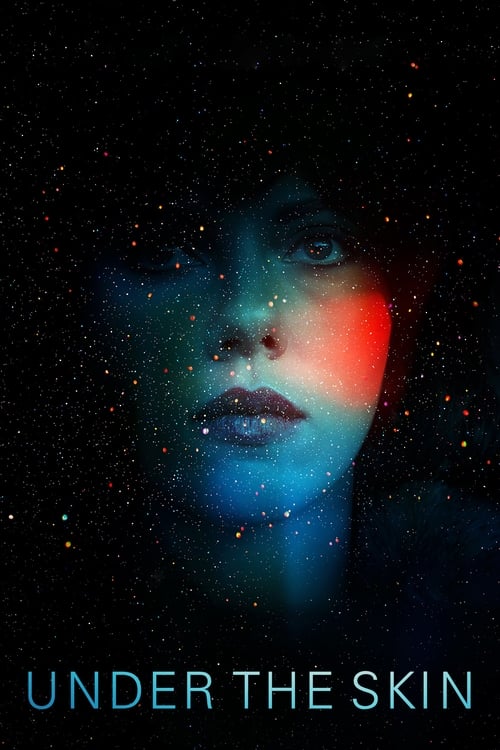
Under the Skin
2014 · Jonathan Glazer
The Zone of Interest made him a once-a-decade event director, then his Oscars speech refusing "Jewishness being hijacked by an occupation" became one of the most contested awards moments ever, with open letters both denouncing and defending him. Impossible to invoke neutrally.
For when you want a film to chew on for days and you're willing to be unsettled to get it — this is a challenge, not a comfort, best watched late, alone or with someone who won't talk. Reach for it when you're craving strange and beautiful over fast and fun.
What it's about
An alien wearing the body of a beautiful young woman drives a van through Glasgow, chatting up solitary men and luring them somewhere they don't come back from. She is a predator running a routine — until the human life she's been imitating starts to get under her skin, and her curiosity about what she's wearing becomes dangerous to her. It follows her from city streets to the Scottish coast and highlands as the hunt slowly turns into something else.
The experience
Hypnotic and genuinely unnerving — long stretches of near-silence, ordinary Scottish streets that feel alien, and a score that gets into your nervous system. It moves slowly and asks you to sit with it, then lands images you will not shake for weeks.
Performances
Scarlett Johansson does something remarkable: she plays a thing learning to be a person, and makes blankness expressive. Much of her street footage was shot with hidden cameras among real, unsuspecting passersby, which gives her scenes an eerie documentary charge.
The craft
Jonathan Glazer splices hidden-camera realism — real Glasgow, real people — with stretches of pure abstraction: black voids, liquid light, images that feel beamed in from somewhere inhuman. Mica Levi's scraping, swarming score is one of the most influential of its decade and half the reason the film works. Big screen and good speakers aren't optional here; the sound is the horror.
Why it matters
A commercial flop that became one of the most acclaimed films of the 2010s, it redefined Glazer as a major art-film director and made Mica Levi's score a landmark that a generation of horror and art-house composers has chased since.
Snapshot
Under the Skin is Jonathan Glazer's third feature and the film that recast him from a gifted stylist of crime and grief into one of the most uncompromising art-cinema directors working in English. Loosely adapted from Michel Faber's 2000 novel, it follows an unnamed alien wearing the body of a young woman (Scarlett Johansson) as she drives a white van through Glasgow and the Scottish countryside, luring solitary men to a literal void where they are harvested. What begins as a predatory routine slowly curdles into something stranger: the creature's dawning, fatal curiosity about the human form she inhabits. The film is celebrated for its radical formal austerity — minimal dialogue, hidden-camera realism spliced with stark abstraction, and Mica Levi's landmark debut score. It is at once a science-fiction film, a horror film, an essay on the gaze, and a near-wordless study of embodiment, and it has become one of the most influential English-language art films of its decade.
Industry & production
The project's defining feature is the length and difficulty of its gestation. Glazer developed the adaptation for roughly a decade following Birth (2004), cycling through screenplay drafts and, by his own account in interviews, far more elaborate and expensive conceptions of the material — including reportedly a larger-scale version closer to the novel's plot. The film that emerged is the product of deliberate reduction: budget, dialogue, and exposition all stripped away until only a sensory armature remained. The final screenplay is credited to Glazer and Walter Campbell, a longtime collaborator from Glazer's advertising work; the two pared Faber's satirical, plot-heavy novel down to its primal situation.
Financing came from the British public-art-cinema ecosystem — Film4 and the BFI Film Fund, with Creative Scotland support reflecting the Scottish shoot — alongside private equity (Silver Reel) and the American producer Nick Wechsler, with Glazer's own JW Films. This is a characteristically British art-film funding stack, and it explains both the film's freedom and its modest scale. Precise budget figures reported in the press should be treated cautiously; what is clear is that the production was modestly resourced for a film starring an A-list American actor, and that much of its expressive power was achieved through method rather than money. It premiered in competition at the Venice Film Festival in 2013 — where it drew a famously divided response, including audible booing — before a 2014 theatrical release, distributed in the United States by A24 in what became one of that young company's signature early titles.
Technology
Under the Skin's most discussed technical gambit is its hybrid capture method. For the seduction scenes set on Glasgow's streets, Glazer rigged the van and surrounding locations with small, concealed digital cameras and filmed Johansson — in a dark wig and unglamorous coat, largely unrecognized — approaching real, non-professional men who did not initially know they were being filmed. Those who responded were subsequently approached by the production, told the truth, and asked to sign releases; the footage of men who declined was not used. This documentary-grade hidden-camera apparatus, blended with conventionally staged material, gives the film its uncanny tonal seam between observed reality and constructed nightmare.
Against this realism, the film deploys frank artifice for its abstract sequences: the seductions resolve in an inky black void where the men, transfixed, walk forward and sink into a reflective liquid surface. These were achieved practically, on built sets with controlled lighting and reflective black floors, rather than as purely digital constructions, which is part of why they feel so physically present and so hard to place. The visual-effects work is restrained and integrated rather than spectacular — a deliberate refusal of the genre's usual idiom.
Technique
Cinematography
Daniel Landin's photography is fundamental to the film's identity. The hidden-camera street footage is grainy, available-light, and documentary in texture — overcast Glasgow rendered with no glamour. The staged material, by contrast, is composed with cold precision: the alien's face isolated in close-up behind windscreen reflections, the abstract void scenes built from pure black with a single luminous figure, the Highland landscapes vast and indifferent. Landin and Glazer repeatedly frame Johansson watching, the camera adopting her studying, affectless gaze, so that the film's point of view is itself alien — humanity observed as specimen. The palette runs to muted grays and blacks punctuated by the red of her lips and coat.
Editing
Paul Watts's editing controls the film's hypnotic, deliberate rhythm. The cutting is patient, holding on faces and landscapes well past conventional comfort, and it orchestrates the film's central tonal modulation — from the repetitive, almost procedural early predation to the increasingly fragmented, drifting passages of the second half, as the creature loses her purpose. The editing also manages the delicate intercutting of hidden-camera reality with staged abstraction, a join that could have read as a gimmick but instead sustains a single, coherent dream-state.
Mise-en-scène / staging
The film's staging swings between extremes: the cluttered, vérité specificity of Scottish shopping precincts, nightclubs and roadside laybys, and the absolute emptiness of the black harvesting space. Glazer stages the seductions as quiet, almost banal transactions that turn, without a visible threshold, into something abyssal. The recurring motorcyclist "handlers" who clean up after the alien introduce a note of bureaucratic, unexplained menace. Crucially, Glazer withholds explanation at every turn — there is no exposition of the aliens' purpose, biology, or origin — so that the mise-en-scène carries meaning the script refuses to state.
Sound
Sound design and Mica Levi's score are inseparable from the film's effect, and the soundtrack is one of its towering achievements. Levi — known as the musician Micachu, and scoring her first feature — built the music largely from violas and strings, slowed, detuned, and processed into something that seems to throb beneath the skin: insectile glissandi for the predation, a queasy seductive pulse for the void scenes. The music functions as the alien's interiority made audible, a senscorium we are denied in words. The dense Scottish accents of the hidden-camera footage, sometimes near-unintelligible, deepen the sense of a human world overheard rather than fully understood.
Performance
Scarlett Johansson's performance is a study in subtraction. For much of the film she plays a being mimicking humanity without possessing it — her affect flat, her smile a learned tool, her watchfulness total. The casting is itself part of the meaning: a globally famous emblem of desirability deployed precisely as a predator weaponizing desire, then stripped, over the film's course, into vulnerability and finally horror. The non-professionals she encounters supply much of the film's reality. Most striking is Adam Pearson, a man with neurofibromatosis, who plays a solitary young man she lures and then, in the film's pivot toward empathy, spares — a sequence that turns the film's interest in the gaze and the human face into something tender and unbearable.
Narrative & dramatic mode
The film operates in an anti-expository, sensory-immersive mode that is closer to experimental cinema than to genre storytelling. Its narrative is simple and mythic — a predator who begins to feel, abandons the hunt, and is destroyed by the very humanity she approaches — but it is delivered almost entirely through behavior, image, and sound rather than dialogue or plot mechanics. The dramatic arc is one of inversion: the hunter becomes the hunted. Having spared the disfigured man, the creature flees her mission, wanders the Highlands, attempts to eat and to be touched as a human would, and ultimately encounters human predation herself when a forestry worker attempts to rape her; in the struggle her human skin tears, revealing the black form beneath, and he burns her alive in the snow. The film ends with smoke rising into an indifferent sky — a fall from predator to victim that doubles as a tragedy of failed embodiment.
Genre & cycle
Under the Skin sits at the intersection of science fiction, horror, and art film, and it belongs to a small lineage of alien-among-us films treated as existential rather than spectacular — most obviously Nicolas Roeg's The Man Who Fell to Earth (1976), with which it is constantly compared. It arrived at the leading edge of the 2010s wave of austere, atmosphere-driven genre cinema — often loosely labeled "elevated horror" — that A24 in particular came to represent. But it resists the cycle's conventions as much as it anchors them: there is no clear monster logic, no third-act explanation, and the horror is philosophical, located in the alien's perception of human bodies as objects, food, and mystery.
Authorship & method
The film is a near-total expression of Glazer's authorship, but it is also a portrait of a director who works through collaboration and obsessive iteration. Glazer came to features from a celebrated career in music videos (Radiohead, Massive Attack, Jamiroquai) and commercials (the Guinness "Surfer" spot), a background visible in his command of image-and-sound as primary meaning. His method here was famously protracted and exploratory — years of rewriting with Walter Campbell, the decision to film real strangers, the willingness to discard a more conventional and expensive film in favor of abstraction. Daniel Landin's cinematography, Paul Watts's editing, and above all Mica Levi's score are not decorative contributions but co-authors of the film's logic; Glazer's signature is precisely his ability to fuse such collaborators into a single sensibility. The result is a film that feels authored to the molecule while remaining genuinely collective.
Movement / national cinema
Under the Skin is a British art film, funded through the UK's public-cinema institutions and rooted physically in Scotland — Glasgow's streets, the surrounding countryside, the Highlands. It belongs to the strand of British cinema that prizes formal risk and landscape over social realism's usual register, and its Scottish setting is integral rather than incidental: the anonymity of the crowds, the specific texture of the accents and weather, the emptiness of the terrain into which the alien flees. It can be read alongside a tradition of outsider-in-Britain films, but its closest kin are art-cinema works that use genre as a vehicle for metaphysics. Internationally, it reflects the festival-and-boutique-distributor economy — Venice premiere, A24 release — through which such ambitious English-language work now reaches audiences.
Era / period
Released in 2013–2014, the film is very much of the early digital-cinema moment, exploiting lightweight, concealable cameras in ways that would have been impractical a decade earlier, and arriving as boutique distributors were reshaping the market for difficult art films. It also reflects a period of renewed seriousness about science fiction as a vehicle for ideas about embodiment, gender, and perception. Its preoccupations — the surveilling gaze, the woman's body as both weapon and trap, the alien's-eye view of human desire — landed in a cultural moment increasingly attuned to questions of looking and objectification, and the film has only grown in stature as those conversations have intensified.
Themes
At its core the film is about embodiment — what it is to wear a body, to be seen as one, and to feel from inside one. It systematically reworks the cinematic male gaze: the camera's habitual objectification of the desirable woman is literalized as predation, then turned inside out as the alien herself becomes an object of male violence. It is a film about empathy and its costs — the creature's destruction follows directly from her first stirrings of fellow-feeling. It meditates on the human face (the Adam Pearson sequence), on appetite and consumption, on alienation in its most literal sense, and on the gulf between performing humanity and possessing it. Its refusal of explanation makes these themes resonant rather than didactic; the film thinks through sensation.
Reception, canon & influence
Critical reception evolved from the polarized Venice premiere — admiration and bafflement, including booing — into broad acclaim. Over 2014 the film accumulated strong reviews and a prominent place on year-end best-of lists, and by the decade's close it featured regularly on critics' best-of-the-2010s rankings, securing its position in the contemporary art-cinema canon. Mica Levi's score in particular was widely cited as among the finest of recent film music and brought her significant recognition; readers should consult awards records for specific nominations rather than rely on summary here.
Its influences run backward to Nicolas Roeg's The Man Who Fell to Earth and to Stanley Kubrick's 2001: A Space Odyssey in its cosmic abstraction and patient awe, with critics also invoking the structural and avant-garde traditions and the existential alien-encounter film generally; the immediate source is Michel Faber's novel, radically transformed. Glazer has spoken in interviews of long development and many discarded conceptions rather than naming a tidy list of models, so specific attributions beyond these widely noted touchstones should be made with care.
Forward, the film's influence has been considerable. It helped legitimize the austere, sensory, ambiguity-embracing mode of art-horror that defined much of the 2010s independent landscape, and it stands as a touchstone for filmmakers pursuing science fiction as interior, philosophical experience. Mica Levi's success here opened a path that continued with subsequent acclaimed scores (notably Jackie), influencing a turn toward dissonant, texture-based film music. For Glazer himself it confirmed a method of patient, formally radical filmmaking that he carried forward to The Zone of Interest (2023). More than a decade on, Under the Skin is regularly taught and cited as a model of how genre, abstraction, and real-world capture can be fused into a singular, disquieting whole.
A Deleuzian reading
Start with the face.
The full Deleuzian reading of Under the Skin →
Reception
Booed and cheered in equal measure at its Venice 2013 premiere and a genuine box-office flop, it spent the rest of the decade climbing best-of lists — by 2019 it was a fixture near the top of 'best films of the 2010s' polls.
How Under the Skin was received, from release to now →
Influences: the films it descends from and the films it influenced
- The Man Who Fell to Earth (1976) — Casts a pop icon (Bowie) as a literally alien body and fractures the alien's perception through elliptical, disorienting cross-cut editing — the exact template Glazer reworks by casting Johansson and filtering an ordinary Earth through an estranged gaze.
- 2001: A Space Odyssey (1968) — The black-void abstraction and slow non-verbal awe of the Stargate/monolith sequences model meaning carried by image-and-sound alone — directly echoed in the black-room harvesting voids that replace exposition entirely.
- Persona (1966) — Performance-by-subtraction: a near-blank female face whose withholding becomes the drama, and identity dissolving through affectless staring — the acting grammar behind Johansson's emptied-out alien.
- Repulsion (1965) — Builds horror from a woman's subjective, sensory interior rather than plot, treating environment as externalized perception — the apartment-as-mind logic Glazer projects outward onto Glasgow.
- The Passenger (1975) — Documentary capture of real landscapes and crowds around a drifting, opaque protagonist, rendering alienation through architecture and patient long observation rather than psychology.
- Stalker (1979) — Patient, textural rhythm and the 'zone' as a rule-bound sensory space crossed slowly — the deliberate, hypnotic tempo and material-surface attention Glazer adopts.
- Carnival of Souls (1962) — An uncanny woman adrift among ordinary people, shot in stark available light with an eerie drone score — a low-budget prototype of the austere, ambiguity-embracing elevated-horror tone.
- Bicycle Thieves (1948) — Neorealist non-professional casting and on-the-street capture of unscripted life as the bedrock of authenticity — the principle Glazer radicalizes by filming unwitting real strangers with hidden cameras.
- Birth (2004) — Glazer's own prior film establishes the patient long-take method and a star (Kidman) performing through stillness and subtraction — the directorial discipline carried directly into Under the Skin.
- Solaris (1972) — Glazer transposes Tarkovsky's alien-as-mirror device — an alien body accumulating human psychological weight — into Mica Levi's pre-ambient score, whose organic-electronic timbres directly descend from the ANS's biological-synthetic fusion, while the film's affect-suppressed performance logic applies Solaris's internalized-affect mode to a female body.
- Eraserhead (1977) — Mica Levi's score functions as environmental dread rather than dramatic underscoring — the same Splet-derived logic of sound as atmosphere rather than commentary — while Johansson's locked-off, expressionistically still performance and the film's body-horror defamiliarization of human flesh descend directly from Eraserhead's staging and performance vocabulary.
- Sexy Beast (2001) — Glazer extends Sexy Beast's space-as-entrapment principle to its most abstract register: the van-interior seduction sequences use the same logic of contained space as psychological and physical trap, with silence deployed as the primary menace instrument and the protagonist's incoherence — her inability to fully inhabit human performance — generating dread rather than empathy.
- The Witch (2015) — Austere naturalistic dread built from period available light, thick regional accents and slow-build sensory horror — part of the A24 elevated-horror lineage Under the Skin helped legitimize.
- Annihilation (2018) — Renders alien encounter as bodily, interior experience and closes on near-abstract image-and-sound (Salisbury/Barrow's dissonant texture score) in place of explanation — sci-fi as philosophical sensation.
- High Life (2018) — Interior, embodiment-driven sci-fi of confinement and bodily fluids over plot, treating space travel as sensory-philosophical experience rather than spectacle.
- Jackie (2016) — Mica Levi's direct follow-up score transplants the same swooning, detuned glissandi to a biopic — the continuation of the dissonant, texture-based film-music turn she launched here.
- The Zone of Interest (2023) — Glazer pushes the Under the Skin method further with hidden multi-camera rigs, available-light 'real capture' staging, and a Mica Levi sound-design score that replaces conventional drama with sensory dread.
- I Saw the TV Glow (2024) — Demonstrates withheld interiority as a formal principle — a blank, isolated-in-frame protagonist scored by alien electronic drone — so that alienation is rendered texturally rather than through dialogue or backstory.
- Morvern Callar (2002) — Scottish, anti-expository sensory cinema centered on an opaque woman, using available-light textures and music-as-interiority — the closest national and aesthetic cousin in British art cinema.
- Beau Travail (1999) — Tells through bodies-in-abstraction, ritual movement and elliptical sensory image over narrative — the embodiment-first, plot-averse mode Under the Skin shares.
- There Will Be Blood (2007) — Jonny Greenwood's dissonant, texture-based string score — out of the same Radiohead milieu Glazer came from — is the immediate model for Levi's atonal, glissando-driven scoring as primary meaning.
- Ex Machina (2014) — Cool, clinical interrogation of the gaze upon a synthetic female body who turns the hunt around — the inverted-male-gaze, hunter-becomes-hunted predicament staged through observation.
- The Ice Tower (2025) — A masklike female icon rendered through opaque performance, a designed soundscape over sparse score, and a slow, gliding camera that estranges the human face.
- Sirāt (2025) — Generates dread by welding an electronic score to alien landscape and casting non-professionals in unscripted encounters, paralleling Sirāt's score-driven non-pro method.
- Only God Forgives (2013) — Radical performance minimalism in which an affectless protagonist traverses stylized urban and natural space with internal life withheld from the camera entirely, meaning conveyed through visual texture and electronic score rather than psychology, dialogue, or conventional dramatic revelation — the formal premise is identical, applied to a female and science-fiction context.
- Her (2013) — An alien consciousness learning to register human embodiment and emotion through close tactile observation — rendered entirely through Mica Levi's chamber score and extreme close-up work — the sibling approach to Her's central formal problem of a non-human intelligence learning to feel through sensory experience.
- Enemy (2014) — Glazer and DP Daniel Landin push digital desaturation into a monochromatic affective register where color functions as psychological temperature rather than representational information — the same totalizing-grade strategy Enemy applies with its amber monoculture — and both films use this chromatic reduction to render the human body as alien terrain within an otherwise recognizable urban landscape.
- Arrival (2016) — Alien intelligence rendered through procedural opacity and physical ritual without expository disclosure; the desaturated visual palette, refusal of conventional narrative resolution, and treatment of the human body as site of cognitive estrangement run parallel to Arrival's formal commitments without direct influence.
- Us (2019) — Glazer uses differential color grading to partition the alien's interior void from the world she passes through, and stages threshold crossings — van doors, liquid floors, water surfaces — as the film's structural pivots, a formal vocabulary Us shares in its underground/surface color-coding and its obsessive return to the beach as threshold space.
- The Substance (2024) — The implicating gaze that watches Scarlett Johansson being watched by men, making the camera structurally complicit in the male gaze it anatomises; diegetic sound design (Mica Levi) that renders the female body simultaneously alien and hyper-tactile.
Similar films
- Annihilation (2018) — influence & lineage
- Birth (2004) — influence & lineage
- The Zone of Interest (2023) — influence & lineage
- Sirāt (2025) — influence & lineage
- The Invisible Man (2020) — shared sensibility
- The Girl with the Dragon Tattoo (2011) — shared sensibility
- The Skin I Live In (2011) — shared sensibility
- Blade Runner 2049 (2017) — shared sensibility
All the films related to Under the Skin →