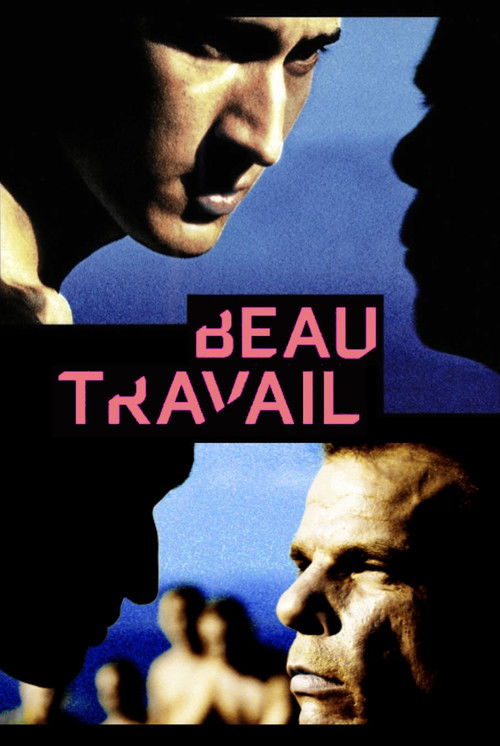
Beau Travail
2000 · Claire Denis
For when you want to be transported rather than told a story — a late-night, lights-off film that asks for patience and repays it with images you'll carry for years. Firmly on the challenge end, but a short one, and unforgettable.
What it's about
At a French Foreign Legion outpost on the scorched coast of Djibouti, a rigid sergeant runs his troops through drills, chores, and exercises that look more like choreography than combat training. When a handsome, effortlessly well-liked young recruit arrives, something curdles in the sergeant — a jealousy he can't name and can't control. He tells the story himself, looking back from exile, trying to understand what he did and why.
The experience
Hypnotic and strange — almost wordless stretches of men training, marching, and moving under desert light, charged with tension that never gets spoken aloud. It works on you like music: you feel the envy and longing in bodies and rhythm before you could ever explain the plot.
Performances
Denis Lavant is extraordinary as Galoup — a coiled, weathered body that expresses everything the character can't say, culminating in one of the most talked-about pieces of physical acting in modern cinema.
The craft
Claire Denis strips out dialogue and psychology and builds the film from movement, landscape, and sound instead — sun-bleached rock, salt water, drills staged like ritual dance, opera on the soundtrack. It's one of the most purely sensory dramas ever made, and it rewards the biggest screen and best speakers you can find.
Why it matters
It became one of the defining art films of its era and cemented Denis as a major world director; its influence on how filmmakers shoot bodies, masculinity, and desire is everywhere. Its final minutes are legendary.
Snapshot
Beau Travail is Claire Denis's elliptical, sensuous reworking of Herman Melville's unfinished novella Billy Budd, Sailor, transposed to a French Foreign Legion outpost on the sun-bleached coast of Djibouti. Its narrator, the rigid sergeant Galoup (Denis Lavant), recalls from exile in Marseille the days when his ordered existence was disturbed by the arrival of a beautiful, well-liked recruit, Gilles Sentain (Grégoire Colin), and by his own consuming, inarticulate jealousy. Around this thread Denis builds a film that all but dispenses with conventional plot, dialogue, and psychology, substituting bodies in motion, landscape, ritual, and music. Commissioned for television, it became instead one of the defining art films of its era — a work whose meanings are carried less by what is said than by how men stand, sweat, march, and ultimately, in its legendary final image, dance. By the 2010s and 2020s it had migrated from cult admiration to the center of the canon, frequently cited among the greatest films ever made.
Industry & production
Beau Travail originated outside the feature-film economy. It was produced for the Franco-German cultural broadcaster ARTE as part of a television series under the banner Terres étrangères ("Foreign Lands"), which invited filmmakers to make work about characters living far from home. Denis, who had built a reputation through the 1990s with films including Chocolat (1988), S'en fout la mort (1990), and Nénette et Boni (1996), seized the brief as an opportunity to return imaginatively to the African geographies of her own childhood.
The production was modest in scale and shot on location in Djibouti, the small East African nation that remains the site of a long-standing French military presence — a fact that lends the film's depiction of the Legion an unforced documentary authority. The constraints of a television commission — limited budget, compact crew, real and unglamorous locations — shaped the film's aesthetic of concentration and economy rather than diminishing it. Though made for the small screen, Beau Travail premiered on the festival circuit, where its formal audacity was recognized immediately, and it went into theatrical and international release in 1999–2000, by which point it was clearly being received as a major cinematic work rather than a TV item. Precise budget and box-office figures are not reliably part of the public record, and it would be misleading to assign numbers here; what matters is that the film's significance has never been commercial but critical and artistic.
Technology
The film was shot photochemically on 35mm, the standard professional format of its moment, and its images bear the grain, depth, and tonal richness of celluloid exposed under intense natural light. Denis and her cinematographer worked largely with the available Djiboutian sun — the hard overhead glare of the desert, the metallic shimmer of the Gulf of Tadjoura, the blue dusk of the barracks — rather than elaborate lighting rigs. This is a film made before the digital transition reshaped low-budget production, and its reliance on location light, lightweight camera setups, and a small crew reflects both the economics of a television commission and a deliberate aesthetic of immediacy. There is no spectacle of technological apparatus; the "technology" of Beau Travail is the human body and the landscape, recorded with disciplined attention.
Technique
Cinematography
The cinematography is by Agnès Godard, Denis's most important and enduring collaborator, whose camera is fundamental to the film's identity. Godard films the legionnaires' bodies with a tactile, almost haptic intimacy — torsos, backs, hands, the play of muscle and skin against rock, sea, and sky. The Djibouti landscape is rendered as a vast, abstract arena: salt flats, volcanic terrain, and the horizon line of the gulf become a stage on which the men's exercises read as both military drill and choreography. Godard alternates this widescreen grandeur with close, sensual study, and her images are organized as much by rhythm and texture as by narrative information. The cumulative effect is a cinema of surfaces and gestures — looking that is charged with a desire the film never names aloud.
Editing
Edited by Nelly Quettier, Beau Travail is constructed associatively rather than causally. The film moves between Galoup's present-tense exile in Marseille, his voiced-over recollection, and the recalled Djibouti past, but it refuses smooth chronological scaffolding. Scenes are pared to fragments; transitions are elliptical; training sequences are assembled into montages that feel closer to dance films or music video than to war drama. The editing privileges juxtaposition — domestic chores against combat drills, individual bodies against the group — and it allows duration and repetition to accrue meaning. This montage logic is central to the film's modernism: it asks the viewer to feel relationships of jealousy, longing, and discipline rather than to be told them.
Mise-en-scène / staging
The film's staging is its most celebrated formal achievement. The legionnaires' physical training was developed as choreography in collaboration with the dancer-choreographer Bernardo Montet, and the exercises — men circling one another with arms outstretched, grappling, stretching in unison against the landscape — are staged with the deliberation of contemporary dance. Domestic rituals (ironing, cooking, making beds, mending) are staged with equal care, so that the boundary between the martial and the tender, the masculine and the maternal, dissolves. Denis composes the men as a collective body and then isolates Galoup, Sentain, and the commander within it, using spatial arrangement — who stands apart, who is encircled, who watches — to externalize a drama of desire and exclusion that the dialogue never articulates.
Sound
Sound and music are load-bearing. Denis draws extensively on Benjamin Britten's opera Billy Budd (1951), itself adapted from the same Melville source, so that the film carries a layer of intertextual and emotional commentary on its own action; the operatic voices set the Legion's rituals within a register of fate and tragic homoerotic longing. Original music was contributed by collaborators including Eran Tzur, and the film's soundscape mixes this score with the ambient sound of wind, sea, marching, and the pop and dance music of the Djibouti nightclub. The most famous sonic gesture is the use of Corona's 1990s dance hit "The Rhythm of the Night" in the closing scene — a startling, ecstatic rupture that lifts the film out of realism altogether.
Performance
Denis Lavant's performance as Galoup is one of the great pieces of physical acting in modern cinema. Known for his work with Leos Carax, Lavant uses his weathered, knotted body and contained ferocity to render a man whose inner life is almost entirely repressed and whose feeling expresses itself only through bearing, control, and finally through movement. Grégoire Colin, as Sentain, supplies an open, unguarded physical presence that motivates Galoup's fixation without the film ever resorting to explanation. Michel Subor brings a weary gravity to the commander, Bruno Forestier — a performance enriched by intertextual resonance discussed below. The acting throughout is gestural and reactive rather than verbal; the ensemble of legionnaires functions almost as a corps de ballet.
Narrative & dramatic mode
Beau Travail operates in a lyric, recollective mode rather than a dramatic one. Its spine is Galoup's retrospective narration, written and spoken from his post-Legion life in Marseille, which frames the Djibouti events as memory shot through with regret and self-justification. The film thus belongs to the tradition of the unreliable, interiorized confession, but it withholds the catharsis such narration usually promises. Conflict is present — Galoup's jealousy, his persecution of Sentain, the act of cruelty that leads to his own disgrace — yet it unfolds obliquely, in glances and silences, and the "plot" can be summarized in a sentence. Denis is interested less in events than in states: desire, discipline, exile, the longing for belonging. The dramatic mode is closer to poetry or music than to the well-made play.
Genre & cycle
Nominally a drama set in the world of the military, Beau Travail resists genre placement. It is not a war film — there is no combat with an enemy — nor a conventional literary adaptation, despite its Melvillean source. It sits within the broader current of late-1990s European art cinema preoccupied with the body, sensation, and the limits of narrative, and it is often discussed alongside the so-called "cinema of the body" associated with Denis and her contemporaries. Its fusion of dance, ritual, and cinema also aligns it with a small tradition of films that treat physical movement as the primary expressive medium. If it belongs to a cycle, it is the cycle of Denis's own oeuvre — a body of work returning obsessively to colonialism's afterlives, to outsiders, and to the eroticized male body.
Authorship & method
Beau Travail is a paradigmatic auteur film, but its authorship is collaborative in a way Denis has always foregrounded. The script was developed by Denis with her frequent co-writer Jean-Pol Fargeau, freely adapting Melville's Billy Budd — recasting Claggart, Budd, and Captain Vere as Galoup, Sentain, and Forestier — while filtering the material through Britten's operatic version. Denis's method is intuitive and sensory: she builds films around bodies, places, and music as much as around screenplay, trusting montage and performance to generate meaning. Her key collaborators are essential to that method — Agnès Godard's camera, Nelly Quettier's editing, Bernardo Montet's choreography, and the chosen musical sources by Britten and others. Denis's own biography is part of the authorship: raised in colonial French Africa as the daughter of a colonial administrator, she returns in Beau Travail, as in Chocolat, to the landscapes and moral residue of the French presence on the continent. The casting of Michel Subor is itself an authorial gesture: his character's name, Bruno Forestier, deliberately echoes the protagonist he played decades earlier in Jean-Luc Godard's Le Petit Soldat, threading a line of cinephile memory through the film.
Movement / national cinema
The film is a product of French art cinema's enduring willingness to fund and broadcast formally radical work, here through the ARTE television culture that sustained much ambitious European filmmaking in the 1990s. Denis is not easily slotted into a movement; she emerged after the New Wave and is sometimes loosely linked to a generation of French directors who pushed cinema toward extremity and sensation around the turn of the millennium. Yet Beau Travail also reaches back to French modernist traditions and, through Subor and the Forestier reference, explicitly to Godard. At the same time it is a film of the Francophone postcolonial world, set in a former French territory and concerned with what the Legion — that quintessentially French institution of foreign bodies — is still doing in Africa. It belongs to French national cinema while interrogating the nation's imperial reach.
Era / period
Made at the very end of the 1990s and released as the new century began, Beau Travail arrived at a moment when international art cinema was increasingly drawn to duration, the body, and the erosion of narrative — tendencies that would define much festival cinema of the 2000s. It also arrived amid a broader European reckoning with the colonial past, and its choice of the Foreign Legion in Djibouti reads as a quiet meditation on imperial obsolescence: soldiers maintaining rituals of purpose in a place whose strategic rationale has faded. The film both crowns Denis's productive 1990s and anticipates the more confrontational, sensual cinema she would make in the decade that followed.
Themes
At its core Beau Travail is about desire that cannot speak its name — the homoerotic charge that binds and destroys Galoup, suspended forever between attraction, envy, and the wish to belong. It is about discipline and the body: the way institutions shape men into a collective through ritual, and the way that shaping is both beautiful and a kind of violence. It is about exile and belonging — Galoup's need for the Legion as a home, and his expulsion from it. And it is a postcolonial work, watching European men perform martial purpose against an African landscape that regards them with indifference, the local women and townspeople present at the edges as a reminder of a world the soldiers do not truly inhabit. Jealousy, repression, masculinity, and the gap between an ordered surface and a churning interior run through every sequence.
Reception, canon & influence
Beau Travail drew strong critical admiration on release and grew steadily in stature over the following two decades, moving from the esteem of cinephiles and critics into the broad canon of essential modern cinema. Its reputation crystallized in major critical surveys: in the influential decennial Sight and Sound poll of critics, it placed among the very highest-ranked films in the 2022 edition — one of the most acclaimed films directed by a woman and a marker of how thoroughly the critical establishment had come to regard it as a masterwork.
The influences on the film are unusually legible. Its primary source is Melville's Billy Budd, Sailor, mediated through Benjamin Britten's opera, and behind it lies Denis's own colonial-African upbringing and her career-long preoccupations. The intertextual link to Godard's Le Petit Soldat, carried by Michel Subor's character name, places the film consciously within the lineage of French modernist cinema.
Its influence forward has been substantial. Beau Travail helped legitimize a cinema built on the body, choreography, and elliptical montage, and it is regularly invoked by filmmakers and critics as a model for how movement and music can replace exposition. Its closing sequence — Galoup alone in an empty nightclub, his body finally erupting into a wild, liberated dance to "The Rhythm of the Night" — has become one of the most celebrated and analyzed endings in cinema, endlessly cited as an image of repression breaking into ecstasy. More broadly, the film consolidated Claire Denis's standing as one of the foremost filmmakers of her generation and demonstrated that a work made on modest means for television could enter, and reshape, the permanent canon.
A Deleuzian reading
Start with the dance.
The full Deleuzian reading of Beau Travail →
Reception
A festival-circuit critics' darling in 1999 that mainstream audiences barely saw, it has since climbed higher than almost any film of its era — all the way to #7 on Sight & Sound's 2022 greatest-films-of-all-time poll, the highest-ranked film directed by a woman in the poll's history.
How Beau Travail was received, from release to now →
Influences: the films it descends from and the films it influenced
- Le Petit Soldat (1963) — Denis casts the same actor Michel Subor and names his commandant Bruno Forestier after Godard's protagonist, threading the film's cinephile memory and modernist anti-plot directly into its DNA.
- Pickpocket (1959) — Bresson's model of building meaning from hands, gait, and repeated gesture rather than psychology — culminating in a sudden bodily release — is the template for Denis's reading of the legionnaires' drills.
- Un Chant d'Amour (1950) — Genet's silent rendering of confined male bodies as rhythmic, desiring choreography establishes the homoerotic gestural grammar Denis applies to the Foreign Legion.
- Olympia (1938) — Riefenstahl's filming of male physical exercise as sculptural, balletic spectacle is the aesthetic Denis both borrows and critically interrogates in the slow-motion training rituals.
- Querelle (1982) — Fassbinder's stylized adaptation of a literary sailor/military homoeroticism — bodies posed as desiring tableaux — prefigures Denis's freely-adapted Melville recast as choreographed male display.
- Billy Budd (1962) — Ustinov's screen staging of Melville's moral triangle (Vere–Claggart–Budd) is the narrative armature Denis transposes into Forestier–Galoup–Sentain via Britten's operatic reading.
- L'Atalante (1934) — Vigo's lyrical privileging of sensual bodies, water, and desire over plot mechanics models the anti-narrative, body-first lyricism Denis pursues.
- Chocolat (1988) — Denis's own debut returns to the same French-colonial African landscape and its moral residue, with Agnès Godard's sun-saturated bodies establishing the method Beau Travail refines.
- Full Metal Jacket (1987) — Denis explicitly choreographed her Foreign Legion drilling sequences as formal homage to FMJ's boot-camp geometry — Agnès Godard's symmetrical compositions of synchronized bodies performing ritualized physical labor, and the institutional destruction of Sentain's identity through Galoup's theater of degradation, are direct extensions of Kubrick's method of staging military ritual as choreographic cinema.
- The Swimming Pool (1969) — Denis extends La Piscine's formal logic of male rivalry in spatial containment to the Foreign Legion: Agnès Godard's camera surveils sun-damaged bodies with the same homoerotic surveillance gaze Tarbès applied to Delon and Ronet, while ambient-diegetic sound over a near-absent score becomes the film's primary emotional register.
- Woyzeck (1979) — Denis compresses Melville's Billy Budd into a military chamber tragedy using theatrically precise blocking, wide environmental framing of uniformed bodies against Djibouti's landscape, and pre-existing music used non-illustratively — adapting Woyzeck's model of literary compression into architecturally determined social fate.
- Touki Bouki (1973) — Denis's elliptical, choreographic postcolonial montage in Djibouti — meaning built from bodies, landscape and ironic source music rather than plot — descends from Mambéty's rhythmic, gapped construction.
- L'Intrus (2004) — Nelly Quettier's associative, elliptical montage from Beau Travail is pushed further, letting bodies and landscape carry an almost dialogue-free narrative.
- Moonlight (2016) — Jenkins openly cites Beau Travail: water, repressed Black masculinity, and bodies rendered as desiring sculpture, with music substituting for expository dialogue.
- Hunger (2008) — McQueen builds the film around discipline, endurance, and the male body's physical ordeal, using durational physical performance rather than plot — Denis's body-cinema applied to the prison.
- Stranger by the Lake (2013) — Guiraudie structures desire through repeated bodily ritual in a single landscape, letting choreographed gesture and gaze replace narrative exposition in Denis's manner.
- Portrait of a Lady on Fire (2019) — Claire Mathon's natural-light cinematography of bodies and the charged exchange of looks descends from Godard/Denis's haptic, available-light filming of desire.
- Yes (2025) — Turns the sudden eruption of dance into the body's release of repressed ideology, choreography as emotional climax — the dance-as-rupture Lapid threads through his work.
- God's Own Country (2017) — Masculine longing expressed through choreographed bodies-at-labor and muscular physicality rather than a single spoken confession.
- If Beale Street Could Talk (2018) — Denis, a director Jenkins repeatedly cites, models the sensual close attention to Black skin and bodies and the music-scored elliptical editing that lets emotion, not exposition, structure a scene.
- And Then We Danced (2019) — Denis choreographs male bodies into military drill so that desire registers purely as movement, then closes on a solo eruption of dance to a pop track — the exact grammar Akin reuses for Merab's cathartic Robyn 'Honey' solo.
- Zama (2017) — Denis's sensory, elliptical colonial cinema — bodies, heat and gesture organized by rhythm rather than plot — models Zama's substitution of bodily sensation and choreography for expository storytelling.
- Climax (2018) — Denis frames choreographed bodies as pure cinema and ends on a solitary dance-to-exhaustion, the ecstatic movement-as-collapse grammar Climax expands into an ensemble.
- The Amazing Catfish (2013) — Godard's treatment of bodies as choreographed, muscular graphic forms teaches the physical, gesture-first attention to actors that Catfish applies to caregiving and illness.
- Trouble Every Day (2001) — Denis and Agnès Godard extend the haptic-bodies cinematography — skin filmed in extreme tactile proximity — into horror, proving the technique portable beyond the Legion.
- La Ciénaga (2001) — Martel's cinema-of-the-body works through tactile sound design, languid skin, and anti-plot ellipsis, sharing Denis's sensory-first refusal of conventional dramaturgy.
- Morvern Callar (2002) — Ramsay constructs an elliptical, near-wordless body-and-landscape film whose meaning rides on needle-drop music, paralleling Denis's substitution of song for narration.
- Chungking Express (1994) — Denis organizes narrative around bodies in states—physical sensation and mood as primary dramatic units rather than plot events—and uses elliptical editing to withhold causal connective tissue; this character-state grammar runs parallel to Wong's, developed independently from shared Nouvelle Vague influences.
- Bright Future (2003) — Denis applies Bressonian economy of male bodies — choreographed behavioral sequences stripped of psychological explanation, scored with non-diegetic ambient music — to a post-colonial social fable, producing the same surface-as-symptom staging grammar Kurosawa uses.
- Under the Skin (2014) — Tells through bodies-in-abstraction, ritual movement and elliptical sensory image over narrative — the embodiment-first, plot-averse mode Under the Skin shares.
- Humanité (1999) — Anti-theatrical choreography of bodies in real light over psychological narration, resolving on a famously ambiguous final image kin to Dumont's withheld closure.
- BPM (Beats per Minute) (2017) — Shares the device of dissolving political/bodily tension into pure rhythmic dance abstraction — Campillo's strobe-lit nightclub finales work like Denis's closing dance, letting choreographed bodies carry what dialogue cannot.
- White Mangrove (2020) — Choreographs laboring bodies against a postcolonial coastal landscape through elliptical, near-plotless structure, converting repetitive physical work into rhythmic formal device.
- Madame Satã (2002) — Choreographs the male body through Genet (Billy Budd) with Agnès Godard's body-close camera, a parallel translation of Genet's outlaw eroticism into pure physical staging.
- Fox and His Friends (1975) — Shares the affectless-ensemble performance register and tableau staging where blocking silently encodes hierarchy and desire, treating homoerotic power without expository psychology.
- I'm No Longer Here (2019) — Renders interiority through choreographed bodies and detonates it in a final solo dance, the interiority-through-body and long-take-dance grammar Frías centers on Ulises.
Similar films
- Chocolat (1988) — influence & lineage
- L'Atalante (1934) — influence & lineage · often watched together
- A Man Escaped (1956) — often watched together
- The 400 Blows (1959) — often watched together
- Le Trou (1960) — often watched together
- Jeanne Dielman, 23, quai du Commerce, 1080 Bruxelles (1976) — often watched together
- Battleship Potemkin (1925) — often watched together
- 35 Shots of Rum (2009) — shared sensibility
All the films related to Beau Travail →