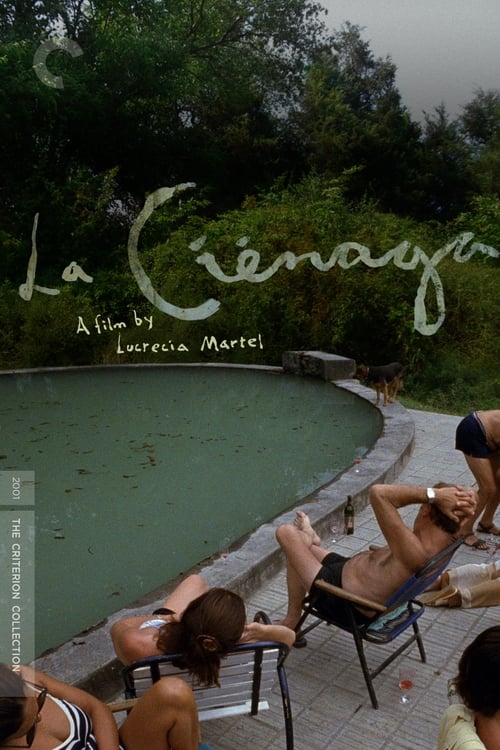
La Ciénaga
2001 · Lucrecia Martel
For when you want atmosphere over story — a slow, sweaty film that gets under your skin and stays there. This is a challenge, not comfort viewing: reach for it when you're patient and want to be unsettled by ordinary life.
What it's about
Two related middle-class families sweat out a long summer in northern Argentina — one at a decaying country estate with a filthy pool, the other in a cramped house in town. A matriarch injures herself on broken glass and takes to her bed with wine and grievances, while kids roam the hills with rifles and dogs and the adults gossip, drink, and let everything slide. Nothing much happens, and that's exactly the point: the rot in this family, and this class, is happening in every idle afternoon.
The experience
Humid, drowsy, and quietly nerve-wracking — the film keeps you braced for an accident that always seems one careless moment away. You feel the heat and the flies; the dread creeps in through sound and half-glimpsed danger rather than plot.
Performances
Graciela Borges is indelible as Mecha, the wine-soaked matriarch — imperious, wounded, and slowly dissolving in her own bed, she makes decline magnetic without a single big scene.
The craft
Martel builds the film almost entirely out of sound — buzzing insects, distant thunder, ice in glasses, overlapping voices — so the dread arrives through your ears before your eyes. Her fragmented framing crops bodies and crowds the frame with limbs and clutter, making a family drama feel like something on the verge of catastrophe. Worth good speakers more than a big screen.
Why it matters
A landmark debut that helped found the New Argentine Cinema of the 2000s and announced Martel as one of the most original filmmakers alive; its influence runs through a generation of Latin American slow-burn realism.
Snapshot
La Ciénaga ("The Swamp") is Lucrecia Martel's feature debut and one of the founding works of the so-called New Argentine Cinema. Set during a torpid summer in the subtropical province of Salta in northern Argentina, it observes two related bourgeois families as they marinate in heat, alcohol, boredom, and inherited decline. There is barely a plot in the conventional sense: a matriarch, Mecha, gashes herself falling on broken glass beside a filthy swimming pool; her cousin Tali manages a chaotic household in town; children roam with guns and dogs through a countryside that hums with unspoken menace. Martel converts this near-stasis into an atmosphere of dread, using fragmented framing and an extraordinarily dense soundtrack to make ordinary domestic life feel perpetually on the edge of catastrophe. The film announced a wholly formed sensibility and became, almost immediately, a reference point for a new generation of Latin American filmmakers.
Industry & production
La Ciénaga emerged from the productive crisis of late-1990s Argentine cinema, a moment when a state financing reform (the 1994 Cinema Law and the strengthened INCAA) and a wave of film-school talent converged to enable low-budget, artistically ambitious first features. The project's crucial early validation came from abroad: Martel's screenplay was recognized through international development channels — it received the Sundance/NHK International Filmmakers Award — which helped attract financing to an unproven director working in an uncommercial register.
The film was shepherded by Lita Stantic, the veteran producer whose career links the political cinema of the 1980s (she produced María Luisa Bemberg's films) to the new movement she helped midwife; her involvement was instrumental in giving first-time auteurs like Martel the room to work. The production also drew international co-financing, notably the participation of the Spanish company El Deseo, the outfit run by Pedro and Agustín Almodóvar, whose backing of Latin American auteurs lent the project both capital and prestige. This Argentine–Spanish co-production structure was typical of how the era's most distinctive films reached completion and international distribution.
Beyond these well-established facts, precise budget and box-office figures for the film are not something I can reliably state; the theatrical returns of such an austere art film were modest, and its economic life has been primarily festival, critical, and home-video/streaming based rather than commercial.
Technology
La Ciénaga was shot photochemically on 35mm film, the standard for feature production in 2001, and finished for conventional theatrical projection; contemporary reference sources give it a widescreen aspect ratio (in the 1.85:1 range). What is significant technologically is less any novel apparatus than Martel's exploitation of ordinary tools toward unusual ends. Her cinematographer worked largely with available and naturalistic light to render the estate's gloom and the glare of the countryside, and the film's most advanced "instrument" is arguably its multitrack sound design: a layered construction of ambient noise, off-screen events, and near-subliminal texture that depends on careful post-production mixing rather than on spectacle. In this sense the film belongs to a lineage of directors for whom the recording and manipulation of sound is the primary technological art. There is essentially no non-diegetic musical score, a deliberate refusal that throws all expressive weight onto recorded environmental sound.
Technique
Cinematography
Shot by Hugo Colace, the film's visual grammar is one of its defining achievements. Martel systematically refuses the establishing shot: we are rarely told where we are or how the bodies in a room relate spatially, and scenes are built from tight, often oblique fragments — a shoulder, the back of a neck, legs in a bed, ice in a glass. The camera crowds its subjects, cropping heads and cutting figures at the frame edge, so that the human body is presented as partial, overheated flesh rather than as a composed portrait. Depth is frequently collapsed or confused; foreground obstructions and shallow focus keep the viewer slightly disoriented. The palette is muddy and humid — greens, browns, the algae-thick water of the pool — and the light is heavy and enervating. This is a cinematography of proximity and withholding: intimacy without clarity.
Editing
Cut by Santiago Ricci, the film's editing reinforces its atmosphere of drift and dread. Continuity is deliberately loosened; scenes begin and end abruptly, and the film moves laterally among a large ensemble without privileging a single throughline or building conventional suspense. Yet the cutting is not random — it withholds and elides in ways that keep an undertow of anxiety running beneath the languor, repeatedly setting up motifs (the gun, the ladder, the pool, the wound) that the viewer instinctively fears will pay off in disaster. The result is a temporality of stagnation punctuated by dread, an editing rhythm that mirrors the swamp of the title.
Mise-en-scène / staging
Martel stages density and clutter: too many bodies in too little space, children draped over adults and over one another, servants and family members entangled across the boundaries the household pretends to maintain. The crumbling country house — damp, dim, disordered — is a character in itself, and the stagnant pool is its emblem. Bodies are constantly touching, sweating, lying down; the horizontal, prone posture dominates. The staging repeatedly places danger casually within the frame (loaded rifles, broken glass, a child on a ladder) without underlining it, so that menace becomes ambient rather than plotted.
Sound
Sound is arguably Martel's supreme instrument, and La Ciénaga is a landmark of film sound design. The track is saturated with off-screen event — distant thunder that never quite breaks into rain, gunshots from unseen hunting, dogs, insects, television murmur, the scrape of furniture, ice, breathing. These sounds do not merely decorate the image; they construct an off-screen world that presses on the visible one and generates a continuous low-grade unease. Because there is no orchestral score to guide the emotions, this environmental sound carries the film's affect entirely. The approach became a signature of Martel's cinema and is frequently cited in scholarship on contemporary sound design.
Performance
The acting is naturalistic, overlapping, and deglamorized. As Mecha, the veteran star Graciela Borges gives a study in dissipated, self-pitying decline; as her cousin Tali, Mercedes Morán is warmer and more harried. Around these two experienced actresses Martel arranges a large cast of adolescents and children whose performances feel unforced and physically candid — bodies sprawled, half-asleep, half-aroused, careless. Martel's method draws performances that seem overheard rather than delivered, with dialogue often mumbled, cross-cutting, or trailing off; the effect is of eavesdropping on a family rather than watching a drama performed for us.
Narrative & dramatic mode
The film operates in an anti-dramatic, observational mode. It has no protagonist and no plot engine; instead it distributes attention across an ensemble and lets narrative accumulate as texture, gesture, and dread. Causality is muted, exposition is withheld, and the "story" is largely a matter of atmosphere and foreboding — a mode critics have described as a cinema of sensation. Two loose threads give it shape: the physical peril that seems to hover over the careless children, and a parallel motif of religious longing (a reported apparition of the Virgin on a neighborhood water tank, followed on television). The film builds toward a domestic accident that arrives with shocking offhandedness, confirming the dread the whole film has cultivated while refusing the catharsis of a conventional climax.
Genre & cycle
Nominally a drama, La Ciénaga is better understood as an art film that borrows the grammar of dread from horror and the thriller while withholding their events. It belongs to a cycle of turn-of-the-millennium slow, observational world cinema, and specifically to the New Argentine Cinema's preference for small-scale, present-tense, class-attentive stories over the allegory and melodrama of earlier national film. Within Martel's own body of work it is the first panel of what critics call her "Salta trilogy," followed by La Niña Santa (The Holy Girl, 2004) and La Mujer sin Cabeza (The Headless Woman, 2008) — three films sharing a province, a class milieu, a sound-forward method, and an interest in guilt, the body, and Catholic unease.
Authorship & method
La Ciénaga is a director's film in the fullest sense, and Martel wrote as well as directed it. Her method is rooted in her own upbringing among the provincial bourgeoisie of Salta: she has spoken of building her films from remembered sensation — heat, the sound of a house, the drowsy dread of childhood — rather than from plot. She storyboards and controls framing with unusual precision, and her refusal of establishing shots and conventional coverage is a deliberate ethical and perceptual stance, forcing the viewer into partial, embodied, uncertain seeing.
Her key collaborators here shaped that vision: cinematographer Hugo Colace, whose humid, cropped images realize her spatial disorientation; editor Santiago Ricci, who sustains the film's drifting, dread-laden rhythm; and producer Lita Stantic, whose institutional support made the film possible. On music, the salient authorial choice is absence: Martel largely forgoes non-diegetic score, so there is no composer imposing feeling from outside the frame — the "score" is the ambient world. The film's sound design, built as a dense layered environment, is central to its authorship; sound is treated with the care other directors reserve for the image. (I am confident about the sound-forward method as Martel's signature; I would not want to over-attribute specific mixing credits I cannot verify precisely.)
Movement / national cinema
The film is a cornerstone of the Nuevo Cine Argentino (New Argentine Cinema), the loose movement of the late 1990s and 2000s that also produced filmmakers such as Pablo Trapero, Lisandro Alonso, and Adrián Caetano. This cinema turned away from the allegorical, nationally symbolic modes of the post-dictatorship era toward low-budget realism, present-day settings, non-professional or understated performance, and an attention to class and everyday texture. Martel is widely regarded as the movement's foremost auteur and its most formally radical figure. La Ciénaga also participates in a broader wave of acclaimed early-2000s Latin American cinema that drew unprecedented international festival attention to the region, though Martel's austere sensibility stands apart from the more commercially crossover titles of that moment.
Era / period
The film is a document of Argentina at the turn of the millennium, made on the eve of the country's catastrophic 2001 economic collapse; its portrait of a provincial bourgeoisie sunk in torpor, denial, and quiet rot has often been read as an oblique image of a class and a nation in decline. Aesthetically it belongs to a global early-2000s turn toward "slow cinema" and sensory realism, and its production circumstances — lean budgets, international co-financing, festival launch — are characteristic of how ambitious art films were financed and circulated in that period.
Themes
The film's central subjects are class and its corrosions: the casual, intimate, and unequal entanglement of a white bourgeois family with the Indigenous and mestizo servants they depend on, disdain, and desire. Adjacent to class runs an insistent thematics of the body — sweating, wounded, adolescent, drunk, prone — and of a diffuse, unspoken sexuality that circulates among siblings, cousins, and servants. Decay and stagnation saturate everything, from the algae-choked pool to the collapsing house to the alcoholic drift of the adults. There is a persistent undertow of danger to children, treated with a fatalism that indicts adult negligence. And there is faith: the reported apparition of the Virgin, and the yearning it stirs, sets popular Catholic hope against the film's atmosphere of futility. Race, heat, torpor, and menace fuse into a single suffocating condition — the swamp of the title as social and moral metaphor.
Reception, canon & influence
La Ciénaga was a critical sensation on release. It premiered at the Berlin International Film Festival in 2001, where it won the Alfred Bauer Prize (awarded for a work of particular innovation), and it traveled widely through the international festival circuit, establishing Martel as a major new voice. Critics singled out its formal audacity — the fractured framing, the enveloping sound, the refusal of exposition — and its unsettling atmosphere, and the film has retained and grown its stature over the following two decades.
On influences backward: Martel is famously resistant to citing a canonical lineage, grounding her work instead in personal memory and sensation rather than cinephile homage, so claims of direct sources should be made cautiously. Critics have nonetheless productively situated the film in relation to the Chekhovian tableau of a decaying gentry idling toward ruin, and to the acid class observation of Luis Buñuel's bourgeois comedies; its dread-soaked domesticity has also been linked to the grammar of horror. These are interpretive affiliations more than documented debts.
On influence forward: the film's impact has been large. It helped define the international profile of New Argentine Cinema and demonstrated that a rigorously anti-dramatic, sound-driven cinema could command global attention. Martel's methods — the withheld establishing shot, the cropped body, the dense off-screen soundscape, the ambient dread — have been widely absorbed and are routinely invoked in discussions of contemporary art cinema and of film sound in particular. Martel herself became one of the most esteemed directors of her generation, and La Ciénaga is regularly named in critical polls and surveys of the best films of the twenty-first century, its reputation as a modern classic now firmly settled. As the opening statement of her Salta trilogy, it also inaugurated one of the most coherent and admired bodies of work in recent world cinema.
A Deleuzian reading
Start with the pool.
The full Deleuzian reading of La Ciénaga →
Reception
It arrived at Berlin in 2001 as the shot heard round the New Argentine Cinema, winning the Alfred Bauer Prize, and its stature has only grown since — capped when a 2022 poll of Latin American critics voted it the greatest Latin American film ever made.
How La Ciénaga was received, from release to now →
How to watch La Ciénaga: what to notice on a first viewing
- Notice how rarely you see a whole room or body. Martel builds scenes from tight fragments, a shoulder, the back of a neck, legs in a bed, refusing the wide shot that would tell you where everyone stands. You end up as disoriented as the heat-drugged family themselves, never quite sure who is where.
- Listen for thunder, gunshots, and dogs you never actually see. With no orchestral score, the whole soundtrack fills with off-screen noise, distant thunder that never breaks, unseen hunting, insects, television murmur, pressing in from outside the frame. The dread comes entirely from what you hear and cannot locate, not from anything the camera shows you.
- Notice how many bodies are lying down in every scene. Martel crowds too many people into too little space, children draped over adults, everyone sweating and horizontal, so the household reads as one tangled mass rather than separate individuals. The clutter makes the family's boundaries, of class, of privacy, of who belongs to whom, feel like they are dissolving in the heat.
- Notice the loaded guns and broken glass lying around, unremarked on. Loaded guns, broken glass, and ordinary household hazards appear casually within the frame, never underlined by the camera or the music, just part of the household's clutter. The film trusts you to feel the danger these objects carry without ever pointing at them.
- Listen for dialogue that overlaps, trails off, or gets mumbled. Martel directs her cast toward performances that sound overheard rather than delivered, lines crossing each other, trailing into nothing, never cleaned up for clarity. You feel like you have wandered into a real family's house, not a movie set built to explain itself to you.
The whole guide to watching La Ciénaga, with the keys for a rewatch →
Influences: the films it descends from and the films it influenced
- Viridiana (1961) — Establishes the acid class observation Martel inherits — a decaying provincial gentry and the servant/master intimacy rendered through domestic ritual and bodily proximity rather than dramatic plot.
- The Exterminating Angel (1962) — Bourgeoisie trapped in a torpid house idling toward ruin, with entropy and stasis used as structure instead of narrative event — the anti-dramatic architecture La Ciénaga applies to a summer that never resolves.
- The Spirit of the Beehive (1973) — A child's estranged, sensory perception inside a somnolent house where dread is manufactured from ambient hush and half-understood adult worlds rather than from any horror incident.
- Cría Cuervos (1976) — The decaying bourgeois household filtered through a child's memory-sensation, mortality and stagnation seeping through domestic space — the remembered-childhood method Martel names as her own source.
- Jeanne Dielman, 23 quai du Commerce, 1080 Bruxelles (1975) — Anti-dramatic observation of domestic bodies with off-center, decapitating framing that refuses the establishing master shot and lets duration, not incident, carry the film.
- Cries and Whispers (1972) — Cropped, shallow-focus close bodies of illness and the servant's tending hands — decay treated as tactile texture and servitude staged as physical intimacy.
- L'Avventura (1960) — Dedramatization as method: the plot event dissolves into duration and atmosphere, and ennui becomes the true subject, licensing Martel's refusal of consequence.
- Au Hasard Balthazar (1966) — Fragmented framing that privileges hands, feet and partial bodies over establishing coverage, and treats sound as an autonomous dramatic layer independent of the image.
- Eraserhead (1977) — A continuous enveloping ambient soundscape treated as the film's emotional engine, with off-screen and industrial sound generating dread the image withholds — the sound-forward authorship Martel makes her signature.
- Zama (2017) — Extends the same craft into colonial history — layered off-screen sound design, cluttered bodily density in the frame, and decay staged as ambient bodily stagnation.
- Silent Light (2007) — Non-professional overheard naturalism and elliptical, sound-immersive dread inside a provincial family, absorbing Martel's anti-dramatic tableau of domestic decline.
- Under the Skin (2013) — Exposition-free narrative carried by an oppressive off-screen soundscape and art-horror dread grammar, extending Martel's method that sound, not plot, produces unease.
- Hereditary (2018) — Maps the art-horror grammar onto a decaying domestic household, generating dread through cropped framing, dollhouse spatial disorientation and sound design rather than shock — the horror-of-the-domestic Martel pioneered.
- The Wonders (2014) — Cluttered bodily density of children in a stagnating provincial family, shot in shallow-focus fragments with overheard naturalist performance and no imposed non-diegetic score.
- Our Land (2026) — Establishes the layered off-screen sound design and fragmented, body-close framing — the Martelian soundscape and decentered eye — that the documentary inherits as method.
- Sound of Falling (2025) — The model for concrete, layered off-screen sound design and partial, cropped framing of bodies pressed into a single decaying rural household.
- The Second Mother (2015) — Reads class through bodies drifting and colliding in a torpid family house shared with indigenous servants, using proximity and off-screen space rather than plot to expose the master-servant fault line.
- White Mangrove (2020) — Off-screen servant labor and humid bourgeois torpor built through dense sound design and withheld causality, producing plotless slow pressure in a resort-adjacent setting.
- Belén (2025) — Argentine realism's use of dense off-screen sound and cramped, oppressive institutional/domestic geography to register social rot without expository dialogue.
- La Libertad (2001) — Nuevo Cine Argentino sibling emerging the same year: durational, near-plotless observation with soundscape-forward realism that trusts ambient noise over dialogue and event.
- The Headless Woman (2008) — Martel's own Salta-trilogy extension: withheld establishing shots and cropped, shallow-focus framing that transmit class guilt through dense off-screen sound rather than exposition.
- Tropical Malady (2004) — International slow-cinema sibling building enveloping ambient (jungle) sound and refusing the dramatic climax, so environment and off-screen texture replace narrative payoff.
- Ratcatcher (1999) — Martel deploys off-screen ambient sound and truncation of scenes before their dramatic completion as primary storytelling devices, withholding adult explanation through a child's eye perspective — a parallel formal development to Ramsay's methods reached from a distinct but convergent tradition.
- Code Unknown (2000) — Martel's episodic network of unresolved vignettes, periphery blocking that positions social relations at the compositional edge, and available-light 35mm that refuses to aestheticize the social textures it observes constitute a contemporaneous formal rhyme with Code Unknown's episodic-network structure.
- Beau Travail (2000) — Martel's cinema-of-the-body works through tactile sound design, languid skin, and anti-plot ellipsis, sharing Denis's sensory-first refusal of conventional dramaturgy.
- The Currents (2025) — The New Argentine benchmark for layered ambient sound and active off-screen aural space, with a stagnant-water motif of bodily torpor — the observational sound ethos The Currents inherits.
- Castle of Purity (1973) — Latin American family-as-microcosm of decay built on a dense diegetic soundscape and a pervasive water motif, the house rendered as an inescapable trap.
Similar films
- Cria! (1976) — influence & lineage
- Zama (2017) — influence & lineage
- The Headless Woman (2008) — influence & lineage
- Martin (Hache) (1997) — shared sensibility
- The Currents (2025) — shared sensibility
- Our Land (2026) — shared sensibility
- The Mysterious Gaze of the Flamingo (2025) — shared sensibility
- The Wolf House (2018) — shared sensibility