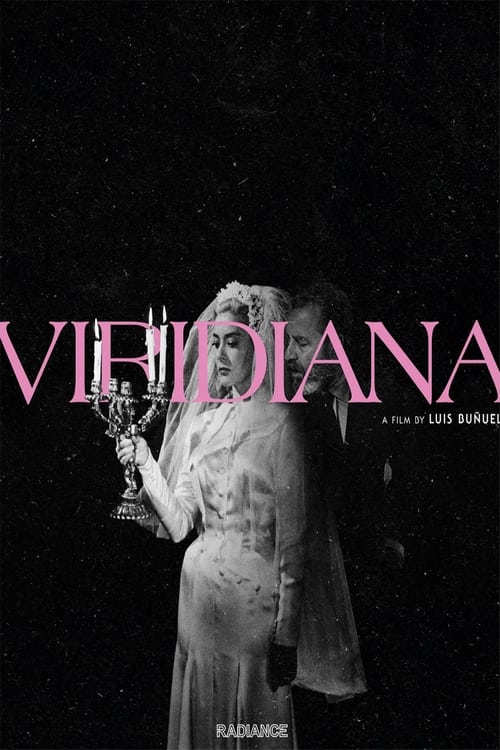
Viridiana
1962 · Luis Buñuel
For when you want to be provoked — a film to argue with, ideal for a viewing with someone who likes their classics with teeth. Challenge, not comfort.
What it's about
On the eve of taking her vows, a young novice is sent to visit the wealthy, reclusive uncle who has paid her way but whom she barely knows — and who is unsettlingly fixated on her resemblance to his dead wife. The visit goes wrong in ways that make returning to the convent impossible, so she stays on at the estate and tries to practice pure Christian charity in the real world, taking in the local beggars. The real world has other plans.
The experience
Cool, elegant, and wickedly subversive — it plays like a drama while quietly sawing through everything its heroine believes, then erupts into one of cinema's most gleefully scandalous set pieces. You come out amused, disturbed, and not sure which you should be.
Performances
Silvia Pinal gives Viridiana a luminous, unnerving purity that makes her undoing sting, and Fernando Rey is quietly devastating as the uncle whose courtliness masks something rotten.
The craft
Buñuel directs with deceptive plainness — crisp black-and-white, no tricks — so that his charged, blasphemous images seem to arrive out of nowhere and hit twice as hard. Every object in the frame (a skipping rope, a crown of thorns, a wedding dress) is loaded and pays off. It's a masterclass in how much a director can say while appearing to just tell a story.
Why it matters
It won the Palme d'Or, was promptly banned in Franco's Spain and denounced by the Vatican — a scandal that sealed its legend and marked Buñuel's triumphant return from decades of exile. Few films have enraged so many powerful institutions so efficiently.
Snapshot
Viridiana is Luis Buñuel's first film made in Spain after more than two decades of exile, and one of the most notorious provocations in the history of European cinema. The premise is deceptively simple: a young novice, Viridiana (Silvia Pinal), is sent on the eve of taking her vows to visit her wealthy uncle, Don Jaime (Fernando Rey), a recluse who has supported her financially but barely knows her. Struck by her resemblance to his long-dead bride, Jaime dresses her in his wife's wedding gown, drugs her, and very nearly violates her before recoiling; the next morning he tells her, falsely, that he did, hoping to bind her to him — then, when she flees in revulsion, hangs himself. Guilt-stricken and unable to return to the convent, Viridiana renounces her vows and tries instead to live out Christian charity on her uncle's estate, taking in a band of beggars, lepers, and vagrants. The experiment ends in catastrophe: while she and the household are away, the paupers ransack the house in a drunken orgy — culminating in the film's infamous freeze-frame parody of Leonardo's Last Supper — and Viridiana herself is nearly raped. The film closes with her abandoning her piety altogether, joining her worldly cousin Jorge and the maid Ramona in an implied ménage over a game of cards. Viridiana is at once a savage satire of Catholic charity, a surrealist's catalog of fetish and desire, and a coldly lucid argument about the futility of private virtue against social reality. It won the Palme d'Or at Cannes and was promptly banned in Buñuel's own country.
Industry & production
The production history of Viridiana is inseparable from one of the great public scandals of mid-century film politics, and its essential facts are well established. After decades working in Mexico, Buñuel was lured back to Spain by an unusual confluence of interests: the Mexican producer Gustavo Alatriste (then married to Silvia Pinal, whom he was promoting as a star) and the Spanish company UNINCI, in which figures associated with the political left held stakes, partnered to make the film, with additional involvement from Films 59. The Franco regime, eager for international cultural prestige, permitted the return of its most famous cinematic exile and approved a script that censors had reviewed — Buñuel having, by most accounts, supplied an ending and details calibrated to slip past them while reserving his sharpest gestures for the cut itself.
What followed is documented and dramatic. Spain submitted Viridiana as its official entry to the 1961 Cannes Film Festival, where it shared the Palme d'Or (the jury's grand prize) with Henri Colpi's Une aussi longue absence. The triumph turned to disaster when the Vatican newspaper L'Osservatore Romano denounced the film as blasphemous and sacrilegious. The Spanish government, humiliated, banned the film outright, dismissed the director general of cinema who had accepted the prize on the country's behalf, and effectively suppressed Viridiana within Spain; it would not be shown there legally until 1977, after Franco's death. Because the film's Spanish nationality had been officially repudiated, it circulated internationally as a Mexican production. The exact budget and box-office returns are not figures I can state with confidence and I will not invent them; what is firmly established is that the film became a cause célèbre whose notoriety guaranteed its international distribution and cemented Buñuel's late-career resurgence.
Technology
Viridiana was shot on 35mm black-and-white film in and around Madrid in early 1961, using the conventional sound-film apparatus of its day, and it is not a film of technological innovation. Its interest lies entirely in the disciplined deployment of established tools rather than in any new instrument. Buñuel was a famously economical, fast director who shot efficiently and cut in his head, and the picture's technical profile reflects that pragmatism: standard studio and location lighting, orthodox lenses, no optical pyrotechnics beyond the single celebrated freeze-frame. The film belongs squarely to the analog, photochemical era, and its power is achieved through composition, performance, and montage rather than through any apparatus that would mark it as a technical landmark. If anything, its restraint is the point — Buñuel's surrealism by 1961 had become a matter of content and juxtaposition delivered in an almost transparent, classical style.
Technique
Cinematography
The cinematography is by José F. Aguayo, a leading Spanish cameraman who would shoot Buñuel again on Tristana (1970). Aguayo's black-and-white photography is lucid, deep-focused, and unshowy — a clean, classical surface that lets Buñuel's disturbing content register without editorializing flourish. The lighting favors a sober naturalism, with the estate interiors rendered in graded grays that suit the film's mood of faded gentility and creeping decay. Aguayo and Buñuel reserve their most pointed images for moments of fetishistic or blasphemous charge — the close framing of Viridiana's feet and the corset and crucifix-knife among Don Jaime's relics, the careful tableau composition of the beggars arranged to echo Leonardo. The camera is generally placed at a cool, observational remove; Buñuel rarely uses it to push us toward identification, preferring a slightly clinical distance that lets irony and unease accumulate. It is photography in service of a surrealist's eye for the telling object, photographed plainly so that its strangeness is undeniable.
Editing
The editing, credited to Pedro del Rey, is in keeping with Buñuel's classical economy: largely invisible, rhythmically efficient, and built to deliver narrative and shock without calling attention to itself. Buñuel was renowned for shooting with the cut already determined, minimizing coverage, and the film moves with an unhurried but never slack tempo. The decisive editorial gesture is the orgy sequence, where the cutting builds the beggars' feast into mounting chaos and then arrests it in the single freeze-frame of the Last Supper tableau — a beggar woman "photographing" the group by lifting her skirts — before releasing the action back into mayhem. That collision of stillness and motion, sacred composition and profane content, is the film's editorial signature, and it demonstrates how Buñuel used montage sparingly but with maximum conceptual force.
Mise-en-scène / staging
Staging is where Buñuel's authorship is most concentrated. The film is a dense inventory of charged objects and gestures: the jump rope a child skips with, whose handles Don Jaime covets and which becomes the noose he hangs from and, later, an obscene accessory; the wax-fruit and relics; the corset; the crown of thorns and crucifix that doubles as a switchblade. Buñuel arranges these props as a surrealist arranges dream-symbols, embedding fetish and sacrilege in the texture of an apparently realist drama. The estate is staged as a closed, decaying world — overgrown grounds, shuttered rooms, the dead wife's preserved wardrobe — a space of arrested time and repressed desire. The orgy's recreation of Leonardo's Last Supper, with thirteen beggars ranged along a table, is the most analyzed piece of staging in Buñuel's career: a precise blasphemous citation that turns Christian iconography into a portrait of the very wretched the Church claims to serve. Throughout, blocking and prop placement do the thematic work, often more than dialogue.
Sound
Viridiana has no original score; like much of Buñuel's work it deploys pre-existing classical music with deliberate, ironic counterpoint, the music here adapted and arranged by Gustavo Pittaluga. The film's most celebrated sound gesture is the use of the "Hallelujah" chorus from Handel's Messiah (alongside other sacred music, including Mozart's Requiem) to score the beggars' destructive orgy — sacred majesty laid over profane chaos, a juxtaposition that is itself an argument. The contrast extends to the ending, where contemporary pop/rock music underscores the final card game, jolting the film into a secular, worldly present. Buñuel, who had an acute and idiosyncratic ear, generally uses sound diegetically and sparingly, trusting silence and ambient noise; his music cues are rare and pointed, weapons rather than wallpaper. The effect is to make the soundtrack a vehicle of irony rather than emotion.
Performance
The performances are pitched to Buñuel's cool, anti-sentimental register. Silvia Pinal plays Viridiana with a grave, contained purity that the film methodically dismantles; her restraint is essential, since the character must remain sincere for the satire of her charity to land. Fernando Rey, in the first of several iconic collaborations with Buñuel (he would anchor Tristana and That Obscure Object of Desire), gives Don Jaime a melancholy, courtly perversity — a man whose fetishism and necrophiliac longing are played with sympathy rather than caricature, making him genuinely tragic. Francisco Rabal's Jorge supplies the film's pragmatic, secular counterweight, an unsentimental modernizer whose worldliness ultimately "wins." The beggars, many played for grotesque specificity, are directed to avoid both pathos and condescension; Buñuel refuses to ennoble the poor, depicting them as fully human in their cruelty, appetite, and ingratitude. The ensemble's flatness of affect is a deliberate strategy: emotion is withheld so that the film's ideas can operate without melodramatic cushioning.
Narrative & dramatic mode
The film's dramatic mode is ironic tragedy shading into black comedy — a moral fable constructed to demolish its own apparent moral. Its structure falls into two movements: first the chamber drama of Viridiana and Don Jaime, a study in repression, desire, and guilt that ends in suicide; then the social experiment of Viridiana's charity, which the film escalates toward grotesque farce in the orgy before delivering its deflationary coda. The engine is dramatic irony of a philosophical kind: we watch a sincere attempt at Christian goodness produce ruin, and the narrative is engineered to make that outcome feel not like bad luck but like inevitability. Buñuel withholds catharsis and redemption; characters do not learn uplifting lessons, and the ending substitutes worldly accommodation (the card game, the ménage) for any spiritual resolution. This refusal of conventional moral payoff is itself the dramatic argument. The mode is detached, lucid, and unsentimental — closer to a surrealist's parable than to psychological realism, even as it is told largely through realist means.
Genre & cycle
Viridiana sits at the intersection of the art-cinema drama and the surrealist provocation, and it is best understood within Buñuel's own late cycle rather than any external genre trend. It inaugurated the extraordinary run of films — The Exterminating Angel (1962), Diary of a Chambermaid (1964), Belle de Jour (1967), The Milky Way (1969), Tristana, The Discreet Charm of the Bourgeoisie (1972), That Obscure Object of Desire (1977) — that constitute his celebrated final period, in which surrealist preoccupations are delivered through increasingly polished, accessible narrative surfaces. Generically it can be read as anticlerical satire, as social-problem drama turned inside out, and as a film of bourgeois (and ecclesiastical) critique. It belongs to the broad postwar European art cinema that took moral and metaphysical questions as its subject, but its specifically surrealist lineage — the privileging of desire, fetish, and blasphemy — distinguishes it from the humanist art film of its contemporaries.
Authorship & method
Viridiana is an unmistakable work of single authorship realized through a small set of crucial collaborators. Luis Buñuel — co-founder, with Salvador Dalí, of cinematic surrealism via Un Chien Andalou (1929) and L'Âge d'Or (1930), and by 1961 a veteran of Mexican commercial production — co-wrote the screenplay with Julio Alejandro, a frequent collaborator who helped shape several of his Spanish-language scripts. The writing translates Buñuel's lifelong obsessions — the hypocrisies of the Catholic Church, the cruelty beneath bourgeois propriety, foot-and-shoe fetishism, the eroticism of repression — into a tight dramatic machine. Cinematographer José F. Aguayo provided the clean classical surface; editor Pedro del Rey shaped its economical rhythm; the music was adapted by Gustavo Pittaluga from sacred classical sources rather than composed afresh, consistent with Buñuel's career-long practice of ironic musical appropriation. Producer Gustavo Alatriste enabled the film and tied it to Silvia Pinal's stardom, while the Spanish companies UNINCI and Films 59 furnished its fraught national base. Buñuel's method here is the mature surrealist's: realist storytelling as a Trojan horse for dream-logic and provocation, executed with speed, economy, and an almost documentary plainness that makes the transgressive content land all the harder.
Movement / national cinema
The film occupies a singular position in both surrealism and Spanish national cinema. As surrealism, it is the movement's most prominent re-eruption into mainstream art cinema decades after its 1920s origins, carrying the anticlerical, anti-bourgeois, desire-centered program of the original Paris avant-garde into the era of festival prizes. As Spanish cinema, it is paradoxical: made in Spain, repudiated by Spain, exiled into Mexican nationality, and unseen at home for sixteen years, it nonetheless became, retrospectively, a foundational text of Spanish film — the return of the country's greatest director and a covert assault on the cultural apparatus of the Franco dictatorship. The scandal it provoked exposed the limits of the regime's attempt to instrumentalize art for prestige, and the film stands as a landmark of anti-Francoist culture even though it could not be shown to Spaniards. It is thus simultaneously a high point of international surrealism and a cornerstone, however suppressed, of modern Spanish national cinema.
Era / period
Viridiana is profoundly marked by its moment: 1961, in a Spain two decades into Franco's authoritarian Catholic dictatorship, when the Church was a pillar of state power and censorship governed cultural life. The film's anticlericalism and its derision of pious charity are direct provocations aimed at that order, and the ferocity of the official response measures how raw those nerves were. Internationally, the film belongs to the early-1960s flowering of European art cinema, when festivals like Cannes were arenas of cultural prestige and political signaling, and when directors were increasingly understood as authors with serious moral and philosophical ambitions. It also reflects Buñuel's own trajectory — a surrealist of the 1920s, hardened by exile and years of journeyman work in Mexico, returning with undimmed radicalism to the European stage. Watched today, it remains startlingly modern in its refusals, though its specific charge depended on a religious and political context whose intensity has since shifted.
Themes
The film's governing theme is the futility — even the danger — of private Christian charity divorced from social reality. Viridiana's earnest attempt to redeem the poor through personal virtue is shown to be naïve and self-flattering, productive of chaos rather than grace; Buñuel sets her sincere idealism against the intractable appetites of the people she would save and lets reality win. Anticlericalism and blasphemy run throughout, most explicitly in the Last Supper parody, which turns sacred iconography into an indictment. Repressed and perverse desire is everywhere — Don Jaime's fetishism and necrophiliac longing, the eroticized objects, the constant proximity of the sacred and the carnal — expressing Buñuel's surrealist conviction that desire cannot be moralized away. Against Viridiana's failed spirituality the film sets Jorge's secular pragmatism, which alone produces tangible results (he, not she, actually improves the estate), suggesting that the modern, worldly, and unsentimental inherit the future. Beneath all of it runs a bleak view of human nature as ungovernable by ideals — the film's coldest and most surrealist proposition.
Reception, canon & influence
On its 1961 premiere the film was an immediate sensation: it shared the Palme d'Or at Cannes, was condemned by the Vatican as blasphemous, and was banned in Spain, a sequence of events that made it one of the most talked-about films of its moment. Critical reception abroad was largely admiring, celebrating it as a masterful return by a major artist and a fearless act of provocation, even as the specifics of individual reviews are best left unquoted where I cannot cite them precisely. Over time it has settled firmly into the canon as one of Buñuel's supreme achievements and a touchstone of both surrealism and political art cinema.
Looking backward, the film draws on Buñuel's own foundational surrealism with Dalí (Un Chien Andalou, L'Âge d'Or) and its tradition of anticlerical, desire-driven provocation; on the long European tradition of anticlerical satire; and, in its Last Supper tableau, on the direct appropriation of Renaissance religious iconography for subversive ends.
Looking forward, Viridiana launched the celebrated final phase of Buñuel's career and helped legitimize an entire mode of art cinema that married realist storytelling to surreal, transgressive content. Its Last Supper freeze-frame became one of the most cited images in film history, a template for later directors staging blasphemous or ironic religious tableaux. Its cold dismantling of charitable idealism and bourgeois piety anticipated decades of subsequent provocation cinema, and it remains a foundational reference for filmmakers interested in anticlerical satire, the cinema of cruelty, and the surrealist embedding of fetish and dream within realist narrative. As a political artifact, its suppression in Spain made it a permanent emblem of art's defiance of authoritarian and ecclesiastical control — a film whose scandal and whose mastery have proven equally durable.
A Deleuzian reading
Watch the skipping rope.
The full Deleuzian reading of Viridiana →
Reception
It won the Palme d'Or at Cannes in 1961 as Spain's official entry — then was promptly denounced by the Vatican as blasphemous and banned in Franco's Spain until after the dictator's death. The scandal only cemented it; it's now routinely called Buñuel's masterpiece and a fixture of greatest-films polls.
How Viridiana was received, from release to now →
Influences: the films it descends from and the films it influenced
- Un Chien Andalou (1929) — Establishes the surrealist shock-cut and dream-logic editing that Viridiana smuggles intact (the somnambulant night visit, the fetish trunk of shoes) into an otherwise classically continuous narrative.
- L'Âge d'Or (1930) — Originates Buñuel's anticlerical provocation and the eroticized foot-and-object fetish (the toe-sucking statue) that Viridiana refines into the charged crucifix-knife and skipping rope.
- Las Hurdes (Land Without Bread) (1933) — Pioneers the deadpan documentary plainness and observational distance Viridiana uses on its beggars, letting cruelty land without editorializing camera or commentary.
- Los Olvidados (1950) — Perfects the realist-surface-with-dream-eruption method—a single oneiric insert puncturing documentary naturalism—that becomes Viridiana's structural blueprint.
- Nazarín (1959) — Supplies the ironic-tragedy template of the sincere Christian whose charity is repaid with degradation, the exact dramatic machine Viridiana inverts on a female saint.
- The Young One (1960) — The very next film extends the moral-reversal technique — a protagonist's virtue exposed as untenable inside an enclosed household — pursuing the same impossibility-of-innocence thesis in conventional dramatic dress.
- The Criminal Life of Archibaldo de la Cruz (1955) — Extends the Catholic-bourgeois critique through charged fetish props (crucifix-knife, the beggars' 'Last Supper') deployed against pious respectability.
- The Exterminating Angel (1962) — Made the same year with producer Alatriste and Silvia Pinal, it runs the identical engine—bourgeois ritual collapsing into surreal entrapment, scored only by ironically borrowed sacred music rather than original composition.
- Diary of a Chambermaid (1964) — Extends Viridiana's fetish of charged footwear into a whole drama, the old master's boot-lacing and the murdered girl's shoes carrying the eroticized-object grammar forward.
- Simón del desierto (1965) — Continues the anticlerical satire of sainthood with the same anti-sentimental flatness, mocking ascetic piety as Viridiana mocked charitable idealism.
- Belle de Jour (1967) — Carries the surreal-fetish-within-realist-narrative method to its apex, embedding repression-driven daydreams in a polished classical surface without marking the seams.
- Tristana (1970) — Reunites Fernando Rey as the predatory patriarch and deploys charged objects (the amputated leg, the bell-tower) with the same anti-sentimental observational distance.
- The Discreet Charm of the Bourgeoisie (1972) — Universalizes Viridiana's cold dismantling of bourgeois propriety, again with Fernando Rey, dream irrupting into a dinner-ritual structure scored by silence rather than music.
- Teorema (1968) — Borrows Viridiana's device of a charged outsider whose arrival exposes and detonates the hypocrisies of a pious bourgeois household, told with the same realist gravity.
- Salò, or the 120 Days of Sodom (1975) — Inherits the cinema of cruelty and the blasphemous-tableau composition, staging degradation in cold, frontal, painterly arrangements that descend from the Last Supper freeze-frame.
- M*A*S*H (1970) — Directly cites Viridiana's most famous shot, staging an ironic Last Supper tableau of the surgeons that mimics da Vinci's composition for satirical blasphemy.
- The White Ribbon (2009) — Extends Viridiana's project of cold observational dismantling of piety and authority, using classical deep-focus black-and-white and withheld judgment to indict a sanctimonious order.
- Dogtooth (2009) — Carries forward the Buñuelian deadpan staging of domestic cruelty and repression, treating the bourgeois household as a closed surreal system observed at clinical distance.
- Satyricon (1969) — The grotesque feast staged as a frieze-composition parody of the Last Supper — bodies arranged as pictorial tableau, held in a wide static frame without dramatic staging — directly prefigures the Trimalchio banquet sequence, where Donati's design organizes the space as a picture to be read rather than a scene to be followed.
- The 400 Blows (1959) — Shares the contemporaneous reinvention of the freeze-frame as an expressive terminal device—an arrested image that withholds resolution rather than supplying it.
- The Skeleton of Mrs. Morales (1960) — Mounts the same anticlerical assault on ostentatious piety and the theme of sainthood-as-cruelty, exposing sanctity's violence within a Hispanic production.
Similar films
- L'Âge d'or (1930) — influence & lineage · same viewing thread · often watched together
- The Discreet Charm of the Bourgeoisie (1972) — influence & lineage · same viewing thread · often watched together
- Simon of the Desert (1965) — influence & lineage · same viewing thread
- The Exterminating Angel (1962) — influence & lineage · same viewing thread
- Nazarín (1959) — influence & lineage · same viewing thread
- Belle de Jour (1967) — influence & lineage · same viewing thread
- Diary of a Chambermaid (1964) — influence & lineage · same viewing thread
- Tristana (1970) — influence & lineage · same viewing thread
All the films related to Viridiana →
Watch it with: curated runs of related films
- Buñuel and the Bourgeoisie — A run of surrealist provocations where every dinner, prayer, and marriage bed hides an appetite polite society can't admit — watch them together for the way Buñuel (and Pasolini's Theorem) keep pulling the tablecloth out from under the well-heeled.