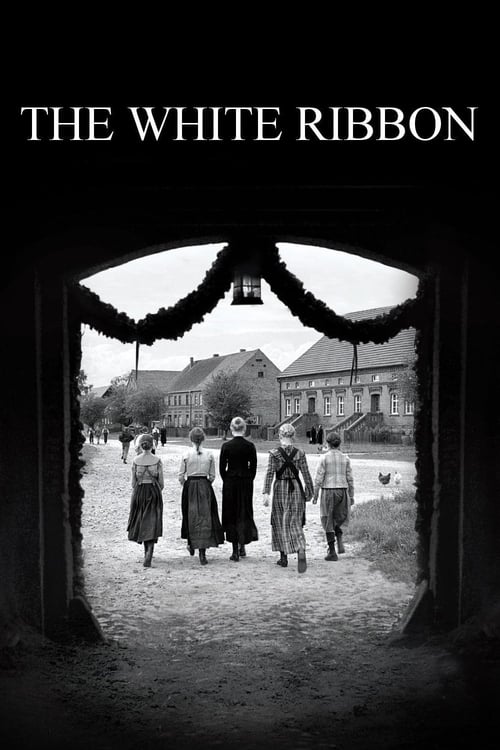
The White Ribbon
2009 · Michael Haneke
For when you want something serious to sit with — a slow, demanding film for a contemplative evening, closer to reading a great dark novel than to being entertained.
What it's about
A Protestant village in northern Germany in the last year before the First World War, remembered decades later by its former schoolteacher. Strange punishments begin to arrive — the doctor felled by a hidden tripwire, a barn in flames, a child beaten in the woods — and no culprit is ever caught. What surfaces instead is a portrait of a community run on authority, shame, and discipline, and of the children being raised inside it.
The experience
Austere, hushed, and quietly chilling — it moves with glacial composure and keeps its violence just off-screen, which somehow makes it worse. The cold weight of it stays with you long after.
Performances
The ensemble is flawless, with Burghart Klaußner's stern pastor as its icy center, and the children give performances of uncanny, unnerving control.
The craft
Shot in luminous black and white with every frame composed to the millimeter, and with no score at all — only ambient sound and silence. Haneke deliberately withholds exactly what a mystery usually promises, and that restraint is where the dread comes from.
Why it matters
It won the Palme d'Or at Cannes and stands as one of the defining European films of its decade — a landmark reckoning with how ordinary discipline curdles into mass evil.
Snapshot
A small Protestant village in the Havelland region of northern Germany, the summer of 1913 through the spring of 1914. An aged schoolteacher, looking back across the cataclysm of the twentieth century, tries to reconstruct a sequence of violent and inexplicable incidents — a wire strung across a path that fells the village doctor's horse, a barn fire, a child found beaten in the woods — that preceded the outbreak of the First World War. No culprit is ever confirmed. The mystery dissolves into the murk of the narrator's fallible memory, leaving a portrait of a community so rigidly organized around authority, shame, and punishment that violence has become its structural grammar. The White Ribbon is Michael Haneke's most formally austere and historically ambitious film: a meditation on the conditions that produce mass evil, rendered in luminous black and white and delivered with the patience of a coroner's inquest.
Industry & production
The White Ribbon was a major European co-production anchored by the German company X-Filme Creative Pool alongside the Austrian Wega Film and the French Les Films du Losange, the Paris-based art-house distributor and producer that has been Haneke's French home since Code Unknown (2000). Haneke has noted in interviews that he carried the project for a considerable number of years before production finally cohered; the research into Wilhelmine Protestant village life was extensive. The budget, while substantial for European art cinema, was modest by mainstream standards — precise figures have not been widely confirmed in accessible sources — and the film was supported through the network of national film funds that sustains prestige European production.
Principal photography took place primarily in the German state of Schleswig-Holstein and in Lower Saxony, where the flat agricultural landscape and surviving vernacular architecture could plausibly stand in for the pre-industrial north of the period. The production team undertook significant set dressing and period reconstruction to eliminate anachronism; Haneke's characteristic demand for total environmental control was, by all accounts, uncompromised. The film was shot in 2007–2008 and premiered at Cannes in May 2009, where it won the Palme d'Or before moving through international distribution to wide critical recognition.
Technology
The film's defining technological choice — and one of the more discussed decisions in recent European cinematography — is that The White Ribbon was shot on color negative and converted to black and white through a digital intermediate process. Haneke and his cinematographer Christian Berger chose color acquisition specifically to achieve a tonal range and a quality of light that they felt could not be replicated by shooting directly on black-and-white stock. The DI desaturation allowed for granular post-production control over the film's final look: its cool, almost graphic whites; its dense, information-rich blacks; its middle grays that carry the full weight of a German winter afternoon. The effect is visually closer to the documentary photography of August Sander — whose portraits of early-twentieth-century Germans were an acknowledged visual reference — than to the high-contrast expressionism of the Weimar cinema that came later. The frame is wide-format at 1.85:1. No digital effects are employed; the film's uncanny quality is entirely a product of staging, light, and the restrained manipulation of the photochemical/digital interface.
Technique
Cinematography
Christian Berger's work here is an act of principled restraint. The camera rarely moves. When it does, the movement is deliberate and slow — a measured pan to reveal something withheld, a track that maintains the geometry of a scene rather than punctuating it. The dominant mode is the locked-off long take, the camera placed at a middle distance that refuses both the intimacy of close-up identification and the detachment of a god's-eye overview. The effect is that of an impartial witness: present, unhurried, unwilling to editorialise. Interior scenes are lit to suggest the quality of northern European natural light — pale, diffuse, coming from windows as if from no other source — and this lends even domestic settings the feeling of exposure. Berger had collaborated with Haneke across several films, including The Piano Teacher (2001) and Caché (2005), and by The White Ribbon the visual vocabulary they had built was fully mature: the film is, frame for frame, one of the most precisely composed works in Haneke's filmography.
Editing
Monika Willi, Haneke's regular editor through his middle and late career, works in the film's dominant mode of omission. Scenes end before their emotional discharge arrives. The editing withholds catharsis as a structural principle: we often see an interrogation begin, or a punishment approach, and then the cut comes — and what occurred in the interval is given to us, if at all, in the flat aftermath. This technique, familiar from Haneke's earlier work, carries special weight in a film whose announced subject is the origins of violence. The rhythm of the cut trains the viewer to experience events the way the narrator says he experienced them: incompletely, from the wrong angle, with too many things already over.
Mise-en-scène / staging
The staging is theatrical in the richest sense: actors are placed in depth, in compositions that articulate power through spatial position. The pastor stands while his children sit; the baron is framed in doorways that separate him from the labourers; the schoolteacher occupies middle ground between the ruling class and the peasantry. Haneke enforces a discipline of stillness — figures wait to be addressed before speaking, children do not fidget — that makes the rare eruption of physical action register as genuinely violent. Doorways, thresholds, staircases, and windows are used systematically to organize interior space as a diagram of social constraint. The white ribbons themselves appear sparingly; their symbolic weight arrives through a logic of sparse, deliberate presentation rather than through repeated visual emphasis.
Sound
Haneke's longstanding refusal of the conventional non-diegetic score — the manipulative orchestral underlining he has explicitly criticized in interviews as a mode of coercing audience response — is here taken to its furthest extent. What serves as "music" is either strictly diegetic (a chorale rehearsed in the church, a hymn heard from inside a building) or the ambient texture of a world that preceded electrical amplification: wind, grain, horses, the creak of wooden floors. The silence around dialogue in The White Ribbon is qualitatively different from the silences in most films; it carries the pressure of what cannot be said. Sound design rather than score carries emotional meaning, and the design is so integrated with the image that it reads as natural.
Performance
Haneke cast the film with a combination of established German-language stage and screen actors in the adult roles and, for the children, a mixture of trained and non-professional young performers. The adult performances — Burghart Klaußner as the rigid pastor, Ulrich Tukur as the ineffectual baron, Christian Friedel as the young schoolteacher — are calibrated to the same distance principle that governs the camera: we observe behavior rather than interiority. Haneke has been consistent in interviews about managing performance by limiting what actors are told about their characters' inner lives, directing toward external action and specific physical tasks. The result is a company that reads as psychologically opaque in precisely the way the film argues its world was. The children, several of whom are genuinely remarkable, convey a quality of uncanny composure that the narrative makes retrospectively sinister without overplaying the effect in any single moment.
Narrative & dramatic mode
The film is structured as a retrospective mystery whose terms of resolution are refused from the outset. The narrator's opening voiceover — delivered by an elderly Ernst Jacobi, speaking for the now-aged Friedel character — announces immediately that he is uncertain whether his account is reliable. This is not a conventional framing device; it is a fundamental statement about the epistemological condition of the whole film. We are watching, from the first frame, a reconstruction that may be wrong. The mystery form is used not to generate suspense toward revelation but to demonstrate that explanation — moral, historical, causal — may simply not be available. The implication that the village children are collectively responsible for the incidents is assembled from circumstantial evidence over the film's two and a half hours, but Haneke provides no confirmation and no final scene in which the truth is established. The drama ends with the approach of war, and the narrator's voice notes that he lost track of the people he has been describing. The mystery is subsumed into the larger catastrophe, as if to say: these small violences were the rehearsal.
Genre & cycle
The White Ribbon inhabits the tradition of the European art film period drama while working systematically against its most comfortable conventions. The look of Wilhelmine Germany has historically been aestheticized in German and international cinema, most notably in the warm-toned nostalgia of the Heimatfilm genre and its revisionist descendants. Haneke strips that nostalgia out completely; the film's visual beauty serves no picturesque function. As a mystery, it belongs to a cycle of films in the 2000s that use the genre's apparatus of investigation and withholding without providing the genre's satisfactions — a tendency visible in films as different as David Fincher's Zodiac (2007) and Carlos Reygadas's Silent Light (2007). As a historical film about the roots of fascism, it enters a long tradition of German-language attempts to anatomise what produced the twentieth century's catastrophes, from the Frankfurt School's theoretical inquiries to the self-examination that runs through New German Cinema.
Authorship & method
Michael Haneke was born in Munich in 1942 and trained in philosophy, psychology, and theater direction at the University of Vienna before building a career in Austrian television through the 1970s and 1980s. His feature filmmaking from The Seventh Continent (1989) onward has been extraordinarily consistent in its preoccupations and its methods: a formal austerity derived from Bresson and Dreyer; a refusal of emotional manipulation; an insistence that the viewer's complicity in representation is itself a subject. The White Ribbon was written by Haneke as an original screenplay; he does not work from literary adaptations here, though the influence of Thomas Bernhard's prose — another Austrian who examined the authoritarian residue in Central European culture — is sometimes noted by critics, and the record on this is more impressionistic than documented.
Christian Berger's cinematographic collaboration with Haneke represents one of the more sustained and productive partnerships in contemporary European cinema. Monika Willi's editing extends a working relationship that had shaped several of Haneke's most important films. There is no original score, so no composer is listed among the film's principal creative collaborators, which is itself an authorial statement.
Movement / national cinema
Haneke is Austrian, not German, but The White Ribbon sits at the intersection of Austrian and German cultural production and belongs unambiguously to the tradition of German-language art cinema. Its historical setting places it in dialogue with New German Cinema — the movement associated with Fassbinder, Herzog, and Wenders in the 1970s — which made the excavation of German historical guilt one of its defining projects. Haneke has inherited that project while rejecting the New German Cinema's more expressionistic or melodramatic registers. Internationally, the film is part of the loose formation sometimes called "slow cinema" — a tendency in 2000s and 2010s art filmmaking, encompassing directors as different as Béla Tarr, Lisandro Alonso, and Carlos Reygadas, that privileges duration, restraint, and the resistance to conventional narrative resolution. Whether "slow cinema" constitutes a coherent movement or a critical convenience remains debated; the record on this is genuinely contested.
Era / period
The White Ribbon was released into a particular critical climate. The mid-2000s through early 2010s saw a consolidation of European art cinema at the major festivals — Cannes, Venice, Berlin — around a mode of rigorous, austere filmmaking that was implicitly positioned against the more emotionally direct traditions of Hollywood genre film and against the perceived commercial compromises of prestige historical production. The film arrives as a summation of this tendency. It also arrives in the context of Haneke's own reputation, which had been building since the Cannes success of Caché (2005), and the retrospective recognition of Funny Games (1997/2007) and The Piano Teacher as major works.
Themes
The film's announced subject is the origin of a certain kind of evil: the structural, normalized, intergenerational evil that Haneke associates with fascism, and which he locates not in individual monsters but in social formations. The village's hierarchies — feudal landowner above peasant farmer, pastor above congregation, parent above child, man above woman — are organized around the principle that authority is its own justification and that its maintenance requires perpetual discipline. The white ribbons themselves are tokens of enforced purity, tied to the children as reminder of their fallen nature. The violence that erupts in the film is, by implication, the overflow of a system that makes violence its own primary technology of order: what the children may have done to others is what has consistently been done to them.
Guilt and shame are distributed through the community in ways that prevent anyone from identifying the actual sources of violence. The film is also, more quietly, about memory and historical knowledge — about what can be known of the past and by whom, and about the danger of confident retrospective narrative. The narrator tells us he believed he had understood what happened; the film withholds the confirmation that would make that understanding stable.
Reception, canon & influence
The White Ribbon received the Palme d'Or at Cannes 2009 under a jury presided over by Isabelle Huppert, the first unanimous jury vote in several years; this was taken as a signal of the festival's institutional commitment to the kind of uncompromising European art cinema the film represents. It won the BAFTA for Best Film Not in the English Language and received Academy Award nominations for Best Foreign Language Film and Best Cinematography — the latter nomination being relatively unusual for a film of this aesthetic disposition, and a testament to Berger's work. It lost the Foreign Language Film Oscar to Juan José Campanella's El secreto de sus ojos (Argentina, 2009).
The film's backward influences are legible across its every formal decision. Carl Theodor Dreyer's Protestant moral rigor — particularly Ordet (1955) and Day of Wrath (1943) — is the primary ancestor. Robert Bresson's economy of means, his distrust of psychological expressiveness in performance, and his use of ellipsis are equally present. Fritz Lang's M (1931), another film that studies a community organizing itself around violence, is a structural reference point, though the tonal register is entirely different. August Sander's photographic documentation of Weimar-era Germans provides the visual template. Ingmar Bergman's investigations of Protestant community and repression — Winter Light (1963), Fanny and Alexander (1982) — inform the social texture.
The film's forward influence is harder to measure precisely, as the record on reception in subsequent filmmaking is necessarily partial and impressionistic. Its success consolidated the viability of the long-take, non-score, unsatisfied-mystery mode in European art cinema and arguably strengthened the festival reception of work in similar registers through the early 2010s. Haneke himself followed it with Amour (2012), which won a second Palme d'Or and extended the austere method into domestic chamber drama. Among Germanophone filmmakers, its example — particularly its use of historical period not for nostalgia but for diagnosis — has been a visible presence, though direct attribution is difficult to document. It stands, alongside Caché and The Piano Teacher, as one of the essential films of Haneke's career and as one of the defining works of twenty-first-century European cinema.
A Deleuzian reading
Start with the wire.
The full Deleuzian reading of The White Ribbon →
Reception
Arrived as an instant heavyweight — Palme d'Or at Cannes 2009 and a Golden Globe — then suffered one of the era's famous Oscar upsets when The Secret in Their Eyes beat it (and A Prophet) for Best Foreign Language Film; its critical standing has only hardened since, regularly landing on best-of-the-century lists.
How The White Ribbon was received, from release to now →
Influences: the films it descends from and the films it influenced
- Day of Wrath (1943) — Dreyer's procedural structure of community accusation — prolonged interrogation scenes in austere domestic interiors with locked-off camera — establishes the template of a village organized around identifying a concealed transgressor without supplying a verdict.
- Ordet (1955) — Dreyer's staging of Protestant household interiors as hierarchical spatial diagrams — characters positioned at exact distances encoding authority, no musical underscore, duration extended until spiritual weight accumulates — is the direct formal model for Haneke's household compositions.
- Au hasard Balthazar (1966) — Bresson's elliptical editing system, which systematically bypasses the emotionally cathected moment (the cruelty, the assault) and rejoins the narrative in the aftermath, is the direct model for Haneke's principle of withheld catharsis.
- M (1931) — Lang's spatial organization of an entire city around a hidden perpetrator — surveillance networks, community assembly, tribunal — provides the structural template for a village of locked-off shots conducting an inquiry that never identifies its culprit.
- The Servant (1963) — Losey's systematic use of doorways, stairs, and interior thresholds as the primary locus of power transactions — figures shot through apertures, framed in liminal domestic space — is the antecedent of Haneke's threshold-framing technique for encoding social hierarchy spatially.
- L'Avventura (1960) — Antonioni's structural move of positing a conventional mystery (Anna's disappearance) then formally refusing resolution — the inquiry dissolves rather than concludes — establishes 'mystery without revelation' as a viable modernist narrative architecture.
- Winter Light (1963) — Bergman's use of harsh natural light in underdressed Protestant interiors to strip emotional comfort — bare stone surfaces, no score in the church sequences — equates formal austerity with spiritual and moral interrogation in a way Haneke inherits directly.
- Fanny and Alexander (1982) — The Bishop's household sequences establish the grammar of patriarchal domestic space as architecturally coercive — rooms that constrain movement, thresholds separating authority from subordination — which Haneke adopts for the schoolteacher's home.
- Jeanne Dielman, 23 quai du Commerce, 1080 Bruxelles (1975) — Akerman's locked-off camera at fixed mid-distance height, refusing emotional close-ups while observing domestic labor in durational real time, directly anticipates Haneke's compositional principle of observation without psychological penetration.
- Caché (2005) — Shot by Christian Berger in the same locked-off long-take surveillance mode, with no non-diegetic score and a narrative that refuses to identify its perpetrator, Caché is the direct formal sibling, applying the same system to bourgeois urban guilt rather than rural Protestant community.
- The Piano Teacher (2001) — Berger extends his diagnostic lighting grammar from The Piano Teacher into black-and-white 35mm photography, sustaining the same frontal staging and clinical interior illumination — now rendering institutional violence in early 20th-century Germany — while the editing's withheld cuts remain unchanged.
- Mouchette (1967) — Confronts cruelty toward and among children in austere black-and-white, withholding the explanatory climax exactly as Bresson refuses to sentimentalize Mouchette's torment.
- Of Gods and Men (2010) — The film restricts its entire musical dimension to the monks' diegetic liturgical chanting, extending Haneke's diegetic-only sound principle into a context where communal ritual and approaching violence are both borne by the same unmanipulated sonic register.
- Amour (2012) — Haneke transposes the White Ribbon's formal system — locked-off mid-distance compositions, no non-diegetic score, systematically withheld catharsis — into a domestic chamber drama, replacing the village community with a single Parisian apartment.
- Ida (2013) — Pawlikowski's B&W digital cinematography in the Academy ratio — figures placed low in the frame against heavy negative space, frontal middle-distance framing indebted to the same August Sander photographic tradition — extends the 'historical period as diagnosis not nostalgia' approach to Polish post-war reckoning.
- Stations of the Cross (2014) — Each of the film's fourteen scenes is a single uncut locked-off shot, directly adopting Haneke's formal proposition that static duration can render community coercion visible, here applied to a German Catholic family's system of religious discipline.
- The Zone of Interest (2023) — Glazer adopts the locked-off long-take and diegetic-only sound design as structural principles for representing the Holocaust's domestic surround, displacing all horror into the offscreen sonic environment — extending Haneke's principle that what is withheld from representation carries more force than what is shown.
- Sound of Falling (2025) — German place-bound transgenerational guilt rendered through austere monochrome chiaroscuro, watchful non-professional children, and meaning withheld off-screen.
- All Quiet on the Western Front (2022) — Monika Willi co-edited The White Ribbon with Haneke and went on to edit Berger's film; her Haneke-trained approach — the withholding cut that refuses emotional punctuation and forces behavioral reading rather than affective response — is the direct editorial transmission linking Haneke's ethically precise European art cinema to Berger's anti-romantic editorial logic.
- The Killing of a Sacred Deer (2017) — Haneke's metronomic pacing, institutionally cold wide framing, and structure of collective guilt processed as classical tragedy — punishment before explanation, doom before understanding — directly calibrate Sacred Deer's temporal and moral register.
- The Power of the Dog (2021) — Haneke's retrograde thriller structure — presenting a community's unreliable social surface while withholding the violent truth beneath until the final frames — and his use of strategic silence within long static takes as a tension mechanism directly inform Campion's elliptical narrative architecture and her refusal of generic resolution.
- TÁR (2022) — Haneke's depiction of institutional abuse through a community of complicity — keeping the camera at an even, unblinking distance that refuses to authorize either victim or perpetrator — is the direct model for TÁR's refusal to stage the alleged events, making culpability a matter of atmospheric accumulation rather than dramatic revelation.
- Monster (2023) — Haneke's inversion of the institutional-thriller genre — placing children under institutional suspicion while gradually reversing the moral charge — is the clearest formal precedent for Monster's genre subversion, where the school's disciplinary apparatus is revealed as the instrument of misreading rather than detection.
- The Seed of the Sacred Fig (2024) — Clinically stages the patriarch's movements through domestic threshold spaces — doorways, staircases, the boundary between inner and outer rooms — to map family hierarchy onto the reproduction of authoritarian social structure; the sustained performance of bourgeois ordinariness that conceals systemic violence is the formal model for Rasoulof's judicial-father characterization.
- The Turin Horse (2011) — Tarr's locked-off long takes documenting physical rural labor in exhausting real time — with no orchestral score, only a single repeating accordion motif — constitute a parallel formal statement to Haneke's mode, arrived at through Tarr's independent development of the slow-cinema long-take.
- The Lives of Others (2006) — Christian Berger's high-contrast black-and-white photography renders a Protestant village community as a mutual surveillance network in which every transgression is observed and recorded, using the same formal structure as The Lives of Others — a narrator-watcher who cannot explain what he has observed — with suppressed-interiority ensemble performance and an editing architecture of withheld institutional disclosure.
- Dogtooth (2009) — Near-contemporaneous with Dogtooth, Haneke's proscenium-like institutional framings, suppressed-affect child performances, and closed authoritarian community offer a formally parallel model of childhood socialization as institutional violence — the two films together define the dominant formal mode of the festival-arthouse horror of their moment.
- The Painted Bird (2019) — Christian Berger's anamorphic 35mm monochrome, wide-angle Central European rural landscape, episodic village-level violence witnessed through a child's limited comprehension, and non-professional cast inhabit the same formal toolkit as The Painted Bird, both arguing that monochrome austerity is the only ethical register for European systemic violence against the innocent.
- Society of the Snow (2023) — Haneke combines posthumous first-person narration, Bressonian performance restraint, and austere cold-climate cinematography to convert collective guilt into moral inquiry — the same cluster of formal techniques Bayona deploys, substituting alpine snow for Haneke's Prussian winter.
- The Girl with the Needle (2024) — Haneke's decision to render pre-WWI community violence in stark black-and-white with a rigorously restrained camera that refuses psychological explanation — horror constituted by the community's institutions rather than any single agent, the descent narrative structured as moral revelation withheld — is the closest contemporary formal model for the film's structural-evil architecture.
- The Hunt (2012) — Rural community implicating itself through accusation and punishment of children, built on austere staging and withheld score — the same dramatic-irony machine of suspicion-as-contagion.
- Small Things Like These (2024) — Desaturated, period-precise reconstruction of a community whose silence sustains its cruelty; complicity rendered as a formal problem of what the frame and the townspeople refuse to see — the complicity-drama in austere monochrome key.
- The Ascent (1977) — Deploys the same severe black-and-white moral austerity — cold, deep-focus monochrome as an instrument of ethical judgment over a community's collaboration and cruelty.
- The Spirit of the Beehive (1973) — Uses austere fixed-frame, painterly compositions and children positioned as silent watchers to build a political allegory of a society's latent violence.
- Leviathan (2014) — Rigorously composed, desaturated tableaux that convert a community's cruelty into a national moral indictment through withheld explanation — the state-of-the-nation tragedy built from formal austerity.
- Never Look Away (2018) — A sibling German reckoning tracing the seeds of twentieth-century atrocity, whose austere painterly monochrome and withheld moral verdict stand as the rigorous counter-model to von Donnersmarck's legible, emotionally resolved treatment of the same guilt.
Similar films
- Sound of Falling (2025) — influence & lineage
- Amour (2012) — influence & lineage
- Caché (2005) — influence & lineage
- The Zone of Interest (2023) — influence & lineage
- Funny Games (1997) — shared sensibility
- The Piano Teacher (2001) — shared sensibility
- The Bridge (1959) — shared sensibility
- The Painted Bird (2019) — shared sensibility
All the films related to The White Ribbon →
Film essays and courses that include it
- The Grammar of Dread: Twelve Films That Built Cinema's Language of Unease
- The Difficult Love: How Cinema Learned to See Inside the Family
- The Land Speaks: Rural Landscape as Moral Force
- The Town That Knows: Small-Town Life from Idyll to Tribunal
- What the Frame Cannot Hold: Cinema's Long Reckoning with Off-Screen Atrocity
- The Film That Accuses You