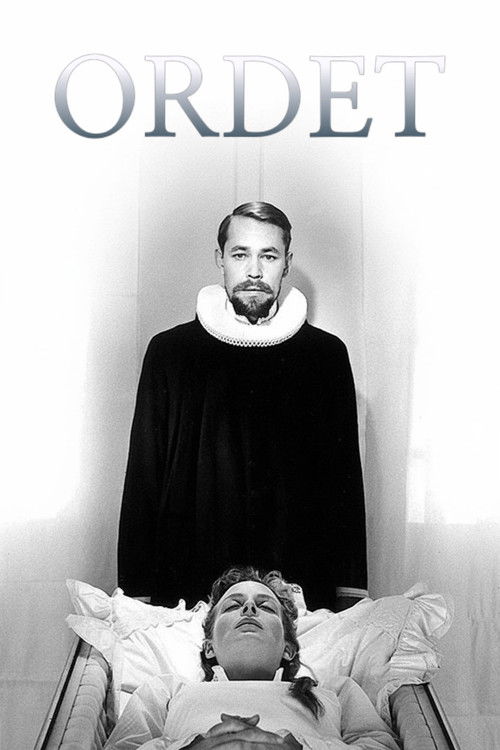
Ordet
1955 · Carl Theodor Dreyer
For when you want a film that takes the biggest questions — faith, doubt, death, miracles — completely seriously, and you're ready to sit still and let it work on you. A challenge, and one of the most rewarding ones in all of cinema.
What it's about
On a farm in rural Denmark, a devout patriarch presides over three sons whose beliefs have gone separate ways: the youngest shares his father's faith, the eldest has lost his entirely, and the middle son has gone mad and believes he is Jesus Christ. Courtships, meals, and family friction fill the house — until a difficult childbirth puts every one of their convictions to the test.
The experience
Slow, hushed, and hypnotic — the film moves at the pace of farmhouse life, all long takes and quiet rooms, and then builds to a final stretch of overwhelming emotional force. It asks for patience and repays it with something close to awe.
Performances
Preben Lerdorff Rye's Johannes, the son who wanders the farm speaking as Christ, is unforgettable — an otherworldly, haunted presence that could easily have been ridiculous and instead becomes the film's soul.
The craft
Dreyer builds the entire film from fewer than 120 shots across two hours — a gliding camera drifts through the farmhouse turning ordinary domestic life into ritual, and the black-and-white photography gives every room the gravity of a church. Watch it undistracted, in the dark; its power is cumulative and total.
Why it matters
Winner of the Golden Lion at Venice in 1955 and routinely ranked among the greatest films ever made — the summit of religious art in cinema and a touchstone for every filmmaker drawn to stillness and transcendence.
Snapshot
Ordet ("The Word") is Carl Theodor Dreyer's penultimate feature, a chamber drama of faith set among Jutland farmers that culminates in one of cinema's most audacious gestures: the literal raising of a dead woman from her coffin. Adapted from a 1925 play by the Lutheran pastor and dramatist Kaj Munk — executed by the Nazis in 1944 — the film distills theological argument into the rhythms of rural domestic life: meals, births, courtships, and a coffin in the parlor. Across roughly two hours composed of fewer than 120 shots, Dreyer fuses an almost documentary attention to the textures of the Borgensgård farmhouse with a hieratic, gliding camera style that turns the everyday into ritual. It won the Golden Lion at Venice in 1955 and is routinely counted among the supreme achievements of religious art in the medium — a film that asks, with disconcerting sincerity, whether genuine faith might still perform miracles in a modern, disenchanted world. Its power lies in Dreyer's refusal to ironize: the resurrection is staged not as metaphor but as event, photographed with the same grave realism as everything preceding it.
Industry & production
Ordet was produced by Palladium, the long-established Danish studio best known for popular comedy, and represents an unusual instance of commercial backing for an austere art film. Dreyer had been one of the most prestigious yet commercially fraught directors in European cinema; after the troubled reception and financing of Vampyr (1932) and the long gestation of Day of Wrath (1943), he worked only intermittently. From 1952 he held the lease on the Dagmar cinema in Copenhagen, a sinecure granted by the Danish state that gave him financial security and the freedom to develop projects slowly. Ordet was the first feature he completed after a gap of more than a decade (following Two People in 1945), and it was made under conditions of considerable deliberation rather than haste.
Dreyer had long wanted to film Munk's play; he had seen it staged and considered an earlier Swedish film version (Gustaf Molander's 1943 Ordet) inadequate to the material. Munk's standing as a national martyr — a clergyman-playwright murdered by the occupying Germans — gave the adaptation cultural weight in postwar Denmark. The production was shot largely on constructed sets at Palladium's facilities, with location work in the West Jutland landscape around the Vedersø region associated with Munk's own parish. Budgets and exact financial figures for the production are not well documented in widely available English-language sources, and any precise box-office accounting should be treated with caution. What is clear is that the film was a critical rather than a popular sensation, its prestige consolidated by the Venice award.
Technology
Ordet was made with the standard professional apparatus of mid-1950s European production: 35mm black-and-white film, photographed in the Academy ratio, with synchronized sound recorded for a largely studio-based shoot. Dreyer did not pursue the era's fashionable novelties — no widescreen, no color, no stereophonic sound — and the film's technological conservatism is itself a stylistic choice. The crucial "technology" of Ordet is less hardware than method: the integration of constructed interiors with a mobile camera that could travel through space without the cuts that lighting and equipment limitations would normally impose. The set for the Borgensgård farmhouse was built to permit continuous camera movement across its rooms, and lighting was arranged to sustain long takes in which the camera and actors move freely. The black-and-white cinematography exploits a restrained tonal palette — chalky whites, deep grays — that supports the film's spiritual abstraction without recourse to expressionist contrast.
Technique
Cinematography
The photography is by Henning Bendtsen, who would become one of Dreyer's most important late collaborators (he also shot Gertrud in 1964). The visual signature of Ordet is the long, slow take built around an unhurried tracking camera. Rather than cutting between speakers, Dreyer's camera drifts — repositioning, reframing, following figures as they cross the room — so that dramatic emphasis is created by movement and composition rather than editing. The effect is at once realist and ceremonial: the camera seems to attend to the characters with a patient, almost reverent gaze. Lighting is soft and diffuse, modeling faces and the white-walled interiors into a luminous flatness; Bendtsen and Dreyer pursued an even, "milky" quality of light that drains the image of conventional drama and lends it a stilled, devotional calm. The famous resurrection scene is staged in this same lucid register, refusing any visual signal — no shadow, no shift in tone — that might cue the supernatural as illusion.
Editing
Ordet's editing is defined by its scarcity. The film is built from an unusually small number of shots, many of extreme duration, so that the cut becomes a rare and weighted event. By absorbing dialogue exchanges and movements into single sustained takes, Dreyer minimizes the analytic découpage of classical cinema; transitions tend to occur between scenes rather than within them. This economy concentrates attention on duration and the slow accretion of mood. The pacing is deliberate to the point of severity — a tempo that mirrors the patience of faith and the gravity of the events depicted, and that makes the final, decisive action land with overwhelming force precisely because nothing has been hurried.
Mise-en-scène / staging
The staging is the film's deepest achievement. Dreyer choreographs actors and camera within the Borgensgård interior as a single continuous system; figures arrange and rearrange themselves in the frame with a sculptural deliberateness, often facing forward or composed in frieze-like groupings. The whitewashed walls, sparse furniture, and the recurrent table become an almost abstract stage on which theological positions are embodied. Objects carry sacramental weight: the coffin, the cradle, the cup of coffee, the lamp. The famous sequence of Inger's death and the family's vigil reduces the décor to essentials, isolating the human figures against emptiness. This abstraction-through-realism — recognizably ordinary spaces rendered metaphysically charged — is the hallmark of Dreyer's late manner.
Sound
Sound in Ordet is sparse and functional, dominated by speech and silence rather than score. There is little non-diegetic music; Dreyer trusts the cadence of voices, the ticking of domestic time, and pointed silences to carry the spiritual atmosphere. The hush of the death watch and the stillness surrounding Johannes's pronouncements are as expressive as any image. When sound does intrude — the cry of the newborn, the chiming of a clock, the breath returning to Inger — it acquires extraordinary force against the surrounding quiet. The restraint reflects Dreyer's broader aesthetic of subtraction.
Performance
Dreyer drew grave, interiorized performances from a largely Danish stage and screen ensemble. Henrik Malberg plays the patriarch Morten Borgen with weathered authority; Emil Hass Christensen is the doubting eldest son Mikkel; Birgitte Federspiel gives Inger a warmth and physical reality that anchor the film's emotional stakes — her difficult childbirth and death are played with harrowing conviction. Preben Lerdorff Rye, as the "mad" Johannes who believes himself Christ, delivers his lines in a flattened, somnambulant register that estranges him from the naturalism around him, marking him as a figure standing outside ordinary reality. Dreyer's direction of actors favored containment over display: gestures are minimized, faces composed, emotion held beneath the surface until it breaks through. The result is an ensemble that feels at once utterly concrete and quietly transfigured.
Narrative & dramatic mode
The narrative mode is that of the chamber drama or Kammerspiel: a small cast, a confined setting, a compressed time frame, and a structure inherited directly from the stage. Dreyer retains the architecture of Munk's play — the conflict among three brothers, the cross-confessional romance between Anders and the tailor's daughter Anne, the sectarian feud between Morten's grace-centered faith and the dour, sin-conscious creed of the tailor Peter — and organizes it around debate as much as action. Much of the film consists of theological and familial argument conducted at the kitchen table. Yet beneath the talk runs a melodramatic substructure of birth, death, and restoration. The dramatic engine is the testing of belief: each character's faith is defined by what they expect God to do, and the climax adjudicates among them. The ending — Johannes, restored to sanity, calls Inger back to life at her dead child's prompting, and she revives — converts a realist drama into something closer to a miracle play, demanding that the spectator either accept the event or confront their own incapacity for faith.
Genre & cycle
Ordet sits within the rare genre of the serious religious film, and more specifically the tradition of spiritual or "transcendental" cinema. It belongs to no commercial cycle; rather, it is one of a small constellation of mid-century European art films that took faith as a genuine, unironized subject. Within Dreyer's own filmography it forms part of an informal trilogy of films centered on persecuted or visionary figures and the collision of belief with the world — alongside The Passion of Joan of Arc (1928) and Day of Wrath (1943), and looking forward to the unrealized Jesus film Dreyer planned for decades. Critically it is often grouped with the work of Robert Bresson and the later Ingmar Bergman as a touchstone of austere, contemplative religious cinema, though Dreyer's affirmative ending sets it apart from the doubt that pervades Bergman's chamber films.
Authorship & method
Ordet is unmistakably an auteur work, the product of Dreyer's singular and slowly refined method. Dreyer wrote the screenplay himself, adapting Munk while compressing and intensifying the play's structure. His working method was famously exacting and protracted: long preparation, meticulous control of every compositional element, and a refusal to compromise pace or style for accessibility. His central collaborator on the image was cinematographer Henning Bendtsen, whose mastery of the gliding long take and luminous, even lighting realized Dreyer's vision and who would reunite with him on Gertrud. The editing, attributed to Edith Schlüssel, serves Dreyer's principle of the rare cut. Music plays a minimal role, consistent with Dreyer's preference for silence over score. Across these collaborations Dreyer functioned as the absolute organizing intelligence: the actors' restraint, the abstraction of the sets, the tempo of the camera, and the theological seriousness all flow from his conception. The film exemplifies what critics have called his late "style of subtraction" — the elimination of everything inessential until the bare human face and the moving frame carry the entire metaphysical burden.
Movement / national cinema
As Danish cinema, Ordet stands somewhat apart from any school, but it is deeply rooted in a Scandinavian Protestant culture and in the legacy of the silent Nordic masters. Dreyer's formation owed much to the great Swedish directors Victor Sjöström and Mauritz Stiller, with their fusion of landscape, moral gravity, and psychological intensity. The film's subject — the doctrinal disputes between the joyful, Grundtvigian faith associated with Morten and the severe revivalism of the Inner Mission, embodied in the tailor Peter — is specifically Danish, drawn from the religious geography of rural Jutland that Kaj Munk knew intimately. Internationally, Dreyer is less a national figurehead than a sovereign individualist, but Ordet helped renew global attention to Danish art cinema and stands as a monument of the country's film culture, later honored by Danish institutions as a national treasure.
Era / period
Made in 1955, Ordet arrives at the height of the postwar European art film, in the decade that also produced Bergman's breakthrough, Bresson's mature work, and the gathering of forces that would become the New Wave. Against this backdrop Dreyer's film is conspicuously anti-modern in style yet radical in its sincerity. The 1950s were an era of secularization and existential doubt in European intellectual life; Ordet's insistence on the possibility of literal miracle ran against the current, which is part of what made it both controversial and arresting. It can also be read in relation to the trauma of the occupation — Munk's martyrdom, the testing of Danish moral and spiritual identity — though Dreyer keeps such resonances implicit. The film thus belongs to its moment as a deliberate counter-statement: an affirmation of faith offered in an age of disbelief.
Themes
The governing theme is faith — its varieties, its failures, and its power. Dreyer dramatizes a spectrum of belief: Morten's confident but conventional piety; Mikkel's modern unbelief; the tailor Peter's grim, judgmental creed; and Johannes's "madness," which turns out to be the only faith strong enough to expect a miracle. The film argues, with troubling directness, that institutional religion has domesticated faith into something that no longer believes in its own God — that the truly faithful person would appear insane to the church. Allied themes include the conflict between the letter and the spirit of religion; the sectarian divisions that fracture a single Christian community; love crossing confessional lines (Anders and Anne); and the elemental cycle of birth and death, fertility and grief, that grounds the metaphysics in the body. Above all, Ordet concerns the relationship between the word and the deed — between speaking belief and acting on it — culminating in a "word" that, spoken in genuine faith, restores life.
Reception, canon & influence
Ordet premiered to immediate prestige, winning the Golden Lion at the Venice Film Festival in 1955, and it consolidated Dreyer's late-career reputation as one of cinema's foremost spiritual artists. Critical response then and since has centered on the audacity of its ending: some viewers find the resurrection a sublime act of cinematic faith, others an unassimilable provocation, but few deny its force. Over the following decades the film entered the canon of the greatest religious films ever made and has recurred in critics' polls of the cinema's finest achievements; it is frequently cited as Dreyer's masterpiece alongside The Passion of Joan of Arc.
Influences on the film (backward): Most directly, Ordet derives from Kaj Munk's play, with its specifically Danish theological debates, and behind it lies the earlier Molander screen version that Dreyer sought to surpass. Stylistically, Dreyer drew on the gravity and landscape-mysticism of the Swedish silent tradition (Sjöström, Stiller) and on his own evolving practice across Joan of Arc and Day of Wrath, with their persecuted believers and slow, face-centered intensity. The Lutheran and Grundtvigian-versus-Inner-Mission religious culture of rural Denmark supplies the film's intellectual substance.
Legacy (forward): Ordet became a foundational reference for the cinema of spiritual contemplation. Critic Paul Schrader placed Dreyer, alongside Bresson and Ozu, at the center of his influential account of "transcendental style" in film, and Ordet is a key text in that argument. Its patient long takes, its abstraction of ordinary space, and its willingness to film the miraculous with documentary calm resonate through later directors drawn to slow, metaphysically serious cinema — Andrei Tarkovsky's treatments of faith and resurrection, the contemplative durations of Béla Tarr, and the spiritual realism of filmmakers from Bergman to the Dardenne tradition all stand in some relation to the path Dreyer opened. Within Danish cinema the film became a touchstone invoked, by contrast and homage, in later national debates about faith and film, including the work of Lars von Trier, whose Breaking the Waves echoes Ordet's confrontation of miracle with skeptical modernity. More than half a century on, Ordet remains the measure against which serious cinematic engagements with faith are judged: the rare film that does not merely depict belief but stakes its entire form on the possibility that belief might be true.
A Deleuzian reading
Begin with the camera, not the miracle.
The full Deleuzian reading of Ordet →
Reception
No reappraisal arc needed — it won the Golden Lion at Venice in 1955 and has only climbed since, becoming a fixture of Sight & Sound greatest-films polls and shorthand for cinema at its most spiritually serious.
How Ordet was received, from release to now →
Influences: the films it descends from and the films it influenced
- The Passion of Joan of Arc (1928) — Dreyer's earlier experiment in isolating the human face against abstracted white space and carrying spiritual crisis through expression alone is the direct precursor to Ordet's face-centered, set-stripped austerity.
- Day of Wrath (1943) — Establishes the slow lateral gliding camera, frieze-like grouping of figures, and persecuted-believer drama in measured low-key light that Ordet refines into its 'style of subtraction.'
- Master of the House (1925) — Dreyer's chamber-drama (kammerspiel) confined to a single domestic interior, building tension through patient blocking rather than cutting, is the structural model for Ordet's farmhouse staging.
- The Phantom Carriage (1921) — Sjöström's Swedish-silent landscape mysticism and his sober, documentary-calm filming of a supernatural visitation (the dead crossing back) is the tonal antecedent for Ordet treating the miraculous without sensational effect.
- Sir Arne's Treasure (1919) — Stiller's grave, slow Nordic pictorialism — figures composed against austere landscape in long, contemplative takes — feeds the 'nordic-silent-legacy' gravity Dreyer absorbed into Ordet's tempo.
- Pickpocket (1959) — Bresson's flattened, somnambulant performance from non-expressive 'models' is the kindred method to Ordet's contained, trance-like acting register, both suppressing affect to let grace surface.
- Winter Light (1963) — Bergman strips a chamber drama to a faith-in-crisis pastor in silence and bare interiors, deploying Ordet's silence-as-expression and sectarian-doubt material in a Scandinavian key.
- Gertrud (1964) — Dreyer reunites with cinematographer Henning Bendtsen to push the gliding long take and frieze staging even further — figures barely meeting eyes in slow, even light — extending Ordet's method to its terminus.
- Andrei Rublev (1966) — Tarkovsky inherits Ordet's willingness to film faith and the miraculous with grave documentary calm and to let long takes hold on suffering belief until it tips into transcendence.
- The Sacrifice (1986) — Its central wager — a man's act of faith that may have literally averted catastrophe, staged in extended takes — directly extends Ordet's gambit of staking the film's form on the possibility belief is true.
- Sátántangó (1994) — Tarr radicalizes Dreyer's gliding long take and sparse cutting into seven-hour durational rhythm, carrying forward contemplative-cinema time and abstraction of rural space.
- The Turin Horse (2011) — Stark monochrome, repetitive ritual gesture, and the camera's slow circling glide around an austere farmhouse make explicit Tarr's debt to Dreyer's subtraction and frieze composition.
- Breaking the Waves (1996) — Von Trier directly confronts miracle with skeptical modernity — a sacrificial believer whose faith yields a literal supernatural sign — restaging Ordet's central provocation within Danish cinema's later faith debate.
- Silent Light (2007) — Reygadas openly restages Ordet's resurrection climax — a woman raised by a kiss — within a Mennonite community, using gliding long takes and contained performances as an explicit formal homage.
- L'Enfant (2005) — The Dardennes carry forward Dreyer's spiritual realism: grace dramatized through restrained, behavior-level observation and withheld expression rather than dialogue or score.
- The Testament of Ann Lee (2025) — Austere plainness and patient long takes serving a faith-as-literal-miracle subject, where ecstasy is presented as a mode of knowledge rather than delusion.
- The Seventh Seal (1957) — Dreyer's rigorous long-take staging treats motionlessness as a spiritually weighted state; his actors hold stillness as theological posture — the most direct technical precedent for Bergman's direction of von Sydow and Björnstrand as figures whose spiritual condition is encoded in arrested movement and suppressed gesture.
- Diary of a Country Priest (1951) — A parallel postwar realization of transcendental style: ascetic mise-en-scène, refusal of psychological underlining, and faith dramatized through withholding — the Bresson pillar Schrader pairs with Dreyer.
- Late Spring (1949) — Ozu's stillness, sparse cutting, and 'coda' abstraction of ordinary domestic space form the third leg of Schrader's transcendental triad alongside Dreyer's patient, decentered durations.
- Europa '51 (1952) — Dreyer works the same hagiographic grammar — a miraculous claim tested by a community of skeptical witnesses, rendered through long behavioral takes without expressionist cues — in a rural Protestant register that is the Nordic parallel to Rossellini's Catholic urban scenario of the unassimilable saint.
- A Man Escaped (1956) — Contemporary exemplar of transcendental style: stripped staging, withheld spectacle, and a miracle reached through restraint rather than dramatization — the spiritual reading of duration Schrader paired with Bresson.
- Faraway, So Close! (1993) — Ancestor in staging the supernatural with sober realism: the unembellished, patiently held depiction of a miracle/resurrection among ordinary people, the gravity Wenders borrows for an angel made flesh.
- Biutiful (2010) — Foundational 'naturalized mysticism' — the miraculous (the dead speaking, resurrection) admitted into an austere domestic realism without genre framing, the exact register of Biutiful's morgue visitations.
- Nazarín (1959) — Stages faith and the miracle as a genuine open question via severe, sparse mise-en-scène, sharing Nazarín's strategy of leaving belief unadjudicated so no viewer can claim easy victory.
- The Trial of Joan of Arc (1963) — Renders faith and miracle through slow, frontal, undecorated staging and flat performance, the ascetic religious-cinema register against which Bresson measured his own severity.
- The Flowers of St. Francis (1950) — Stages faith through long-take duration and the plain-spoken holy fool Johannes, sharing Francis's patient, undramatized register for the miraculous.
Similar films
- The Passion of Joan of Arc (1928) — influence & lineage · often watched together
- Andrei Rublev (1966) — influence & lineage · often watched together
- Day of Wrath (1943) — influence & lineage
- The Sacrifice (1986) — influence & lineage
- Gertrud (1964) — influence & lineage
- Winter Light (1963) — influence & lineage
- Diary of a Country Priest (1951) — influence & lineage
- Silent Light (2007) — influence & lineage
All the films related to Ordet →
Watch it with: curated runs of related films
- When the Family Comes Undone — Watch these when you want intimate, one-household dramas where love and grief are the same thing — a parent fading, a marriage on trial, a child at the center of the wreckage.