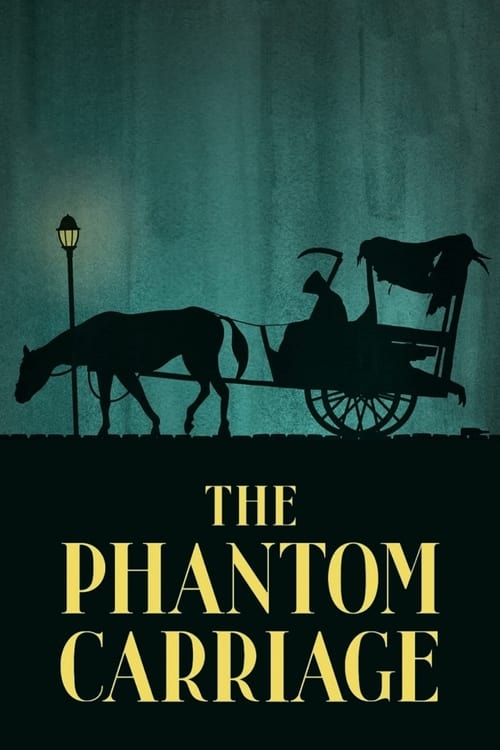
The Phantom Carriage
1921 · Victor Sjöström
For when you want a film to chew on for days, or a candlelit trip to cinema's deep past — ideal for a contemplative winter night, especially around New Year's. A challenge in pace, a reward in atmosphere.
What it's about
Legend says the last sinner to die before midnight on New Year's Eve must drive Death's creaking cart for the year to come, collecting souls. As the bells approach twelve, David Holm — a bitter, consumptive drunkard who has wrecked every life close to his — finds the phantom carriage coming for him, driven by someone he once knew. What follows is a reckoning: his misspent life laid out before him, with the clock still ticking.
The experience
Genuinely eerie a century on — a slow, solemn ghost story that doubles as a hard look at addiction and the harm it spreads. It's haunting rather than frightening, and surprisingly emotional by the end.
Performances
Victor Sjöström directs and stars, and his David Holm is startlingly modern — a portrait of an alcoholic that trades silent-film gesture for real, corrosive bitterness and, eventually, real anguish.
The craft
The ghosts are conjured with painstaking double exposures — translucent figures walking through rooms and across the sea — effects that took enormous care in 1921 and still look uncanny. The story unfolds through flashbacks nested inside flashbacks, a bold structure for its time, and the tinted imagery of the rattling cart is the stuff of nightmares. Best seen with a good live or recorded score.
Why it matters
The crowning achievement of Swedish silent cinema, and a formative influence on later masters — Ingmar Bergman revered it and returned to it throughout his life. Its imagery still echoes in horror today.
Snapshot
The Phantom Carriage (Körkarlen, literally "The Carriage Driver" or "The Wagoner") is the towering achievement of the Swedish silent era and one of the most technically and morally ambitious films of the early 1920s. Adapted by Victor Sjöström from the 1912 novella by Nobel laureate Selma Lagerlöf, it fuses a folk legend, a temperance-movement morality tale, and a ghost story into a single, formally daring structure. The premise is the legend itself: whoever is the last sinner to die before midnight on New Year's Eve is condemned to drive Death's rickety cart for the coming year, gathering the souls of the dead. When the embittered, consumptive drunkard David Holm — played by Sjöström himself — appears to die as the bells toll midnight, the spectral driver who comes for him turns out to be Georges, his dead drinking companion, who forces David to relive the wreckage of his life: the wife and children he terrorized, the prison years, and above all the Salvation Army sister, Edit, who loved him and is now dying of the tuberculosis he helped spread. Built from an intricate lattice of flashbacks-within-flashbacks and celebrated above all for its pioneering use of multiple-exposure superimposition to render the ghostly carriage and its driver, the film is at once a virtuoso technical feat and a genuinely harrowing study of cruelty, contagion, and the possibility of redemption. Its influence runs directly to Ingmar Bergman, who treated it as a private touchstone for his entire career.
Industry & production
The film was produced by Svensk Filmindustri, the company that had grown out of Charles Magnusson's Svenska Bio and that dominated Swedish production during the so-called Golden Age of Swedish silent cinema. Central to that company's identity in this period was its relationship with Selma Lagerlöf, the most celebrated Swedish author of the age and the first woman to win the Nobel Prize in Literature (1909). Magnusson had secured rights to adapt a body of Lagerlöf's work, and the resulting films — by both Sjöström and his great contemporary Mauritz Stiller — became the prestige spine of the Swedish industry. Sjöström had already adapted Lagerlöf in The Outlaw and His Wife and The Sons of Ingmar; The Phantom Carriage is generally regarded as the summit of that collaboration, and Lagerlöf reportedly held Sjöström's screen versions of her work in high esteem.
The picture was a substantial undertaking by the standards of Swedish production, demanding extended studio time for its complex optical work. It was shot at the company's facilities (associated with the Råsunda studio outside Stockholm) with location and exterior material integrated into the largely interior-bound drama. Sjöström wrote the screenplay as well as directing and taking the central role of David Holm — a triple authorship typical of his working method in this era and decisive to the film's coherence of vision. The exact budget and box-office returns are not something the surviving popular record fixes with precision, and it would be invention to assign figures; what is clear is that the film was understood from the outset as a major artistic statement and that it consolidated Sjöström's international reputation, helping pave the way for his subsequent move to Hollywood (where he worked as "Victor Seastrom").
Technology
The Phantom Carriage is, technically, an orthochromatic-stock silent film of the early 1920s, and its lasting fame rests on what Sjöström and his cinematographer extracted from the limited but exacting tools of the period. Its signal achievement is the sustained, narratively integrated use of multiple (double and even triple) in-camera exposures to depict the spectral world: the translucent driver, the ghostly cart, and the souls that rise from dying bodies all appear as semi-transparent presences moving through a solid, photographed reality. Crucially, these effects were not occasional gimmicks but the film's central visual language, deployed across many shots and at varying intensities. Achieving them required a locked-off camera, meticulous measurement, repeated rewinding and re-exposure of the same length of negative, and careful control of lighting and masking so that the superimposed "spirit" elements registered at the right density without spoiling the underlying image. The work was painstaking and, for its moment, technically audacious — superimposition itself was not new, but the precision, scale, and dramatic seriousness of its application here were. Like most films of the era it was distributed in tinted prints, with color washes keying mood and setting (cool tones for night and the supernatural, warmer tones elsewhere), a standard but expressively used technology of the silent period.
Technique
Cinematography
The cinematography is by Julius Jaenzon (often credited as J. Julius), the most important Swedish cameraman of the silent age and Sjöström's regular collaborator, who also shot key works for Stiller. Jaenzon's contribution to The Phantom Carriage is inseparable from its conception: the superimposition effects were his technical responsibility, and their success — the eerie, weightless solidity of the phantom cart gliding across land, through walls, and even over the sea to claim a drowned man — is among the great feats of early cinematography. Beyond the optical work, Jaenzon's lighting gives the film its grave, sculptural quality, modeling faces out of darkness in the cramped interiors where most of the drama unfolds and lending the slum rooms and the Salvation Army hostel a tactile gloom. The camera is generally stable and composed rather than mobile, a discipline partly dictated by the demands of the effects work but also consonant with the film's solemn, contemplative register.
Editing
The film's editing is its most underrated innovation. Sjöström constructs the narrative as a series of nested flashbacks — flashbacks embedded within other flashbacks — as Georges conducts David back through successive layers of his past. This recursive temporal structure, sophisticated even by later standards and remarkable for 1921, demands that the cutting orient the viewer across multiple planes of time and reality without confusion: the frame-tale of the dying night, the recent past of David's encounter with Sister Edit, and the deeper past of his marriage and crimes. The editing also governs the dramatic rhythm of the supernatural passages, intercutting the spirit world's slow, inexorable progress with the human dramas it observes. The result is a film whose form enacts its theme — a man compelled to see his life whole, in collapsing layers, from the vantage of death.
Mise-en-scène / staging
Sjöström's staging is rooted in the naturalist tradition of Scandinavian theater and prose, and the film's physical world is convincingly squalid and lived-in: the cold tenement room, the prison, the tavern, the Salvation Army shelter. Within these spaces Sjöström composes with great economy, arranging figures for maximum moral legibility while avoiding the broad pantomime common in the period. The film's two registers — the documentary grimness of the slum and the ethereal supernatural — are held in deliberate tension, the very ordinariness of the settings making the intrusions of the phantom cart more uncanny. The single most famous staged sequence is the one in which David Holm, in a drunken rage, takes an axe to a door behind which his terrified wife has barricarded herself with their children — a scene of domestic terror whose iconography would echo through later cinema.
Sound
As a silent film, The Phantom Carriage carried no recorded sound and was exhibited with live musical accompaniment that varied by venue; no single definitive original score has the canonical status that the images do. The film's modern life has, however, generated notable new scores. The Swedish Film Institute's restoration was presented with a score by Matti Bye, and a separate, much-discussed accompaniment was composed by the experimental drone duo KTL (Stephen O'Malley and Peter Rehberg), whose dark ambient textures suited the film's funereal atmosphere. These are contemporary interpretations rather than recovered originals, and should be understood as such.
Performance
The acting, led by Sjöström's own performance as David Holm, is strikingly restrained for 1921. Sjöström belonged to a naturalistic school that prized psychological truth over gestural excess, and his David is a fully dimensional study in bitterness — self-pitying, vicious, and yet pitiable, a man whose cruelty is legibly the product of his own degradation. The supporting performances sustain this register: Hilda Borgström as David's broken wife and Astrid Holm as Sister Edit, the consumptive Salvation Army worker whose love for David structures the film's moral arc, both play with a quiet intensity that has aged far better than the histrionics typical of the era. Tore Svennberg plays Georges, the spectral driver. The overall effect is a human gravity that grounds the film's metaphysical machinery.
Narrative & dramatic mode
The film's dramatic mode is that of the moral fable rendered as supernatural tragedy. Its engine is the temperance-era conviction that drink destroys families and souls — David Holm's alcoholism is the proximate cause of every ruin the film catalogs — but Lagerlöf's and Sjöström's treatment transcends simple didacticism through the device of the redemptive vision. The structure is essentially that of a reckoning: like the spirits of A Christmas Carol, the phantom driver compels the sinner to witness his own life from the outside, and the drama lies in whether such seeing can produce genuine change. The nested-flashback construction makes the film a study in retrospection and conscience, and its emotional power comes from the slow accumulation of David's specific cruelties — to his wife, to Sister Edit, to anyone who tried to help him. The ending turns on the question of repentance and the possibility of grace, and Sjöström plays it without easy sentiment, locating the film's hope in something hard-won rather than given.
Genre & cycle
The Phantom Carriage sits at the confluence of several genres: it is a fantasy and a ghost story, a foundational work of supernatural and proto-horror cinema, a literary prestige adaptation, and a social-problem temperance drama. Within early horror and the fantastic it stands alongside the great German works of the same moment — it is roughly contemporary with the explosion of German Expressionist and supernatural cinema — but its idiom is markedly different: where the German films stylize their unreal worlds through distorted design, Sjöström embeds his supernatural within an unflinchingly realistic milieu, producing uncanniness through optical superimposition rather than set design. Within Swedish cinema it belongs to the cycle of Lagerlöf adaptations and to the Golden Age tradition of solemn, landscape-conscious literary films. As a temperance narrative it participates in a broad international current of early-twentieth-century reformist drama, but its artistic seriousness lifts it decisively above the genre's norms.
Authorship & method
The film is overwhelmingly Sjöström's work: he adapted the screenplay, directed, and gave the central performance, an integration of roles that lets the film's vision cohere with unusual completeness. His method married the Scandinavian naturalist's commitment to psychological and social truth with a willingness to pursue technically demanding effects in the service of theme — the superimpositions are not display but the very means by which the film thinks about mortality and conscience. His most important collaborator was cinematographer Julius Jaenzon, whose mastery of in-camera multiple exposure made the spectral imagery possible and whose lighting gave the human scenes their weight; the two men's partnership across Sjöström's Swedish films is one of the defining director-cameraman relationships of the silent era. The source author, Selma Lagerlöf, is the third essential creative presence: the recursive structure, the legend, and the moral architecture are hers, and Sjöström's fidelity to her conception — while reshaping it for the screen — is part of why the film carries such literary density. Specific allocations of creative decisions beyond these credited roles are not securely documented, and it would be speculation to assign them.
Movement / national cinema
The Phantom Carriage is a defining monument of the Golden Age of Swedish silent cinema, the roughly 1913–1924 period in which Svenska Bio / Svensk Filmindustri, under Charles Magnusson, and the twin talents of Sjöström and Mauritz Stiller produced a body of work that briefly made Sweden one of the most artistically respected film cultures in the world. The movement was characterized by literary adaptation (Lagerlöf above all), psychological naturalism, the expressive use of landscape, and a seriousness of purpose that distinguished it from more commercial national cinemas. The Phantom Carriage exemplifies the movement's strengths while pushing beyond its typical use of nature into the technical frontier of optical effects. The Golden Age was relatively short-lived — its decline is conventionally linked to the loss of its leading filmmakers to Hollywood and Germany, Sjöström among them — which makes this film both a high point and a kind of culmination.
Era / period
The film is a product of the early 1920s and of the moral and social preoccupations of its moment: the temperance movement (Sweden debated and restricted alcohol in this very period), the ravages of tuberculosis as a mass killer, and the charitable activism of organizations like the Salvation Army, which the film treats with real respect through the figure of Sister Edit. Its slum settings register genuine contemporary anxieties about poverty, disease, and domestic violence. At the same time it belongs to the immediate post–First World War moment in European cinema, when filmmakers across the continent were pushing the medium toward greater psychological and formal ambition. The film's preoccupation with death, judgment, and the chance of redemption can be read against that broader postwar atmosphere without needing to be reduced to it.
Themes
The film's governing themes are the destructiveness of alcoholism and the contagion — literal and moral — that radiates from a single corrupted life. Tuberculosis functions as both plot and metaphor: David Holm spreads the disease as he spreads misery, and Sister Edit's fatal infection literalizes the idea that cruelty is communicable. Bound up with this are the themes of conscience and retrospection — the compulsion to see one's life whole — and of redemption, the central religious and moral question of whether a ruined man can be remade. Death itself is personified not as a monster but as a laborer, the weary driver of a humble cart, an image that strips mortality of grandeur and renders it pitiable and democratic. Time, memory, and the porousness of the boundary between the living and the dead organize the film's very structure, so that its form and its themes are finally the same thing.
Reception, canon & influence
The Phantom Carriage was received as a major work on its release and has only grown in stature, becoming firmly established in the canon of silent cinema and the subject of a celebrated modern restoration by the Swedish Film Institute that returned its tinting and effects to something near their original force. Its backward influences are clear: Selma Lagerlöf's novella supplies its legend and structure, the naturalist traditions of Scandinavian theater and literature shape its performance style, and the temperance literature of the age informs its moral frame. Its forward influence is among the most consequential of any silent film. Ingmar Bergman regarded it as a formative work and is widely reported to have watched it repeatedly throughout his life; its imagery of a personified Death and its meditations on conscience and mortality reverberate through The Seventh Seal and Wild Strawberries — the latter of which Bergman cast Sjöström himself in the lead role of the aged Professor Borg, an act of homage that closes the circle between the two filmmakers. The film's iconic axe-through-the-door sequence is frequently cited as a forerunner of the analogous scene in Stanley Kubrick's The Shining. More broadly, The Phantom Carriage stands as a foundational text of supernatural and horror cinema and as proof that special-effects technique and profound moral drama need not be at odds — a film whose innovations served, rather than displaced, its seriousness about how a person might be saved.
A Deleuzian reading
Watch the cart cross the water.
The full Deleuzian reading of The Phantom Carriage →
Reception
Hailed on release as the crown jewel of Sweden's silent golden age, it never needed rescuing — but it has drifted from 'important Swedish classic' to something warmer: a film cinephiles now treat as proto-horror and the secret source code of Ingmar Bergman.
How The Phantom Carriage was received, from release to now →
Influences: the films it descends from and the films it influenced
- The Student of Prague (1913) — Established the in-camera multiple-exposure for a spectral double — the actor sharing the frame with a transparent version of himself — the exact technique Jaenzon refines for the carriage and Death.
- Le Manoir du diable (1896) — Pioneered superimposition to render figures as transparent apparitions against an exposed background, the foundational trick on which the film's ghostly coachman depends.
- Ingeborg Holm (1913) — Set Sjöström's template of naturalistic performance restraint and socially-grounded staging that anchors the human, temperance-drama scenes against the supernatural effects.
- Terje Vigen (1917) — Forged the Sjöström–Jaenzon director-cameraman partnership and the method of adapting a national literary text with location naturalism and locked-off compositional gravity.
- The Outlaw and His Wife (1918) — Developed the Scandinavian landscape-naturalism and chiaroscuro exterior lighting, with restrained ensemble acting, that Jaenzon carries into Phantom Carriage's interiors.
- Sunrise (1927) — Builds its redemptive moral fable around superimposition — the overlaid temptress, the ghostly cityscape — using multiple exposure as a vehicle for a man's spiritual reckoning, as Sjöström did.
- Faust (1926) — Stages a personified supernatural agent gliding over the world via massive superimposition composites, the same fusion of effects spectacle and soul-accounting drama.
- Vampyr (1932) — Inherits the superimposed-spectre technique (the detaching shadow, the soul leaving the body) and the Nordic moral-dread atmosphere descended from Sjöström's spectral imagery.
- Wild Strawberries (1957) — Casts Sjöström himself as the aged professor and adopts the nested-flashback/dream recursive structure of an old man reviewing and being judged for his life.
- The Seventh Seal (1957) — Carries forward the device of a personified, conversational Death as a literal character confronting a man over the state of his conscience.
- The Shining (1980) — Directly restages the axe-through-the-splintering-door assault, the film's most cited single-shot bequest to horror staging.
- It's a Wonderful Life (1946) — Reproduces the redemptive-vision device — a supernatural guide walking a despairing man through the consequences of his life on a single fateful night to effect moral rescue.
- Citizen Kane (1941) — Generalizes the recursive nested-flashback construction — a life reconstructed out of order through embedded recollections — that Sjöström pioneered as narrative form.
- The Passion of Joan of Arc (1928) — Sjöström's use of the extreme close-up to render spiritual anguish and moral reckoning — particularly the death-vision sequences where faces register interiority without theatrical gesture — established the close-up as an instrument of spiritual inquiry in Nordic silent cinema that Dreyer inherits and absolutizes.
- Hour of the Wolf (1968) — Sjöström's double-exposure superimposition gave the supernatural a photographic texture within the image rather than a theatrical stage effect, establishing the Swedish cinema grammar for rendering psychic states as light-based distortions that Bergman inherited directly; his nested frame-narrative of a man shown his past as a condition of reckoning also prefigures Hour of the Wolf's survivor-narrator device.
- Day of Wrath (1943) — Pioneered the slow-paced Scandinavian drama of conscience and moral reckoning rendered in painterly chiaroscuro, the Nordic gravity Dreyer inherits.
- Ordet (1955) — Sjöström's Swedish-silent landscape mysticism and his sober, documentary-calm filming of a supernatural visitation (the dead crossing back) is the tonal antecedent for Ordet treating the miraculous without sensational effect.
- Häxan (1922) — Shares the Scandinavian-Golden-Age conviction that elaborate in-camera trick effects should serve a grave moral/historical argument rather than mere spectacle.
- Nosferatu (1922) — Extends the proto-horror grammar of the supernatural rendered through in-camera manipulation (negative exposure, undercranking) integrated with naturalistic location shooting.
- Scrooge (1951) — Shares the Dickensian moral architecture Lagerlöf drew on: a spectral guide, a New Year's/Christmas-eve reckoning, and a flashback-driven conversion narrative of temperance and redemption.
- The Cabinet of Dr. Caligari (1920) — Sjöström constructs a triple-nested flashback structure — present frame → first recall → second recall embedded within the first — that parallels Caligari's frame-story device for generating retrospective uncertainty about the ontological status of the interior narrative.
Similar films
- Wild Strawberries (1957) — influence & lineage · often watched together
- Vampyr (1932) — influence & lineage · often watched together
- Häxan (1922) — influence & lineage · often watched together
- Nosferatu (1922) — influence & lineage
- The Seventh Seal (1957) — influence & lineage
- Scrooge (1951) — influence & lineage
- The Shining (1980) — influence & lineage
- Faust (1926) — influence & lineage
All the films related to The Phantom Carriage →
Watch it with: curated runs of related films
- Where Children Meet the Dead — Watch these together and Coco's candlelit sweetness darkens by degrees into a run of folk fables where the dead won't stay buried and children bargain with mortality under the shadow of war and fascism.