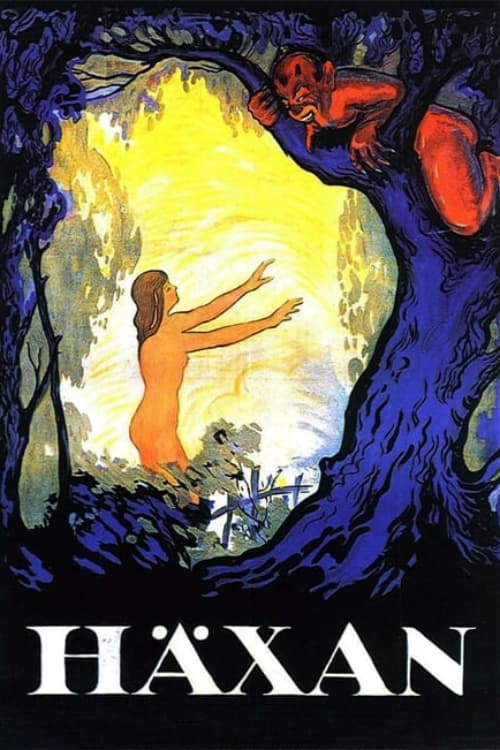
Häxan
1922 · Benjamin Christensen
For when you're in the mood for something genuinely strange — a curiosity-driven night, a Halloween deep cut, or proof to a skeptical friend that silent film can still get under your skin.
What it's about
Part illustrated lecture, part fever dream, this 1922 silent film sets out to prove a thesis: that the 'witches' tortured and burned in the Middle Ages were really sufferers of what its own era called hysteria — misunderstood, mentally ill, or simply inconvenient women. It makes the case through staged vignettes of medieval life: grave robbery, inquisitors at work, possessed nuns, and a full satanic sabbath, with the Devil himself leering through the proceedings.
The experience
Far weirder and more entertaining than 'a 1922 documentary' suggests — by turns scary, gross, and genuinely funny, with imagery that still startles a century on. It plays like a haunted museum exhibit where the paintings come alive.
Performances
Director Benjamin Christensen casts himself as the Devil — a grinning, tongue-flicking apparition that remains one of silent cinema's most indelible images.
The craft
Christensen's staging is astonishing for 1922: elaborate torture-chamber and sabbath sets, trick effects that send witches flying across night skies, demons in grotesque makeup, and painterly tinted compositions modeled on medieval art. Its collage of lecture slides and lurid dramatization was a form nobody had tried before — and few have since.
Why it matters
Banned and censored in several countries and later rediscovered by generations of horror fans — including through a 1960s re-release with narration by William S. Burroughs — it stands at the headwaters of both horror cinema and the documentary-fiction hybrid.
Snapshot
Häxan — released internationally as Witchcraft Through the Ages and in some markets as The Witches — is a Danish-financed, Swedish-produced silent film conceived and directed by the Danish actor-director Benjamin Christensen. It is one of the strangest and most ambitious works of the European silent era: a hybrid that opens as an illustrated lecture, drawing on the late-medieval witch-hunters' manual Malleus Maleficarum and other historical sources, and then dramatizes its argument through a sequence of lurid, sometimes grotesque, sometimes comic vignettes. Its thesis is essentially a work of early popular psychiatry: that the women tortured and burned as witches in the Middle Ages were, in many cases, sufferers of what Christensen's era called hysteria and neurosis — and that the modern asylum and the medieval pyre are uncomfortably continuous institutions. The film is famous today for its imagery of Sabbaths, devils, and torture, for Christensen's own performance as a leering, butter-churning Satan, and for an essayistic, genre-defying structure that would not become common in cinema for decades. It is at once a documentary, a horror film, a costume pageant, and a polemic.
Industry & production
Häxan was made for Svensk Filmindustri, the dominant Swedish studio of the period, during the so-called Golden Age of Swedish silent cinema then defined by Victor Sjöström and Mauritz Stiller. Christensen, a Dane who had already directed the acclaimed The Mysterious X (1914) and Blind Justice (1916) in Denmark, brought the project to the Swedish studio after Danish financing proved insufficient for his ambitions. The film is routinely described in the historical literature as among the most expensive Scandinavian productions of its day, owing to its elaborate sets, large cast of extras, extensive period costuming, and a notably long and meticulous shooting schedule; precise budget figures circulate in secondary sources but should be treated with caution, and I will not assert a specific number.
Production was protracted, in part because Christensen worked with great deliberation and shot a high proportion of his scenes at night to control lighting. The film was completed in 1922 and premiered that year. Its reception across Europe was shaped immediately by its content: the nudity, the explicit torture imagery, and the blasphemous comedy of its Sabbath scenes led to censorship, cuts, and outright bans in numerous markets, and the film was effectively suppressed or heavily trimmed in the United States and elsewhere. This censorship history is the single most important fact about its circulation — for decades Häxan survived in compromised prints, and the restoration of something close to Christensen's original assembly is a relatively modern achievement of film archives, principally in Sweden.
Technology
The film was produced on orthochromatic black-and-white stock typical of the early 1920s, a film sensitivity that renders blues pale and reds dark and that strongly conditioned the heavy makeup and high-contrast lighting of the period. Häxan is technologically a product of the mature silent system: hand-cranked cameras, arc and possibly mercury-vapor lighting for interiors, and in-camera and optical effects rather than the post-photographic compositing of later eras. Its most conspicuous "technology" is in fact artisanal — the film exploits stop-motion and trick photography for its demons and flying witches, superimposition for apparitions, and carefully built miniatures and practical effects for its infernal tableaux.
Like most prestige silent features, Häxan was designed to be exhibited with tinting and toning: surviving restored prints present amber, blue, and other color washes keyed to mood and setting (warm tones for firelit interiors and hell, cool blues for night). These were a chemical/photographic technology of the era, not a stylistic afterthought, and they are integral to the film's intended look. As a silent film it carried no recorded soundtrack; it was conceived for live musical accompaniment.
Technique
Cinematography
The cinematography is credited to Johan Ankerstjerne, a Danish cameraman who had worked with Christensen before. The film's visual signature is its dense, sculptural lighting. Christensen and Ankerstjerne favored low-key, directional illumination — faces and bodies modeled out of darkness, candle- and fire-light motivated within the frame, and deep pools of shadow that lend the Sabbath and torture sequences their nightmarish quality. This chiaroscuro is one reason Häxan is so often discussed alongside the German Expressionist cinema of the same moment, though its lighting is arguably more naturalistically motivated (by flames, lanterns, hearths) than the painted, abstract shadow-worlds of Caligari. The camera is largely static, composing in carefully arranged planes; movement and dynamism come from staging and montage rather than from a roving lens.
Editing
Structurally the film is built as a series of discrete parts or chapters, introduced by intertitles and, famously, by Christensen's own lecture-style "pointer" passages in which diagrams, woodcuts, and museum artifacts are presented directly to the viewer. The editing thus operates on two registers: an essayistic, additive logic that juxtaposes documentary illustration with dramatized reconstruction; and, within the vignettes, a more conventional dramatic continuity. The cumulative architecture — exposition, historical illustration, dramatized case studies, and a concluding modern-day argument equating witches with hysterics — is the film's boldest formal gesture, prefiguring the essay film. Within sequences, Christensen cuts to trick shots and superimpositions to realize the supernatural, integrating effects work into the narrative flow.
Mise-en-scène / staging
This is the film's glory. Christensen reportedly drew direct inspiration from medieval and early-modern art — woodcuts, engravings, and paintings of hell, witchcraft, and the Last Judgment — and staged his tableaux to evoke those sources. The Sabbath scenes teem with grotesque detail: devils, cavorting witches, the kissing of Satan's posterior, infants and corpses pressed into the rituals of inversion. Interiors of the inquisitor's chamber and the torture room are crowded with period instruments and props. The famous procession of witches flying across the night sky on broomsticks, the demons emerging from shadow, and the recurring image of Satan churning or beckoning are all achievements of staging, costume, makeup, and practical effect rather than of camera virtuosity. The production design has a tactile, hand-built materiality that remains startling.
Sound
Häxan is a silent film and was made without synchronized sound; its meaning was carried by image, intertitle, and live musical accompaniment in the theater. Scores have varied across its life. It is worth flagging the most notorious later intervention: in 1968 a shortened version was released as "Witchcraft Through the Ages," with an English narration spoken by the writer William S. Burroughs and a jazz score featuring the violinist Jean-Luc Ponty. That version is an artifact of its own moment and substantially alters the experience; it should not be mistaken for Christensen's 1922 conception.
Performance
Acting style is broadly within silent-era pantomime conventions, but Christensen draws a striking range of registers. The most celebrated performances are the non-professional and character players cast for their faces — the worn, weathered features of the old women accused of witchcraft are used almost ethnographically. Maren Pedersen, an older woman reportedly cast for her appearance rather than her acting experience, gives the film's most haunting human presence as an accused witch. Christensen himself plays the Devil, with a relish that tips into black comedy — his Satan is sensual, mocking, and physically grotesque, and the performance is a large part of why the film reads as darkly humorous rather than merely macabre. The dramatized hysteria of the possessed nuns and the convulsions of the accused are performed with an emphatic physicality that the film explicitly links, in its final chapter, to the gestures of modern psychiatric patients.
Narrative & dramatic mode
Häxan has no single continuous narrative. It is organized as an argument, not a story. The dramatic mode shifts deliberately: first the detached register of the lecturer presenting historical evidence; then a suite of fictional vignettes — an old woman denounced and tortured, a household swept up in accusation, a convent of possessed nuns, a Sabbath — that function as dramatized illustrations of the lecture's claims; and finally a modern coda that reframes everything in the language of turn-of-the-century medicine. This essayistic, demonstrative structure is what makes the film so unusual for 1922. It addresses the viewer directly, marshals evidence, and advances a thesis, while smuggling in passages of pure spectacle and horror. The result is a work that oscillates between the clinical and the phantasmagoric, often within the same chapter.
Genre & cycle
The film resists single classification, which is precisely its historical interest. It belongs simultaneously to the documentary/educational tradition (the illustrated lecture, the museum-artifact display), to the emerging horror mode (devils, torture, the supernatural made visible), and to the prestige historical pageant. There was no established "horror genre" as such in 1922 — the term and the marketing category solidified later — so Häxan is best understood as a precursor and outlier rather than a member of a cycle. It sits adjacent to the contemporaneous wave of Northern European supernatural and uncanny cinema (Sjöström's The Phantom Carriage, 1921; the German "haunted screen" of Nosferatu, also 1922) without belonging neatly to any of them.
Authorship & method
Häxan is an auteur project in an almost total sense. Christensen wrote, directed, designed the conception of, and starred in the film, and his obsessive, research-driven method — steeping himself in the Malleus Maleficarum and period iconography, then reconstructing them with painstaking control over lighting and staging — defines every level of the work. His key collaborator behind the camera was the cinematographer Johan Ankerstjerne, whose lighting realized Christensen's pictorial ambitions. The film was produced under Svensk Filmindustri. Because it is a silent film, there is no original composer of record in the way a sound film would have one; the 1922 release relied on live accompaniment, and the scores most associated with the film today (including the Burroughs/Ponty 1968 version) are later additions. Where credits for art direction and other craft roles are concerned, the documentary record for early-1920s Scandinavian production is uneven, and I will not assign specific names I cannot ground securely.
Movement / national cinema
The film stands at the confluence of two national cinemas. It is the work of a Danish director and cameraman, products of the once-mighty Danish film industry centered on Nordisk, realized within the Swedish studio system at the height of its international prestige. It is therefore usually discussed as part of the broader Scandinavian silent cinema of the 1910s–20s, with its characteristic attention to landscape, light, folklore, and moral seriousness. At the same time, its expressionistic lighting and its fascination with the demonic and uncanny invite comparison with the contemporaneous German Expressionist movement, even though Häxan is not properly an Expressionist film — its style is more grounded in pictorial naturalism and motivated light than in the abstract distortion of the German school.
Era / period
Häxan is a quintessential product of the early-1920s silent feature at its most ambitious: the moment when European art cinema was demonstrating that film could sustain literary and intellectual seriousness, court controversy, and command large resources. Its subject — the equation of medieval witchcraft with modern hysteria — is firmly of its post-Charcot, pre-psychoanalytic-mainstream intellectual era, when the language of "hysteria" and "nervous illness" dominated popular understandings of (especially female) mental distress. The film's confidence that modern medicine had superseded medieval superstition is itself a period attitude, and modern viewers tend to find its final-chapter psychiatry as historically situated as the witch-beliefs it critiques.
Themes
The film's central theme is the continuity of cruelty across belief systems: the inquisitor and the asylum, the pyre and the cold shower, are presented as successive institutional responses to the same human suffering and the same scapegoating impulse. Closely bound to this is a theme of misogyny and the persecution of women — the film is acutely aware that the accused are overwhelmingly old, poor, marginal women, and it dramatizes how denunciation spreads through fear, coercion, and confession-under-torture. There is a theme of superstition versus reason, though the film complicates its own Enlightenment confidence by reveling so completely in the imagery of the irrational. And there is a current of transgression and the carnivalesque — the Sabbath as a world turned upside down, blasphemous, bodily, and grotesquely funny — that gives the film its disreputable energy and its enduring fascination.
Reception, canon & influence
On release Häxan was a succès de scandale as much as an artistic event. Its imagery of nudity, torture, and Satanic ritual drew censorship and bans across many countries, including the United States, and this suppression shaped its reputation and limited its circulation for decades; for much of the twentieth century it was known largely through cut or altered prints. Critical estimation rose substantially in the latter half of the century as restored prints (notably from the Swedish Film Institute) recovered something closer to Christensen's intended version, and the film is now firmly canonical — regularly cited as a landmark of silent cinema, of the horror tradition, and of the essay film.
Looking backward, the film's influences are art-historical and textual rather than cinematic: the Malleus Maleficarum and other inquisitorial sources; medieval and early-modern visual depictions of hell, the Sabbath, and the Last Judgment; and the late-nineteenth-century medical discourse on hysteria that frames its argument. Its lighting and uncanny imagery share the air of its moment with German Expressionism and with Sjöström's Swedish supernaturalism, though direct lines of borrowing are hard to fix and I will not overstate them.
Looking forward, Häxan's legacy runs along several tracks. As a horror text it stands as a foundational work, its devils, witches, and torture imagery anticipating decades of demonic and witchcraft cinema. As an essay film it is a remarkable early instance of cinema arguing a thesis through montage of document and dramatization, prefiguring a form that later filmmakers would develop self-consciously. Its specific cultural afterlife was secured by the 1968 "Witchcraft Through the Ages" re-release, with William S. Burroughs's narration and Jean-Luc Ponty's score, which delivered the film to a countercultural audience and cemented its status as a cult object. Today it occupies a secure place in the silent canon and is a touchstone for filmmakers and scholars interested in the porous boundary between documentary and horror, reason and spectacle. Christensen himself never made anything else so singular; Häxan remains, by wide consensus, his masterwork and one of the genuine oddities of film history — a movie that lectures you about the irrational while staging the irrational more vividly than almost any film of its age.
A Deleuzian reading
A pointer taps a woodcut.
The full Deleuzian reading of Häxan →
Reception
Scandalous on release — banned in the US and heavily censored across Europe for its nudity, torture and blasphemous devilry — it's since been fully canonized as a visionary one-of-a-kind, a founding text of folk horror and the documentary-fiction hybrid.
How Häxan was received, from release to now →
Influences: the films it descends from and the films it influenced
- Le Manoir du diable (1896) — Establishes the in-camera stop-substitution trick to materialize and vanish the Devil and his imps, the conjuring grammar Christensen reuses for Häxan's stop-motion demons and practical diablerie.
- L'Inferno (1911) — Translates Doré and medieval engravings of Hell into staged living tableaux, the exact strategy by which Häxan reconstructs period woodcuts of the Sabbath, torture, and damnation as moving images.
- Intolerance (1916) — Argues a single moral thesis by assembling discrete historical episodes through cross-cutting, the structural seed Häxan develops into the chaptered essay-film marshaling document toward argument.
- Vampyr (1932) — Carries forward Christensen's fusion of documentary plainness and dread, using diffused chiaroscuro and in-camera optical effects to let the supernatural seep into an ostensibly observed world.
- Day of Wrath (1943) — Builds a witch-hunt narrative on the inquisitorial trial, the persecution of an accused woman, and painterly motivated light, extending Häxan's argument that 'witchcraft' is a machinery of persecution.
- The Seventh Seal (1957) — Stages medieval allegory—Death, the flagellant procession, the witch-burning—as iconographically precise tableaux descended directly from Häxan's reconstruction of medieval visual sources.
- Night and Fog (1955) — Advances the essay-film by montaging document against staged/observed imagery to argue about historical cruelty, the formal heir to Häxan's thesis-by-montage of evidence and dramatization.
- Witchfinder General (1968) — Depicts witch-hunting as an unsentimental bureaucratic process of accusation and torture, dramatizing the institutional persecution-machinery Häxan diagrams through its inquisition reenactments.
- The Devils (1971) — Stages convent 'possession' as hysteria spectacle binding religious ecstasy, torture, and the persecution of women—the dramatized form of Häxan's hysteria-as-witchcraft medical thesis.
- F for Fake (1973) — Self-consciously weaponizes the essay-film's editing of document and performance to interrogate truth and spectacle, extending Häxan's pioneering use of montage to advance an argument.
- The Blair Witch Project (1999) — Blurs document and fiction to authenticate the supernatural, the modern apex of Häxan's documentary-horror hybrid that frames invented dread within a quasi-evidentiary register.
- Antichrist (2009) — Returns Scandinavian cinema to Malleus Maleficarum and witch-hunt iconography, staging the torture and 'gynocide' of a woman as explicit citation of Häxan's persecution-of-women theme.
- The Witch (2015) — Reconstructs period witch-belief from obsessive archival research with period-accurate iconography and candlelit motivated practical light—the most direct modern heir to Christensen's research-driven reconstruction method.
- The Passion of Joan of Arc (1928) — Christensen's witch-trial docudrama applies extreme close-up scrutiny to women's faces during inquisition sequences, using nonprofessional subjects cast for their physiognomies, in the same Scandinavian film culture in which Dreyer was working; both films treat the interrogated female body as the site of institutional violence and the camera as an extension of the tribunal's gaze.
- The Wicker Man (1973) — Quasi-documentary, comparative-religion approach to witchcraft and pagan ritual, the Frazerian/anthropological treatment of folk belief that Hardy's documentary eye revives.
- The Cabinet of Dr. Caligari (1920) — Codifies German Expressionist chiaroscuro and designed shadow as externalized psychology, the lighting idiom Johan Ankerstjerne echoes in Häxan's Sabbath and inquisition scenes.
- The Phantom Carriage (1921) — Realizes Scandinavian supernaturalism through painstaking multiple-exposure spectral effects and motivated lamp-lit cinematography (Julius Jaenzon) within the same Svensk Filmindustri craft milieu as Häxan.
- Nosferatu (1922) — A same-year experiment in rendering the supernatural materially via under-cranking and stop-motion, sharing Häxan's commitment to making the uncanny photographically concrete rather than merely suggested.
- Faust (1926) — Renders the devil and infernal tableaux straight out of Northern-Renaissance woodcut and engraving — the same medieval graphic-art sourcing behind Faust's conception of Mephisto and Hell.
Similar films
- The Cabinet of Dr. Caligari (1920) — influence & lineage · often watched together
- The Phantom Carriage (1921) — influence & lineage · often watched together
- The Devils (1971) — influence & lineage
- Nosferatu (1922) — influence & lineage
- Day of Wrath (1943) — influence & lineage
- Witchhammer (1970) — same viewing thread
- The Magician (1958) — same viewing thread
- Mother Joan of the Angels (1961) — same viewing thread
All the films related to Häxan →
Watch it with: curated runs of related films
- Fever-Dream Horror — Watch these when you want horror that runs on dream logic — witches, circuses, crematoria and occult dread rendered as hand-crafted, hallucinatory nightmare rather than jump-scare.