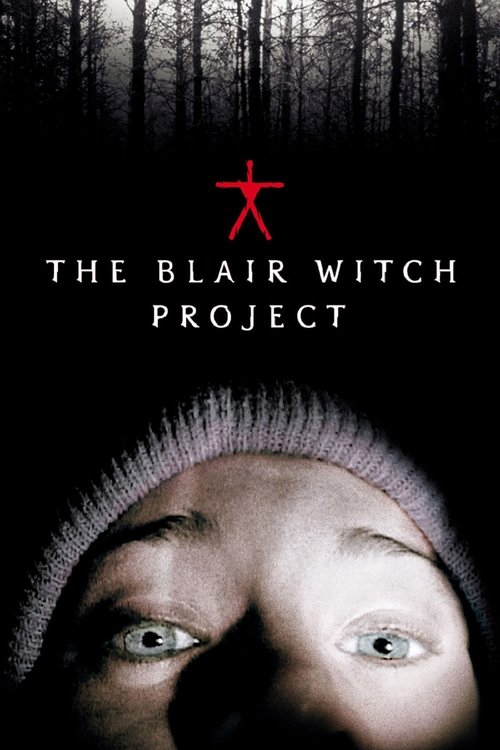
The Blair Witch Project
1999 · Daniel Myrick
For when you're craving a real scare — lights off, sound up, ideally with friends who'll regret it. It's an endurance test of suggestion rather than gore, and it lingers on the walk to your car.
What it's about
In 1994, three student filmmakers hike into the Maryland woods to shoot a documentary about a local legend called the Blair Witch — and are never seen again. A year later their footage is found, and that footage is the film: every frame shot by the students themselves as their weekend project turns into being lost, hunted, and terrified in the dark.
The experience
Slow-creeping dread that curdles into raw panic — you almost never see anything, and that's exactly why it works. The scares come through sound in the night, arguments fraying, and a mounting sense that the woods themselves have turned against them.
Performances
Heather Donahue's largely improvised performance — especially her raw, tear-streaked confession to the camera — became one of horror's defining images, precisely because it never feels acted.
The craft
The actors shot the footage themselves, improvising from scenario notes while the directors engineered real fear from off-screen — a method as radical as the result. Made for almost nothing, it proves sound design and withheld information can out-scare any effects budget. Watch it loud, in the dark.
Why it matters
It made found footage a permanent fixture of commercial horror and pioneered internet marketing that blurred fiction and reality, becoming one of the most profitable films ever made relative to its cost.
Snapshot
The Blair Witch Project is the found-footage horror film that, more than any single predecessor, made the form a permanent fixture of commercial cinema. Conceived and directed jointly by Daniel Myrick and Eduardo Sánchez — the credited solo attribution to Myrick is incomplete; the film is in every substantive sense a co-direction — it presents itself as the recovered raw footage of three student filmmakers who vanished in the Maryland woods in 1994 while documenting a local legend. There is no framing narrator, no recreated drama, no acknowledgment from within the film that it is fiction. The conceit is total. Produced for a sum so small it became part of the film's mythology, marketed through one of the earliest internet campaigns to deliberately blur the line between fiction and reportage, and released by Artisan Entertainment after a midnight Sundance premiere in January 1999, it became one of the most profitable films, measured against its cost, in the medium's history. Its importance is less as a self-contained work than as a hinge: it proved that the textures of amateur video — instability, incompleteness, the camera as a frightened body — could be more frightening than any apparatus of spectacle, and it did so at a moment when consumer video and the web were ready to amplify the claim.
Industry & production
The production is inseparable from its economics, and the economics have been mythologized to the point where precise figures must be treated with caution. The film was shot over roughly eight days in the woods of Maryland in 1997 on a budget routinely reported in the low tens of thousands of dollars for principal photography, with substantial additional money spent afterward on sound work, finishing, and the legal and post-production apparatus required to bring it to release; the often-cited figures vary widely between sources and should be read as approximate rather than audited. Myrick and Sánchez had met as film students at the University of Central Florida. They developed the project under their company, Haxan Films, with producers Gregg Hale and Robin Cowie among the core collaborators.
The decisive industrial event was the 1999 Sundance Film Festival, where the film screened and was acquired by Artisan Entertainment, a distributor then looking to establish itself. Artisan's platform release strategy — opening narrow and expanding as word of mouth built — combined with the marketing campaign to produce a commercial result wildly disproportionate to the outlay. The film is widely reported to have grossed on the order of nearly a quarter of a billion dollars worldwide, a return on cost that remains among the largest ever recorded. These numbers entered the trade and popular press immediately and durably; the orders of magnitude are not in dispute even where exact totals differ.
Technology
The film is a document of a specific technological moment. It was shot on two consumer-and-prosumer formats whose differing textures are built into its grammar: black-and-white footage captured on a Hi8 camcorder, standing in for the "documentary" the students are nominally making, and color footage shot on a 16mm CP-16 film camera, standing in for their behind-the-scenes record. The interleaving of these two looks — one grainy and electronic, one grainier and photochemical — is not decorative but diegetic, motivated entirely by which in-story camera is supposedly running. That the cameras are operated by the characters means every limitation of the gear becomes expressive: auto-focus hunting, blown highlights from a flashlight, the roll and pitch of a handheld frame.
Equally important is the off-screen technology. The marketing campaign exploited the nascent commercial web through a website that presented the Burkittsville legend, the missing students, and the "recovered footage" as fact, with mock police reports and timelines. For audiences in 1999, the internet was novel enough that this material could be encountered without the reflexive skepticism it would meet today, and the campaign is frequently cited as a foundational example of viral and transmedia marketing.
Technique
Cinematography
The cinematography, credited to Neal Fredericks, is radical precisely because it abdicates the conventional cinematographer's role. The images are nominally made by the characters, so the film's visual signature is instability: handheld framing that lurches and searches, focus that fails, compositions that decapitate and exclude as often as they reveal. The most discussed consequence is what the film refuses to show. The supposed witch, the source of the terror, is never depicted. Threat is registered entirely through reaction, through sound off-frame, and through the camera's own panic — the lens pointed at the ground while someone runs, the world reduced to a jolting smear of leaf litter and breath. The famous direct-to-camera confessional, a face lit from below by a held light against total darkness, is among the most reproduced images in modern horror precisely because it concentrates the film's method: a frightened person, a single light source, and nothing else in the frame to rescue them.
Editing
The footage was assembled by the directors from a very large quantity of material shot largely without conventional coverage. The editing's task was to impose a legible escalation onto recordings that are meant to look unshaped, preserving the illusion of raw documentation while in fact engineering a tightening dread. The cuts between the black-and-white video and the color film stock pace the descent, and the structure withholds resolution to the end. The discipline of the edit is in what it leaves rough: jump cuts, dead air, and apparent redundancy are retained because polishing them would betray the conceit.
Mise-en-scène / staging
There is almost no constructed mise-en-scène in the traditional sense; the staging is the forest itself and a small repertoire of unsettling objects placed within it. The stick figures hung from branches, the cairns of stones outside the tent, the bundle wrapped in cloth — these are the film's entire vocabulary of the uncanny, and their power derives from ambiguity. They are never explained, never connected by the film to a visible agent. The most analyzed single space is the abandoned house in the final sequence, with its handprint-marked walls and its terrible final image of a figure standing motionless in a corner, a detail seeded earlier in the dialogue so that it detonates without exposition.
Sound
Sound is the film's true instrument of fear, and it is the area where the most post-production craft was invested. Because the image withholds, the soundtrack carries the threat: cracking branches, children's voices, knocking and rustling at the edge of the tent at night, footsteps with no visible source. The absence of a conventional score is itself a technique — there is no non-diegetic music to cue or console the viewer, so the woods' ambience and the characters' own ragged breathing and crying become the score. The nighttime scenes, in which the screen is often nearly black and the audience is forced to listen into the dark, are the clearest demonstration of the principle that what is heard but not seen is more frightening than what is shown.
Performance
The performances by Heather Donahue, Joshua Leonard, and Michael C. Williams — who appear under their own first names, blurring actor and character — are the load-bearing element of the entire illusion. The three were cast in part for improvisational ability and then placed in a production designed to generate real fatigue, disorientation, and friction. The acting had to read as non-acting; any visible technique would have collapsed the documentary premise. Donahue's confessional monologue, in particular, is among the most cited performances in the genre, a sustained close-up of fear and self-recrimination that has to feel found rather than written.
Narrative & dramatic mode
The dramatic mode is mock-documentary pushed to its limit: the film disclaims its own fictionality and offers itself as evidence. Narrative information arrives only as the characters could plausibly capture it, which means the audience knows exactly as much as the lost filmmakers and no more. The structure is a steady contraction — from confident daylight interviews in town, to growing unease as the group loses its way, to nocturnal terror and disintegration, to an abrupt and unresolved end. There is no explanatory ending, no reveal of the witch, no rescue or retribution. This withholding is the central dramatic gamble: the film trades catharsis for dread, and its refusal to resolve has been both its most criticized and its most influential feature.
Genre & cycle
The film belongs to horror, and specifically to the supernatural-legend strain, but its lasting genre identity is as the work that consolidated found footage into a self-aware cycle. It did not invent the device of presenting fiction as recovered or in-world recording — that lineage runs back through earlier experiments in mock-documentary horror — but it standardized the grammar and proved its commercial viability so decisively that "found footage" became a recognizable marketing and production category in its wake. It sits at the head of a cycle that would later include large studio franchises built on the same premise of amateur cameras and unseen threats.
Authorship & method
Authorship here is genuinely shared and genuinely procedural. Daniel Myrick and Eduardo Sánchez co-wrote, co-directed, and co-edited, and the single-director credit at the head of this dossier understates Sánchez's equal role. Their key collaborators were cinematographer Neal Fredericks and producers Gregg Hale and Robin Cowie within Haxan Films. The most distinctive authorial decision was methodological rather than stylistic: the directors largely withdrew from the set. The actors were sent into the woods with the cameras to shoot much of the footage themselves, guided by GPS waypoints, with notes and direction delivered indirectly and with food and conditions reportedly manipulated to wear the performers down and provoke authentic responses. The filmmakers staged the nighttime disturbances around the tent without the actors' full foreknowledge of their timing or nature. This is an authorship of design and constraint — the directors built a system that would generate the footage — rather than of moment-to-moment, behind-the-camera control. There is no traditional composer; the deliberate absence of score is part of the authorial signature.
Movement / national cinema
The film is an American independent work, and it is best understood within the late-1990s American indie ecosystem in which Sundance functioned as a discovery-and-acquisition engine and small distributors could turn a festival title into a national phenomenon. It is not affiliated with a formal movement, but it shares the period's appetite for low-budget formal risk and for collapsing the distance between fiction and document. Its technological self-sufficiency — made by film-school graduates on consumer gear, marketed on the open web — makes it a landmark of a democratizing turn in American filmmaking as much as of any aesthetic school.
Era / period
The Blair Witch Project is precisely of its turn-of-the-millennium moment. It arrives at the meeting point of affordable consumer video, accessible 16mm, and a public internet new enough to be credulous, and it could not have had the same effect even a few years earlier or later. The 1999 release places it within a remarkable year for American film, but its period significance is technological and cultural: it is the moment the texture of amateur recording became a legitimate, even preferred, register for mainstream horror, and the moment online myth-making became a viable engine for a theatrical release.
Themes
Beneath the machinery, the film's themes are about the limits of documentation and the fragility of the group. Its driving irony is that the camera, the instrument the characters trust to make sense of their experience, becomes the agent of their disorientation — they keep filming as they fall apart, and the act of recording neither protects nor explains. The forest functions as a space stripped of the orienting markers of modern life, where maps fail and direction dissolves, and the horror is as much about getting irretrievably lost as about any supernatural agent. The breakdown of trust among the three filmmakers — recrimination, blame, the collapse of cooperation under fear — is as central as the unseen witch. And the film is finally about the unseen itself: the proposition that meaning withheld is more terrifying than meaning supplied.
Reception, canon & influence
Critical reception was strong and, importantly, attentive to the novelty of the film's method; it was widely praised as genuinely frightening and as a demonstration that suggestion outperforms spectacle, while a strand of viewer response — amplified by the marketing's manipulation of expectation and by the disorienting handheld imagery — registered frustration, motion discomfort, and disappointment at the withheld ending. That split is itself part of the film's history: the campaign sold an experience some audiences did not expect to be so austere.
The influences on the film run backward through the tradition of mock-documentary and through legend-and-folklore horror, and through a broader documentary realist instinct that prizes the look of the unstaged. Its method of improvisation under imposed hardship draws on a vérité sensibility imported into fiction. The influences it exerted are far larger than the modest film itself. It established found footage as a durable commercial form and a template that subsequent horror franchises would industrialize over the following decade. It is a foundational case study in viral and transmedia marketing, regularly taught as such. And it permanently legitimized the idea that the cheapest, least controlled images — shaky, dark, incomplete — could carry a major theatrical release and terrify a mass audience. Its direct narrative legacy within its own title is comparatively thin and uneven, but its formal and industrial legacy is among the most consequential of any low-budget film of its era.
A Deleuzian reading
Start with the shot everyone remembers: Heather's face, lit from below by a light she holds in her own hand, the rest of the frame drowned in black.
The full Deleuzian reading of The Blair Witch Project →
Reception
A Sundance sensation and one of the most profitable films ever made in 1999, it triggered a huge 'that's it?' backlash from audiences expecting a conventional horror movie — but decades on it's been fully rehabilitated as the film that invented modern found-footage and a masterclass in less-is-more dread.
How The Blair Witch Project was received, from release to now →
Influences: the films it descends from and the films it influenced
- Cannibal Holocaust (1980) — Originated the recovered-footage conceit—a doomed documentary crew's exposed reels framed as authentic—including the marketing trick of insisting the deaths were real, the exact authenticity-hoax posture Blair Witch industrialized.
- The Last Broadcast (1998) — A near-direct precursor: an investigative mock-documentary reconstructing the deaths of a TV crew lost in the New Jersey Pine Barrens from their own consumer-video footage, the same legend-horror-via-found-tape architecture released a year earlier.
- David Holzman's Diary (1967) — Established the fake first-person diary film in which the protagonist operates the camera himself and addresses it directly, the self-shot subjectivity Blair Witch hands to its actors in the woods.
- Punishment Park (1971) — Vérité-fiction built from improvising non-actors before a faux-news crew, handheld and breathless, generating authentic exhaustion and fear under engineered duress—Blair Witch's wear-down-the-performers method.
- The War Game (1965) — Pioneered the counterfeit-documentary grammar—newsreel framing, on-the-ground reportage of an event that never happened—treating the unstaged-looking image as the guarantor of dread.
- Man Bites Dog (1992) — A mock-documentary crew shadows its subject until their own diegetic camera becomes complicit in the horror, dissolving the documentary frame the way Blair Witch's filmmakers become victims of the film they're shooting.
- The Texas Chain Saw Massacre (1974) — Pushed 'based on true events' framing, available-light rural grime, and relentless off-screen and just-out-of-frame threat into folk-horror, the unstaged-looking ordeal aesthetic Blair Witch inherits.
- Night of the Living Dead (1968) — Demonstrated that no-budget 16mm grain, available light, and newsreel-style immediacy could terrify a mass audience, legitimizing the cheapest, least-controlled image as a horror delivery system.
- The Shining (1980) — Inherited the sustained refusal to show or explain the threat, trusting ambiguity and off-screen dread over revelation, descending from Kubrick's interpretive openness.
- Häxan (1922) — Blurs document and fiction to authenticate the supernatural, the modern apex of Häxan's documentary-horror hybrid that frames invented dread within a quasi-evidentiary register.
- Candyman (1992) — Builds an entire film from the fieldwork method Candyman opens with — recorded local interviews, contested versions, site visits — and ends in a ruin whose handprint-covered walls function as Rose's graffiti-as-archive, with the researchers written into the legend they came to document.
- Paranormal Activity (2007) — Inherits the engineered nighttime off-screen disturbance—the camera left running while something just out of frame escalates—plus the no-score austerity and the viral, expectation-managing release campaign.
- REC (2007) — Single handheld consumer camera shot in real time with available light and no non-diegetic score, weaponizing off-screen sound and the operator's panic exactly as Blair Witch does.
- Cloverfield (2008) — Scales the shaky single-camcorder, off-screen-monster found-footage method to blockbuster spectacle, proving Blair Witch's grammar of withheld sight could carry a studio tentpole, fronted by a cryptic viral campaign.
- Trollhunter (2010) — A student doc crew filming folklore in remote wilderness, GPS-style trek into the woods, handheld pursuit of a creature kept off-screen until late—Blair Witch's legend-hunt structure transposed to Norwegian myth.
- The Last Exorcism (2010) — A documentary crew's project collapses into the supernatural event it's recording, sustaining the verite-fiction conceit and the filmmakers-as-prey reveal.
- Host (2020) — Migrates the off-screen-threat, no-score, real-time found-footage séance to a screen-share format, preserving Blair Witch's principle that unseen, badly-framed disturbance frightens more than spectacle.
- One Cut of the Dead (2017) — Found-footage micro-budget model with unknown cast shooting their own diegetic footage in-character, blurring crew and performer.
- Nirvanna the Band the Show the Movie (2026) — Codified the found-footage grammar where the shaky diegetic camera is a character-operated object whose limitations and battery-life dictate what the audience is allowed to see.
- Rap World (2024) — Codifies found-footage where the camcorder is diegetic and its low-res, autofocus-hunting handheld limitations become the film's actual visual language rather than a flaw to hide.
- Backrooms (2026) — Codifies the diegetic handheld camera as the sole light source and witness, wringing terror from off-frame space and the impossibility of navigating out of a maze.
- Obsession (2026) — Proved microbudget found-footage could carry a theatrical feature, the formal lineage of Barker's $800 Milk & Serial and his self-shot method.
- The Descent (2005) — Weaponizes low-light, night-vision handheld imagery so that darkness itself becomes the frame and the source of terror — a diegetic-light discipline Marshall inherits.
- Lake Mungo (2008) — Extends the mock-documentary supernatural mode through talking-head interviews and grainy reviewed-footage rather than continuous handheld, mining the same dread of what's barely visible in amateur images.
- Willow Creek (2013) — An explicit homage: a couple films a Bigfoot legend hunt in the woods, climaxing in a single long take of the off-screen tent assault, directly reworking Blair Witch's nighttime improvised terror.
- The Sacrament (2013) — A Vice-style journalist crew documents a remote community and is consumed by the violence they came to record, continuing the procedural mock-doc descent with available light and diegetic-only sound.
- Julien Donkey-Boy (1999) — Released the same year, it independently proves that smeary consumer-camcorder imagery and ambient diegetic sound can carry dread and authenticity rather than read as merely cheap — the parallel 1999 digital-turn discovery.
Similar films
- The Texas Chain Saw Massacre (1974) — influence & lineage
- Cloverfield (2008) — influence & lineage
- [REC] (2007) — influence & lineage
- Night of the Living Dead (1968) — influence & lineage
- The Evil Dead (1982) — shared sensibility
- Sinister (2012) — shared sensibility
- The Ritual (2017) — shared sensibility
- Creep (2014) — shared sensibility
All the films related to The Blair Witch Project →