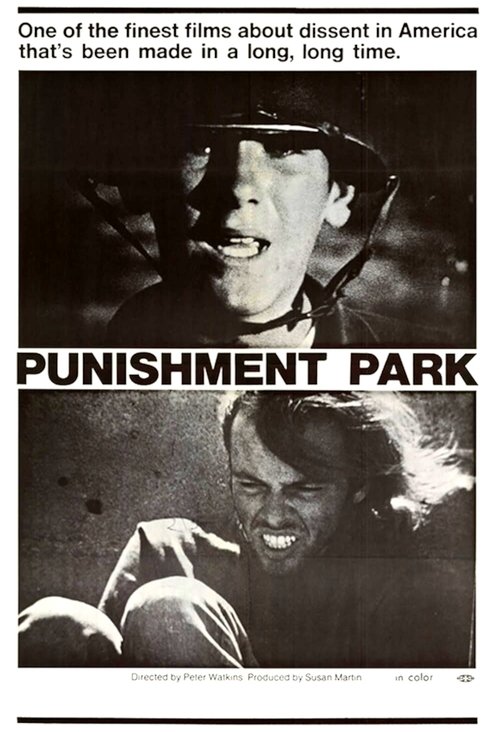
Punishment Park
1971 · Peter Watkins
When you want cinema as confrontation — something to grip you, infuriate you, and give you plenty to chew on afterward. This is a challenge, not a comfort; watch it when you have the stamina for it.
What it's about
In an America under a declared state of emergency, overcrowded prisons give political dissidents a choice: long sentences, or three days in 'Punishment Park' — a stretch of California desert where they must reach an American flag fifty waterless miles away while police and National Guardsmen hunt them. A foreign TV crew films everything, cutting between one group's desert ordeal and the makeshift tribunal condemning the next batch of antiwar activists, draft resisters, and radicals.
The experience
Unbearably tense and genuinely enraging — the fake-documentary form is so convincing that your body reacts as if it's real, and the tribunal's shouting matches feel like being trapped in the worst argument in American history. It's a film that leaves you shaken and arguing with it for days.
Performances
The cast is largely non-professionals — actual activists and conservatives essentially playing themselves — and their unscripted fury gives the tribunal scenes a rawness no written dialogue could match.
The craft
Peter Watkins shoots in handheld, sweat-and-dust vérité style with improvised confrontations, and the illusion of documentary is nearly total — many first-time viewers have to remind themselves it's staged. The desert heat, the panting sound of the chase, and the escalating tribunal crosstalk make it as visceral as any thriller.
Why it matters
Barely distributed and effectively suppressed in the U.S. for decades, it has since been reclaimed as one of the most prescient American political films — its questions about emergency powers, protest, and state violence keep finding new audiences.
Snapshot
Punishment Park is Peter Watkins's ferocious pseudo-documentary about an America that has legalized the internment and hunting of its political dissidents. Framed as footage shot by a foreign television crew, the film braids two parallel actions: an emergency civilian tribunal, convened in a tent in the California desert, that sentences antiwar activists, draft resisters, and radicals under emergency powers; and the ordeal of a previous group already turned loose in "Bear Mountain National Punishment Park," where detainees who chose the desert over years in prison must cover fifty-odd waterless miles on foot to reach an American flag, pursued by police and National Guardsmen. The premise is speculative, but Watkins grounds it in a real statute — the detention provisions of the 1950 McCarran Internal Security Act — and in the immediate trauma of Vietnam, the Chicago conspiracy trials, and the killings at Kent State and Jackson State in 1970. Shot with nonprofessional performers improvising from their own convictions, the film is less a story than a staged confrontation: a simulation of the American political rupture pushed one step past documentary into prophecy.
Industry & production
Punishment Park was made as a low-budget independent production, outside both the studio system and the British public-broadcasting apparatus that had shaped Watkins's earlier career. By 1971 Watkins was effectively an exile from institutional filmmaking: his BBC nuclear-war film The War Game (1965) had been suppressed by the corporation, and his one studio feature, Privilege (1967) for Universal/Rank, had left him disillusioned with commercial production. He came to the United States and assembled Punishment Park on minimal resources, shooting quickly in the Southern California desert with a small crew and a cast of amateurs recruited for their real-life political positions.
The precise budget and shooting schedule are not firmly fixed in the accessible record — figures often cited are small and the shoot brief (on the order of a couple of weeks), but I would not assert an exact dollar amount, as reliable primary documentation is thin. What is well established is the film's distribution catastrophe. Its American theatrical exposure was minimal; the film is widely reported to have played only a matter of days in New York before being pulled, and it never received meaningful commercial release in the U.S. or U.K. during the period. For decades it circulated semi-underground, in 16mm prints and on the festival and repertory margins, before a restoration and re-release in the mid-2000s (associated with New Yorker Films / Project X) brought it to a wider audience on DVD and in revival screenings. Any box-office figures should be treated as effectively nonexistent; this was not a film that recouped through the market but one that survived through reputation.
Technology
The film was shot on 16mm — the lightweight, fast-stock, sync-sound format that had made observational documentary possible in the preceding decade. This choice is inseparable from the film's meaning: 16mm was the technology of news crews and cinéma vérité, and Watkins weaponizes its texture to make a fiction pass as captured reality. Handheld cameras, available desert light, and portable sync-sound recording allowed a small unit to move with the action — following prisoners across dry lakebed and scrub, whip-panning to catch an outburst in the tribunal tent. The grainy color, blown highlights, and jostled framing are not defects but the authenticating signature of on-the-fly reportage. Watkins had already exploited the same technological logic in Culloden (1964), imagining what a TV news crew would have filmed at an 18th-century battle; here the apparatus is contemporary, and the illusion of a real broadcast-news dispatch is correspondingly sharper.
Technique
Cinematography
The cinematography is credited to Joan Churchill, then early in a career that would make her one of the significant documentary camerapersons of her generation. Her work here is central to the film's power. The handheld camera behaves like a real news camera under stress: it hunts for the speaker, loses focus, reframes, catches faces at the edge of the crowd. In the tribunal scenes it swings between the accused and their inquisitors, implicating the viewer in the interrogation; in the desert it lags behind exhausted runners or races to keep up with pursuing officers, its instability registering both physical hardship and the crew's supposed inability to control events. The desert light is harsh and unflattering, the heat almost palpable in the bleached exposures. Because the imagery so convincingly mimics observed fact, the staged brutality lands with documentary force.
Editing
The film's method is fundamentally an editing conception: two timelines — the tribunal and the park — are cross-cut so that judgment and its consequence unfold simultaneously, the sentencing of one group intercut with the fate of another already condemned. This parallel montage builds a sense of an assembly line of repression, each verdict feeding the next hunt. Over the images runs a spare, reportorial narration (delivered in the register of a foreign correspondent), which contextualizes and counterpoints the action. The specific editor credit I would not state with confidence; Watkins was closely and often personally involved in the cutting of his films, and the structural design here is unmistakably his, but I flag the individual editing attribution as something I cannot verify precisely.
Mise-en-scène / staging
Staging is where Watkins's "structured improvisation" is most visible. The tribunal is a single dominant set — a tent housing a panel of civilian citizens (a labor figure, a conservative matron, a professor, and others standing in for pillars of the establishment) facing the accused across a table. The confrontation is largely verbal, allowed to run long and grow heated, so that the room fills with genuine argumentative pressure. The park sequences use the raw desert as an unadorned arena; there is no production design to speak of beyond a distant flag as the runners' unreachable goal. The absence of dressing is itself the point — the landscape is a stripped stage on which the political abstraction (the state versus the citizen) is played out as physical pursuit. Watkins repeatedly lets performers address the camera or acknowledge the crew, keeping the frame porous and the fiction's documentary premise alive.
Sound
The soundtrack is dominated by voice: overlapping testimony and interrogation in the tribunal, ragged breathing and shouted commands in the desert, and the correspondent's narration threading it together. Sync sound recorded in the field gives the arguments their unpolished immediacy — people talk over one another, the tribunal chair struggles for control. Watkins largely eschews a conventional dramatic score; the film's rhythm comes from speech and cutting rather than music. I would not attribute a specific composer, as the film does not lean on original scoring and reliable credit information here is thin; the sonic experience is closer to a news recording than to a scored drama.
Performance
The performances are the film's most audacious element and the source of much of its friction. Watkins cast nonprofessionals chosen for beliefs close to their characters — young radicals and pacifists as the accused, older conservatives as members of the tribunal — and had them improvise around the scripted situation. The result is that the arguments are not "acted" so much as fought; the ideological heat is real because the participants largely held the positions they voice. This produces moments of raw conviction impossible to fake and, at times, an unevenness that itself reads as authenticity. The approach dissolves the line between performer and person, which is exactly Watkins's aim: to make the confrontation feel less like a play about America than a piece of America caught on film.
Narrative & dramatic mode
The dramatic mode is the fake or "reconstructed" documentary — what would later be loosely called mockumentary, though Watkins's version is polemical rather than comic. The film adopts the full grammar of observational reportage (handheld camera, on-the-spot narration, direct-to-camera testimony, apparent access to unfolding events) in service of a wholly invented scenario. Narrative in the conventional sense is thin: there is no protagonist whose arc we follow, no resolution in the dramatic sense. Instead the film advances through accumulation and juxtaposition — the tribunal's escalating verdicts against the park's grinding attrition — toward an inevitability that feels less plotted than reported. The mode is Brechtian in effect: the documentary surface invites belief while the impossible premise and the direct address keep provoking the viewer to judge. We are positioned not as spectators of a story but as witnesses to a process, and repeatedly asked whose side the camera — and we — are on.
Genre & cycle
Punishment Park sits at the intersection of political drama, dystopian speculation, and the docudrama. Its "hunt the human for sport under state sanction" premise places it in a lineage of survival-as-spectacle fictions, but Watkins strips out the entertainment pleasure such premises usually offer, refusing suspense mechanics in favor of exhaustion and inevitability. Within Watkins's own body of work it belongs to a distinct cycle of speculative pseudo-documentaries — The War Game (imagined nuclear attack), Privilege (imagined pop-culture authoritarianism), Punishment Park (imagined domestic repression) — each extrapolating a present anxiety into a near-future emergency and filming it as though it had already happened. Historically it is part of the early-1970s wave of American political cinema responding to Vietnam and the collapse of the counterculture, though its formal radicalism sets it apart from more conventional message pictures of the period.
Authorship & method
The film is unmistakably an auteur work: Watkins wrote, directed, and shaped it around a method he had been refining since the mid-1960s. That method combines a fictional situation with unscripted performance by people cast for authenticity, filmed in the idiom of live news. His key collaborator on Punishment Park is cinematographer Joan Churchill, whose handheld vérité camerawork gives the film its documentary skin and who would go on to a major documentary career. Watkins himself functions as writer and structuring intelligence; the narration and the two-track architecture are his. Beyond Churchill, individual craft credits (editor, composer) are less securely documented in the accessible record, and I decline to assign them precisely rather than risk error. What is certain is the coherence of authorial intent: the film is an argument, and every technical choice — 16mm, improvisation, cross-cutting, direct address — serves the goal of collapsing the distance between depicted crisis and real one. Watkins would later theorize the standardized structure of broadcast media as the "monoform" and champion long, participatory alternatives (culminating in La Commune (Paris, 1871) in 2000); Punishment Park is an early, aggressive test of using documentary's own tools against the consensus it usually manufactures.
Movement / national cinema
Watkins is a British filmmaker, but Punishment Park is an American subject made in America, and it resists neat national categorization — fittingly, since Watkins spent his career as a stateless, itinerant director working across Britain, the U.S., Scandinavia, and beyond. Formally the film descends from two currents. First, the Anglo-American observational documentary movement — British Free Cinema and, more directly, American direct cinema / cinéma vérité (Drew, Leacock, Pennebaker, the Maysles) — whose techniques Watkins appropriates and turns to fictional and political ends. Second, a broader tradition of politically committed cinema that uses documentary realism for dramatized events, of which Gillo Pontecorvo's The Battle of Algiers (1966) is the towering precedent. Watkins does not belong to a school so much as he stands as a singular figure who industrialized the "reconstructed documentary" into a personal genre, influencing how docudrama and political film would later be conceived on both sides of the Atlantic.
Era / period
The film is saturated in its exact moment: the United States of 1970–71, with the Vietnam War grinding on, the draft resistance movement at its height, the Chicago Seven trial fresh in memory, and the shootings of students at Kent State and Jackson State in May 1970 hanging over everything. Nixon's presidency and the rhetoric of law-and-order backlash supply the film's political weather. Crucially, Watkins anchors the fantasy in law that actually existed — the McCarran Act's Title II, which had authorized emergency detention of suspected subversives (and which was in fact repealed in 1971, the very year of the film) — so that the scenario reads not as far-fetched invention but as a switch that could be flipped. The film is thus both a period document of the antiwar era's despair and a warning that the machinery for repression was already on the books.
Themes
The dominant theme is the fragility of civil liberty under emergency — how quickly due process, dissent, and the rule of law can be suspended when the state declares itself under threat. Closely bound to this is the failure of dialogue across the American divide: the tribunal scenes stage the impossibility of communication between the young radicals and the establishment panel, each speaking past the other until the exchange collapses into coercion. The film interrogates state violence and its legitimation — the way official process (a tribunal, a "park," rules of the game) launders brutality into procedure. It is also a meditation on media and complicity: by casting the whole in the form of a news broadcast, Watkins implicates the camera, and the viewer, in the spectacle of suffering, asking what it means to watch. Underlying all of this is a bleak inquiry into national self-image — the flag as the runners' unreachable goal makes the American promise literally a mirage in the desert.
Reception, canon & influence
Contemporary reception was hostile or, worse, negligible. The film's near-total suppression in the marketplace meant few had the chance to see it, and among those who did, reactions divided sharply — some critics found it unbearably one-sided or crude in its stacking of the deck, others recognized its raw force. I would not attribute specific named reviews without certainty; what the record clearly shows is that the film was commercially strangled and critically marginalized on release, and that its reputation was built slowly, through underground and repertory circulation, over the following decades.
Influences on the film are legible. Watkins built directly on his own Culloden and The War Game, which had established the reconstructed-documentary method. The observational grammar of American direct cinema and the fiction-as-reportage precedent of The Battle of Algiers stand behind its aesthetic, and Brechtian distanciation informs its refusal to let the viewer settle into passive belief. The scenario draws on the concrete political history of McCarthy-era detention law and the conspiracy trials of the late 1960s.
Its legacy forward is that of a slow-burning cult and touchstone. The film's stock rose dramatically in the 2000s, when its restoration and re-release coincided with the post-9/11 debates over indefinite detention, Guantánamo, and emergency powers; many later commentators found it newly, disturbingly prescient. It is now frequently cited in surveys of docudrama and political cinema and treated as one of Watkins's essential works alongside The War Game and La Commune. Its "state-sanctioned human hunt as spectacle" premise anticipates a later strain of dystopian entertainment — the hunt-for-survival scenarios of works from The Running Man to Battle Royale to The Hunger Games — though these resonances are largely thematic convergence rather than documented direct influence, and I present them as anticipation rather than lineage. Its more traceable inheritance is methodological: Punishment Park remains a landmark demonstration of how documentary form can be turned into political weapon, a reference point for filmmakers using vérité techniques to dramatize what the official record would prefer to keep off camera.
Reception
Savaged by US critics in 1971 and yanked from its New York run after just a few days, it spent decades nearly impossible to see — then the post-9/11 era (Patriot Act, Guantánamo) and a mid-2000s DVD rediscovery recast it as eerily prophetic rather than paranoid.
How Punishment Park was received, from release to now →
How to watch Punishment Park: what to notice on a first viewing
- Watch the handheld camera drift out of focus and reframe. Joan Churchill's camera hunts for the speaker, loses him, and swings to catch faces at the edge of the crowd, exactly like a news camera under real pressure. The camera's own instability is what convinces you this is unfolding footage instead of a written scene.
- Notice how the film keeps cutting between the tent and the desert. Watkins cross-cuts a civilian tribunal sentencing one group of detainees with the ordeal of a previous group already turned loose in the park. Judgment and its consequence run side by side, so each verdict in the tent lands as someone already running in the heat.
- Listen for people talking over each other with no music under it. The tribunal argument is recorded live and unpolished, the chair visibly struggling to keep order, and the desert scenes run on ragged breathing and shouted commands instead of score. With no score to cue your feelings, you are left to judge the argument the way you would judge a real one.
- Watch how heated the tribunal argument gets and stays. Watkins cast young radicals and older conservatives close to their real beliefs and let them improvise, so the ideological heat in the room is not performed. You are watching people argue positions they actually hold, which is why the argument never settles into a scripted rhythm.
- Notice how bare the desert is except for one distant flag. There is no production design in the park beyond that flag, so the landscape itself becomes the arena where the state confronts the citizen. A flag you can see but never reach is the whole promise of the country turned into a physical fact.
The whole guide to watching Punishment Park, with the keys for a rewatch →
Influences: the films it descends from and the films it influenced
- Culloden (1964) — Watkins's own founding template: a reporter-and-cameraman chase an 18th-century battle as if broadcasting live TV news, the reconstructed-documentary-as-live-reportage grammar Punishment Park reuses wholesale.
- The War Game (1966) — Perfects the faux-newsreel dystopia with clinical voiceover and terrified nonprofessionals interviewed to camera — the two-track narration-plus-interview architecture Punishment Park directly inherits.
- The Battle of Algiers (1966) — Stages pure fiction and shoots it as grainy handheld newsreel with nonprofessional casting, the fiction-indistinguishable-from-reportage precedent Watkins explicitly builds on.
- Chronicle of a Summer (1961) — Coins cinéma vérité by provoking real people into unscripted confrontation and letting them address the lens, the participatory-provocation method behind the tribunal improvisations.
- Primary (1960) — Pioneers lightweight 16mm handheld sync-sound shooting that follows action live and unstaged — the exact technical grammar Joan Churchill's camera adopts for the desert pursuit.
- Point of Order (1964) — Turns real McCarthy-hearing footage into political indictment through editing alone, a compilation-as-argument precedent for staging the McCarran-Act tribunal as a rigged proceeding.
- Medium Cool (1969) — Splices staged fiction into the real 1968 Chicago convention riots with a handheld documentary camera, collapsing depicted crisis into actual one exactly as Watkins intends.
- Alphaville (1965) — Watkins deploys the declarative-mode political fiction in real Californian desert locations — a pseudo-documentary grammar in which the state apparatus is exposed as pure machinery through Brechtian refusal of narrative smoothing — extending Alphaville's practice of genre as political instrument into the pseudo-newsreel form.
- Edvard Munch (1974) — Extends the method: nonprofessional actors break the fourth wall to address the documentary camera about their own lives, deepening Punishment Park's direct-address device.
- La Commune (Paris, 1871) (2000) — The full flowering of his 'monoform' critique — nonprofessionals restage the Commune while reporting it through anachronistic TV news, Punishment Park's method at feature-epic scale.
- Man Bites Dog (1992) — A faux-vérité crew's growing complicity with the on-camera violence it films extends Watkins's implication of the documentary apparatus itself in the atrocity it records.
- Series 7: The Contenders (2001) — Presents a state-sanctioned lethal hunt entirely as a reality-TV broadcast, inheriting Punishment Park's tactic of using documentary/broadcast form to indict spectacle.
- Death of a President (2006) — Reconstructed political docudrama that fabricates a near-future event in authentic news idiom to critique post-9/11 emergency powers — Watkins's reconstructed-documentary weapon aimed at the War on Terror.
- The Blair Witch Project (1999) — Feature-length improvised performance by unknown nonprofessionals filmed as recovered documentary footage, extending Watkins's nonprofessional-improvisation-as-realism into horror.
- The Idiots (1998) — Pseudo-documentary that uses handheld immediacy and to-camera interviews to stage political provocation as if observed, anticipating von Trier's documentary alibi for transgression.
- Born in Flames (1983) — Uses handheld faux-documentary crews and improvising non-professionals to dramatize a dystopian near-future of state repression, modeling Borden's reportage-of-a-fiction dystopia.
- La Commune (Paris, 1871) (2003) — Source of the embedded-crew conceit and of improvised political argument as the film's language: non-professionals researched their own positions and debated in real time while an acknowledged camera crew inside the fiction decided whom to point at.
- Titicut Follies (1967) — Unnarrated observational vérité exposing state custodial power over confined bodies — the documentary scrutiny Punishment Park converts into fiction to reach what real cameras could not.
- Cathy Come Home (1966) — TV docudrama shot in caught-reportage vérité with improvising nonprofessionals to make a policy argument feel like documentary — the parallel British deployment of the same method.
- David Holzman's Diary (1967) — A wholly fake first-person documentary that weaponizes vérité's authenticity codes in order to interrogate them — the self-reflexive mockumentary impulse Punishment Park shares.
- Winter Soldier (1972) — Documents a real Vietnam-era veterans' tribunal via static testimony-to-camera — the literal nonfiction counterpart to Watkins's fabricated hearing, from the same political moment.
- Even Dwarfs Started Small (1971) — Watkins uses hand-held pseudo-documentary observation with non-professional cast and diegetic-only sound to stage institutional authority brutalizing subjects across an extreme landscape — the same formal vocabulary as Even Dwarfs, though applied to an explicitly politicized mode where Even Dwarfs sustains allegorical indeterminacy.
Similar films
- Medium Cool (1969) — influence & lineage · same viewing thread
- The War Game (1966) — influence & lineage · often watched together
- Edvard Munch (1974) — influence & lineage · often watched together
- La Commune (Paris, 1871) (2003) — shared sensibility
- State of Siege (1972) — shared sensibility
- It Was Just an Accident (2025) — shared sensibility
- Civil War (2024) — shared sensibility
- Dirty Harry (1971) — shared sensibility
All the films related to Punishment Park →
Watch it with: curated runs of related films
- Bearing Witness — Watch these when you want cinema as testimony — ordinary people caught between armies, borders, prisons, and markets, filmed close to the ground and close to documentary.