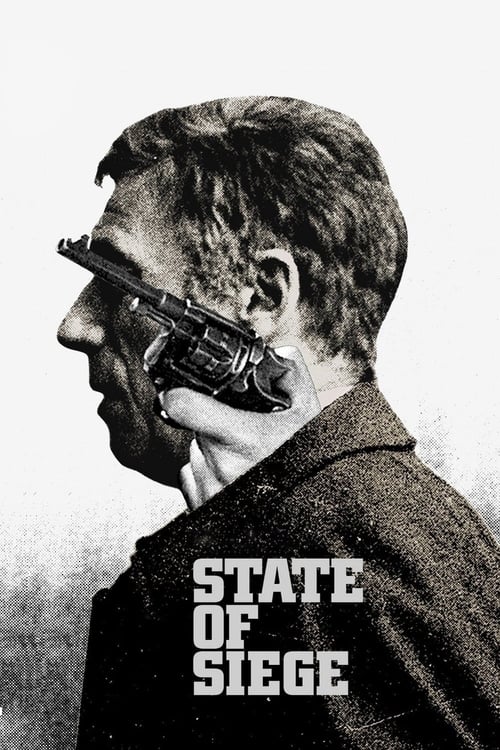
State of Siege
1972 · Costa-Gavras
For when you want a film to chew on for days — something gripping that treats you like an adult and refuses easy villains. This is challenge viewing, best with someone to argue with afterward.
What it's about
In an unnamed South American country under curfew and martial law, urban guerrillas kidnap a visiting American official who claims to be an aid advisor. As they interrogate him in a safe house, the film pieces together — coolly, methodically — what his agency actually does there, while police tear the city apart hunting for him and his captors debate what to do with him. It's drawn closely from a real 1970 case.
The experience
Tense but ice-cold — less a thriller than a cross-examination, tightening its grip through questions and evidence rather than chases. It leaves you unsettled and arguing with yourself on the way out.
Performances
Yves Montand plays the captured official with unnerving composure — courteous, intelligent, never begging — which makes the interrogation scenes a genuine contest rather than a beating.
The craft
Costa-Gavras directs with documentary-style urgency — the film opens on the outcome and reconstructs backward, so suspense comes from understanding rather than surprise. Franco Solinas's script builds its case like a dossier, scene by scene, and the crowd and police sequences have a scale and realism that still bite.
Why it matters
One of the most controversial political films of the 1970s — its account of covert American involvement in Latin America got it pulled from at least one high-profile venue and made it a touchstone for politically engaged cinema.
Snapshot
State of Siege (État de siège) is Costa-Gavras's third consecutive political thriller and the most analytically severe of the trilogy that began with Z (1969) and continued with The Confession (L'Aveu, 1970). Where Z dramatized a single assassination and its cover-up, State of Siege reconstructs the 1970 kidnapping and killing of Dan Mitrione — a United States official attached to the Agency for International Development's Office of Public Safety in Uruguay — by the Tupamaros urban guerrillas. The film renames its protagonist Philip Michael Santore (Yves Montand) and declines to name the country, but the geography, the political vocabulary, and the apparatus of the kidnapping leave little doubt. Built from a screenplay by Costa-Gavras and Franco Solinas, the film opens on Santore's corpse and works backward, using the guerrillas' interrogation as a structural device to anatomize the machinery of U.S. counterinsurgency in Latin America — specifically the export of police repression and torture instruction under the cover of development aid. It is less a suspense vehicle than a procedural indictment, and it remains one of the canonical works of the post-1968 European political cinema.
Industry & production
The film was a French-led international co-production, produced by Jacques Perrin — who had also produced and acted in Z — through Reggane Films, with Italian and West German participation typical of the European art-cinema financing of the period. This pan-European structure was characteristic of Costa-Gavras's output: it pooled capital and distribution across markets while insulating a politically incendiary project from any single national censor or financier. Shooting took place not in Uruguay but in Salvador Allende's Chile in 1972 — Santiago and the northern desert around Antofagasta standing in for the unnamed republic. That choice is historically resonant: Chile under Popular Unity was, briefly, one of the few Latin American states hospitable to a production of this politics, and the location work predates the 1973 coup that would soon make such a film unshootable there.
The picture's most consequential industry episode came in distribution rather than production. State of Siege had been chosen to inaugurate the American Film Institute's new theater at the Kennedy Center in Washington in April 1973; AFI director George Stevens Jr. canceled the opening screening, reportedly on the grounds that the film could be read as rationalizing political assassination. The cancellation became a public controversy and a cause célèbre about censorship, drawing far more attention to the film's American reception than a quiet booking would have. The episode is well documented and is frequently cited as a defining moment in the U.S. distribution of Costa-Gavras's work.
Technology
The film was shot on 35mm color stock with location-based, available-feeling lighting and a largely handheld and shoulder-mounted camera idiom in its street and vehicle sequences — the standard toolkit of early-1970s European realist filmmaking rather than any technological innovation. There is no formal novelty to claim here; the film's modernity lies in method, not apparatus. What the technology enables is mobility: the capacity to stage kidnappings, roadblocks, and police sweeps in real Chilean streets with a documentary plausibility, and to move fluidly between the cramped interiors where Santore is held and the bureaucratic and ceremonial spaces of the state. The synchronized location sound and the integration of radio broadcasts, official announcements, and crowd noise into the texture are period-appropriate rather than groundbreaking.
Technique
Cinematography
The photography is by Pierre-William Glenn, a cinematographer associated with the generation that worked alongside the later New Wave and its inheritors (he shot for Truffaut and Tavernier). His work here is deliberately unglamorous: a muted, sun-flattened palette for the exteriors, functional interior lighting, and a restless, reportorial camera that favors the immediacy of news footage over the composed image. The visual rhetoric is one of withheld beauty — the film refuses the seductions of the thriller's usual surfaces so that the spectator attends to information and argument rather than spectacle. Glenn's camera tends to observe rather than dramatize, holding on faces during interrogation and tracking the logistics of the abduction with a near-procedural patience.
Editing
Editing is by Françoise Bonnot, who had cut Z (for which she received an Academy Award) and was Costa-Gavras's essential structural collaborator. The film's power is largely an editorial achievement. Its architecture is a flashback investigation: the discovery of the body furnishes the frame, and the interrogation scenes become hinges from which the picture cuts outward into reconstruction — to Santore's history, to the workings of the police and the aid mission, to the parallel responses of guerrillas, government, press, and embassy. Bonnot's cutting builds the argument by juxtaposition, intercutting Santore's calm self-justifications with the evidence of what his "public safety" program meant in practice. The rhythm is analytic rather than merely accelerative; suspense is generated by accumulating comprehension rather than by chases.
Mise-en-scène / staging
Costa-Gavras stages the film as a study in systems. The kidnapping is presented as an operation — coordinated, rehearsed, executed by an organization rather than by individuals — and the staging emphasizes process: the simultaneous seizures, the relay of vehicles, the disciplined anonymity of the cells. Against this the film sets the official world of motorcades, press conferences, and parliamentary theater. The confined interrogation space, by contrast, is staged with stillness and frontality, almost as a tribunal, so that the encounter between captor and captive reads as a hearing in which the state's representative is compelled to account for himself.
Sound
The score is by Mikis Theodorakis, the Greek composer who had also scored Z and whose music carried a charged political biography — Theodorakis had been imprisoned and his work banned under the Greek military junta. His contribution gives the film a propulsive, folk-inflected motif that functions less as emotional underscoring than as a marker of collective resistance. Beyond the score, the sound design leans on the documentary furniture of radio bulletins, official statements, and ambient urban noise, reinforcing the sense that the drama is unfolding inside a real, news-saturated public sphere.
Performance
Yves Montand, in his third collaboration with Costa-Gavras, gives Santore as a study in unruffled conviction. The performance's intelligence lies in its refusal of villainy: Santore is courteous, reasonable, even sympathetic in manner, a family man and a professional who explains the logic of anti-communist counterinsurgency without raising his voice. The horror is meant to register precisely through that composure — the banality, in the period's vocabulary, of an administrator of repression. The guerrillas, played by an ensemble that includes Renato Salvatori among the supporting figures, are deliberately underindividualized, presented as a disciplined collective rather than as psychologized protagonists, which is itself an argument about the nature of the movement.
Narrative & dramatic mode
The dominant mode is the dossier-thriller: a reconstruction that uses the apparatus of suspense to deliver a documented case. By opening on the outcome — Santore dead — the film forecloses conventional suspense about whether he will survive and redirects the spectator's attention to why, converting the thriller's forward drive into an investigative one. The interrogation supplies the engine: each question from his captors becomes a portal into exposition, allowing the film to lay out the structure of the aid mission, the training of police, and the methods of repression. This is a cinema of demonstration. It risks didacticism and embraces the risk; characters are functions of a political analysis, and the drama is the gradual exposure of a system rather than the transformation of a soul. The flashback architecture, shared with Z, is the formal signature — a way of making structure legible by refusing chronology.
Genre & cycle
State of Siege belongs to the political thriller cycle that Costa-Gavras effectively defined for international audiences and which flourished in the late 1960s and 1970s. Within his own filmography it completes a loose trilogy — Z on the Greek colonels' milieu, The Confession on Stalinist show trials in Czechoslovakia, State of Siege on U.S. imperialism in Latin America — that systematically turned the genre's machinery against state power across the political spectrum (right-wing junta, Communist apparatus, American hegemony in turn). The cycle's innovation was to graft the suspense and pacing of the commercial thriller onto rigorously researched political subject matter, producing a hybrid that could play in mainstream theaters while functioning as agitation. State of Siege is the most austere and least conventionally exciting of the three, pushing the form toward the essayistic.
Authorship & method
Costa-Gavras (born Konstantinos Gavras, a Greek émigré working in France) is the cycle's organizing intelligence, but State of Siege is as much the work of his screenwriter Franco Solinas. Solinas — author of The Battle of Algiers and Burn! (Queimada) — brought a Marxist, anti-colonial analytical frame and a documentary discipline that shaped the film's procedural method; his interest in the mechanics of empire and insurgency is legible throughout. The collaboration with cinematographer Pierre-William Glenn, editor Françoise Bonnot, composer Mikis Theodorakis, and actor Yves Montand constitutes a repertory of trusted hands, several carried over from Z. The working method is research-driven reconstruction: a real, recent, documented event (the Mitrione case) is restaged with names altered and country unnamed, close enough to the record to function as exposé while retaining the deniability of fiction. Costa-Gavras's authorial stance is unapologetically committed; he has consistently defended the legitimacy of a cinema that takes sides while insisting on factual grounding.
Movement / national cinema
The film sits at the intersection of several currents. It is a product of French commercial-art cinema, financed and crewed in the European co-production system, yet its politics and method align it with the broader transnational political cinema of the post-1968 moment. Through Solinas it connects to the Italian tradition of politically engaged filmmaking and, indirectly, to the anti-colonial Third Cinema impulse that The Battle of Algiers had helped crystallize — though State of Siege remains a metropolitan, European production looking at Latin America rather than a film of that continent's own cinemas. Its Chilean location work ties it, circumstantially, to the brief window of Allende-era openness. It is best understood not as belonging to a single national cinema but as an artifact of an internationalist left film culture.
Era / period
The film is saturated in its moment: the years of the Tupamaros' urban-guerrilla campaign, of exposés about U.S. counterinsurgency aid and the training of Latin American police, of widening awareness of torture as an instrument of state policy. It arrives between the Vietnam-era radicalization of Western audiences and the wave of Latin American coups — the Uruguayan military's assumption of power and the Chilean coup of September 1973 followed within roughly a year of the production. The film thus functions almost as a premonition: shot in a Chile that would shortly be transformed, about methods of repression that the subsequent Southern Cone dictatorships would institutionalize. Its period flavor — the news-cycle texture, the faith that exposure could itself be a political act — is distinctly that of early-1970s engaged cinema.
Themes
The film's central theme is the export of repression: the argument that U.S. development and "public safety" assistance functioned as a delivery system for surveillance, policing, and torture in service of anti-communist order. Around this it develops several concerns: the moral accountability of the functionary, dramatized through Santore's unshaken sense of duty; the question of revolutionary violence and whether the killing of a captive can be justified by the violence of the system he serves — the very ambiguity that alarmed the AFI; the role of a free press and parliamentary forms as either checks on or ornaments of power; and the relationship between metropolitan center and dependent periphery. The film is notably willing to let its guerrillas voice a coherent analysis while declining to sentimentalize them, and it does not resolve the ethical problem of the assassination so much as force the spectator to sit inside it.
Reception, canon & influence
Critically, State of Siege was received as a major and contentious work, admired for its rigor and intelligence and attacked — across the spectrum — for didacticism and for the moral implications of its sympathetic treatment of the guerrillas. The Washington cancellation crystallized the controversy: defenders read AFI's decision as political censorship of an anti-American film, while critics of the film argued it dignified terrorism. That debate is itself part of the film's historical significance and is the best-documented strand of its American reception; precise commercial figures are not something I can responsibly cite here, and the contemporary critical record is more reliably characterized as sharply divided than as a consensus.
Looking backward, the film draws on the investigative-reconstruction method Costa-Gavras and Bonnot perfected in Z, on Solinas's anti-colonial screenwriting established in The Battle of Algiers and Burn!, and on the broader documentary-realist and Brechtian currents of 1960s political cinema. Looking forward, it helped consolidate the template of the fact-based political thriller that would shape subsequent conspiracy and exposé films of the 1970s and after, and it confirmed Costa-Gavras as the genre's internationally legible master — a reputation he would extend with later work such as Missing (1982), which returns to U.S. complicity in Latin American repression with the Chilean coup at its center. The lineage from State of Siege runs through the political-procedural tradition wherever filmmakers have used the grammar of the thriller to prosecute a documented case against power. It remains a touchstone for debates about whether engaged cinema can be both honest and persuasive, and about the responsibilities of a film that dramatizes real political killing.
A Deleuzian reading
It opens on a body.
The full Deleuzian reading of State of Siege →
Reception
Denounced on release as anti-American agitprop and famously yanked from the American Film Institute's opening program at the Kennedy Center in 1973, it's since been vindicated — its claims about US complicity in Latin American torture were later substantiated, and a Criterion release sealed its reappraisal as the underseen third panel of Costa-Gavras' political trilogy.
How State of Siege was received, from release to now →
Influences: the films it descends from and the films it influenced
- Z (1969) — Establishes the investigative-reconstruction template later reused wholesale — Françoise Bonnot's flashback-investigation cutting that assembles a political crime from layered testimony, plus the Theodorakis score and Montand, the exact repertory carried into State of Siege.
- The Battle of Algiers (1966) — Franco Solinas's documentary-procedural screenwriting and Pontecorvo's newsreel-grain handheld restaging of real insurgency supply the anti-colonial analytic method and reportage texture Solinas brings directly to State of Siege.
- Burn! (Queimada) (1969) — Solinas's dialectical script anatomizing the mechanics of empire through a foreign agent who engineers repression is the structural blueprint for Montand's USAID counterinsurgency functionary.
- Salvatore Giuliano (1962) — Originates the inchiesta/dossier form — reverse-chronology reconstruction of a political killing assembled from official record and on-location investigation — which State of Siege's dossier-thriller structure adopts.
- The Confession (L'Aveu) (1970) — Refines the tribunal-interrogation staging and systems-procedural anatomy of a coercive state apparatus, with Montand again as the subject ground down by institutional process.
- La Guerre est finie (1966) — Montand's underplayed clandestine-militant performance and Resnais's flash-cut montage of a revolutionary's interior calculus model the 'banality of the professional' register Montand reverses for the executioner role.
- Rome, Open City (1945) — Neorealist location shooting and raw documentary sound/radio texture as the realist substrate that committed political cinema, including State of Siege's reportage aesthetic, builds upon.
- Missing (1982) — Directly continues State of Siege's indictment of U.S. complicity in Latin American repression, reusing the method of restaging a documented event (the Horman case / Chilean coup) close enough to function as exposé.
- Special Section (1975) — Tribunal-procedural restaging of a documented act of judicial state collaboration, advancing the dialectical-montage prosecution of institutional complicity.
- All the President's Men (1976) — Transposes the political-procedural grammar to journalism — methodical assembly of a documented case against power, desaturated naturalism, process over heroics.
- The Parallax View (1974) — Uses thriller suspense mechanics to expose an institutional assassination apparatus, consolidating the 1970s conspiracy-exposé template State of Siege helped codify.
- Bloody Sunday (2002) — Handheld-reportage restaging of a documented state killing in near-real-time procedural form, inheriting the desaturated, newsreel-textured commitment to the factual record.
- Syriana (2005) — Dialectical cross-cut systems-procedural anatomizing the export of repression through interlocking institutional actors, extending the Solinas/Costa-Gavras 'mechanics of empire' structure to globalized oil politics.
- Munich (2005) — Tony Kushner's dialectical script dramatizes the ethics of revolutionary/state counter-violence and the banality of the functionary-killer — the moral-procedural questions State of Siege foregrounds about sanctioned political killing.
- One Day in September (1999) — Deployed dramatic irony — the audience knows the fatal outcome before the narrative delivers it — as the structuring principle of a political thriller about institutional violence; Macdonald imports this wholesale: viewers know the hostages will die before the film begins.
- 12.12: The Day (2023) — Costa-Gavras's procedural anatomy of a state apparatus rendered through rooms, telephone lines, and chain-of-command is the specific organizational grammar 12.12 adopts: both films make the authorization chain — who called whom, who obeyed, who hesitated — the dramatic substance rather than its backdrop.
- The Secret Agent (2025) — Non-linear procedural structure that reconstructs the bureaucratic architecture of a South American torture state from fragmentary testimony, using genre thriller mechanics to map institutional complicity rather than individual guilt.
- A House of Dynamite (2025) — Operational-detail procedural rendering of political violence through the texture of institutional function — logistics, chain of command, bureaucratic authorization — deploying occupational specificity as the mechanism by which moral editorializing is structurally refused.
- The Baader Meinhof Complex (2008) — A dispassionate procedural anatomy of urban-guerrilla kidnapping and state counter-action, reconstructing clandestine operation logistics step by step — the structural grammar Edel applies to RAF actions.
- The Mattei Affair (1972) — A contemporaneous fact-based reconstruction of a powerful man's death through fragmented, document-driven investigation — Rosi's inchiesta running in exact parallel to Costa-Gavras's procedural method.
- The Day of the Jackal (1973) — Documentary-precise, near-affectless proceduralism of an assassination's logistics, privileging underindividualized professional operators over psychology — the same de-dramatized 'mechanics' grammar.
- Illustrious Corpses (1976) — Systems-procedural conspiracy thriller that indicts the state through an investigator's accumulating dossier of political killings, extending the documented-case-against-power form.
- I... for Icarus (1979) — Shares Yves Montand as the grave moral center of a political thriller built from reconstructed interrogation and the anatomy of state complicity.
- Marighella (2021) — The Latin American urban-guerrilla operation rendered as logistics — vehicle counts, timing, the choreography of a snatch on a city street — with the security apparatus's counter-insurgency training shown as curriculum; Marighella's raid and kidnapping sequences use the same operation-first, motive-later ordering.
Similar films
- Z (1969) — influence & lineage
- Missing (1982) — influence & lineage
- The Battle of Algiers (1966) — influence & lineage
- The Day of the Jackal (1973) — influence & lineage
- Munich (2005) — influence & lineage
- I... for Icarus (1979) — shared sensibility
- Investigation of a Citizen Above Suspicion (1970) — shared sensibility
- Time for Revenge (1981) — shared sensibility