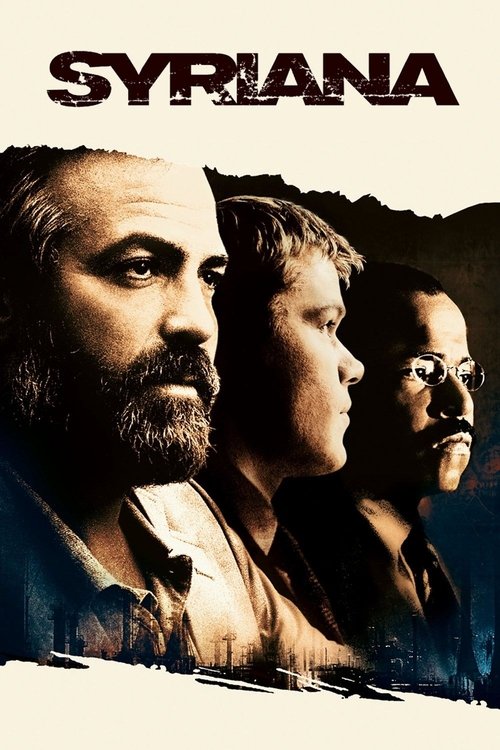
Syriana
2005 · Stephen Gaghan
For when you want to work for it — a smart, angry film to chew on for days and debate afterward. Not a relax-on-the-couch pick; it demands your full attention and repays it.
What it's about
Four stories orbit the global oil trade: a burned-out CIA field agent sent on one last dubious assignment, a Geneva energy analyst pulled into the inner circle of a reform-minded Gulf prince after a personal tragedy, a Washington lawyer vetting a suspicious oil-company merger, and a laid-off Pakistani migrant worker drifting toward militancy. The strands cross continents and slowly tighten around a single question: who actually decides what happens in the Middle East, and who pays for it.
The experience
Dense, tense, and deliberately disorienting — it drops you into rooms mid-conversation and trusts you to keep up, and the paranoia accumulates until the threads snap together. You leave it unsettled and arguing, which is the point.
Performances
George Clooney, heavier and wearier than you've ever seen him, disappears into the spent CIA operative, and Alexander Siddig brings quiet magnetism to the idealistic prince. Jeffrey Wright is all coiled ambiguity as the lawyer who sees everything and says almost nothing.
The craft
Stephen Gaghan braids the storylines with the same globe-spanning structure he scripted for the great drug-trade dramas, shot in a handheld, on-location style that feels closer to reportage than Hollywood. The editing asks you to hold four worlds in your head at once — part of why the film lingers.
Why it matters
A defining entry in the wave of post-9/11 political thrillers, it caught the mid-2000s moment of American anxiety about oil, intelligence, and empire, and won Clooney an Academy Award.
Snapshot
Syriana is the film that most fully translated the post-9/11 American foreign-policy thriller into the register of the multi-strand "network narrative." Written and directed by Stephen Gaghan — who had won an Academy Award for scripting Steven Soderbergh's Traffic (2000) — it applies the same braided, geographically dispersed structure that film used for the drug trade to the global oil economy. Suggested by former CIA officer Robert Baer's memoir See No Evil, it follows four loosely interlocking strands: a burned-out CIA field operative, a Geneva-based energy analyst who is drawn into the orbit of a reform-minded Gulf prince, a Washington attorney vetting a dubious merger of two American oil companies, and a young Pakistani migrant worker in the Gulf who, laid off and adrift, is recruited toward militancy. The film's wager is structural and political at once: that the proper subject is not any single protagonist but the system itself — the web of incentives connecting boardrooms, agencies, oilfields, and madrassas — and that only a deliberately fragmented, withholding narrative can render a process that has no center and no visible author.
Industry & production
Syriana was a product of the mid-2000s "issue cinema" moment, and specifically of two production entities that defined it. The first was Section Eight, the company George Clooney and Steven Soderbergh had founded to use studio capital for director-driven, often politically engaged projects; Clooney and Soderbergh produced, and Clooney also starred. The second was Participant Productions (now Participant Media), Jeff Skoll's then-new company built explicitly around socially conscious films paired with advocacy campaigns — Syriana arrived the same season as Participant's Good Night, and Good Luck (which Clooney directed) and North Country. Warner Bros. distributed.
The film's most widely reported production fact is George Clooney's physical transformation and injury. To play the heavyset, weathered agent Bob Barnes, Clooney gained a substantial amount of weight and grew a beard. During filming of an interrogation/torture sequence he suffered a serious spinal injury — a tear that caused cerebrospinal fluid to leak — which required surgery and left him with chronic pain and, by his own later accounts, a period of severe distress. This is well documented and frequently cited; I'll avoid attaching precise figures to the weight gain, which vary by source.
Casting was an ensemble of prestige character actors rather than a single star vehicle: Clooney as Barnes, Matt Damon as analyst Bryan Woodman, Jeffrey Wright as attorney Bennett Holiday, Chris Cooper as a Texas oilman, Christopher Plummer as the head of a powerful law firm, Alexander Siddig as the reformist Prince Nasir Al-Subaai, William Hurt, Tim Blake Nelson, Amanda Peet, and Mazhar Munir as the young worker Wasim. The deep, dispersed cast is itself an expression of the film's thesis that no one figure commands the narrative.
Technology
Syriana was shot photochemically on 35mm, in the naturalistic, available-light-leaning idiom that cinematographer Robert Elswit favored. The relevant technological story here is less about novel capture tools than about the logistics of a genuinely globe-spanning shoot — production ranged across multiple countries and climates (locations standing in for the Gulf, alongside Washington, Geneva, and elsewhere) to lend documentary specificity to each strand. The film belongs to a tradition that uses real, varied locations and a restrained, observational camera as a technology of authenticity: the look is meant to read as reportage rather than design. Visual effects are minimal and unobtrusive by the standards of a mid-decade studio release; the production's "effects" are largely those of place, weather, and the texture of real environments.
Technique
Cinematography
Robert Elswit — best known for his long collaboration with Paul Thomas Anderson — shot Syriana with a mobile, frequently handheld camera and a muted, location-determined palette. Where Traffic had famously color-coded its strands with overt filtration (tobacco for Mexico, cold blue for the Wakefield story), Syriana pursues a subtler differentiation: the bleached, dust-laden light of the Gulf oilfields and the prince's compound; the gray institutional interiors of Washington and corporate America; the cooler, cleaner light of Geneva. The handheld grammar keeps the viewer in a posture of eavesdropping, catching conversations in medias res, and it reinforces the film's refusal to grant any scene the stability of an establishing, authoritative overview. Elswit's work here is documentary-inflected realism rather than expressive stylization — a deliberate choice that serves the film's claim to be showing how the world actually operates.
Editing
Tim Squyres edited the film, and the editing is arguably its single most consequential technical element, because Syriana's difficulty and its ambition both reside in the cut. The film moves among its strands with minimal hand-holding — no chapter cards, sparse exposition, names and affiliations introduced obliquely — and the assembly trusts the viewer to hold multiple incomplete threads in suspension and to infer connections that the script declines to spell out. This withholding is a formal correlative of the theme: just as the characters operate with partial information, so does the audience. The film has been both praised for this density and faulted for opacity; that division is genuine and worth recording rather than resolving. The cross-cutting accelerates toward convergence in the final act, when the separate lines collide in a single act of violence, the structure's logic suddenly made brutally legible.
Mise-en-scène / staging
The staging favors the unglamorous rooms where power is actually exercised: law-firm conference rooms, government offices, hotel suites, oil-company boardrooms, the antechambers of Gulf palaces. Gaghan and his designers stage much of the drama as conversation — negotiation, briefing, interrogation — shot in plausible, lived-in spaces. The visual rhetoric is deflationary: there is little spectacle in how decisions of enormous consequence are made, and the film insists on that banality. Against these interiors it sets the open, exposed spaces of the oilfields and the worker camps, where the human cost of the abstractions discussed indoors becomes physical — the migrant laborers, the disused infrastructure, the final approach of a small boat toward a tanker.
Sound
Alexandre Desplat composed the score — one of the earliest of his major Hollywood assignments, before his ascent to the front rank of film composers later in the decade. His music for Syriana is restrained and pulse-driven, with a faint Middle Eastern coloration that underscores tension without tipping into exoticism or melodrama; it functions as connective tissue across the strands rather than as emotional editorializing. The sound design more broadly favors a naturalistic density of ambient detail — the languages, machinery, and rooms of a half-dozen worlds — and the multilingual dialogue (English, Arabic, Farsi, Urdu) is itself a sonic argument for the film's transnational scope.
Performance
The ensemble is calibrated to the film's anti-heroic, systemic vision: these are performances of competence, fatigue, and compromise rather than of grandeur. Clooney's Barnes — the role that won him the Academy Award for Best Supporting Actor — is built on the deglamorization of his star image: heavy, tired, increasingly expendable to the agency he has served. Jeffrey Wright gives perhaps the film's most internalized performance as Bennett Holiday, a watchful, careful man whose growing complicity registers in small adjustments rather than speeches. Matt Damon's Woodman carries the film's strand of personal grief and ambition, and Alexander Siddig lends genuine dignity and tragedy to Prince Nasir, the reformer whose attempt to act in his nation's interest marks him for elimination. Chris Cooper and Christopher Plummer supply the hard edges of American oil and law. The performances cohere into a portrait of people doing their jobs inside a machine larger than any of them.
Narrative & dramatic mode
Syriana is a paradigmatic "hyperlink" or network narrative: multiple protagonists, parallel strands, and a structure organized around systemic causation rather than individual agency. Its dramatic mode is deliberately decentered and elliptical. There is no single hero whose choices steer events; instead the film traces how decisions ramify across a web — a merger here producing a layoff there, an intelligence directive producing a death elsewhere — until the strands converge. The mode is closer to tragic irony than to thriller suspense: the audience gradually perceives a fatal logic that the characters, each seeing only their fragment, cannot. The film's withholding of exposition is integral to this mode; comprehension is meant to arrive late and partially, mimicking the epistemic condition of operating inside opaque institutions. The convergent climax delivers not catharsis but a grim demonstration of how the parts were connected all along.
Genre & cycle
The film sits at the intersection of the geopolitical thriller, the conspiracy film, and the ensemble "issue" drama. It belongs to a distinct mid-2000s cycle of politically engaged American films reckoning with the post-9/11 order and the "War on Terror" — a cluster that includes Munich (2005), The Constant Gardener (2005), Good Night, and Good Luck (2005), and, slightly later, The Kingdom (2007) and Body of Lies (2008). Within the longer lineage of the political conspiracy thriller, it descends from the paranoid American cinema of the 1970s — The Parallax View, Three Days of the Condor, All the President's Men — but updates that tradition's individual-investigator structure into a multi-strand, globalized form. It is also, more immediately, the companion piece to Traffic, transposing that film's drug-war anatomy onto oil.
Authorship & method
Syriana is a clear authorial statement by Stephen Gaghan, who both wrote and directed. His signature method — developed as a screenwriter and crystallized in Traffic — is the research-driven, multi-strand systemic narrative, in which a large social problem is dramatized through interlocking lives rather than a single arc. The film's intellectual scaffolding derives from Robert Baer's See No Evil, Baer's account of his years as a CIA field officer, which supplied the Barnes strand and much of the film's insider texture; the screenplay extrapolates outward from that source into the financial, legal, and political domains. Gaghan's stated method involved extensive reporting and interviews, and the film wears that research as density.
His key collaborators define the film's craft: cinematographer Robert Elswit, whose documentary-realist eye grounds the global sprawl; editor Tim Squyres, whose assembly is the film's structural intelligence; and composer Alexandre Desplat, whose restrained, propulsive score binds the strands. Producers George Clooney and Steven Soderbergh, through Section Eight, are part of the authorial picture too: the film is unimaginable outside the particular early-2000s alliance of star power and political seriousness that company represented, and Soderbergh's own multi-strand experiments (including Traffic, which he directed) are a clear precedent.
Movement / national cinema
Syriana is a Hollywood studio film, but it is best understood as part of a specific institutional micro-movement rather than a national-cinema school: the Section Eight / Participant nexus of socially conscious American filmmaking in the mid-2000s, which used studio resources for issue-driven, adult, often left-liberal cinema and frequently paired films with real-world advocacy. It is also a notably transnational production in setting, language, and crew — a film about globalization that is itself globalized in its making. If it belongs to a "movement," it is this brief, well-funded flowering of mainstream American political cinema between roughly 2004 and 2008.
Era / period
The film is inseparable from its moment: the United States in the years after the September 11 attacks and amid the Iraq War, when oil, terrorism, intelligence failure, and the ethics of American power were the dominant terms of public argument. Its anxieties — energy dependence, the corrupting entanglement of state and corporate interest, the radicalization of the dispossessed, the deniability engineered into covert action — are precisely the anxieties of 2005. The film's cynicism about institutions, and its assumption that catastrophe flows from system rather than villainy, are characteristic of the post-9/11 American political imagination. It is, in this sense, a period document as much as a thriller.
Themes
The film's master theme is systemic complicity: the idea that great harms arise not from individual evildoers but from the ordinary functioning of interlocking institutions, each actor rationally pursuing local interests. Around it cluster: oil as the hidden grammar of geopolitics, the through-line connecting every strand; corruption and the law, embodied in the merger Holiday is hired to "investigate" in a way designed to launder it; American power and its deniability, dramatized in the casual disposability of both Barnes and Prince Nasir once they cease to be useful; radicalization as a product of economic dispossession, traced patiently through Wasim's drift from laid-off laborer to militant; and the human cost of abstraction, the gap between rooms where deals are struck and fields where people live and die by them. The film's title — drawn from a term reportedly used in Washington policy circles for the notional remaking of the Middle East — encapsulates the theme of grand designs imposed on real places.
Reception, canon & influence
Critically, Syriana was received as serious, ambitious, and divisive — widely admired for its intelligence, its performances, and its refusal to simplify, and just as widely noted for a density that many viewers and reviewers found genuinely hard to follow. That tension between ambition and opacity is the through-line of its reception and remains its defining critical question. Institutionally it was recognized at the highest level: George Clooney won the Academy Award for Best Supporting Actor, and Gaghan was nominated for Best Original Screenplay. Some commentators on the political right contested its portrait of American oil and intelligence interests, and the film became a minor flashpoint in the era's arguments about Hollywood and the War on Terror — a sign of its purchase on the moment.
Looking backward, its influences are legible: Baer's memoir as documentary source; the 1970s conspiracy thriller as genre ancestor; and, most directly, Traffic as structural template, itself indebted to the multi-strand mosaic tradition (Robert Altman, and the network-narrative experiments that proliferated around the turn of the millennium). Looking forward, Syriana helped consolidate the globalized hyperlink thriller as a recognizable mode and stands as a key entry in the mid-2000s cycle of post-9/11 political cinema; its DNA is visible in subsequent oil-and-empire and intelligence films and in the broader appetite for systemic, ensemble-driven seriousness in studio drama. Within Gaghan's own filmography it remains his most fully realized work as a director. Its longer reputation is that of a flawed but genuinely serious film — frequently cited as emblematic of a brief period when major American filmmakers and stars trained the resources of the studio system on the machinery of global power, and accepted difficulty as the price of fidelity to a subject that resists simplification.
A Deleuzian reading
A white SUV crosses an empty stretch of desert road, hurrying.
The full Deleuzian reading of Syriana →
Reception
In 2005 it landed as the brainy centerpiece of the post-9/11 political-thriller wave — respected, Oscar-nominated, but widely tagged 'confusing.' Today it's less talked about than Traffic or Michael Clayton, yet regularly reclaimed as eerily prescient about oil, money, and the war on terror.
How Syriana was received, from release to now →
Influences: the films it descends from and the films it influenced
- Traffic (2000) — Gaghan's own Oscar-winning screenplay first crystallized the research-driven, multi-strand systemic structure — a single intractable problem refracted through interlocking, geographically separated strands — that Syriana directly extends from drug trade to oil.
- Nashville (1975) — Established the ensemble mosaic in which dozens of barely-connected lives are cross-cut into a portrait of a system rather than a protagonist's arc — the network-narrative grammar Syriana inherits wholesale.
- The Parallax View (1974) — Model for withholding exposition as paranoid method — the audience is kept as disoriented as the investigator inside a conspiracy too large to see, the dread-through-opacity Syriana adopts as a structuring principle.
- Three Days of the Condor (1975) — Template for the CIA-insider thriller built from procedural intelligence-agency texture, supplying the genre register for the Bob Barnes (Robert Baer) strand.
- All the President's Men (1976) — Pioneered the deglamorized institutional procedural — drab interiors, overheard fragments, power rendered as paperwork and meetings — the deflationary staging Syriana uses for its boardrooms and law firms.
- Z (1969) — Defined the docudrama political thriller that dramatizes state corruption through investigative momentum and ensemble complicity rather than a hero, the geopolitical-thriller lineage Syriana belongs to.
- The Battle of Algiers (1966) — Founding text for handheld, newsreel-grained location realism applied to anti-colonial geopolitics — the documentary cinematography idiom Robert Elswit translates to Syriana's Gulf locations.
- Spy Game (2001) — Extends the geographically labeled, color-coded multi-strand espionage map while making the institution's casual expendability of its own operatives the central theme.
- The Sum of All Fears (2002) — Develops the multi-strand geopolitical-institutional thriller — agencies, governments, and operatives cross-cut toward a detonation — pushing the seed's institutional-neutrality further into mosaic structure.
- Three Kings (1999) — Carried forward the cross-cultural, multi-thread treatment of American economic interests in the Middle East, naming the betrayal Three Kings dramatized.
- State of Siege (1972) — Dialectical cross-cut systems-procedural anatomizing the export of repression through interlocking institutional actors, extending the Solinas/Costa-Gavras 'mechanics of empire' structure to globalized oil politics.
- Missing (1982) — Inherits the restrained, institution-dwarfs-the-individual political thriller of American complicity abroad, withholding catharsis for procedural dread.
- Babel (2006) — Extends Syriana's globalized hyperlink form — multilingual strands on separate continents cross-cut toward thematic rather than plot convergence — consolidating the network-narrative-goes-international mode.
- Michael Clayton (2007) — Inherits the deglamorized Clooney performance inside a systemic corporate-malfeasance thriller staged in deflationary interiors, the same Section Eight-era alliance of star power and institutional critique.
- The Good Shepherd (2006) — Carries forward the insider CIA-institutional epic built from procedural authenticity and withheld exposition, treating the agency as an opaque system that consumes its men.
- Body of Lies (2008) — Directly downstream oil-and-empire intelligence thriller cross-cutting a field operative in the Middle East against air-conditioned Langley control, extending Syriana's spatial irony of remote power.
- Zero Dark Thirty (2012) — Extends the deglamorized, research-sourced intelligence procedural into near-documentary register, dramatizing the machinery of state violence as bureaucratic process rather than heroic action.
- A Most Wanted Man (2014) — Inherits the post-9/11 anti-thriller pace — surveillance and intelligence work staged as slow, deflationary tradecraft in muted interiors, ending in systemic betrayal rather than catharsis.
- Crisis (2021) — Supplies the convergent-web network structure: institutional actors cross-cut elliptically and withhold connective tissue so the system itself, not any character, becomes the antagonist.
- Syriana's sibling The Constant Gardener (2005) — Released the same year, it pairs handheld, location-determined palette with a corporate-geopolitical conspiracy unfolding across the global South, sharing Syriana's craft of grounding systemic critique in sweaty, on-the-ground realism.
- Munich (2005) — The post-9/11 intelligence drama treating operational violence as moral contamination — the theme of systemic complicity dramatized through a deglamorized operative, a sibling project of the same political moment.
- Contagion (2011) — Soderbergh and cinematographer Robert Elswit reprise the cool, multi-strand systemic procedural — a global crisis mapped through dispersed expert nodes with withheld connective tissue — the same craft toolkit as Syriana.
- Inside Man (2006) — Applies Traffic's multi-strand color-differentiation grammar to an institutional thriller about elite financial criminality, producing the same formal result Inside Man achieves simultaneously: procedural density and genre momentum as delivery mechanism for a systemic indictment that the puzzle-box surface defers rather than resolves.
- A House of Dynamite (2025) — Multi-threaded geopolitical procedural in which attribution of cause and responsibility is structurally withheld: the fragmented narrative architecture formally enacts the opacity of geopolitical systems rather than simply asserting it as theme, with handheld ambient-practical cinematography reinforcing the impression of observed rather than constructed reality.
- The Bourne Supremacy (2004) — Extends the same post-9/11 geopolitical paranoia in a deglamorized, handheld, multi-strand register, treating espionage as bureaucratic and morally compromised.
- Charlie Wilson's War (2007) — Gaghan's CIA-and-foreign-policy procedural dramatizing covert intervention and its blowback is the sober, multi-thread counterpart to this film's entertaining single-thread version of the same cautionary argument.
- Clear and Present Danger (1994) — Descendant of the post-Cold-War conspiracy-thriller that braids policy, covert ops, and accountability across parallel storylines, dramatizing institutional rot as systemic rather than the work of a single villain.
- The Bourne Legacy (2012) — Robert Elswit's earlier geopolitical-thriller cinematography — desaturated, photochemical naturalism across multiple international threads — is the exact visual register he carries into Legacy's globe-hopping procedural.
- 21 Grams (2003) — Descendant extending the Traffic-derived network narrative — multiple opaque strands the viewer must actively interlace — shot in the same desaturated, handheld, geographically dispersed register.
- The Constant Gardener (2005) — Sibling conscience thriller of the same moment, dramatizing opaque corporate-state collusion through deliberately disorienting, elliptical multi-strand construction.
- Lord of War (2005) — The mid-2000s globalized issue-thriller mapping diffuse, systemic complicity across a commodity economy (oil), the cycle's parallel attempt to dramatize a borderless corrupt market.
Similar films
- Michael Clayton (2007) — influence & lineage
- Babel (2006) — influence & lineage
- Traffic (2000) — influence & lineage
- A Most Wanted Man (2014) — influence & lineage
- Body of Lies (2008) — influence & lineage
- Zero Dark Thirty (2012) — influence & lineage
- Munich (2005) — influence & lineage
- Sicario (2015) — shared sensibility