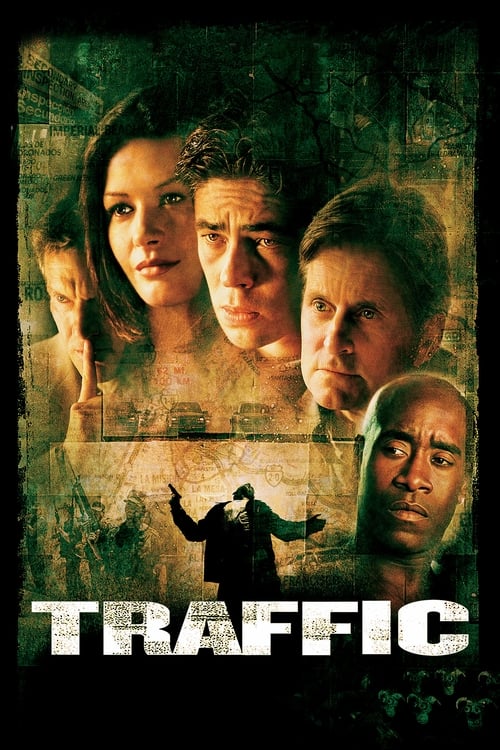
Traffic
2000 · Steven Soderbergh
For when you want a film to chew on for days — serious, adult, conversation-starting viewing rather than escape. A challenge, not a comfort.
What it's about
Three stories track America's war on drugs from every side of it: a newly appointed drug czar in Ohio who discovers his own teenage daughter is an addict, an honest Tijuana cop navigating the lethal politics between cartels and a corrupt general, and San Diego DEA agents whose case against a trafficker turns his pampered wife into a criminal in her own right. The strands never resolve into victory — the film is a portrait of a system, not a case that gets closed.
The experience
Absorbing and unsettling in a slow-burn way — it plays like a thriller but leaves you with the disquiet of a documentary. Bleak in stretches, but so alive with incident and detail that it never feels like homework.
Performances
Benicio del Toro is the soul of the film as the Tijuana cop, a performance of weary, watchful decency that won him the Oscar. Michael Douglas and Catherine Zeta-Jones are also strong in the American strands.
The craft
Soderbergh shot it largely himself, color-coding the three worlds — bleached blues for Ohio, scorched grainy yellows for Mexico — so you always know where you are and how it feels there. The handheld, caught-on-the-fly style and razor cross-cutting made a sprawling policy subject feel urgent and personal.
Why it matters
It won four Oscars including Best Director, capped Soderbergh's landmark 2000, and became the template for the multi-strand 'systemic issue' drama that Hollywood spent the next decade imitating.
Snapshot
Steven Soderbergh's Traffic is a multi-strand procedural drama tracking the United States drug war through three geographically and tonally distinct storylines: a conservative Ohio judge named to the federal drug czar post whose own daughter is sliding into crack addiction; a principled Tijuana policeman navigating the lethal politics between rival cartels and a corrupt military general; and San Diego DEA agents building a case against a cartel-connected businessman whose wife, facing financial ruin, pivots from trophy spouse to operational criminal. The film refuses resolution in any conventional sense — no war is won, no family is healed, no system is reformed — presenting instead a systemic portrait of institutional failure, class complicity, and the grotesque gap between drug-war rhetoric and drug-war reality. Released in December 2000, it became both a major commercial success and one of the most formally ambitious Hollywood films of the decade.
Industry & production
Traffic was adapted from Traffik, a six-part British miniseries that aired on Channel 4 in 1989, written by Simon Moore and directed by Alastair Reid. The British series followed a European drug pipeline from Pakistan through Germany, mapping supply and demand across national lines with comparable moral ambiguity. Producer Laura Bickford acquired the rights and brought the project to Soderbergh, who had come off the commercial and critical recalibration of Out of Sight (1998) and was in the midst of producing Erin Brockovich (2000) concurrently.
The production was distributed by USA Films, a specialty label positioned between the major studio system and the art-house independent sector. The modest (by Hollywood standards) budget allowed Soderbergh unusual latitude to work with a stripped-down crew and documentary-influenced methods. Casting assembled a mixed roster of established stars — Michael Douglas, Catherine Zeta-Jones, Dennis Quaid, Albert Finney — alongside character actors with deep reserves of naturalism: Don Cheadle, Luis Guzmán, Benicio del Toro. Erika Christensen, then largely unknown, was cast as the judge's daughter Caroline. The production shot on location in Tijuana, Cincinnati, Washington D.C., and San Diego, refusing studio approximations of these geographically and culturally specific environments. Benicio del Toro has spoken publicly about immersing himself in Tijuana prior to and during production, working to absorb the specific accent and social texture of the city.
Technology
Soderbergh shot the film himself under the pseudonym Peter Andrews — a practice he would continue across much of his subsequent career, borrowing his father's first name and his mother's maiden name. The choice to serve as his own cinematographer was not merely logistical; it was a bid for the kind of total formal control more associated with European art cinema than Hollywood production. He shot on Super 35mm rather than anamorphic, allowing a handheld intimacy while retaining the option for widescreen framing.
Each storyline was subjected to a distinct photochemical and optical treatment. The Mexico sequences were shot with a warming filter and overexposed to produce a bleached, yellow-amber look that read as heat, dust, and moral ambiguity simultaneously. The Ohio and Washington D.C. storyline was desaturated toward cold blue-gray, conveying the institutional chill of privilege and policy abstraction. The San Diego DEA plot occupied a comparatively neutral visual register. These treatments were largely achieved in-camera and at the printing stage rather than exclusively in post, giving the images a material texture that distinguishes them from the digital color grading that would dominate Hollywood within a few years. The grain is visible throughout; close-ups are often slightly soft or flared. The camera frequently works with available light or motivated practical sources.
Technique
Cinematography
Soderbergh's handheld work in Traffic is purposive rather than merely kinetic. The camera behaves differently in each storyline, not only tonally but in its spatial relationship to subjects. In Mexico, the camera is close, sometimes almost uncomfortably so, pressing into del Toro's face in moments of calculation or fatigue, tracking through crowds with a documentary instability. In Ohio and Washington, wider, slightly more composed framings reflect the ordered social world Robert Wakefield (Douglas) inhabits — until that order begins to crack and the camera grows restless with him. The San Diego sequences, shot with the most conventional fluency, gradually accumulate their own unease. Soderbergh consistently avoids the establishing-shot grammar of classical Hollywood exposition, trusting viewers to orient themselves through character action and environmental texture.
Editing
Stephen Mirrione edited the film and won the Academy Award for Film Editing — a recognition that acknowledged what is genuinely difficult about the cut: the management of three narrative worlds at different paces, with different emotional registers, that must create cumulative pressure without converging into conventional plot machinery. Mirrione and Soderbergh largely keep the storylines separate rather than crosscutting between them within scenes; transitions between worlds tend to occur at chapter-like breaks rather than through shot-to-shot interleaving. This gives each strand room to breathe on its own terms, while the juxtaposition of storylines across the film's architecture creates meaning that no single thread generates alone. The editing is especially controlled in how it withholds the satisfaction of convergence: Michael Douglas and Benicio del Toro's characters never share a frame.
Mise-en-scène / staging
Soderbergh stages actors against lived-in environments with minimal production design artifice. Tijuana's streets, Cincinnati's prep-school interiors, the bland conference rooms of Washington bureaucracy — all are treated as documents of themselves. His staging frequently places characters in relation to institutional or domestic space in ways that comment on their social position: Wakefield is often dwarfed by the scale of official Washington, shrinking as his public authority grows while his private life collapses. Helena Ayala (Zeta-Jones), by contrast, is staged in interiors that signal wealth before we understand what purchased it, the staging becoming retrospectively ironic as her complicity is revealed.
Sound
Cliff Martinez's score operates in the electronic-ambient register he had developed with Soderbergh on earlier collaborations. It is largely tonal and atmospheric rather than melodic, maintaining an undertow of unease without signaling affect in the directive way that conventional thriller scoring would. The sound design privileges ambient texture — the noise of cities, the silence of suburbs — and Martinez's electronic pulses are integrated low in the mix, felt more than consciously heard. The score is particularly effective in the Mexico sequences, where it introduces a dissonance that resists the picturesque.
Performance
The film's performances range in mode from the deliberately naturalistic (del Toro, Cheadle, Guzmán) to the more conventionally dramatic (Douglas, who anchors a storyline that depends on psychological interiority). Del Toro's Javier Rodriguez has become the film's most-discussed performance: minimally verbal, expressing intelligence and moral calculation through physical stillness and strategic opacity. The role won him the Academy Award for Best Supporting Actor. Christensen's performance as Caroline Wakefield is often cited as a breakthrough in depicting addiction without the melodramatic shorthand the subject habitually invites in American cinema — her descent is physically and behaviorally specific. Catherine Zeta-Jones, who was primarily known at the time for lighter fare, gave a performance of considerable cold determination that recalibrated critical estimation of her range.
Narrative & dramatic mode
Traffic operates in the mode of the procedural mosaic, a form that accumulates meaning through parallel tracks rather than through a single protagonist's arc. The film descends from Robert Altman's multi-strand ensemble pictures — particularly Short Cuts (1993) and Nashville (1975) — but is organized around a thematic premise (the drug war) rather than a place, and so its strands are held together by subject rather than geography. It belongs to a cycle of what critics have called "hyperlink cinema" or "network narratives," films of the late 1990s and 2000s — Magnolia, Amores perros, Babel — that map social phenomena through interlocking storylines that rarely meet neatly at a center.
The film's dramatic mode is relentlessly anti-cathartic. There is no climactic confrontation in which the drug war's contradictions are resolved or even usefully articulated in a single speech. Wakefield's final gesture — abandoning his drug czar post to attend his daughter's recovery meeting — is a retreat from public policy into private life that the film presents without irony as the only available response to structural failure. Javier Rodriguez's reward for his cooperation with the DEA is baseball field lights for his neighborhood — a small, lateral gesture of dignity in a system that offers no paths to structural change. The film trusts the weight of accumulated dramatic irony to make its argument rather than resorting to monologue or thesis statement.
Genre & cycle
Traffic is generically a drug thriller, but it systematically declines the genre's conventions. The thriller typically depends on a protagonist whose agency can intervene in events; Traffic distributes its cast across positions where individual agency is structurally constrained at every level. The drug trade wins — not because of dramatic failures of will, but because it is more adaptive than law enforcement, more deeply integrated into the economy, and sustained by demand that policy cannot address. The film participates in the late-1990s/early-2000s cycle of socially engaged ensemble films that used genre architecture to deliver systemic critique — a lineage that includes Magnolia, Crash, Syriana (written by Traffic's own Stephen Gaghan), and, on television, The Wire.
It also belongs to a distinct Hollywood cycle of films engaging with US-Mexico border politics in the NAFTA era: Traffic arrived alongside The Three Burials of Melquiades Estrada, and adjacent to a longer critical tradition examining the border as a zone of asymmetric exchange. The film's visual coding of Mexico as warm, overexposed, and dusty against the cold blue of American institutional life has attracted scholarly criticism for reproducing Orientalist visual hierarchies — associating the global south with sensory excess and the north with rationality — even as the film's narrative complicates easy moral geography.
Authorship & method
By the time of Traffic, Soderbergh had established a distinctive mode of operation within American cinema: the prestige-independent filmmaker working within the studio system's financial apparatus while exercising unusual control over form. He has been candid that shooting his own films as "Peter Andrews" is partly about maintaining authorial continuity and partly about speed — he knows his intentions without a separate DP needing to translate them.
Stephen Gaghan's screenplay won the Academy Award for Best Adapted Screenplay. Gaghan conducted extensive research in the field — interviews with DEA agents, law enforcement in Mexico, users and dealers — and the film's texture of specific procedural detail is attributed partly to this research basis. Cliff Martinez, who had composed for Soderbergh on sex, lies, and videotape (1989), The Underneath (1995), and Out of Sight, brought a consistent electronic-ambient sensibility to the collaboration. Stephen Mirrione went on to a major career as an editor (Babel, The Informant!, several Coen Brothers films), and his work on Traffic is widely cited in discussions of ensemble film editing.
Movement / national cinema
Traffic exists in an interesting position with respect to national cinema categories. It is fully a product of the American studio-adjacent system, financed and distributed domestically, centered on American policy debates. But its Mexican storyline engages with Mexican social reality — the corruption of the military-cartel nexus, the precarity of honest policing — in ways that were somewhat unusual for Hollywood productions of the period, which more typically used Mexico as anonymous backdrop. The film's Mexico sequences borrow from the visual and social texture of Mexican urban cinema without being in dialogue with it in any formal sense. The film has been more widely discussed in American film studies than in Mexican film scholarship, where its representation of the country has been viewed with some ambivalence.
As an American production, it belongs to the early-2000s renaissance of socially ambitious Hollywood filmmaking that used the commercial apparatus of major distribution to reach mass audiences with subjects and formal strategies previously confined to art cinema or documentary.
Era / period
Traffic appeared at a specific political and cultural moment: the late Clinton years, a period of relative domestic prosperity in which anxiety about drug policy, urban crime, and border management ran alongside debates about the consequences of NAFTA for economic and criminal flows between Mexico and the United States. The film arrived before the War on Terror reorganized American security discourse, and its preoccupation with a domestic war that was demonstrably failing had a different resonance in 2000 than it would have by 2002. Viewed from the other direction, it engages with a drug war that had been declared by Nixon in 1971 and intensified under Reagan's mandatory minimums in the 1980s; the film's pessimism draws on three decades of accumulated evidence.
The period also saw the consolidation of the DVD market as a venue for films that rewarded close attention and re-viewing, which aided Traffic's cultural afterlife.
Themes
The film's organizing thematic concern is the gap between the language of war and the reality of systemic interdependence. The drug war is prosecuted in military terms — command structures, territorial seizures, enemy combatants — but the film demonstrates at every turn that demand and supply are continuous with the legal economy, not external to it. Helena Ayala's story makes this explicit: cartel money is real estate is wealth is social respectability. The Douglas storyline pursues the same logic from the demand side: addiction does not respect educational attainment or class position or the drug policy convictions of one's parents.
Race and class are threaded through all three storylines as structural determinants of who is prosecuted, who is protected, who is expendable. Caroline Wakefield's addiction is treated as a medical and family crisis; Black users in the same Cincinnati streets are arrested. Javier Rodriguez survives by understanding which authorities to trust, which is very few. The film does not moralize about these disparities; it simply places them in the frame without comment, trusting the accumulation to do the argumentative work.
The film also meditates on the limits of institutional response to problems that are produced by institutions. Wakefield's appointment as drug czar is presented from the start as a ceremonial office — well-intentioned, resourced, and structurally impotent. The film's anti-cathartic ending insists that retreat to the immediate and human is the only dignified response when systemic solutions are unavailable: attending one meeting, turning on the lights, stopping the speech.
Reception, canon & influence
Traffic was met with near-unanimous critical enthusiasm on release and performed strongly at the box office, earning substantially more than its production budget. It won four Academy Awards: Best Director, Best Supporting Actor (del Toro), Best Adapted Screenplay (Gaghan), and Best Film Editing (Mirrione). Soderbergh became the first director since 1938 — when Frank Capra achieved the feat in a different context — to be nominated for Best Director for two films in the same year, having also been nominated for Erin Brockovich. The awards recognition was widely read as an endorsement of the film's formal ambition as well as its social seriousness.
Influences on the film are multiple and traceable. The most direct source is the British Traffik (1989), which established the multi-national, multi-perspective procedural architecture and the central irony of the drug-czar domestic storyline. Altman's ensemble films — particularly Short Cuts — provided a model for distributing meaning across parallel tracks without centering a single protagonist. The documentary tradition of cinema vérité, from Cassavetes through the Maysles brothers and beyond, informs Soderbergh's handheld aesthetic. European art cinema's willingness to leave narrative threads unresolved — Antonioni is a plausible reference point, though Soderbergh has not always cited specific influences in public interviews — underwrites the film's anti-cathartic structure.
Legacy and influence forward are substantial and specific. Traffic helped legitimize the multi-strand social-issue film as a commercially viable Hollywood form. Stephen Gaghan's follow-up, Syriana (2005), which he wrote and directed, applied the same structural approach to the geopolitics of oil, and was read by critics as a direct descendant — a transposition of the Traffic method onto a different geopolitical crisis. The visual color-coding of distinct storylines through distinct photochemical treatments became a widely imitated practice in the 2000s, not only in film but in television: The Wire (HBO, 2002–2008), while not formally indebted to Traffic in the same way, shares its systemic and institutional orientation and its refusal of redemptive narrative. David Simon has acknowledged the cultural conversation around Traffic as part of the climate in which The Wire was developed, though he has been careful to distinguish his television project from the film's feature structure.
The film's color-coding of Mexico as warm/amber has become a reference point in discussions of Hollywood's visual representation of Latin America, with scholars including those writing in the tradition of postcolonial film studies examining how the technique codes geography as affect and treats the global south as a space of sensory excess. This critique complicates the film's progressive political reputation without dissolving it: Traffic is simultaneously a film that takes Mexican corruption and Mexican humanity seriously as subjects, and one that reproduces visual conventions that flatten the country into a register of heat and danger.
In the longer history of the drug-war film, Traffic remains a canonical reference — cited in academic literature on addiction cinema, law enforcement representation, and the ethics of social-issue filmmaking — and in Soderbergh's own filmography it marks the moment at which his formal and commercial ambitions aligned most completely.
A Deleuzian reading
Start with the color.
The full Deleuzian reading of Traffic →
Reception
An instant critical event in 2000 — four Oscars and 'important movie' status overnight — and it's still rated as peak Soderbergh, though its once-daring color-coded look now reads to some as the most dated thing about it.
How Traffic was received, from release to now →
Influences: the films it descends from and the films it influenced
- Traffik (1989) — Traffic is a direct adaptation of this six-part Channel 4 miniseries; Soderbergh and Gaghan retained the tri-strand architecture splitting supply, enforcement, and demand across national borders, and inherited Reid's structural refusal to resolve the systemic drug-war critique through any individual arc's success.
- Nashville (1975) — Altman invented the chapter-structured network narrative in which twenty-plus characters operate in separate social orbits whose juxtaposition generates meaning no single thread produces; Traffic's strand architecture and principled withholding of cathartic convergence descend directly from this template.
- Short Cuts (1993) — Altman's Los Angeles ensemble procedural codified the technique of cutting between socially disparate storylines so that their adjacency creates ironic commentary on a common social condition; Soderbergh has cited Short Cuts as the American network-narrative model Traffic adapts for a drug-war subject.
- The Battle of Algiers (1966) — Pontecorvo and cinematographer Marcello Gatti established handheld 35mm, available light, and non-actor faces as an authenticating grammar for politically charged subject matter; Soderbergh's Mexico sequences adopt this documentary-realism logic wholesale to confer moral weight through photographic texture rather than argument.
- The French Connection (1971) — Friedkin and Owen Roizman's handheld location cinematography in a drug procedural established the American template of urban grit-as-moral-texture — restless camera, lived-in environments, institutional geography shot without studio approximation — that Traffic inherits and systematizes across three national spaces.
- Medium Cool (1969) — Wexler's handheld, available-light embedding of fiction within real political events established the American grammar of authenticity-through-camera-instability in political cinema; Traffic's Tijuana sequences deploy precisely this logic, using photographic instability as social-realist credential rather than stylistic choice.
- The Limey (1999) — Soderbergh's immediately preceding film, which he also shot himself under the Peter Andrews pseudonym, was the laboratory for fragmented non-linear editing and available-light handheld intimacy; Traffic systematizes that approach into the per-strand color-differentiation architecture at larger scale.
- Out of Sight (1998) — Systematizes the warm/cold location-coded color scheme into the film's entire visual grammar, expanding the technique trialed here.
- Decalogue V (1989) — Soderbergh drenches the Mexico strand in a jaundiced yellow-green filtration to color-code moral geography — a direct extension of Idziak's use of a diseased palette as ethical commentary rather than realism.
- Lone Star (1996) — Takes the multi-strand border film and hardens it into formal system — each strand its own stock and grade — while keeping Lone Star's insistence that the Spanish-language strand carry equal narrative weight and stand subtitled rather than dubbed into the dominant tongue.
- 21 Grams (2003) — Iñárritu fragments Traffic's strand-by-strand chapter structure into radical temporal disruption, intercutting before, during, and after a central event across three protagonists; the film inherits Traffic's network-narrative grammar and the anti-cathartic logic of withheld convergence while pushing formal disruption further than Soderbergh's more legible strand separation.
- City of God (2002) — Meirelles and co-director Kátia Lund's handheld documentary realism — location shooting in actual Rio favelas, non-professional faces, available-light cinematography — extends Traffic's authenticating grammar into Brazilian drug-crime geography, while the episodic chapter structure mirrors Traffic's strand-based architecture as social portraiture.
- Syriana (2005) — Gaghan, who wrote Traffic's screenplay, wrote and directed Syriana applying the identical procedural-mosaic format — multiple parallel strands, institutional critique across national borders, withheld catharsis — to oil geopolitics, making it the most direct structural extension of Traffic's narrative architecture into another systemic subject.
- Babel (2006) — Iñárritu and Rodrigo Prieto extend Traffic's multi-continent per-strand visual differentiation — each of four national strands receives a photographic texture calibrated to geography and class — while pushing the anti-cathartic systemic critique toward a more globally dispersed institutional failure thesis.
- Sicario (2015) — Villeneuve and Roger Deakins apply Traffic's procedural drug-war format — institutional agents operating across the Mexican border, per-location visual register, anti-cathartic revelation of systemic failure — with Deakins's Nogales tunnel sequence directly echoing the bleached yellow-amber visual grammar Soderbergh established for Traffic's Tijuana cinematography.
- Inside Man (2006) — Soderbergh's use of differentiated color-grade registers to separate simultaneous narrative strands — bleach-bypass for Mexico, saturated blue for Ohio — establishes the digital intermediate workflow Inside Man compresses into two temporal registers: the warm amber 'then' of the hostage crisis vs. the cooler, overexposed 'now' of the post-event witness interviews.
- The Bourne Identity (2002) — The first major American studio film to use digital intermediate color grading as a primary narrative tool—extreme hue manipulation coded to story geography—demonstrating the DI pipeline that Liman and Wood adopted for Bourne's institutional-gray desaturation.
- Black Bag (2025) — Soderbergh's own template for distributing narrative knowledge across an ensemble such that each strand's partial information creates a lateral investigation structure — no single character holds the complete picture — is the architectural precedent for Black Bag's ensemble-suspect gallery, where the viewer assembles the truth from oblique angles rather than following a single investigative line.
- Sicario: Day of the Soldado (2018) — Originates the multi-strand US–Mexico drug-war mosaic and the institutionally-corrupt cross-border procedural that Sheridan's Alejandro (del Toro again as a cartel-adjacent operator) extends.
- Crisis (2021) — The direct formal template — color-graded multi-strand architecture, director-operated handheld camera and available-light realism tracing a single drug across enforcement, trafficking, and family tiers that never fully converge.
- Confessions of a Dangerous Mind (2002) — Establishes editor Stephen Mirrione's multi-strand cross-cutting and format-coded color cinematography, the collaborator method carried into Confessions.
- Contagion (2011) — The direct precursor: a color-coded multi-strand network narrative on a systems-level subject, self-photographed by Soderbergh as 'Peter Andrews' and cut by Stephen Mirrione, whose method Contagion transplants wholesale onto epidemiology.
- Magnolia (1999) — Anderson's network-narrative ensemble employs the same chapter-transition structure and refuses to unify its disparate threads into consoling resolution; both films inherit Altman's ensemble model and push it toward institutional critique in which no individual agency redeems the larger system.
- Amores Perros (2000) — Iñárritu and Rodrigo Prieto independently developed the same triptych structure — three socially stratified strands each visually differentiated in grain and palette, unified by a single collision point without cathartic resolution — making this a parallel formal evolution of Traffic's per-strand grammar rather than a derivation from it.
- Requiem for a Dream (2000) — Aronofsky and Matthew Libatique's visual system distinguishes drug-state from sober reality through distinct photographic registers — fish-eye, time-lapse montage, split-screen — employing the same logic as Traffic's per-strand color grammar: in-camera optical technique used to externalize social and psychological condition without expository dialogue.
- Ocean's Thirteen (2007) — Soderbergh as Peter Andrews developing the DI color-as-narrative-strand principle — each storyline assigned a distinct color temperature to mark its world — the same technique Ocean's Thirteen uses to separate the casino's amber hermetic interior from the cooler register of the outside world.
- Blow (2001) — Soderbergh's use of color temperature as explicit structural grammar — warm sepia for Mexico, bleached blue for Ohio — is the same technique Kuras applies in Blow for temporal and moral coding; both films belong to the same prestige drug-trade cycle and Traffic's cinematographic rigor provided a contemporaneous benchmark against which Blow's approach was measured.
- The Constant Gardener (2005) — Sibling in color-coded geographic storytelling, using distinct grades and handheld textures to separate first-world and developing-world strands of a single transnational injustice.
- Maria Full of Grace (2004) — Soderbergh's grain, available-light handheld, and bottom-to-top cross-section of trafficking shares the labor-and-migration framing, even as Maria narrows the systemic mosaic to a single mule's body.
- Ocean's Twelve (2004) — Origin of the location-coded color strategy — assigning each city its own filtered palette/grade — which Twelve borrows to color-tag its European capitals.
- F1 (2025) — Editor Stephen Mirrione's Oscar-winning structuring of complex multi-strand action, the assembly craft he brings to cutting F1's simultaneous cars into a coherent, legible race.
- Elite Squad: The Enemy Within (2010) — Soderbergh's mosaic drug-war thriller — desaturated, handheld available-light shooting and a widening spiral that binds street enforcement to political complicity — is a parallel deployment of the same systemic-corruption structure.
- Erin Brockovich (2000) — Its fractured, self-conscious formalism is the deliberate counterweight to Erin's 'invisible' direction; the two same-year films together launched Soderbergh's most prolific phase and his dual Best Director nominations.
- Revenge (1990) — Systematizes Revenge's warm-cool scheme into method: Mexico graded hot amber with tobacco filtration against cold blue-green North America, with the Spanish left subtitled but the compositions and stock doing the geographic argument the dialogue doesn't.
Similar films
- Sicario (2015) — influence & lineage
- 21 Grams (2003) — influence & lineage
- Amores Perros (2000) — influence & lineage
- Babel (2006) — influence & lineage
- Syriana (2005) — influence & lineage
- Requiem for a Dream (2000) — influence & lineage
- The Limey (1999) — influence & lineage
- Sicario: Day of the Soldado (2018) — shared sensibility
All the films related to Traffic →