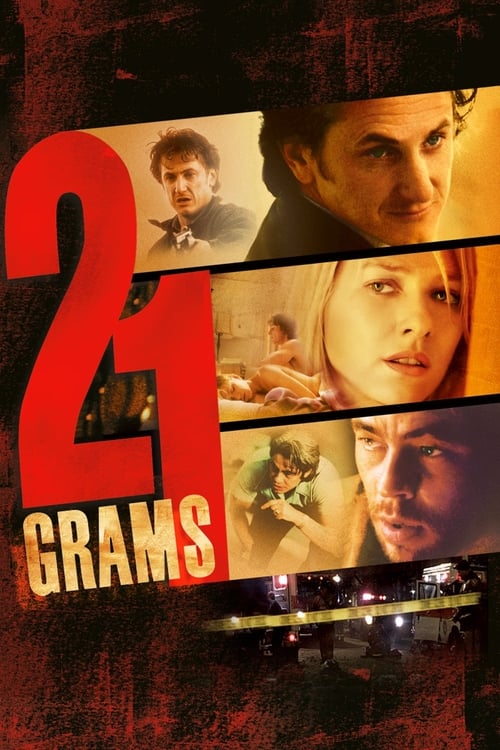
21 Grams
2003 · Alejandro G. Iñárritu
For when you want a film that hurts on purpose — a serious, wrenching drama to sit with, not escape into. This is challenge viewing, best when you have the emotional bandwidth and someone to talk it over with after.
What it's about
A car accident in New Mexico binds three strangers who should never have met: a mathematician with a failing heart, a suburban wife and mother whose family is torn apart in an instant, and a born-again ex-con whose hard-won faith is suddenly put on trial. As the wreckage settles, their lives keep pulling toward each other — through a heart transplant, through guilt, through the need to know who else was in the crash. It's a story about grief, blame, and what people owe each other after the worst day of their lives.
The experience
Heavy, raw, and deliberately disorienting — the story arrives in shuffled fragments, so you're piecing together what happened while feeling the full weight of it. It's emotionally punishing in the way a great sad song is: you come out wrung dry but glad you went.
Performances
Sean Penn, Naomi Watts, and Benicio del Toro all work at full intensity — Watts is devastating as a woman hollowed out by loss, and del Toro gives the ex-con a coiled, tormented gravity that's hard to shake.
The craft
The shuffled chronology is the whole engine: scenes from before, during, and after the accident are intercut so that cause and consequence land on top of each other, and the film asks you to assemble it. The look is grainy, handheld, and desaturated — bleak on purpose — which makes the flashes of tenderness hit harder.
Why it matters
The middle film of Iñárritu's loose trilogy about lives colliding through catastrophe, it cemented his reputation internationally and helped make fractured, multi-strand storytelling a signature of 2000s serious drama.
Snapshot
21 Grams is Alejandro González Iñárritu's second feature and the middle panel of the loose "Trilogy of Death" that began with Amores Perros (2000) and closed with Babel (2006). Like its predecessor, it interlaces three lives that collide through a single catastrophic car accident: Paul Rivers (Sean Penn), a mathematics professor dying of heart failure; Cristina Peck (Naomi Watts), a recovering addict whose husband and two daughters are killed; and Jack Jordan (Benicio del Toro), a born-again ex-convict whose truck causes the deaths and whose faith collapses under the guilt. Paul receives the dead husband's transplanted heart, and the film follows the moral and emotional aftershocks as the three are drawn together. Its defining formal gesture is a radically shuffled chronology: the story is delivered in fragments out of sequence, so that consequences precede causes and the viewer reconstructs the timeline as an act of detection. The title invokes the popular claim that the human body loses twenty-one grams at the instant of death — the supposed weight of the soul. This was Iñárritu's first English-language production, shot in Memphis, Tennessee, and it confirmed the international arrival of a Mexican director, screenwriter, and creative team who would shape art-house cinema through the 2000s.
Industry & production
The film was produced by This Is That Productions, the company of Ted Hope, Anne Carey, and Robert Salerno (Salerno produced alongside Iñárritu), and distributed in the United States by Focus Features, the specialty arm of Universal that was then establishing itself as a leading distributor of director-driven international and independent fare. It was an American independent production made by a largely Mexican authorial team — Iñárritu, screenwriter Guillermo Arriaga, cinematographer Rodrigo Prieto, and composer Gustavo Santaolalla (Argentine) — crossing into the English-language market on the strength of Amores Perros, which had been nominated for the Academy Award for Best Foreign Language Film. The casting of Sean Penn, Naomi Watts (then ascendant after Mulholland Drive), and Benicio del Toro (fresh from his Oscar win for Traffic) gave the project marquee weight while keeping it firmly within prestige-independent rather than studio-tentpole economics. I do not have reliable budget or box-office figures to cite and will not invent them; the film is generally understood to have been a modestly budgeted production that performed respectably in specialty release and over-performed in awards-season visibility.
It premiered at the Venice Film Festival in 2003, where Sean Penn won the Volpi Cup for Best Actor. In the subsequent awards season, Naomi Watts was nominated for the Academy Award for Best Actress and Benicio del Toro for Best Supporting Actor; neither won. The performances, rather than the film's design or direction, were the focus of its institutional recognition.
Technology
21 Grams was shot photochemically on Super 16mm film, a deliberate choice that — enlarged to 35mm for theatrical release — yields pronounced grain, reduced tonal smoothness, and a documentary tactility appropriate to the material's rawness. The film predates the wholesale shift to digital capture in narrative features, and its texture is inseparable from its emulsion. Postproduction color work was central: the production employed photochemical color manipulation, including bleach-bypass-style desaturation, to strip warmth and saturation from the image. The lightweight 16mm camera package also enabled the pervasive handheld shooting, which would have been far more cumbersome on heavier 35mm rigs. In short, the technology served the aesthetic — small-gauge film and portable cameras producing a grainy, mobile, color-drained surface.
Technique
Cinematography
Rodrigo Prieto's photography is the film's most discussed craft element after the performances. Working almost entirely handheld, Prieto keeps the camera close to the actors, often in shallow focus, restless and reactive rather than composed. The frame breathes with the operator; it follows faces and gestures and frequently sits in tight, uncomfortable proximity to suffering. Prieto and Iñárritu deployed a desaturated, cool, high-contrast palette — skin tones drained, greens and warmth pulled out — to render a world that feels physically depleted, consistent with the bodies and lives in crisis. The 16mm grain is allowed to show, reinforcing an aesthetic of immediacy and degradation. The overall visual program is of a piece with the era's "raw realist" art cinema: the camera as a nervous, embodied witness rather than a stable observer.
Editing
Editing is where 21 Grams most fully announces itself, and Stephen Mirrione (who had cut Steven Soderbergh's Traffic) is effectively a co-author of the film's experience. The screenplay's three strands are not merely cross-cut but atomized and reordered, so that the film opens amid aftermaths whose origins arrive only later. Each fragment forces the viewer to register characters in altered states — Paul healthy then dying then recovering, Cristina sober then shattered then vengeful, Jack devout then broken — and to infer the causal sequence from physical and emotional cues. The cutting is also kinetic within scenes, matching the handheld camera with abrupt, associative transitions. The structure is the film's argument: it dissolves the consoling logic of beginning-middle-end and insists that grief and consequence do not arrive in order. Whether the device deepens the drama or merely complicates it became the central critical debate around the film.
Mise-en-scène / staging
The staging favors cramped, unglamorous American interiors — hospital rooms, motel rooms, cheap apartments, suburban kitchens, churches, and prison-adjacent spaces — and a Memphis stripped of regional picturesqueness. Production design and locations emphasize an anonymous, depressed working- and middle-class America. Bodies are staged in states of physical extremity: illness, addiction, pregnancy, injury, prayer. The blocking is intimate and often static within the handheld frame, letting performers carry scenes through faces and small actions rather than elaborate movement. The world is deliberately unbeautiful, a moral landscape rather than a scenic one.
Sound
Gustavo Santaolalla's score is spare and string- and guitar-based, built around small recurring motifs rather than orchestral swell — an aesthetic of restraint that lets silence and ambient sound carry weight. The sound design favors the close, grainy intimacy of the image: breath, ambient hum, the textures of rooms. The cumulative effect is hushed and interiorized, refusing emotional cueing of the conventional kind even as the narrative withholds its own chronology.
Performance
Performance is the film's most universally praised dimension. Sean Penn plays Paul with a guarded, deteriorating intensity; Benicio del Toro renders Jack's lurching journey from violent past to fragile faith to guilt-stricken collapse with heavily physicalized interiority; and Naomi Watts delivers the film's emotional center as Cristina, moving from contented mother to annihilated widow to woman consumed by the urge for revenge. Watts's grief scenes in particular were singled out as career-defining. The non-linear structure places extraordinary demands on the actors, who must inhabit discontinuous emotional states across the shoot and across the cut without the scaffolding of sequential build. Charlotte Gainsbourg (as Paul's wife), Melissa Leo (as Jack's wife), and Danny Huston appear in significant supporting roles.
Narrative & dramatic mode
The film operates in a tragic-realist register organized around a fractured, puzzle-like temporal structure. This is its signature and the engine of its meaning: by withholding chronology, the narration converts viewing into reconstruction, and converts a melodramatic premise — a fatal accident, a transplanted heart, a revenge plot — into an essay on how cause and consequence, guilt and grace, are actually experienced: nonlinearly, in fragments, after the fact. The three-protagonist mosaic structure, in which strangers are bound by a single violent contingency, is a direct continuation of the architecture of Amores Perros and would recur, globalized, in Babel. The mode is unrelievedly grave; the film offers little comic release and structures itself around loss, faith, and the question of whether existence carries any measurable residue — the twenty-one grams of the title.
Genre & cycle
Nominally a drama with crime and thriller elements, 21 Grams belongs less to a commercial genre than to a turn-of-the-millennium art-cinema cycle of "network" or "hyperlink" narratives — films that interweave multiple strands joined by chance, often with scrambled or braided chronology. Its closest siblings are Iñárritu and Arriaga's own Amores Perros and Babel, alongside the contemporaneous vogue for fractured-time storytelling that runs from Pulp Fiction (1994) through Memento (2000) and Soderbergh's Traffic (2000). It also participates in a longer lineage of multi-protagonist ensemble dramas about interlinked American lives, of which Robert Altman's Short Cuts (1993) and Paul Thomas Anderson's Magnolia (1999) are the touchstones. Within that cycle, 21 Grams is distinguished by the severity of its tone and the aggressiveness of its temporal scrambling.
Authorship & method
The film is best understood as the product of a tight, recurring authorial collective rather than a single auteur. Iñárritu directs with an emphasis on actor-driven intensity, handheld immediacy, and morally weighted suffering, and he shares the central structural conceit with screenwriter Guillermo Arriaga, whose scripts for all three "death trilogy" films are built on chance collisions and braided lives. (The Iñárritu–Arriaga partnership, productive across the trilogy, later ruptured publicly over questions of authorship — a well-documented falling-out that ended their collaboration after Babel.) Rodrigo Prieto (cinematography), Stephen Mirrione (editing), and Gustavo Santaolalla (music) complete the core creative unit; Prieto and Santaolalla in particular were longtime Iñárritu collaborators whose work defines the trilogy's grainy, desaturated, musically spare house style. The working method foregrounds raw performance captured close and mobile, then radically restructured in the edit — meaning that the film's final form is substantially authored in postproduction, in the assembly of fragments, as much as on set.
Movement / national cinema
21 Grams is a key document of the early-2000s international breakthrough of Mexican filmmakers — the cohort often grouped with Iñárritu, Alfonso Cuarón, and Guillermo del Toro ("the three amigos") whose success reshaped global art cinema and Hollywood's relationship to Mexican talent. Though shot in the United States in English, the film carries the sensibility of the Nuevo Cine Mexicano that Amores Perros had announced — its mosaic structure, its unsparing treatment of violence and class, its grainy realism — transplanted to American soil. It thus sits at a hinge: the moment a Mexican authorial team proved it could carry its aesthetic into the Anglophone market without dilution, paving the way for Iñárritu's subsequent Hollywood career and eventual Academy Awards for Birdman and The Revenant.
Era / period
The film is a product of the early 2000s art-house moment, when fractured chronology and hyperlink narration were both fashionable and contested, when specialty divisions like Focus Features were at their peak as distributors of director-driven cinema, and when photochemical capture was still standard. It is also legible against its immediate cultural backdrop — a post-9/11 American mood preoccupied with sudden catastrophe, mortality, faith, and the randomness of who lives and who dies — though the film treats these as existential rather than topical concerns. Its preoccupation with born-again Christianity, addiction recovery, and damaged working-class lives locates it specifically in an early-2000s American social landscape.
Themes
The governing themes are mortality and the measurability of a life — encapsulated by the title's conceit of the soul's weight — and the relationship between chance, guilt, and grace. The transplanted heart literalizes a metaphysical question: what passes from the dead to the living, and what debts the living owe. Faith is examined without sentimentality through Jack, whose born-again conviction cannot survive his guilt; revenge and grief are anatomized through Cristina; and the desire to find meaning, or at least continuation, through Paul. Underlying all three is a meditation on contingency — how a single arbitrary accident reorganizes multiple lives — and on whether suffering can be redeemed or merely endured. The scrambled structure is itself thematic: it dramatizes the claim that we live our consequences out of order and assemble meaning only retrospectively.
Reception, canon & influence
Critical reception was strong but genuinely divided, and the division is itself part of the film's record. Admirers praised the ferocity of the performances — especially Watts and del Toro — Prieto's photography, and the ambition of the structure; skeptics argued that the chronological scrambling was a manipulation that imposed difficulty on what was at root a melodrama, manufacturing profundity through form. This "is the structure essential or merely decorative?" debate followed Iñárritu and Arriaga across the trilogy and intensified with Babel. Institutionally, the film's recognition clustered on acting: Penn's Volpi Cup at Venice and Oscar nominations for Watts and del Toro.
Looking backward, the film's influences are clear: the multi-protagonist American ensemble drama of Altman's Short Cuts and P.T. Anderson's Magnolia; the fractured-chronology vogue of Pulp Fiction and Memento; the network-narrative structure of Soderbergh's Traffic (whose editor, Mirrione, cut 21 Grams); and, most directly, the template Iñárritu and Arriaga had built in Amores Perros. Looking forward, it consolidated the international standing of its creative team and helped sustain the early-2000s cycle of hyperlink cinema; it is frequently invoked as a defining example of "puzzle film" or non-linear narration in subsequent criticism and teaching. Its longer legacy is bound up with Iñárritu's own trajectory — toward Babel, the public dissolution of the Arriaga partnership, and an eventual move into long-take maximalism (Birdman, The Revenant) that is in many ways a reaction against the fragmented method 21 Grams perfected. Within the canon it endures as a touchstone of 2000s art cinema and as the film that proved a Mexican authorial team could carry its sensibility, intact, into English-language production.
A Deleuzian reading
You meet Paul Rivers more than once before you can place him.
The full Deleuzian reading of 21 Grams →
Reception
It landed in 2003 as a prestige gut-punch — Venice prizes, two acting Oscar nominations, serious-cinema credentials. Twenty years on it's caught in the backlash against 2000s fractured-timeline 'hyperlink cinema,' with the performances still revered even by people who've cooled on the structure.
How 21 Grams was received, from release to now →
Influences: the films it descends from and the films it influenced
- Amores Perros (2000) — The direct template: Iñárritu and Arriaga's braided three-strand structure colliding at a single traumatic crash, captured in Prieto's grainy super-16 handheld and assembled into meaning in the edit.
- Magnolia (1999) — Modeled the hyperlink ensemble bound by chance, coincidence and guilt, plus the practice of letting a spare recurring musical motif (Santaolalla's role here) thread emotionally across disconnected lives.
- Traffic (2000) — Direct craft conduit — its editor Stephen Mirrione cut 21 Grams — and its color-coded, handheld, desaturated network-narrative look prefigures Prieto and Mirrione's fragmented assembly.
- The Sweet Hereafter (1997) — Pioneered non-linear editing as a grammar of grief, scattering a fatal accident's before-and-after across the timeline so chronology itself carries mourning and guilt.
- Three Colors: Red (1994) — Established chance, fate and moral interconnection as a formal system, the metaphysics-of-coincidence sensibility underlying the trilogy's 'chance, guilt, grace' design.
- The Limey (1999) — Shatters a grief-and-vengeance melodrama into deliberately disordered shards, extending The Limey's proof that nonlinear assembly can intensify a genre story's emotional charge.
- Babel (2006) — Sibling and trilogy capstone — extends the same Iñárritu/Arriaga/Prieto/Mirrione/Santaolalla method of chance collisions across braided timelines, intensifying the 'is the scrambling essential' debate to its breaking point.
- Incendies (2010) — Guillermo Arriaga's braided, withheld multi-strand chronology cross-cut to detonate a late convergence — the editing grammar behind Incendies' interleaved mother/twins timelines.
- Beautiful Boy (2018) — Shuffled, non-chronological editing that withholds cause-and-effect so grief registers associatively rather than causally.
- The Broken Circle Breakdown (2012) — Models the shattered-chronology grief mosaic that withholds and then detonates a death out of sequence, generating tragic irony from reordered fragments — the editing architecture Broken Circle adopts wholesale.
- We Live in Time (2024) — Demonstrates shuffling a grief/illness drama into non-consecutive fragments so the viewer supplies causal order — the associative-assembly editing model Payne's fractured chronology adopts for a smaller, domestic register.
- Super Deluxe (2019) — Fractured, non-chronological reassembly of three lives around a collision teaches the withholding-and-reveal sequencing that keeps interwoven fates legible.
- Short Cuts (1993) — Established the multi-protagonist ensemble of intersecting strangers whose lives brush against each other, the dramaturgical scaffold Arriaga's script rebuilds around a single fatal accident.
- Pulp Fiction (1994) — Popularized scrambling chronology as authorship — withholding and reordering scenes so the audience reassembles cause and effect, the core 'is the structure essential' device 21 Grams pushes to fragmentation.
- Memento (2000) — The puzzle-film grammar of doling out narrative out of sequence so form enacts a character's disordered relation to time, the exact 'puzzle film' lineage critics file 21 Grams under.
- Nashville (1975) — The foundational large-ensemble mosaic converging on one violent event, originating the overlapping-lives architecture Altman codified and Arriaga inherited.
- Breaking the Waves (1996) — Modeled raw, mobile handheld coverage of extreme emotional and physical suffering, captured close on grainy stock — the 'unglamorous performance captured close and mobile' aesthetic Prieto adopts.
- The Three Burials of Melquiades Estrada (2005) — Sibling written by Arriaga solo, carrying his signature non-linear, death-driven braided structure into another's direction, isolating the screenwriter's authorship of the fractured form.
- Crash (2004) — Descendant in the mid-2000s hyperlink cycle 21 Grams helped sustain — strangers' lives colliding through chance and guilt across a fractured ensemble built for moral catharsis.
- Syriana (2005) — Descendant extending the Traffic-derived network narrative — multiple opaque strands the viewer must actively interlace — shot in the same desaturated, handheld, geographically dispersed register.
- The Burning Plain (2008) — Descendant in which Arriaga directs his own non-linear template — fractured timelines fusing two women across a fire and a fatal accident — revealing the braided-chronology method as fundamentally his.
- Birdman (2014) — Reactive descendant — Iñárritu's pivot to ostentatious unbroken long takes is a deliberate inversion of the postproduction-assembled fragmentation 21 Grams perfected, defining one method against the other.
- Requiem for a Dream (2000) — Iñárritu's fragmented parallel-descent structure — multiple protagonists converging on catastrophe through aggressively cross-cut non-linear editing — is the closest structural sibling to Aronofsky's four-way fugue, both films treating the parallel cut not as suspense device but as formal expression of inevitability.
- City of God (2002) — Extends the same desaturated-handheld grammar into a fully shattered, time-shuffled mosaic where the viewer reassembles causality from flash-forward fragments.
Similar films
- Amores Perros (2000) — influence & lineage · often watched together
- Babel (2006) — influence & lineage · often watched together
- Traffic (2000) — influence & lineage
- Memento (2000) — influence & lineage
- Pulp Fiction (1994) — influence & lineage
- Biutiful (2010) — often watched together
- Intacto (2001) — shared sensibility
- Society of the Snow (2023) — shared sensibility
All the films related to 21 Grams →