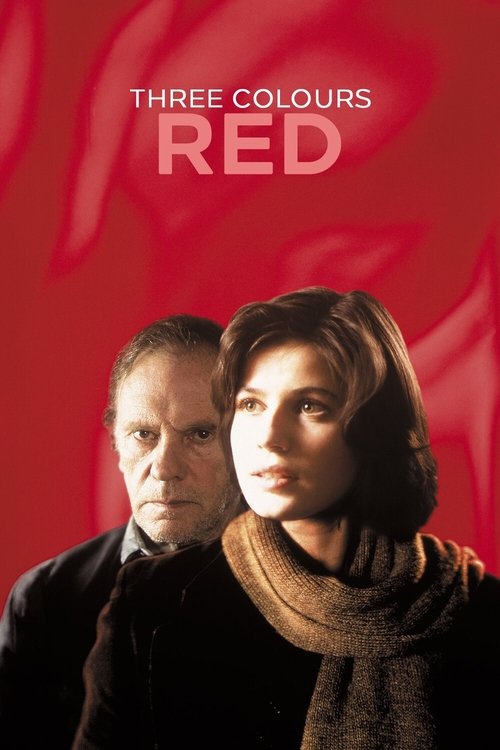
Three Colors: Red
1994 · Krzysztof Kieślowski
For when you want a film to chew on for days — contemplative, romantic in an unusual key, and gentle even when it's asking big questions. Perfect for a slow, thoughtful evening alone or with someone you like talking to.
What it's about
Valentine, a young model in Geneva, runs over a dog on a rainy night and traces it back to its owner: a retired judge who spends his days eavesdropping on his neighbors' phone calls, entirely unashamed. Out of that uncomfortable meeting grows a strange, deepening friendship between a hopeful young woman and a man who has given up on people — while nearby, a young law student lives out a story that seems to rhyme with the judge's own past.
The experience
Hushed, warm, and quietly uncanny — it moves like a mystery even though the mystery is really about coincidence, fate, and whether two people can meet at the wrong time. It leaves you with a kind of tender vertigo, noticing connections everywhere.
Performances
Irène Jacob glows as Valentine — openness that never reads as naive — and Jean-Louis Trintignant gives one of the great late-career performances as the judge, thawing by barely perceptible degrees.
The craft
The color red is threaded through nearly every frame — awnings, jackets, brake lights, a giant billboard — turning the whole city into a web of signals, and the camera glides between lives with an eerie sense of design. The score deepens the film's feeling that something just beyond understanding is arranging events; it's gorgeous on a big screen.
Why it matters
The final film of Kieślowski's Three Colors trilogy and of his career, it earned multiple Oscar nominations and is widely held up as one of the summits of European art cinema in the 1990s.
Snapshot
Three Colors: Red is the concluding film of Krzysztof Kieślowski's trilogy organized around the colors of the French tricolor and their corresponding revolutionary ideals. Red's value is fraternité—brotherhood, solidarity—though Kieślowski characteristically complicates this into something stranger and more metaphysically charged: a sympathy between strangers across time, the possibility of fate intervening to correct a life gone wrong. A part-time model in Geneva named Valentine (Irène Jacob) runs over a dog on a rain-wet street, traces its owner to a villa, and finds a retired judge (Jean-Louis Trintignant) who passes his solitary days listening, without evident guilt, to his neighbors' private telephone calls. Around this central duo, Kieślowski quietly constructs a doppelgänger architecture: a young law student across the street, Auguste (Jean-Pierre Lorit), seems to be living a version of the judge's own youth, moving toward the same failures. The film closes the trilogy with a near-miraculous act of convergence—the survivors of a Channel ferry disaster include Valentine, Auguste, and the principal characters from Blue and White—a gesture at once melodramatic and earned, a formal declaration that lives rhyme.
Industry & Production
Red is a French-Swiss-Polish co-production, financed primarily through Marin Karmitz's MK2 Productions, which had backed the entire trilogy. Karmitz had become one of the key producers of serious European art cinema by the early 1990s, and his partnership with Kieślowski gave the Polish filmmaker access to resources and distribution infrastructure that allowed the trilogy to reach a broad international audience while remaining formally uncompromising. Principal photography took place in Geneva, Switzerland—a setting that lends the film a particular quality of clean, prosperous, slightly inhuman orderliness, against which the film's themes of hidden inner lives and chance connection read all the sharper.
Kieślowski had announced, before the release of Red, that he intended this to be his final film. He spoke of exhaustion with the creative process and a desire to retire to a village in Poland. He died on March 13, 1996, following heart surgery, making the announcement retrospectively prophetic. The trilogy was thus understood by critics and audiences, from the moment of Red's wider release, as a valediction.
Technology
Like the preceding two films—Blue (1993) and White (1994)—Red was shot on 35mm film. The production predates digital intermediate color grading, which means the film's saturated, warm-toned palette—its pervasive reds, ambers, and ochres—was achieved primarily through production design, costume, and photochemical processing rather than post-production manipulation. This places particular pressure on the practical execution of every setup; the color world of the film was built into the frame, not adjusted afterward. Anamorphic framing was used throughout the trilogy, giving images a horizontal spaciousness that Kieślowski and his collaborators used to position characters at deliberate distances from one another within the widescreen field.
Technique
Cinematography
Piotr Sobociński served as director of photography on Red, the third of the trilogy's three different cinematographers (Slawomir Idziak shot Blue; Edward Kłosiński shot White). Sobociński's contribution is a warm, amber-and-crimson palette sustained through meticulous production design and selective filtration. Red objects are embedded throughout compositions as structural anchors: Valentine's jacket, bowling-alley signage, the interiors of the judge's villa, the model's poster that recurs on a street billboard. The film makes extensive use of glass surfaces—windows, aquarium walls, the visor of a motorcycle helmet—to create layered images in which characters observe one another at a remove, a visual correlative for the film's thematic preoccupation with surveillance and mediated connection. The opening sequence—an extreme close-up rush along telephone cables and underwater fiber-optic routes—is a bravura statement of the film's central metaphor: connection as infrastructure, invisible and rushing, traversing enormous distances between human beings who remain essentially apart.
Editing
Jacques Witta served as editor across all three films of the trilogy. In Red, the central structural challenge is the management of two parallel storylines—Valentine and the judge; Auguste and his girlfriend Karin—that never intersect narratively but resonate thematically. Witta and Kieślowski use cross-cutting not to build suspense but to accumulate meaning: the similarities between Auguste's present trajectory and the judge's remembered past are established through rhythmic alternation rather than exposition. The rhythm is generally unhurried; Kieślowski was not interested in pace as an end in itself, and Red's editing allows scenes to breathe until a quietly devastating detail arrives.
Mise-en-scène / Staging
Kieślowski's mise-en-scène is characterized by a studied casualness that belies extreme precision. Characters move through spaces that appear naturalistic but are saturated with visual information: the judge's villa is a cabinet of surveillance equipment and legal records, Valentine's apartment spare and transient. Kieślowski stages conversations across thresholds—doorways, the edge of a kitchen counter—so that characters are perpetually at the boundary of genuine encounter. The recurring motif of the billboard—Valentine's modeling image in enormous public scale, observed by Auguste from his window—functions as a visual hinge connecting the two storylines without dialogue, the face that belongs to one narrative haunting the other.
Sound
Zbigniew Preisner's score is integral to the film's emotional architecture. Preisner, who had composed for all of Kieślowski's mature work since No End (1985), returned for Red with music that draws on bolero rhythms and builds gradually toward the trilogy's closing catharsis. Preisner had developed, with Kieślowski, the fiction of "Van den Budenmayer"—an invented 18th-century Dutch composer whose "works" appear within the diegesis of multiple Kieślowski films, including The Double Life of Véronique and Blue. This conceit allows Preisner's music to function simultaneously as score and as prop, as diegetic sound and as extradiegetic commentary, the fictional attribution adding a layer of irony about authorship and origin that rhymes with the film's concerns. The telephone—its ring, its static, the audible breath on the line—is a significant sound motif throughout, reinforcing the film's interest in mediated intimacy.
Performance
Jean-Louis Trintignant's performance as the retired judge is one of the great late-career turns in European cinema. He plays a man who has constructed his misanthropy as a kind of philosophical position and is slowly, against his will, moved by Valentine's unguarded openness. The performance is managed largely through stillness and the face—Trintignant speaks in low, measured sentences, and the camera frequently holds on him in close-up as the judge processes information he does not know what to do with. Irène Jacob, who had worked with Kieślowski previously in The Double Life of Véronique (1991) and had won the Best Actress prize at Cannes for that role, brings a quality of luminous receptivity to Valentine: she is the film's moral center, a person constitutionally incapable of indifference. The casting of Jacob across both films is not incidental; Kieślowski was interested in how the same face, the same presence, could carry different emotional charges in different fictional contexts—the actress herself as a kind of doppelgänger across his own work.
Narrative & Dramatic Mode
Red operates through accumulation and rhyme rather than conventional dramatic escalation. The central relationship between Valentine and the judge is not a romance in any conventional sense; it is closer to what Kieślowski described in interviews about the trilogy as a sympathy between souls who recognize one another across generations. The doppelgänger structure—Auguste's story mirroring the judge's past—suggests that fate operates in drafts, that a life lived wrongly may be corrected in a parallel version. This is not presented as consolatory fantasy; the judge's past pain is real and unhealed. What Kieślowski offers instead is the possibility that recognition—seeing another person clearly, as the judge sees Valentine and as she sees him—is itself a form of grace. The film's final convergence, the ferry disaster from which the protagonists of all three films emerge as survivors, reads as a formal assertion of this logic: that coincidence, at sufficient scale, begins to look like providence.
Genre & Cycle
Red belongs to the tradition of the European art film in its concern with interiority, coincidence, and moral ambiguity, but it also draws on the thriller's vocabulary—surveillance, hidden information, the slow revelation of a past crime. The trilogy as a whole was a signal contribution to the renewal of serious European co-production cinema in the early 1990s, a period in which the consolidation of the European project following the Maastricht Treaty and the economic transformation of Eastern Europe created new funding structures and new thematic territories. Red is the most formally accomplished of the three films and the one that most clearly demonstrates Kieślowski's interest in the metaphysics of connection—a concern that would later be identified, loosely and not always usefully, as a precursor to what critics called "network narrative" cinema.
Authorship & Method
Kieślowski's creative method was deeply collaborative. His long-standing screenwriting partnership with lawyer Krzysztof Piesiewicz, which produced No End, Dekalog, and the entire Three Colors trilogy, was unusual in that Piesiewicz brought a practitioner's knowledge of Polish legal and moral culture rather than a writer's formation; the two developed scripts through extended conversation, Kieślowski drawing out moral dilemmas and Piesiewicz supplying procedural and human texture. Sobociński joined a trilogy in which each film's visual world had been conceived as distinct—his work on Red is continuous with but distinguishable from Idziak's more expressionist, filtered approach in Blue. Preisner's music functions not as underscoring but as a presence—he and Kieślowski treated the score as a collaborating voice rather than a servant of image. Editor Witta is the trilogy's unsung formal architect: the parallel-structure editing of Red in particular required sustained compositional intelligence to make meaning without mechanical parallelism.
Movement / National Cinema
Kieślowski trained at the Łódź Film School and emerged from the tradition of the Polish School and the moral cinema movement of the 1970s and 1980s—filmmakers including Andrzej Wajda, Andrzej Munk, and Krzysztof Zanussi who used genre conventions to explore ethical and political questions under conditions of censorship. His move toward Western European co-production in the early 1990s reflected both personal artistic ambition and the political changes following 1989. Red is formally a French film—French production, French-language script, Swiss setting, French distributor—but it carries the marks of Kieślowski's formation in Polish cinema: the moral seriousness, the interest in the individual's relation to bureaucratic and moral systems, the Catholicism latent in its structure of sin and possible redemption.
Era / Period
The Three Colors trilogy was conceived and released during the immediate post-Maastricht period, as the European project was being consolidated institutionally. Kieślowski was explicit in interviews that the trilogy engaged with the French Revolutionary ideals in a spirit of questioning rather than celebration: liberté, égalité, fraternité as problems rather than achievements, values that remain structurally unresolved. Red was released in 1994 into a European cinema landscape still absorbing the shock of the Cold War's end; it is a film acutely attentive to isolation amid connectivity, to the way modern communication infrastructure creates the sensation of contact without its substance—a concern that has only grown more resonant.
Themes
Fraternity, in the film's conception, is not warmth or kinship but recognition—the willingness to see another person as a version of oneself, to acknowledge that their life illuminates yours. The judge's voyeurism is the dark twin of this: he listens to his neighbors not out of affection but because connection has become, for him, tolerable only at a safe remove. Valentine's effect on him is precisely to make that remove untenable. The film is also preoccupied with fate and revision: the doppelgänger structure suggests that human lives have a shape, that certain events recur, and that recurrence may be corrective. Kieślowski does not commit to a theological framework for this belief; the metaphysics remains suggestive rather than dogmatic. Loneliness—specifically the loneliness of the prosperous modern European city, of people separated by glass and telephone lines who could reach one another but do not—is the film's phenomenological ground.
Reception, Canon & Influence
Critical reception: Red was rapturously received on its premiere in competition at the 1994 Cannes Film Festival, where the trilogy's simultaneous critical presence dominated conversation. The film earned three Academy Award nominations: Best Director (Kieślowski), Best Original Screenplay (Kieślowski and Piesiewicz), and Best Cinematography (Sobociński)—a remarkable degree of recognition for a foreign-language art film. In the years following Kieślowski's death in 1996, critical esteem for the trilogy consolidated rapidly; Red in particular began appearing on decade-end and century-end lists of the greatest films, and it remains a fixture of canon-building exercises including the Sight & Sound polls.
Influences on the film (backward): The voyeurism at Red's center—the judge's telephone surveillance—echoes the Hitchcockian tradition, particularly Rear Window (1954), though Kieślowski is interested in the ethical and psychological dimensions of watching rather than in suspense mechanics. The spiritual quality of the film, its treatment of chance encounter as potentially grace-laden, descends from Robert Bresson, whose Pickpocket (1959) and Au hasard Balthazar (1966) established a grammar of spiritual minimalism in European cinema that Kieślowski absorbed and secularized. The parallel-lives structure, and the casting of Jacob across two Kieślowski films, develops ideas he had been exploring since The Double Life of Véronique (1991). Within his own career, the Dekalog (1988)—ten films for Polish television structured around the Commandments—served as the direct preparatory laboratory for the trilogy's methods: the moral case study, the coincidental encounter, the world made dense with latent meaning.
Legacy (forward): Red's influence on subsequent cinema is most visible in the proliferation of network narratives in the late 1990s and 2000s—films structured around interconnected strangers whose lives touch obliquely before a convergence. The trajectory from Kieślowski to films like Amores Perros (2000), 21 Grams (2003), or Babel (2006) passes through several intermediaries and cannot be attributed simply; Kieślowski was one reference point among several for filmmakers working in this mode. More directly, his example as a Central European director working across national co-production structures influenced a generation of Eastern European filmmakers seeking Western distribution without artistic compromise. Wong Kar-wai has acknowledged a kinship with Kieślowski's aesthetic of melancholic longing and near-connection, though the specific formal debts are elusive. What Red gave cinema most durably is a model for how coincidence can function as both structural device and metaphysical proposition without becoming sentimental: the insistence that lives rhyme, managed with sufficient rigor and restraint, becomes a formally defensible claim about the nature of human time.
A Deleuzian reading
Start with the cables.
The full Deleuzian reading of Three Colors: Red →
Reception
Acclaimed from the start — it premiered at Cannes in 1994 to raves and landed three big Oscar nominations — and its stock has only risen since: now it's routinely called the crown of the trilogy and one of the great final films ever made, given weight by Kieślowski's retirement announcement and his death two years later.
How Three Colors: Red was received, from release to now →
Influences: the films it descends from and the films it influenced
- The Double Life of Véronique (1991) — Kieślowski built the doppelgänger architecture here first — two women whose lives rhyme across geography without meeting — establishing the structural grammar and Preisner's score language that Red's Auguste/judge mirroring inherits and intensifies.
- Dekalog (1988) — The series develops Kieślowski and Piesiewicz's method of running parallel non-intersecting storylines where cross-cutting accumulates thematic meaning rather than narrative momentum — the editorial spine Red's dual-track structure directly inherits.
- The Conversation (1974) — Centers a surveillance professional defined by his capacity to listen to private communications; the judge's wiretapping as both vocation and moral condition descends from Harry Caul's profession as formal and ethical premise.
- Blow-Up (1966) — Antonioni's anamorphic widescreen staging positions protagonists at studied distances within the horizontal field, encoding isolation through negative space and off-center composition — the spatial grammar Sobociński employs throughout Red.
- Vertigo (1958) — Supplies the thriller-genre scaffold Red inhabits: a controlling male figure, surveillance of a woman, and doppelgänger psychology in which a second figure is cast as the remake of a lost original — a structure Kieślowski inverts but does not escape.
- Persona (1966) — Sven Nykvist's use of reflective glass surfaces and extreme close-up to explore identity merger between two people whose lives double each other directly informs Sobociński's layered-window compositions as a visual correlative for mediated selfhood.
- Hiroshima Mon Amour (1959) — Resnais and editor Henri Colpi establish the non-linear parallel time-stream edited for accumulation of feeling rather than causal plot; Kieślowski and Witta inherit this unhurried, meaning-over-momentum rhythm for Red's cross-cutting.
- A Short Film About Love (1988) — A retired judge's eavesdropping on his neighbors' phone calls becomes an explicit ethics-of-the-gaze parable, directly extending the looking-versus-loving inquiry into surveillance as care.
- Magnolia (1999) — Directly extends Red's network-narrative convergence model: parallel non-intersecting storylines that accumulate meaning through cross-cutting and resolve in a single catastrophic/miraculous event, with the trilogy-convergence-finale as explicit structural template.
- Code Unknown (2000) — Applies Kieślowski's parallel non-intersecting storylines in a European city, refusing narrative resolution and using cross-cutting to build moral weight rather than suspense — hardening the Red structural approach into political confrontation.
- Amores Perros (2000) — Inherits the convergence-by-accident narrative architecture — separate non-intersecting stories unified by a single crash — directly extending Red's climactic Channel ferry disaster as a formal device for closing parallel tracks.
- Mulholland Drive (2001) — Extends doppelgänger architecture into full narrative structure — two women whose identities double and collapse — and deploys the public-face/billboard motif (an actress's image haunting private identity) in direct formal rhyme with Red's modeling poster recurrence.
- 21 Grams (2003) — Fragments temporal cross-cutting so the edit accumulates emotional meaning rather than chronological clarity, parallel lives converging through fate — a more aggressive formalization of the non-chronological meaning-building editing Red demonstrates.
- Caché (2005) — Adopts the surveillance-as-moral-premise — a protagonist defined by his relationship to others' hidden lives — and fuses thriller-genre vocabulary with psychological interiority, the dual inheritance Red passes through the judge's wiretapping figure.
- Certified Copy (2010) — Develops doppelgänger architecture through performance rather than parallel editing — two characters who slip into a prior relationship's roles — while adopting Red's threshold-blocking staging and stillness-and-close-up performance grammar in a European tourist setting.
- The Lives of Others (2006) — Kieślowski's retired judge who taps his neighbors' phone calls and is humanized by what he overhears is the closest narrative ancestor of Wiesler; Piotr Sobociński's shallow-focus close-ups registering micro-adjustments in the judge's listening face model the cinematographic strategy Hagen Bogdanski deploys for Mühe, and both films rest on the observation-transforms-the-observer structure The Lives of Others makes its moral engine.
- Babel (2006) — Interlinked moral drama in which chance and unseen connection bind geographically separate lives, a model for Babel's fate-by-coincidence design.
- Corpus Christi (2019) — Shot by Piotr Sobociński Sr., whose warm-yet-clinical, restlessly intimate handheld camera is the literal paternal craft inheritance carried into Corpus Christi by his son and DP Piotr Sobociński Jr.
- Super Deluxe (2019) — A fate-versus-chance moral chamber piece built on lives brushing by coincidence, model for treating happenstance as quasi-metaphysical structure rather than plot convenience.
- Like Someone in Love (2012) — Ancestor for the telephone as the actual dramatic channel — voices of people the film never shows — and for the unclassifiable charge between an aging solitary man and a young woman whose intimacy is built from overheard speech rather than contact.
- Three Colors: Blue (1993) — Establishes within the trilogy both Preisner's diegetic/extradiegetic score blur — music characters seem to half-hear from an otherworldly source — and Witta's editorial language of meaning-driven, unhurried cross-cutting that Red's structure inherits.
- Short Cuts (1993) — Released the same year, Altman simultaneously develops the multi-strand hyperlink narrative with parallel non-intersecting storylines in a single city, cross-cutting for thematic resonance rather than suspense — a parallel formal solution to the same structural problem.
- Three Colors: White (1994) — Piotr Sobociński's third variation on the rotating-DP scheme, pushing the frames-within-frames staging White uses (doorways, car windows, the courtroom's glass) into full surveillance-by-glass, and closing the system by surfacing Karol and Dominique among the ferry survivors.
Similar films
- Three Colors: Blue (1993) — influence & lineage
- The Double Life of Véronique (1991) — influence & lineage
- Code Unknown (2000) — influence & lineage
- Amores Perros (2000) — influence & lineage
- Three Colors: White (1994) — shared sensibility
- Amour (2012) — shared sensibility
- A Short Film About Love (1988) — shared sensibility
- A Short Film About Killing (1988) — shared sensibility