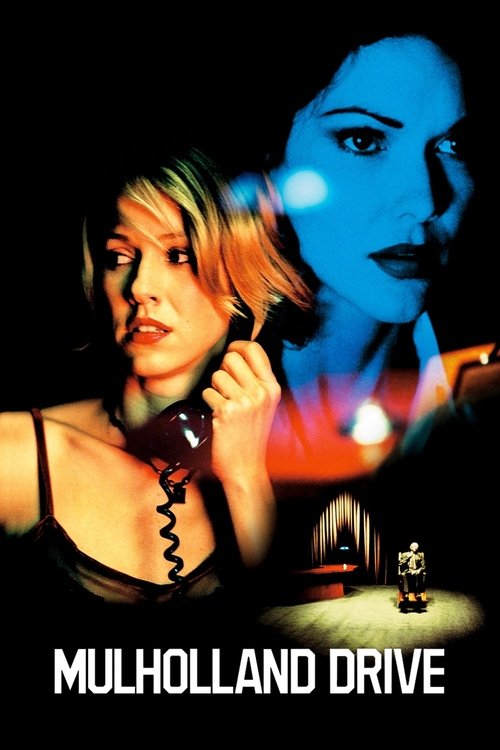
Mulholland Drive
2001 · David Lynch
His January 2025 death was a global grief event that revealed how central he'd become to young cinephile identity; "Fix your hearts or die" and the daily weather reports became memorial memes. The reference point for everything called "Lynchian."
For when you want a film to chew on for days — a puzzle you'll be assembling in your head at 2 a.m. Choose it when you're up for a challenge and a spell, not comfort; it rewards total surrender.
What it's about
Betty, a beaming aspiring actress fresh off the plane, arrives at her aunt's Hollywood apartment to find a beautiful stranger hiding there — a woman with no memory of who she is or why a hitman might want her dead. As the two investigate her identity across Los Angeles, a film director's casting troubles turn sinister, and the city's dream logic starts to bend around everyone.
The experience
Seductive, frightening, and impossible to shake — it plays like a glamorous noir dreamed by someone on the edge of a nightmare, veering from swooning romance to some of the scariest scenes ever put in a non-horror film. You leave it disoriented and immediately wanting to talk about it.
Performances
Naomi Watts is astonishing — a performance of such range and daring that a single audition scene mid-film became instantly legendary — and Laura Harring's amnesiac beauty is the perfect unreadable center for the mystery.
The craft
Lynch conducts the whole thing like music: velvet-dark cinematography, sound design that makes silence menacing, and a nightclub sequence that's among the most emotionally overwhelming scenes of its era. It began life as a rejected TV pilot, and the reworking produced a structure nobody has successfully imitated. Watch it loud, in the dark.
Why it matters
Voted the greatest film of the twenty-first century in the 2022 Sight & Sound poll, it became the defining art-house touchstone of its era and the peak of Lynch's Hollywood nightmares.
Snapshot
Mulholland Drive begins as a noir mystery set in the dream factory of Los Angeles — a wide-eyed ingénue named Betty Elms helps an amnesiac brunette she nicknames Rita piece together a fractured identity — before folding back on itself in its final third to reveal that the dream was the structure all along. What had appeared to be a guileless thriller resolves into a devastated portrait of desire, failure, and the murderous logic of envy. The film's two-part architecture, its accumulation of surrealist detours, and its refusal of stable interpretation established it immediately as a touchstone of art cinema. By the time of the Sight & Sound centenary poll in 2022, it was ranked the greatest film of the twenty-first century.
Industry & production
Mulholland Drive did not begin as a feature film. In 1999, Lynch shot an extended television pilot for ABC, conceived as an open-ended mystery series. ABC rejected the pilot, reportedly finding it too eccentric and narratively unresolved for network broadcast. The footage sat unaired. French broadcaster and production company Canal+ subsequently stepped in with financing that allowed Lynch to return to production, shoot additional material — including the film's devastated final third — and reconceive the whole as a self-contained feature. This origin is inscribed in the work: the sprawling, episodic middle section retains the digressive energy of prestige television, while the final act delivers not a season finale but an annihilating recontextualization. The film was produced by Mary Sweeney and Neal Edelstein, among others, and was a French-American co-production released through Universal Pictures internationally. Its budget was modest by Hollywood standards. Casting Naomi Watts in the central role proved consequential: she had been largely unknown to American audiences, and the performance launched her career.
Technology
The film was shot on 35mm film in a standard 1.85:1 aspect ratio, with no digital intermediate or significant digital manipulation in the image itself — a conventional photochemical workflow that Lynch used to achieve his characteristic textural warmth. The decision to remain on film stock, at a moment when digital video was beginning to attract art filmmakers, was consistent with Lynch's general conservatism regarding image capture. Sound, however, was treated as a primary expressive register rather than a support system. The Dolby SR mix was engineered to make Badalamenti's score and the film's ambient noise design feel equally weighted, blurring the boundary between diegetic and non-diegetic sound in ways that compound the film's ontological instability.
Technique
Cinematography
Peter Deming, who had previously shot Lynch's Lost Highway (1997), served as director of photography. Deming's work on Mulholland Drive deploys a range of focal lengths and lighting schemes that map onto the film's two psychological registers. In the dream sections, the cinematography favors warm, diffuse light — the kind of golden late-afternoon glow of Hollywood mythology — while longer lenses compress space and give faces an idealized, slightly unreal luminosity. Naomi Watts is photographed as a 1950s movie star. The color palette becomes noticeably cooler and more muted in the film's final sequences, the switch functioning almost as a key change. The scene in Club Silencio is particularly precise: Lynch and Deming use deep shadows and theatrical spotlighting to produce an image that looks like a stage illusion, which is exactly what the scene is about. The darkness behind Betty and Rita as they watch the performance is not merely deep but actively consuming, as though the frame itself is becoming unstable.
Editing
Mary Sweeney, Lynch's longtime collaborator and partner, edited the film. Her approach honors Lynch's preference for rhythm over classical continuity: cuts arrive on feeling rather than eyeline, and scenes are permitted to breathe past the point of narrative necessity. The editing of the film's first two-thirds maintains a deliberate opacity, declining to connect the film's parallel plot strands — the Betty/Rita story, the Adam Kesher story, the man terrified of the figure behind Winkie's, the hitman's accumulating blunders — in any conventional expository way. This is a structural decision rather than an oversight: the editing withholds the glue because in retrospect there is no glue. The final transition, from the blue box to the world of Diane Selwyn, is abrupt almost to the point of brutality, a cut that functions as a collapse rather than a development.
Mise-en-scène / staging
Lynch's staging consistently uses thresholds and enclosures as charged spaces. The apartment on Havenhurst, the bungalow at the Sierra Bonita, the interior of Club Silencio, the Cowboy's corral — each space is overdetermined, weighted with an almost theatrical sense of what it means to cross its boundary. His actors are often asked to hold positions longer than naturalism would dictate, a technique that gives performances an uncanny, slightly stylized quality without tipping into outright expressionism. The scene in which Adam Kesher is visited by the Cowboy in the corral at night is staged as a fable: the lighting, the deliberate pacing, the Cowboy's elliptical dialogue. Nothing is coded as mundane because nothing in the film's dreamwork is mundane.
Sound
The sound design, supervised by Lynch himself, is one of the most discussed in contemporary cinema. A persistent low-frequency hum, almost subsonic, underlies much of the film's Hollywood sequences; it is the sound of the city as an organism, or perhaps of the dream sustaining itself. Club Silencio is the film's explicit thesis statement about recorded sound: the emcee announces that there is no band — everything is a recording, an illusion — and then Rebekah del Rio lip-syncs to a prerecorded version of herself performing a cappella a Spanish-language version of Roy Orbison's "Crying" ("Llorando"), before collapsing to the stage while the song continues. The performance stops; the recording does not. Betty and Rita weep uncontrollably even as they understand, on some level, that the emotion has been manufactured. Lynch presents this as the condition of cinema itself.
Performance
Naomi Watts gives one of the defining performances of the decade in a role that requires her to play two characters — Betty and Diane — and to render explicit, within the Betty sections, that Betty herself is a performance. The scene in which Betty rehearses a script for an audition at the apartment, then delivers a radically transformed version of the same scene at the audition, demonstrates what the role demands: the ability to modulate between registers of sincerity without either collapsing into one another. Laura Harring brings a different kind of mystery to Rita/Camilla — largely reactive, largely surface — which is precisely correct for a figure who is, within the film's logic, a projection. Justin Theroux's Adam Kesher operates in a register closer to satire, absorbing humiliation with mounting bewilderment.
Narrative & dramatic mode
The film's structure has generated substantial critical literature. Its most parsimonious description: the first two-thirds constitute Diane Selwyn's dying fantasy, reconstructing her own life with Betty as her wish-fulfillment surrogate, Rita as Camilla domesticated and dependent, and the Hollywood power structures that thwarted her recast as cartoonish villains. The final third is the reality the dream was constructed to suppress — Diane's failed career, her obsessive and ultimately murderous relationship with Camilla, her hiring of a hitman, her guilt. But Lynch resists this explanation being totalizing. Several elements of the film — the man behind Winkie's, the blue-haired woman in the balcony at Club Silencio — do not resolve neatly into either the dream logic or the reality logic, and appear to operate at a third level of address that remains genuinely ambiguous. Lynch has consistently declined to provide an authorized interpretation, and the film's richness depends on this refusal.
Genre & cycle
Mulholland Drive is in sustained dialogue with Hollywood noir, particularly the strand of noir that takes the film industry itself as its subject. Its most direct ancestor is Billy Wilder's Sunset Boulevard (1950), which established the template of a woman broken by Hollywood mythology retreating into a fantasy of her own significance. Both films use the city of Los Angeles as a metaphysical space, both position the protagonist as unreliable narrator of her own story, and both end in destruction. Lynch extends this template by giving it a psychoanalytic architecture borrowed from dream-work rather than classical mystery plotting. The film also participates in the neo-noir cycle of the 1990s and early 2000s, alongside films like L.A. Confidential (1997) and Chinatown's retrospective influence, though its relationship to that cycle is parodic as much as sincere.
Authorship & method
Lynch wrote and directed the film, and his authorial presence is unusually legible — not as a set of signatures imposed from outside but as the medium through which the film thinks. His creative partnership with composer Angelo Badalamenti, which began with Blue Velvet (1986), reaches something like a culmination here. Badalamenti's score — lush, swooning, slightly wrong in its harmonic choices — functions as the affective underlayer of the dream, providing the sense of a beautiful world that is about to collapse. The collaboration operates through a process Lynch has described in interviews: he plays a scene on piano while Badalamenti improvises, the music evolving from Lynch's verbal descriptions of emotional states. Mary Sweeney's editorial sensibility shapes the film's rhythm at a fundamental level. Deming's cinematography, as noted, is calibrated precisely to the film's shifting ontological registers. Within the Hollywood industry, Lynch works as an autonomous filmmaker with creative control negotiated against the exigencies of financing — a position that required, in this instance, the failure of the ABC pilot before the film could exist.
Movement / national cinema
Lynch is commonly positioned within American independent cinema, but the designation is complicated by the French financing of Mulholland Drive and by Lynch's own artistic genealogy, which runs through European art cinema as much as through American genre. The film belongs to a tradition of Hollywood self-critique that includes Sunset Boulevard, The Bad and the Beautiful (1952), and later Barton Fink (1991), all of which use the machinery of studio filmmaking as a site of psychic horror. It also affiliates with the international surrealist film tradition — Buñuel most directly, with Belle de Jour (1967) as an obvious precursor in its dream-logic structuring of female desire and its suppression. Mulholland Drive thus occupies a genuinely hybrid position: formally American in its genre references, in institutional practice a French co-production, and in sensibility European art cinema.
Era / period
The film was shot in 1999 and released in 2001, at the hinge between two cultural moments. In its original conception as a TV pilot, it reflects the late-1990s expansion of prestige cable and network television, the emergence of serialized storytelling as a viable form for sophisticated narrative. As a feature film, it arrived at a moment when American independent cinema was beginning to consolidate around puzzle-film structures — Memento (2000) had just opened — and audience appetite for narratively demanding work was newly recognized by distributors. Lynch's film is both of and in excess of this moment: more formally radical than the puzzle films it superficially resembles, more invested in emotional devastation than in the pleasures of ingenious plotting.
Themes
The film's central preoccupation is the violence done by desire — specifically, by a desire for recognition and love that is structured as fantasy rather than relation. Hollywood functions as the external form of an internal condition: the industry that promises transformation and delivers humiliation is also the structure of Diane's obsession with Camilla. The dark side of American mythology — that talent and aspiration deserve reward, that the right face in the right light can change a life — is exposed as the engine of a very specific cruelty. Identity is correspondingly unstable: the film presents the self as a performed and revisable construct, and the fluidity of its female characters' identities (Betty/Diane, Rita/Camilla) is not postmodern play but a symptom of psychic damage. Lesbian desire runs through the film as something that the dream can accommodate but that reality punishes; the women's relationship is permitted to be consummated in the fantasy and is figured as the primary cause of catastrophe in the real. The film holds this material without pathologizing it, allowing it to exist as one axis of a larger argument about who gets to be desired and who is destroyed by desiring.
Reception, canon & influence
Mulholland Drive premiered at Cannes in 2001, where Lynch shared the Prix de la mise en scène (Best Director) with Joel Coen, who won for The Man Who Wasn't There. The film opened to strong critical response in North America; Roger Ebert awarded it four stars and named it among the best films of the year. Lynch received an Academy Award nomination for Best Director, one of the few times the Academy acknowledged his work. The film's reputation has grown steadily rather than peaked at release: in the Sight & Sound 2012 critics' poll it ranked very highly, and in the 2022 poll it reached first place, displacing Vertigo from the top position. This trajectory — from acclaimed arthouse release to consensus greatest film of the century — is unusual and suggests a work whose claims on audiences increase with distance and re-viewing.
The film's backward debts are clear. Sunset Boulevard provided the structural skeleton; Hitchcock's Vertigo (1958) provided the blonde/brunette doubling, the identity obsession, the remaking of one woman in the image of another. Buñuel's surrealism, particularly the narrative logic of Belle de Jour and The Discreet Charm of the Bourgeoisie, informs the dream machinery. Fellini's 8½ (1963) and Juliet of the Spirits (1965) precede it in treating cinema-world as a site of psychological unraveling. Lynch's own earlier work — Blue Velvet's suburban uncanny, Twin Peaks' soap-opera surrealism, Lost Highway's amnesiac narrative split — all feed directly into Mulholland Drive's method.
Its forward influence is harder to trace causally but pervasive. Darren Aronofsky's Black Swan (2010) is the most legible debtor: the same structure of a woman whose obsession and desire for recognition generates a splitting of identity, the same final collapse of the real into the performance. The rise of the "puzzle film" as a recognized art-cinema subgenre in the 2000s owes something to Mulholland Drive's demonstration that mainstream art-house audiences would submit to radical narrative withholding if the affective stakes were high enough. More diffusely, the film has been a touchstone for filmmakers exploring unreliable subjectivity, Hollywood mythology, and the relationship between cinema and dream — a set of concerns that has not diminished in the quarter-century since its release.
A Deleuzian reading
There is no band.
The full Deleuzian reading of Mulholland Drive →
Reception
Famously born as a rejected ABC TV pilot, it premiered at Cannes 2001 to raves (and some baffled walkouts) and won Lynch Best Director there; within fifteen years the BBC's 2016 critics' poll crowned it the greatest film of the 21st century.
How Mulholland Drive was received, from release to now →
Influences: the films it descends from and the films it influenced
- Sunset Boulevard (1950) — Provides the foundational template Lynch inherits wholesale: Hollywood as a machine that produces illusions and destroys those who believe in them, encoded in a noir frame whose dead/unreliable narrator makes the industry's mythology the film's explicit subject rather than its backdrop.
- Vertigo (1958) — Supplies the dual-register identity structure Lynch adapts: one woman constructed to embody another's fantasy, the revelation of the substitution functioning as the film's formal climax rather than its inciting incident — the crime is the act of making someone into an image.
- Un Chien Andalou (1929) — Establishes the precedent for dream-logic editing — cuts motivated by emotional association and unconscious rhyme rather than causality — that Lynch uses as his primary structural principle across the film's first two-thirds.
- Last Year at Marienbad (1961) — Codifies the European puzzle-film template Lynch inherits: a narrative that permanently refuses to adjudicate between competing versions of events, sustained by the formal certainty of the image against the semantic uncertainty of what the image depicts.
- Persona (1966) — Establishes the figure-doubling device — two women in sustained close proximity whose psychic boundaries dissolve under the pressure of watching and being watched — that Lynch adapts as the structural and thematic engine of the Betty/Rita and Diane/Camilla pairings.
- 3 Women (1977) — Demonstrates that female identity migration can function as a self-sufficient narrative structure without psychological explanation, using a triadic character design and dreamlike tonal consistency to achieve the productive ambiguity Lynch pursues — and proves the mode is viable in American rather than strictly European art cinema.
- Eraserhead (1977) — Establishes Lynch's own industrial-subsonic sound design template — an omnipresent mechanical hum functioning as the film's unconscious — that Mulholland Drive's sound team inherits and recalibrates for Los Angeles, replacing factory noise with the city's electrical organism.
- Lost Highway (1997) — Lynch's direct formal rehearsal: the mid-film identity swap is first tested here, where a credited protagonist becomes a different character without explanation, establishing the dual-protagonist structure and the Patricia Arquette split casting that Mulholland Drive refines into a fully theorized formal system.
- Eyes Wide Shut (1999) — Kubrick constructs ritual spaces with identical formal logic — symmetric staging, controlled theatrical lighting, long-take duration held past naturalistic necessity — to produce an atmosphere where the threshold between performed ceremony and psychic reality is permanently unresolvable, the same ontological strategy Lynch deploys at Club Silencio.
- Three Colors: Red (1994) — Extends doppelgänger architecture into full narrative structure — two women whose identities double and collapse — and deploys the public-face/billboard motif (an actress's image haunting private identity) in direct formal rhyme with Red's modeling poster recurrence.
- 8½ (1963) — Lynch absorbed 8½'s method of unmarked register shift and extended it to an entire feature architecture: reality and dream interpenetrate without optical signals, and the film's second half retroactively reframes the first as fantasy — Fellini's technique of treating interior time as spatially continuous with exterior reality scaled to a structure of total narrative indeterminacy.
- Belle de Jour (1967) — Lynch adopts Buñuel's specific formal combination of making fantasy sequences visually indistinguishable from reality sequences and using a circular structure to retroactively recontextualize the opening, producing the same retrospective epistemological crisis that Belle de Jour's carriage bookends create.
- Inland Empire (2006) — Extends Mulholland Drive's core formal vocabulary — Badalamenti sound design, dual-register performance, Hollywood as a system of illusions — using digital video's inherent instability to dissolve the film/reality boundary further than 35mm permitted, the same thesis stated with a rougher, more corrosive instrument.
- Black Swan (2010) — Aronofsky transplants Lynch's dual-register performance structure — the ingénue and her dark double, idealized public self against destructive inner life — into the ballet world, substituting handheld physiological close-up for Lynch's theatrical stillness while preserving the same split-psyche architecture.
- A Tale of Two Sisters (2003) — Kim Jee-woon applies Lynch's structural recontextualization device — the climactic revelation that one female character is a projection of another's guilt, retroactively reframing all prior scenes — within Korean gothic melodrama's spatial and chromatic vocabulary, demonstrating the template's portability.
- Enemy (2013) — Villeneuve borrows Lynch's device of the unexplained double as externalization of repressed psyche, resolving the puzzle film's semantic ambiguity through a surrealist image (the spider) rather than a psychological one — Lynch's formal grammar applied to male dread of domesticity and repetition.
- Under the Silver Lake (2018) — Mitchell extends Lynch's Hollywood-as-dreamworld conceit into neo-noir conspiracy: Los Angeles as a system of encoded messages whose decoding promises meaning and delivers only more code, weaponizing the puzzle-film's deferral of resolution as a critique of masculine pattern-seeking in a city built on manufactured mythology.
- Only God Forgives (2013) — Dream-logic narrative structure that suspends causal explanation and positions violence and desire beneath a glamorous surface as architectural conditions rather than mysteries to be solved — both films treat the inexplicable as structural premise, and both investigate evil as something latent in the image's visual grammar before it is articulated dramatically.
- The Neon Demon (2016) — Renders Los Angeles as a devouring labyrinth and the entertainment industry as a machine that dissolves a young woman's identity — the most proximate antecedent for the fable's structure.
- Soulmate (2023) — Supplies the structural conceit that a female dyad's story is a re-authored wish-version of events, forcing a retrospective reframing of everything already seen.
- I Saw the TV Glow (2024) — Models the film's core structural device: two incompatible aesthetic worlds housing one dissolving self, where the 'real' timeline is the anti-cathartic denial of the fantasy one, told through dream-logic rather than explained plot.
- Clouds of Sils Maria (2014) — The audition scene where the same pages are played twice and the second reading turns predatory is the exact device Assayas systematizes: a scripted exchange whose register shifts mid-take, forcing the viewer to retroactively re-sort text from life.
- Teenage Sex and Death at Camp Miasma (2026) — One performer holding two versions of a woman without a cut to explain it, and Club Silencio's lip-sync — a musical interlude staged as an ontological rupture rather than a breather.
- The Double Life of Véronique (1991) — Kieślowski's optical doubling device — amber light, shallow focus, and doppelgänger logic deployed to suggest one woman's psychic awareness of her mirror self — anticipates Lynch's use of Naomi Watts and Laura Harring as psychic registers of the same consciousness rather than distinct characters.
- Caché (2005) — Haneke uses ambiguous surveillance footage as a structural device that permanently refuses to resolve its ontological status — diegetic? fantasized? accusatory? — applying the puzzle-film's semantic instability to political guilt with the same formal rigor Lynch applies to erotic fantasy.
- All About My Mother (1999) — Lynch independently deploys scene-within-scene theatrical staging as a tool for blurring performance and reality — Club Silencio functions as a theatrical mise-en-abyme exposing cinematic spectatorship itself, a parallel move to La Agrado's monologue collapsing theatrical and cinematic address in the same year's art-film circuit.
- The Prestige (2006) — Lynch deploys identity doubling where two women may be fragments of the same consciousness, embedding a retroactive narrative restructuring — a second half that forces rereading of the first — within a story explicitly about performance and manufactured selfhood, the same structural logic The Prestige uses for its magician-twin reveal.
- L.A. Confidential (1997) — Peter Deming's glamour portraiture lighting deploys studio-era Hollywood illumination to expose manufactured identity as institutional violence — the same visual grammar Spinotti uses for Basinger's Veronica Lake scenes, inverted so the glamour itself becomes the instrument of psychic and systemic destruction.
- The Game (1997) — The film constructs an elaborate diegetic reality, then retroactively frames it as fantasy, forcing the viewer to re-read every prior scene as manufactured wish-fulfillment — extending The Game's strategy of staging the diegesis as a designed experience the viewer cannot decode from inside.
- Unbreakable (2000) — Lynch's withheld genre declaration — sustaining the syntax of a noir long past the moment a conventional thriller would announce itself, then deploying a structural reframing that retroactively reconfigures all prior footage — is the formal operation Shyamalan executes with Unbreakable's title-card epilogue; both films also use reflective surfaces to literalize doubled or fractured identity.
- Mad Detective (2007) — Lynch applies perceptual-neutrality across the film's two halves — dream registers as reality and reality as dream with no cinematographic hierarchy — and uses detective investigation as the vehicle through which perceptual collapse is delivered, the same structural logic as Mad Detective.
- Memento (2000) — Organizes its narrative around a self-comforting fiction that the structure quietly exposes — the unreliable-narration puzzle built from a protagonist's denial.
- Tropical Malady (2004) — A contemporaneously released bisected narrative whose second half re-encodes the first through unresolved doubling, demonstrating the same diptych logic that asks the viewer to read one panel against the other.
- Irma Vep (1996) — The actress dissolving into her role amid a dream-logic critique of the film industry, kin to Cheung's slippage of identity into Irma Vep.
- Cure (1997) — Lynch works the same vein of hypnotic identity dissolution and amnesiac contagion of self, where one figure rewrites another's personhood — Cure's Mamiya mechanism rendered as oneiric structure.
Similar films
- Eraserhead (1977) — influence & lineage · same viewing thread · often watched together
- Last Year at Marienbad (1961) — influence & lineage · often watched together
- Vertigo (1958) — influence & lineage · often watched together
- Persona (1966) — influence & lineage · often watched together
- Lost Highway (1997) — influence & lineage
- Inland Empire (2006) — influence & lineage
- Possession (1981) — same viewing thread
- Un Chien Andalou (1929) — influence & lineage · often watched together
All the films related to Mulholland Drive →
Watch it with: curated runs of related films
- Doubles, Dreams, and Dissolving Selves — Watch these when you want the floor to give way — dream machines, hypnotists, doppelgängers, and haunted houses where perception and identity quietly come undone.