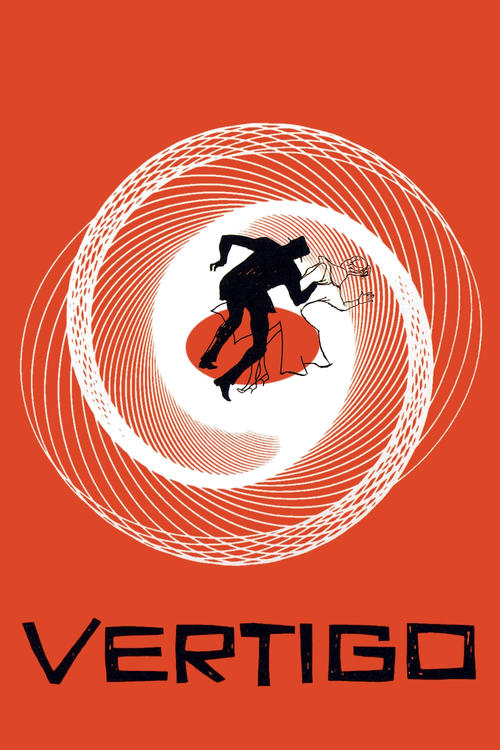
Vertigo
1958 · Alfred Hitchcock
For when you want a film to chew on for days — a late-night, lights-off watch about desire curdling into something darker. Choose it when you're up for hypnotic and haunting over fast and fun.
What it's about
Scottie Ferguson, a San Francisco detective forced into retirement by a paralyzing fear of heights, is hired by an old friend to follow his wife Madeleine, who drifts through the city as if possessed by a woman long dead. What starts as surveillance slides into fascination, and fascination into an obsession that begins to consume him.
The experience
Dreamlike and slow-pulling rather than white-knuckle — it works like a trance, wrapping you in color, music, and repetition until the romance starts to feel like sickness. It's unsettling in a way that deepens on every rewatch.
Performances
James Stewart weaponizes his own decency, letting it rot into something desperate and controlling, while Kim Novak does astonishing double work as a woman who seems to exist between worlds.
The craft
Hitchcock at his most sumptuous: VistaVision and Technicolor turn San Francisco into a city of greens and shadows, Bernard Herrmann's spiraling score aches through every scene, and the famous dolly-zoom effect — invented here to convey dizzying fear — became a permanent part of film language. It's ravishing on a big screen with good sound.
Why it matters
Coolly received in 1958, it was revalued over decades into a consensus pick for the greatest film ever made, topping the Sight & Sound critics' poll in 2012 — the definitive case of a movie outliving its first reviews.
Snapshot
Vertigo is a psychological thriller about the compulsive reconstruction of the desired woman, made in VistaVision and Technicolor at Paramount Pictures by Alfred Hitchcock at the apex of his Hollywood authority. It stars James Stewart as John "Scottie" Ferguson, a San Francisco detective whose acrophobia leads to a colleague's death and his own early retirement, and Kim Novak in a double role as Madeleine Elster — the apparently haunted wife he is hired to surveil — and Judy Barton, the working-class woman he subsequently tries to reshape in Madeleine's image. What begins as a Poe-inflected tale of obsession and doubling discloses itself, unusually, as a structure of repetition and guilty knowledge. Dismissed or only cautiously praised on release, Vertigo underwent a decades-long critical revaluation and in 2012 displaced Citizen Kane at the top of the Sight & Sound decennial critics' poll, a position it held until the 2022 poll, where it placed second behind Chantal Akerman's Jeanne Dielman. It remains one of the most theorized films in the medium.
Industry & production
Hitchcock's production company, Alfred J. Hitchcock Productions, made the picture for release through Paramount. The source material was the 1954 French novel D'entre les morts (From Among the Dead) by the crime-writing team Pierre Boileau and Thomas Narcejac. There is a well-attested account, based on the authors' own statements, that they composed the novel with Hitchcock specifically in mind after he had reportedly been outbid for the rights to their earlier novel Celle qui n'était plus (1952), which became Henri-Georges Clouzot's Les Diaboliques (1955). Whether or not the anecdote is entirely precise in its mechanics, the strategic targeting is consistent with what Boileau-Narcejac acknowledged, and the resulting purchase made Vertigo one of the few Hitchcock pictures explicitly written toward him.
Hitchcock's original intention for the role of Madeleine/Judy was Vera Miles, who had appeared in The Wrong Man (1956) and with whom he had a developing working relationship. Miles became pregnant before shooting began, and Kim Novak — then under contract to Harry Cohn at Columbia Pictures — was borrowed for the production, a loan-out arrangement that gave Hitchcock a major star but also a performer whose chemistry with the material, and with Stewart, was neither automatic nor uncomplicated.
The screenplay was written by Alec Coppel, who drafted an initial adaptation, and then extensively revised by Samuel A. Taylor, a playwright and screenwriter who added psychological texture and much of the dialogue as it now stands. The film was shot largely on location in San Francisco — the Brocklebank Apartments on Nob Hill, Ernie's Restaurant, the Palace of the Legion of Honor, the sequoia groves at Big Basin Redwoods State Park, Fort Point beneath the Golden Gate Bridge — with studio work at Paramount. The mission tower climax was built at Columbia Ranch in Burbank; the actual Mission San Juan Bautista in Carmel Valley has no bell tower, and the construction of a studio substitute allowed Hitchcock the controlled vertical geometry the sequence required.
Technology
Vertigo was shot in VistaVision, Paramount's proprietary widescreen format introduced in 1954. VistaVision ran the film horizontally through the camera on a double-frame negative, producing a larger image area than conventional 35mm and allowing for exceptionally fine-grained enlargement. This gave Burks a high-resolution negative from which Technicolor prints were struck for theatrical release. The format's latitude was well suited to Hitchcock's compositional precision and to the film's palette of warm ambers, cool grays, and the saturated greens and grays of the San Francisco coastal light.
The technique most associated with the film at a technical level is the dolly zoom, sometimes called the "Vertigo effect," in which the camera moves backward through space while the lens simultaneously zooms inward, keeping the subject in frame while distorting the apparent depth of the background. This was executed in the film by second-unit photographer Irmin Roberts; the concept was Hitchcock's and the practical realization was Roberts's. The effect had not been used in a feature film in this systematic way before, and its subsequent saturation across decades of cinema — from Jaws to Goodfellas to a thousand thriller sequences — testifies to how precisely it captured a subjective state: the experience of space warping under psychological pressure. In the film it is used sparingly, appearing at the staircase sequences as a figure for Scottie's vertigo, which is understood as both physical and psychic.
Technique
Cinematography
Robert Burks was Hitchcock's principal cinematographer from Strangers on a Train (1951) through Marnie (1964), with the single exception of Psycho (1960), where the speed and economics of television-influenced production led to a different arrangement. Burks's work on Vertigo is characterized by a sustained attention to color as psychological register: the greens — the green of Judy's dress, the green neon of the Hotel Empire exterior — function as recurrence and haunting. Hitchcock and Burks used filtered light and careful production design to ensure that Madeleine is consistently associated with cool, slightly unearthly tones, while the film's few warmly lit domestic spaces (Midge's apartment) carry a quality of safety the narrative refuses. The use of long focal lengths compresses space and isolates figures; the wide frame of VistaVision allows characters to occupy precisely positioned negative space in ways that a narrower aspect ratio would not accommodate.
Editing
George Tomasini served as editor on Vertigo and on the majority of Hitchcock's Paramount and early Universal pictures — from Rear Window (1954) through The Birds (1963). Hitchcock's editing philosophy, grounded in his admiration for the Kuleshov effect and for what he took from the Soviet montage tradition, was to pre-edit in storyboard before a frame was shot, making the cutting an extension of his pre-production design rather than a discovery in the cutting room. Vertigo's most structurally audacious editorial choice is the revelation midway through the film — given to the audience but withheld from Scottie — that Judy and Madeleine are the same woman. Hitchcock and Taylor revised earlier drafts to place this disclosure before the film's second half rather than at the climax, a decision that shifts the film's suspense from "what is the mystery?" to "when will Scottie know what we know?" — a form of dramatic irony that inflects every subsequent scene with a quality of painful foreknowledge.
Mise-en-scène / staging
Hitchcock's staging foregrounds the mechanics of looking: Scottie watches Madeleine, the audience watches Scottie watching Madeleine, and the camera — often at some remove, using telephoto compression — conflates these positions. The surveillance sequences in the first half of the film (the flower shop, the museum, the bay) are conducted almost entirely in silence, reducing Scottie to the function of an eye. The later sequences, in which he attempts to dress Judy as Madeleine, are shot in closer, more agitated framings, and the moment when his reconstruction is complete — when Judy emerges from the hotel bathroom with her hair pinned up, bathed in a theatrical green light — is staged as a grotesque fantasy consummation: a hallucination literalized. Henry Bumstead's production design and Edith Head's costume design were integral to this structure. Head's gown for Madeleine (the gray suit especially) functions almost as a uniform of idealized femininity, and the point at which Judy's own clothes are progressively replaced by it is the film's moral center.
Sound
Bernard Herrmann composed the score, and it is among the most analyzed in film music history. Herrmann drew on the Wagnerian tradition — the influence of the Liebestod from Tristan und Isolde is structurally audible in the spiraling harmonic movement of the main theme, in the way tonal resolution is perpetually deferred — and on his own developing idiom of unresolved chromatic tension. The "Prelude" uses a habanera rhythm combined with ascending spiral arpeggios that thematize obsession as musical form. The "Scene d'Amour" is among the most explicitly erotic passages in classical Hollywood scoring. Herrmann uses celesta, harp, strings, and divided woodwinds to create a texture that hovers between lushness and unease. The film's first act is unusually sparse in dialogue, and the score carries much of the psychological exposition during the surveillance sequences. The relationship between Hitchcock and Herrmann — which began with The Trouble with Harry (1955) and ended acrimoniously with the score Herrmann wrote for Torn Curtain (1966), which Hitchcock rejected — was among the most productive director-composer partnerships in Hollywood history.
Saul Bass designed the opening title sequence, one of the founding texts of motion graphics: spiraling forms emerge from a woman's eye, prefiguring the film's central imagery of the vortex, the loop, the endlessly rehearsed circle. Bass's title design for Hitchcock across this period (also Psycho, North by Northwest) established a grammar for the thriller title sequence that remains current.
Performance
James Stewart's performance as Scottie Ferguson is deliberately placed against the grain of his established persona. By 1958, Stewart had built a career partly on likability — the idealistic naif of the Capra films, the decent Everyman of The Glenn Miller Story — and partly, through his Anthony Mann westerns, on an American masculinity capable of violence and obsession. Hitchcock uses the latter strain and exacerbates it. Scottie is not sympathetic in the conventional sense; his treatment of Judy, which the film makes no effort to disguise, is coercive. Stewart plays him with a focused, slightly glazed intensity that prevents audience identification from ever settling into comfort. Kim Novak, working under the burden of Hitchcock's dissatisfaction with her methods and with the ghost of Vera Miles, produced a performance that has been increasingly recognized for its precision: her Madeleine is constructed as a performance within the fiction (Judy is performing Madeleine), and Novak calibrates the degree of performance at each level of the story's layering.
Narrative & dramatic mode
The film is structured as a double narrative. Its first half follows the conventions of the romantic mystery, governed by uncertainty about Madeleine's sanity and the supernatural suggestion of possession. Its second half dismantles the mystery and replaces it with something bleaker: the revelation that Scottie's experience was a staged confidence trick, and that his love was solicited to make him a false witness to a murder. The remainder of the film — Scottie's obsessive reconstruction of Judy as Madeleine — is then not a solution to the mystery but a re-enactment of it, undertaken in full knowledge (on Judy's part, and eventually on the audience's) of what the enactment costs. The film ends not with resolution but with another death and the strong implication that Scottie's vertigo, now psychically complex, may never close. The narrative mode is closer to the tragic-ironic than to the conventionally thrilling, and this may account for both the initial critical unease and the subsequent theoretical interest.
Genre & cycle
Vertigo inhabits the psychological thriller, the Gothic romance, and the detective film, without settling into any of them. It belongs to the mid-1950s cycle of psychoanalytically inflected Hollywood films — including Spellbound (1945), Rear Window (1954), and Marnie (1964) among Hitchcock's own work — that used Freudian frameworks to externalize interior states. It is also part of a broader Hollywood tradition of what has sometimes been called the "male melodrama" or the "male weepie," films in which the emotional suffering is organized around a male protagonist whose culpability the narrative acknowledges but does not punish. The film's debt to Gothic conventions — the dead woman who exerts power over the living, the ancestral curse, the obsessive return — aligns it with Rebecca (1940) and with the wider literary tradition running through Poe, Collins, and du Maurier.
Authorship & method
Hitchcock's working method by this period was highly controlled at the pre-production stage. He storyboarded extensively, designed scenes in collaboration with his cinematographer before shooting, and understood the editing before the camera turned. His relationship with Robert Burks, George Tomasini, and Bernard Herrmann constituted a stable creative unit across much of the 1950s and early 1960s, and the consistency of visual and sonic grammar across these films is partly attributable to that continuity. Vertigo is also characteristic of Hitchcock's interest in the mechanics of the woman-as-image: a recurring preoccupation across his career that here becomes the film's explicit subject rather than its suppressed logic. His collaboration with costume designer Edith Head — spanning many films — was particularly load-bearing on Vertigo, where dress functions as the apparatus of transformation and control.
Movement / national cinema
Vertigo is a Hollywood studio film, made within the Paramount system, but it does not map cleanly onto the conventions of classical Hollywood narration. Its willingness to withhold conventional resolution, its use of the woman's subjectivity as an ethical problem for the narrative, and its absorption of European literary and psychoanalytic materials place it in a position the French critics of Cahiers du cinéma understood clearly: for Rohmer, Chabrol, and Truffaut, Hitchcock was not a genre craftsman but an author of the first order, and Vertigo — along with Rear Window — was among the films they used to make that case. The French New Wave's auteurist revaluation of Hitchcock preceded his American critical rehabilitation by roughly a decade.
Era / period
The film was made at the high-water mark of the Paramount-Hitchcock relationship and of the VistaVision era. It belongs to the period of late classical Hollywood — after the Paramount Decrees (1948) had broken the studio system's vertical integration but before the industry's more thoroughgoing restructuring in the 1960s. Hitchcock was operating at unusual creative autonomy for a filmmaker of his commercial prominence: his television series Alfred Hitchcock Presents (1955–62) had given him a further platform, substantial additional income, and a degree of insulation from studio pressure. The late 1950s pictures — The Wrong Man (1956), Vertigo (1958), North by Northwest (1959), Psycho (1960) — represent a concentrated sequence of formally experimental work made within an ostensibly commercial framework.
Themes
The film's central preoccupation is with the male construction of the idealized woman as an act of violence. Scottie's love for Madeleine is inseparable from the conditions under which it was solicited, and his love for Judy is inseparable from his refusal to accept her as herself. The film makes this explicit in the sequence in which he takes Judy shopping for clothes and hairstyling with the explained rationale that she resembles someone he once knew; the scene is played as romance by the film's surfaces while being legible as coercion at every point. Related to this is the film's meditation on memory, loss, and the impossibility of repetition. Scottie's vertigo is ultimately less about heights than about time: the terror of the gap, the fall away from the idealized past moment. The Carlotta Valdes backstory introduces a parallel structure of obsessive men and destroyed women across generations, suggesting the pathology is not individual but historical.
Reception, canon & influence
The film was a commercial underperformance on its first release and received respectful but often puzzled reviews in the American press. Some critics found Stewart's character unsympathetic and the film's structure ungainly. The French critical reception — particularly among the Cahiers critics who had been theorizing Hitchcock's authorship for several years — was warmer. The film was withdrawn from circulation by Hitchcock in 1973, along with four other titles he retained ownership of (Rear Window, Rope, The Trouble with Harry, The Man Who Knew Too Much). Following his death in 1980, the films were re-released; Vertigo returned to theaters in 1983. A major restoration, produced by Robert A. Harris and James C. Katz, was completed and released in 1996, using new photochemical and digital techniques to restore color and sound closer to the original elements. This restoration substantially broadened the film's theatrical audience and contributed to its critical rehabilitation.
Laura Mulvey's enormously influential 1975 essay "Visual Pleasure and Narrative Cinema," published in Screen, used Vertigo as one of its primary texts for the theorization of the male gaze in classical Hollywood cinema — the structuring of the female image as spectacle for a masculine spectatorial position. The essay, drawing on Freudian and Lacanian frameworks, lodged Vertigo permanently in the curriculum of film studies and feminist theory, and the volume of subsequent scholarship it generated is among the largest for any single film.
Looking backward, the film draws on D'entre les morts for its narrative architecture; on Poe's "Ligeia" and the broader Gothic literary tradition for its motif of the dead woman's return; on the dreamlike visual registers of Surrealism (Hitchcock's own Spellbound had featured a Salvador Dalí dream sequence in 1945); and on the conventions of noir, particularly the femme fatale and the compromised investigator, which the film simultaneously exploits and deconstructs.
Looking forward, the film's influence runs through Brian De Palma's Obsession (1976) and Body Double (1984), both of which cite it explicitly in plot and visual grammar. Chris Marker's La Jetée (1962), made almost contemporaneously, is not a direct derivation but shares the ontology of the fixed image and the woman who exists only as photographic arrest — a resonance Marker himself acknowledged in his later film Sans Soleil (1983), which contains an extended meditation on Vertigo and its San Francisco locations. David Lynch's work, particularly Mulholland Drive (2001), inherits the dual-identity structure and the logic of the dream woman. Almodóvar, in multiple films, has acknowledged the depth of Hitchcock's influence on his construction of female subjectivity. The visual device of the dolly zoom passed into the general grammar of film language almost immediately, though rarely with the precision of its original deployment. By any measure of formal influence, theoretical generativity, and canonical weight, Vertigo stands as one of the defining works of the medium's first century.
A Deleuzian reading
A door opens in a hotel room and a woman walks out drowned in green.
The full Deleuzian reading of Vertigo →
Reception
In 1958 it underperformed at the box office and got shrugging reviews, then spent years out of circulation as one of the 'lost Hitchcocks.' By 2012 it had climbed all the way to #1 on Sight & Sound's greatest-films poll, dethroning Citizen Kane after 50 years — cinema's definitive slow-burn reappraisal.
How Vertigo was received, from release to now →
Influences: the films it descends from and the films it influenced
- Laura (1944) — Preminger's staging of a detective's erotic fixation on a dead woman's portrait — and the structural shock of her living double's appearance — is the direct narrative precedent for Scottie's transference from surveilled Madeleine to encountered Judy.
- Portrait of Jennie (1948) — Joseph August's graduated color tinting (sepia to full Technicolor) to mark the boundary between ordinary perception and a man's spectral obsession with a possibly-ghost woman establishes color-as-psychological-register as the technique Burks and Hitchcock systematize with Vertigo's green-light sequences.
- Letter from an Unknown Woman (1948) — Ophüls's tragic-ironic narrative structure — the audience's privileged knowledge of the woman's feelings producing pathos from the man's structural blindness — is the emotional and narratological grammar that Vertigo inherits for its double-narrative irony.
- The Red Shoes (1948) — Jack Cardiff's Technicolor expressionism, where saturated otherworldly color functions as a direct index of obsessive interior states rather than decoration, establishes color-as-psychological-register in the mode Burks extends with Vertigo's green-coded haunting sequences.
- Gaslight (1944) — Cukor's staging of enclosed interiors as instruments of a man's systematic manipulation of a woman's perception and self-knowledge is the Gothic architectural and dramatic grammar Vertigo inherits for Scottie's engineering of Judy's identity transformation.
- Les Diaboliques (1955) — Written by the same Boileau-Narcejac team who wrote Vertigo's source novel, the film's mid-film disclosure that the 'dead' woman has been alive and engineering events from concealment is the direct structural template for Hitchcock's revelation that Judy was always Madeleine.
- Written on the Wind (1956) — Sirk's male melodrama form — male obsessive projection onto a woman rendered through Russell Metty's expressive color cinematography and a narrative logic of fatal non-possession — establishes the genre register Hitchcock inhabits and subverts in Vertigo.
- To Catch a Thief (1955) — Robert Burks directly extends the color-as-erotic-language grammar: Madeleine's gray suit transforming into Judy's green gown uses costume color as psychological-erotic notation, escalating the fireworks-as-intercourse equation Burks first coded in the Carlton Hotel window sequence.
- Sunset Boulevard (1950) — Hitchcock extends Wilder's meta-casting logic — Kim Novak cast precisely for her constructed femininity — and Bernard Herrmann's score develops the ironic-orchestral tradition Waxman established: music that comments on its own grandiosity while scoring obsessive delusion.
- Strangers on a Train (1951) — Burks at the peak of the Hitchcock collaboration; the doubling theme fully elaborated through Madeleine and Judy as manufactured halves of one woman; Scottie's complicit passivity converted to active guilt — Strangers on a Train's transfer-of-guilt logic carried to its terminus, where the nominally innocent hero becomes the direct instrument of the woman's death.
- The Lady from Shanghai (1947) — Hitchcock rebuilds Lady from Shanghai's central mechanism — a woman's hair bleached and cut to unmake her public identity — as explicit plot architecture, with Scotty remaking Judy into Madeleine enacting the same logic of persona erasure through physical transformation that Welles performed on Hayworth.
- Gilda (1946) — Hitchcock extends Gilda's shallow-depth-of-field isolation of the female figure as image-over-person into a systematic formal investigation of male-directed performance: Novak's Madeleine/Judy, reconstructed by a man from his own fantasy, is the explicit elaboration of what Maté and Vidor's camera does to Hayworth — the woman consumed by the image a watching man has constructed of her.
- Peeping Tom (1960) — Powell literalizes the violence latent in Vertigo's surveillant staging grammar: where Hitchcock figures the male gaze as scopophilic possession, Powell makes the camera a murder weapon, articulating what Vertigo's voyeurism-as-staging implies about the aggression structuring the male look.
- La Jetée (1962) — Marker compresses Vertigo's circular tragic structure — the male protagonist's compulsive return to a memory-image of a woman revealing that his obsession was always directed toward his own death — into photo-film form, retaining the double-narrative architecture and the disclosure that the return IS the catastrophe.
- Blow-Up (1966) — Antonioni extends Vertigo's surveillant staging grammar: where Scottie reads Madeleine through binoculars and physical tailing, Thomas reads the woman through the camera lens, and both films stage the male investigator's technical image-capture refusing to yield the truth he projects onto his subject.
- The Conversation (1974) — Coppola directly inherits Scottie's role as hired technical voyeur whose professional competence is undone by erotic projection: Harry Caul's catastrophic misreading of a recorded woman's voice reproduces the structural logic of the surveillant male's fatal over-identification with his target.
- Obsession (1976) — De Palma transposes Vertigo's exact narrative architecture — obsessed widower meets his dead wife's double abroad, reconstructs her in the original's image — and commissions Bernard Herrmann's final score, which replicates Herrmann's Vertigo harmonic language as an explicit structural and musical homage.
- Sans Soleil (1983) — Marker's essay film formally analyzes Vertigo's San Francisco locations as a found text about cinema's relationship to memory and loss, treating Hitchcock's staging of the male gaze's desire to reanimate the lost woman-image as the medium's own foundational compulsion.
- In the Mood for Love (2000) — Doyle and Li Ping-bing's cinematography develops Vertigo's color-as-psychological-register: saturated greens and ambers track obsessive desire, and slow-motion repetition of the woman's cheongsam appearance figures compulsive return with the same structural grammar as Vertigo's Madeleine surveillance sequences.
- Mulholland Drive (2001) — Lynch directly inherits Vertigo's double-narrative disclosure structure: an apparent story in the film's first two-thirds is revealed to be a fantasy constructed by the protagonist, with the real identity concealed behind the constructed one — mid-film mystery disclosure as a formal principle of narrative architecture.
- Twinless (2025) — Models the obsessive reconstruction of a lost double, withholding then exposing the deception so the audience aches ahead of the deceived character — pure structured dramatic irony.
- Miroirs No. 3 (2025) — The originating model Petzold openly mines — a mourner remaking a living woman into the image of a lost dead one — with suspense generated by knowledge withheld from the surrogate, not from the watcher.
- Blade Runner (1982) — The staging of Deckard's apartment scenes — Rachael spotlit against darkness, reconstructed as an image by the detective's obsessive gaze — transposes Scottie's fabrication of Madeleine from fragments; Bernard Herrmann's use of sustained orchestral romanticism as a vehicle for uncanny dread establishes the emotional grammar that Vangelis inherits and translates into synthesizer register.
- Twelve Monkeys (1995) — The predestination loop as romantic tragedy — a protagonist compelled to re-witness a death at the same location he observed in childhood — is Hitchcock's formal invention Gilliam directly appropriates; the airport sequence's closing revelation mirrors the bell tower's double disclosure of past and present collapsing into one moment.
- Persona (1966) — Bergman shares Vertigo's formal project of staging identity-dissolution between a dominant figure and a woman-as-constructed-image: Nykvist's extreme close-up grammar of face-to-face selfhood-unraveling, and the narrative of one self absorbed into another's projection, are cognate with Scottie's reconstruction of Judy as Madeleine.
- Rear Window (1954) — Shares the telephoto compression of male obsessive desire: Scottie tails Madeleine from a distance using long-lens surveillance, the gap between observer and observed producing the same distortions of desire visible in Jeff's courtyard watching — the morally ambivalent male star paralyzed by looking at a woman pushed here from diagnostic comedy to explicit pathology.
- The Man Who Knew Too Much (1956) — The next film in the identical Stewart-Herrmann-Burks-Tomasini production cluster; Herrmann's score migrates from the Albert Hall cantata's sustained-tension orchestral writing into a Wagnerian romantic obsession grammar, while Tomasini's decelerated editing — held back from conventional rhythm to maximize audience anguish over withheld information — is pushed from a single set piece into the film's entire structural principle.
- Eyes Without a Face (1960) — Boileau-Narcejac adapted D'entre les morts for Hitchcock with the same structural logic they bring to Franju: Scottie's obsessive physical reconstruction of Madeleine — her hair, clothing, face staged as an aesthetic object under male control — is the structural twin of Génessier's surgical reconstruction of Christiane, the male shaping of female surface as a form of possession.
- Witness for the Prosecution (1957) — Hitchcock's parallel exploration of performance-indistinguishable-from-truth uses systematic sympathy manipulation — the audience fully invests in the performed identity before the reveal reframes everything — deploying false memory reconstruction as a structural device in the same season as Witness, from the same cultural moment.
- Rebecca (1940) — The most direct descendant: obsessive love for an absent/dead woman, identity dissolved into another's image, and the past colonizing the present — Rebecca's 'tyranny of memory' theme realized as full subjective psychodrama.
- Stage Fright (1950) — Hitchcock himself extends performance-as-deception — a woman knowingly playing a fabricated role while the audience's belief is the true subject — the mature flowering of Stage Fright's concerns.
- Open Your Eyes (1997) — Supplies the romantic-obsessional template in which a man's idealized image of a woman warps his grip on reality, executed through subjective POV and a fixated camera that Amenábar borrows for César's pursuit of Sofía.
- High Anxiety (1977) — The source of the dolly-zoom (track-out/zoom-in) that Brooks literalizes as 'High Anxiety,' staging acrophobic vertigo with the exact contra-zoom optical device Hitchcock and cameraman Irmin Roberts invented for the bell-tower.
- Angel Heart (1987) — Builds the investigation-into-a-woman that is secretly an investigation into the seeker's own dissolving identity, with descending/spiraling visual motifs — Angel Heart echoes its falling imagery and identity collapse.
- Phantom of the Paradise (1974) — The spiraling, obsessive doubling and romantic-fatalist camera movement that shape De Palma's swooning treatment of Winslow's fixation on Phoenix.
- The Face of Another (1966) — Ancestor of the obsessive remaking of a person's face/identity, bound to a circling, waltz-like Herrmann motif — a structural rhyme with Takemitsu's recurring waltz threading Nakadai's reconstruction of self.
Similar films
- The Conversation (1974) — influence & lineage · often watched together
- Mulholland Drive (2001) — influence & lineage · often watched together
- Psycho (1960) — same viewing thread · often watched together
- Rear Window (1954) — same viewing thread · often watched together
- Diabolique (1955) — influence & lineage · same viewing thread
- Strangers on a Train (1951) — same viewing thread
- Rebecca (1940) — same viewing thread
- Notorious (1946) — same viewing thread
All the films related to Vertigo →
Watch it with: curated runs of related films
- The Golden Age of Suspense — A run of immaculate mid-century crime pictures — Hitchcock plus his sharpest rivals — where guilt, obsession, and dangerous romance are staged in gorgeous black-and-white; watch them close together and the shared DNA of the perfect-murder plot lights up.
Film essays and courses that include it
- The Constructed Self: A Century of Gender and Identity on Screen
- Alfred Hitchcock
- The Fractured Mind: Twelve Landmarks of the Psychological Thriller
- The Ache of Distance: Cinema's Language of Longing
- The Shape of Longing: How Cinema Reinvented Romance
- The Investigator's Eye: From Sam Spade to Zodiac
- The Other Self: A Century of Doubling
- Wanted: The Erotic Triangle from Film Noir to Now
- Where the Dead Wait: The Cinema of Grief and Return
- The Film That Watches You Back
- The Shot That Pulls the Ground Away
- The Sound of the Inside
- The Self That Splits in Two
- The Perfect Protagonist
- The Self That Will Not Hold
- The Beautiful Cruelty