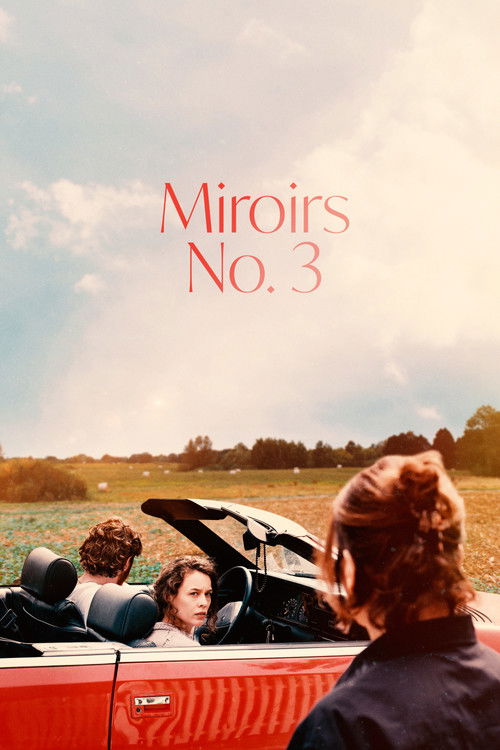
Miroirs No. 3
2025 · Christian Petzold
For a slow, contemplative evening when you want something gentle on the surface but with an undertow — a film to sit with rather than be jolted by. Comfort and disquiet in the same glass.
What it's about
A piano student named Laura survives the car crash that kills her boyfriend, and the woman who witnessed it — Betty — takes her in. In Betty's countryside household, Laura finds an unexpected rhythm of meals, chores, and quiet care that starts to feel like healing. But the longer she stays, the more she wonders what this family actually wants from her, and what hole she might be filling in their lives.
The experience
Hushed, tender, and quietly eerie all at once — it moves at the pace of grief, with a low hum of unease underneath the domestic warmth. You spend the whole film reading faces, and it rewards that attention.
Performances
Paula Beer, in her fourth straight film with Petzold, carries the whole thing on stillness — grief, suspicion, and gratitude passing over her face without a word of explanation.
The craft
Petzold works in compressed chamber-drama form here — 86 minutes, no fat — with his longtime collaborators behind camera and in the edit keeping every scene clean and deliberate. The title comes from a movement of Ravel's piano suite Miroirs, and music is woven into the film's emotional logic; it's a quiet film that rewards a room with no distractions more than a big screen.
Why it matters
It marked Petzold's first appearance at Cannes, premiering in the Directors' Fortnight in 2025, and extends one of the defining director-actor partnerships in current European cinema.
Snapshot
Miroirs No. 3 is Christian Petzold's twelfth feature: an 86-minute chamber drama in which a grieving piano student is absorbed into the household of a woman who watched her boyfriend die. It premiered in the Directors' Fortnight (Quinzaine des Cinéastes) at the 2025 Cannes Film Festival on 17 May 2025 — Petzold's first appearance at the festival — and opened theatrically in Germany on 18 September 2025, with international release rolling into 2026. The film reunites Petzold with Paula Beer for the fourth consecutive time, after Transit (2018), Undine (2020) and Afire (2023), and with his long-standing technical family: cinematographer Hans Fromm, editor Bettina Böhler, and the producers at Schramm Film. Borrowing its title from the third movement of Maurice Ravel's piano suite Miroirs — "Une barque sur l'océan" — it is among Petzold's most compact and deceptively serene works: a story about the dead, about substitution, and about whether a person can be loved as a replacement for someone else. Critical reception out of Cannes was warm rather than rapturous, with reviewers treating it as quintessential Petzold — supple, withholding, and quietly devastating.
Industry & production
The film is a German production from Schramm Film Koerner & Weber (here credited as SCHRAMM FILM Koerner Weber Kaiser), the Berlin company that has produced essentially Petzold's entire mature cinema. Producers are Florian Koerner von Gustorf, Michael Weber, and Anton Kaiser; the film was co-produced with the public broadcasters ZDF and the Franco-German cultural channel ARTE. This financing structure — a modestly budgeted auteur feature underwritten by public television — is the standard apparatus of the German art film and of the so-called Berlin School in particular, and it is exactly the model that has given Petzold the freedom to make small, exacting pictures on his own terms for two decades. Concrete budget figures are not part of the public record; reported worldwide box office is on the order of $1 million, consistent with a festival-driven specialty release rather than a commercial event. US distribution was taken up by a specialty distributor for a 2026 release. The compactness of the production — a near-single-location shoot in the Uckermark countryside north of Berlin, a small cast, an 86-minute cut — is itself an industrial fact: this is cinema scaled to the resources and rhythms of European public-service co-production.
Technology
Miroirs No. 3 is, technologically, an unshowy digital production. Petzold and Fromm have long favored clean, naturalistically lit digital capture over any fetish of format or grain, and nothing in the film's reception suggests a departure. There is no spectacle apparatus here — no large-scale VFX, no elaborate camera rigs — and the film's "technology" is better understood as the technology within the story: the family runs an auto-repair workshop, and machines, engines, and the mechanics of repair recur as motifs. The opening catastrophe is a car crash, and the household's livelihood is the fixing of broken vehicles; the film quietly rhymes mechanical repair with the far less tractable repair of grief. The detailed technical specifications of camera and lensing are not part of the published record, and it would be invention to assert them.
Technique
Cinematography
Hans Fromm, Petzold's cinematographer since the 1990s, again shoots in the limpid, undemonstrative style that has become a signature of their collaboration: balanced compositions, available-feeling light, a palette of summer greens and domestic interiors. The Uckermark landscape — water, woods, a country house — is rendered with the same unhurried clarity Fromm brought to Undine and Afire, so that beauty arrives without underlining. Critics repeatedly described the film as "light as air," and the photography is the chief instrument of that lightness: the camera observes the new household with apparent placidity, which is precisely what makes the undertow of dread effective. The crash that opens the film is handled with characteristic restraint rather than visceral impact.
Editing
Bettina Böhler, who has cut Petzold's films for his entire career, shapes the picture's novella-like economy. At 86 minutes the film is exceptionally tight, and the editing is doing the concealment: information about the family's history is withheld and parceled out so that the viewer, like Laura, only gradually senses that the comfort of the house rests on a hidden wound. Böhler's cutting favors calm, legible scenes over montage flourish; the suspense is structural, a matter of what is shown when, rather than of rhythmic agitation.
Mise-en-scène / staging
The film is built around a house and a family unit, and Petzold stages it as a chamber piece — bodies arranged around tables, a piano, a workshop, the spaces of a home that is both refuge and trap. The recurring image of the mirror (announced in the title) governs the staging: Laura is positioned as a reflection, a double of the dead daughter Jelena, and the household's rituals — meals, music, domestic routine — are arranged to slot her into a vacant role. Objects carry weight in the Petzold manner: the piano, the cars, the rooms of an absent girl. The countryside idyll is staged as deliberately, suspiciously perfect, a too-good home whose serenity the audience is invited to mistrust.
Sound
Sound is central, beginning with the title. The score draws on the classical piano repertoire — Ravel above all, alongside Chopin — pieces that "float through" the film as both diegetic practice and emotional register, since Laura is a pianist preparing for an audition. Petzold has long used music structurally rather than decoratively, and here the act of playing — of returning to the instrument — becomes the measure of Laura's passage through grief. The Ravel movement that gives the film its name, "Une barque sur l'océan," supplies the governing image of a small boat on a vast sea: solitude, drift, survival. The published record does not detail an original score apart from this classical sourcing, and beyond it the sound design is, by all accounts, naturalistic and quiet.
Performance
Paula Beer anchors the film as Laura, in a register critics described as minor-key and interior — depression and numbness giving way, slowly, to something like re-entry into life. The role extends the spectral, between-worlds quality Beer has brought to Petzold's recent films while grounding it in concrete grief. Barbara Auer plays Betty, the woman who takes Laura in, in a performance that must hold tenderness and need in the same gesture, since Betty's care is also a kind of appropriation. Matthias Brandt as the husband Richard and Enno Trebs as the son Max complete the family; both have worked with Petzold before (Brandt in Afire, Trebs across several films), and the ensemble's lived-in ease is essential to the film's lure — the household has to feel genuinely warm for its hidden purpose to disturb.
Narrative & dramatic mode
The dramatic mode is the slow-burn psychological drama with a fairy-tale substratum — the abandoned or grieving young woman taken into a house that is not what it seems. The structure is one of dawning recognition: Laura, and the viewer, accept the family's comfort before grasping that she has been cast as a replacement for Jelena, the daughter whose suicide devastated the household. The revelation reframes everything that preceded it, in the way Petzold's films habitually turn on a buried fact. Crucially, the film resists the thriller payoff its setup seems to promise. Rather than tipping into menace, it modulates toward release: Laura leaves, and the closing movement finds her performing successfully at her conservatory audition while the family watches from the audience — an ending of letting go rather than entrapment. Several critics characterized the film precisely as a drama "about letting go," a ghost story that chooses healing over horror.
Genre & cycle
Generically the film sits at the crossing of grief drama, ghost story, and modern fairy tale — categories Petzold has spent his career dissolving into one another. It belongs to a recognizable cycle in his recent work: the summery, water-and-nature pictures shot in and around the Uckermark with Paula Beer, beginning with Undine and Afire. Petzold had spoken of Undine and Afire as parts of an elemental trilogy; that scheme stalled, and Miroirs No. 3 is best understood not as its tidy completion but as an adjacent third panel — sharing the cast, the landscape, the seasonal light, and the preoccupation with the dead among the living — rather than a formally announced capstone. Within Petzold's larger filmography it rhymes most directly with Phoenix (2014) and Undine: stories of substitution, of a woman asked to be someone she is not, of identity reconstructed across the line of death.
Authorship & method
Petzold writes and directs alone here, and the film bears the marks of his method: literary and musical scaffolding (Ravel, the fairy-tale doppelgänger), genre frameworks bent toward melancholy and history, and a trust in withholding. The notable shift from earlier years is the absence of his late mentor and frequent co-writer Harun Farocki, whose influence shaped Petzold's analytical bent; the recent films are warmer, lighter, more openly emotional, and Miroirs No. 3 continues that softening. His core collaborators are integral to the authorship and deserve naming as such: cinematographer Hans Fromm and editor Bettina Böhler, both career-long partners whose calm classicism is inseparable from the "Petzold style"; the producers at Schramm Film (Koerner von Gustorf, Weber, Kaiser), who have sustained that style commercially; and, as a performing collaborator approaching the status of co-author, Paula Beer, whose presence now defines this phase of his work. There is no credited original composer in the conventional sense — the score is sourced from the piano repertoire, with Ravel as organizing principle.
Movement / national cinema
Petzold is the most internationally visible figure of the Berlin School (Berliner Schule), the loose tendency in German cinema that emerged around the late 1990s and 2000s — alongside filmmakers such as Angela Schanelec and Christian Petzold's contemporaries — characterized by formal precision, observational restraint, ambivalent realism, and a refusal of melodramatic catharsis. Miroirs No. 3 is recognizably a product of that lineage in its discipline and its mistrust of easy emotion, even as its fairy-tale warmth marks how far Petzold has traveled from the movement's cooler origins. It is also a paradigmatic instance of the German public-television-funded art film, made within the ZDF/ARTE ecosystem that underwrites much of the country's auteur cinema.
Era / period
The film is contemporary, set in present-day Germany — Berlin (Laura is a student at the city's University of the Arts) and the rural Uckermark to its north. There is no overt period or historical-reckoning dimension of the kind that animated Barbara (set in the GDR) or Phoenix (postwar). Instead the "period" is the eternal present of grief and summer, a deliberately unmoored, almost timeless register that the fairy-tale framing encourages. The 2025 moment registers obliquely, in the texture of ordinary contemporary life — a repair shop, a conservatory audition, a country house — rather than in any topical commentary.
Themes
The governing themes are grief, substitution, and the persistence of the dead among the living. Laura is loved as a mirror — a replacement for Jelena — which makes the film an inquiry into whether being wanted as a stand-in is a form of care or of erasure, and whether the living can ever fully meet the dead's claim on the surviving. Mirrors and doubling structure everything, from the title to the casting of Laura into a vacant role. Repair is the film's central metaphor: a family that mends machines cannot mend its own loss, and Laura's slow return to the piano figures the harder, non-mechanical labor of healing. Water and drift — the boat on the ocean of the Ravel movement — supply images of solitude and survival. And beneath it all runs Petzold's perennial subject: identity reconstructed in the wake of catastrophe, the self remade in someone else's image. Unusually for the genre, the film ultimately privileges release over entrapment — the theme of letting go that critics seized upon.
Reception, canon & influence
Influences on the film (backward): The most explicit source is musical — Ravel's Miroirs and the broader Chopin/Ravel piano tradition, which furnish both title and structuring imagery. The narrative draws on the deep folk-tale archetype of the stranger taken into a too-perfect house, and on the doppelgänger tradition that Petzold has mined throughout his career. Within his own oeuvre the film's most direct antecedents are Phoenix and Undine — earlier studies of women asked to become substitutes or doubles — and its texture extends the summer-idyll mode of Afire. The long shadow of Harun Farocki, and Petzold's lifelong engagement with Hitchcock and with the melodramas of substitution, remain legible in the architecture of withheld information and uncanny return.
Critical reception: Reviews from Cannes and the subsequent release were predominantly positive, treating the film as "textbook Petzold" — a compact, masterful, novella-like work distinguished by Beer's and Auer's performances and by its refusal of melodrama. A recurring note was that, while not ranked among his very greatest (the bar of Barbara, Phoenix, and Undine being high), it is a deeply controlled and affecting minor-key film, a "balm" rather than a thriller. Critics admired its lightness and its emotional generosity, and read it as a gentle, even consoling turn in his work.
Legacy / what it shaped (forward): As a 2025–2026 release, the film's longer-term influence cannot yet be assessed, and it would be premature to claim one. Its immediate significance is twofold: it consolidates the late-Petzold mode — warmer, more fairy-tale-inflected, anchored by Paula Beer — that the recent films have established, and it marks his belated arrival at Cannes after a career largely associated with the Berlinale. Whether it comes to be seen as the closing panel of the loosely conceived Beer cycle or simply as another fine entry in a remarkably consistent body of work is a judgment the record is, for now, genuinely too young to make.
A Deleuzian reading
Watch how they seat her.
The full Deleuzian reading of Miroirs No. 3 →
Reception
It premiered in Directors' Fortnight at Cannes 2025 to a polite 'minor Petzold' consensus — but by its 2026 US rollout, the tune had shifted, with critics arguing the minor key is precisely the point.
How Miroirs No. 3 was received, from release to now →
How to watch Miroirs No. 3: what to notice on a first viewing
- Watch each small kindness slot Laura into a role. A meal offered, a piece of music encouraged, ordinary household rituals arrange her, one gesture at a time, into a vacant place at the table. No single kindness looks wrong, which is exactly how the mold closes around her.
- Watch how bright and ordinary every room looks. Fromm shoots in plain summer greens and available light, so the household never once looks like a place to be afraid of. The dread here has no shadow to hide in, which is what makes it so hard to name.
- Watch Laura go still while the music keeps moving. Paula Beer plays her numbed and between worlds, a watcher more than an actor, especially in the scenes where she sits at the piano and listens. Grief here looks like a person who can only look and listen, with no move available to make.
- Listen for Ravel and Chopin float through the house. Classical piano pieces run through the film as both Laura's actual practice and its emotional register, never used as simple background music. Whether Laura can play again becomes the film's real measure of whether she can live again.
- Notice the family fixing engines in the workshop. The household runs an auto-repair shop, and machines get mended constantly on screen while something else in the family stays broken. Watching them fix cars all day is the film's quiet joke about what they can't actually repair.
The whole guide to watching Miroirs No. 3, with the keys for a rewatch →
Influences: the films it descends from and the films it influenced
- Phoenix (2014) — Establishes Petzold's substitution architecture — a survivor rebuilt to impersonate her own lost self — and the withholding of recognition until a single devastating gesture, the same delayed-recognition economy Beer's character moves through here.
- Undine (2020) — Grafts a myth/fairy-tale armature onto naturalist Berlin-School texture with Paula Beer as the uncanny woman, plus the auto/industrial-repair motif (Christoph the diver, the broken figurine) that returns as Miroirs' auto-shop world.
- Afire (2023) — Supplies the warm summer-idyll chamber mode — a small group stranded in a house away from the city, shot in Hans Fromm's unforced daylight — that this film inhabits.
- Ghosts (2005) — First fully states the 'grieving parent projects a dead child onto a living stranger' substitution melodrama that organizes the household Beer's character is taken into.
- Yella (2007) — Codifies the Berlin-School uncanny return — a woman moving through a world that may be a posthumous double of itself — built on elliptical cutting that withholds the ground truth.
- Barbara (2012) — The clearest template for the 'Petzold style' deployed here: Bettina Böhler's reticent, gap-leaving edit and Fromm's calm classical framing carrying suppressed emotion without underlining.
- Transit (2018) — Perfects the device of a person assuming a dead other's identity and life, the narrative dealing information so sparingly that the audience pieces the swap together late.
- Vertigo (1958) — The originating model Petzold openly mines — a mourner remaking a living woman into the image of a lost dead one — with suspense generated by knowledge withheld from the surrogate, not from the watcher.
- The Double Life of Véronique (1991) — Demonstrates a doppelgänger built structurally on a piano score and pervasive mirror/glass refractions, the exact fusion of musical scaffolding and doubling imagery Petzold borrows from Ravel.
- Three Colours: Blue (1993) — Models grief organized by a classical-music architecture and a repair arc, the score functioning as the character's withheld interiority surfacing in fragments.
- Persona (1966) — The foundational two-women chamber piece in which identities mirror, bleed, and exchange in near-isolation — the formal kernel of substitution-as-staging.
- L'Avventura (1960) — Pioneers the slow-burn in which one woman slips into the absent place of a vanished other, with a deliberately elliptical, information-withholding narration.
- Marseille (2004) — Shares the Berlin-School grammar at work here — naturalistic available light, hard ellipses, and emotion held just off-screen — applied to a woman trying on another life.
- Everyone Else (2009) — Parallel Berlin-School chamber two-hander observing a relationship under strain through unforced, behaviorally precise performance rather than plot, the register Beer and Auer play in.
Similar films
- Phoenix (2014) — influence & lineage
- Sound of Falling (2025) — same viewing thread
- The Mysterious Gaze of the Flamingo (2025) — same viewing thread
- The Currents (2025) — shared sensibility
- Romería (2025) — shared sensibility
- Father Mother Sister Brother (2025) — shared sensibility
- Anatomy of a Fall (2023) — shared sensibility
- Love Letters (2025) — shared sensibility
All the films related to Miroirs No. 3 →
Watch it with: curated runs of related films
- What the Mothers Left — A run of daughters and young women — grieving lost mothers, wary of surrogate ones, unearthing the family's secrets — where a house or a legacy keeps shaping who a girl becomes.