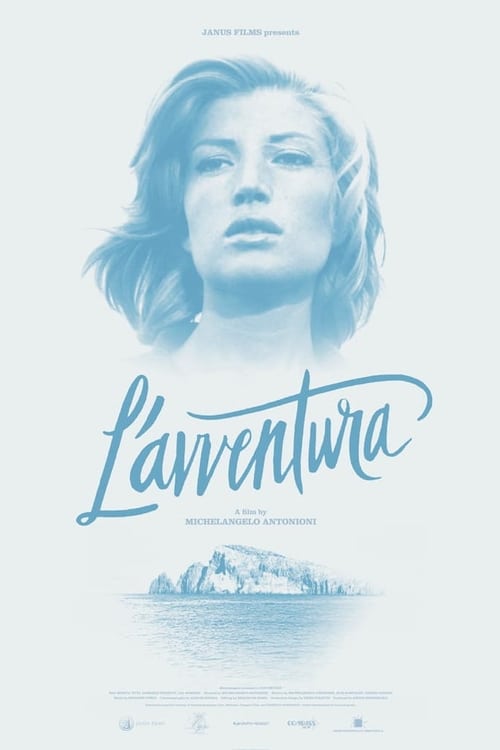
L'Avventura
1960 · Michelangelo Antonioni
For when you want to sink into something slow, gorgeous, and haunting — a film to sit with rather than race through, and to argue about afterward. This is a challenge, not comfort food: pick it when you're in the mood to let a movie withhold things from you.
What it's about
Two women and a man take a yachting trip to a barren volcanic island off Sicily, and one of them — Anna, moody and restless — simply vanishes. Her lover Sandro and her best friend Claudia comb the rocks for her, then follow faint leads back across Sicily. Somewhere in the searching, the two of them drift into a romance neither can justify, shadowed by guilt over the woman they're supposedly still looking for.
The experience
Slow, spacious, and quietly unnerving — the film keeps withholding the answers a mystery usually promises, and that withholding gets under your skin. You watch beautiful, idle people fail to connect against enormous empty landscapes, and the mood is less suspense than a low ache. It asks patience and pays it back in atmosphere you can't shake.
Performances
Monica Vitti, as Claudia, carries the film with her face — restlessness, guilt, and longing playing across it in long wordless stretches. It's the performance that made her the emblem of a whole era of European cinema.
The craft
The black-and-white compositions are the star: figures placed small against volcanic rock, sea, and stark modern architecture, so the landscape itself seems to comment on the people. Antonioni lets scenes run past the point where other directors would cut, and the film's rhythm — long takes, dead time, silence — becomes its meaning. On a big screen the island sequence is overwhelming.
Why it matters
Booed at Cannes in 1960, then almost immediately canonized, it broke the rule that a mystery must be solved and opened the door for decades of films about mood, drift, and disconnection. It made Antonioni the defining modernist of European cinema.
Snapshot
A wealthy young woman named Anna vanishes on an uninhabited volcanic island in the Tyrrhenian Sea. Her friend Claudia and her lover Sandro search for her, and then, without ceremony or resolution, stop searching. The search becomes a romance, the romance becomes an affair, and the disappearance remains exactly that. L'Avventura is the film in which Michelangelo Antonioni abolished the detective-story contract with the audience and replaced it with a different and more unforgiving bargain: the mystery will not be solved because the mystery is not the point. What remains is time, landscape, the bodies of people who cannot reach each other, and a sustained, almost geological silence. The film stands as one of the two or three decisive ruptures in postwar cinema.
Industry & production
L'Avventura was an Italian-French co-production, financed by Produzioni Cinematografiche Europee and the French company Société Cinématographique Lyre. Cino Del Duca and Robert Haggiag produced; the budget was modest by any measure, and the production was troubled. Principal photography took place across Sicily and the Aeolian Islands in the summer and autumn of 1959, with the volcanic outcropping of Lisca Bianca — a genuinely uninhabited island — serving as the location for Anna's disappearance. The Sicilian towns of Noto and Troina appear extensively in the latter half of the film. Shooting on exposed, windswept rock with a large ensemble in difficult weather created logistical strain, and Monica Vitti later recalled working conditions that were physically grueling.
The film had its world premiere at the Cannes Film Festival in May 1960, where it was met with audible hostility from a portion of the audience during the screening. The reception became one of the most storied incidents in festival history. A group of filmmakers and critics — the precise composition of which varies across different accounts, so the details should be treated with some caution — subsequently circulated a statement in the film's defense, affirming its seriousness and its right to exist. The jury awarded L'Avventura a Special Jury Prize. Within two years, critical opinion had reversed so completely that the film would appear near the top of virtually every significant poll of the greatest films ever made.
Technology
The film was shot in black and white on 35mm. Cinematographer Aldo Scavarda, working in his most celebrated collaboration, employed a wide range of focal lengths to serve Antonioni's compositional strategies: wide-angle lenses that could hold characters in a vast, indifferent landscape in the same field as minute architectural details, and occasional telephoto compressions that flatten figures against stone or sea. The use of available light where possible and the production's location-dependent schedule meant that lighting conditions shifted substantially across the Sicilian sequences, contributing to the film's texture of contingency. No special optical processes or notable technical innovations are recorded for the production; what is distinctive is not the equipment but the systematic subordination of conventional cinematographic priorities — faces, legible emotion, narrative clarity — to pictorial and spatial ones.
Technique
Cinematography
Scavarda's work under Antonioni's direction produces a visual grammar in which the conventional hierarchy of the image is inverted. Human figures are not anchored at the center of the frame commanding the viewer's attention; they drift to edges, are obscured by walls or columns, or are dwarfed by landscape until they read as incidental marks on stone. The island sequence establishes this immediately: Anna's disappearance is prepared not by close-up emphasis but by her progressive absorption into the terrain, so that her absence feels less like an event than like a completion of something the landscape was already doing. The Sicilian baroque towns that dominate the film's second half introduce a different kind of visual oppression: ornate, crumbling facades that dwarf the characters and suggest an architecture of excess persisting long after the civilization that produced it has exhausted itself. Natural light and shadow are used to produce a sense of time passing at a pace alien to conventional drama.
Editing
Eraldo Da Roma, Antonioni's regular editor through this period, executes a cutting strategy defined by what it refuses to do. Conventional continuity editing subordinates time to causation: cuts happen when something happens, and the rhythm of the film follows the rhythm of events. L'Avventura systematically withholds this. Scenes end before their apparent conclusion; scenes begin after their apparent beginning. The ellipses are not stylistic flourishes but structural arguments: time passes, nothing resolves, and the film's shape enacts the same structural abandonment that its characters perform when they set aside the search for Anna. There are no match cuts designed to underline emotional beats. The edit is as withholding as the characters.
Mise-en-scène / staging
Antonioni's blocking consistently places characters in relations of non-connection. Two people in conversation are staged so that they face different directions or so that architecture intervenes between them. Sandro and Claudia's developing entanglement is rendered through proximity and spatial drift rather than through sustained eye-contact. The film's most celebrated single staging moment — Claudia scanning the empty island horizon for Anna while Sandro stands behind her, near but unreachable — is characteristic: the geometry of the scene says what the dialogue does not need to say. Antonioni had spoken publicly about his interest in the psychological interiors of characters as expressed through external behavior and environment rather than through confession or confrontation, and the staging throughout L'Avventura embodies this method with unusual consistency.
Sound
Giovanni Fusco's score is scored for small forces and used with extreme economy. Long stretches of the film pass without non-diegetic music, particularly during the island sequence, where wind and sea dominate the soundtrack. Fusco had already collaborated with Antonioni on several earlier films, and his approach — cool, slightly dissonant chamber writing that comments obliquely rather than underlines — would continue through the trilogy. The absence of score during sequences of high emotional or narrative consequence inverts conventional practice and reinforces the film's refusal to cue the audience's responses. Silence is deployed as expressive material.
Performance
Monica Vitti, in her first major film role, performs Claudia with a quality of attentiveness — to her surroundings, to Sandro, to her own uncertainty — that is unlike conventional film acting. The performance does not anchor the audience emotionally in the way a traditionally expressive performance would; instead it keeps the viewer observing the character's surface rather than granted access to her interior. Gabriele Ferzetti as Sandro plays a man whose weakness and charm are inseparable, and the performance is careful not to make the character either sympathetically vulnerable or straightforwardly contemptible. Lea Massari as Anna is on screen only briefly before her disappearance, but the performance makes her feel fully inhabited rather than merely functional. Antonioni was known for working with actors through extended rehearsal and improvisation rather than through technical instruction, and the performances in L'Avventura have the quality of behavior rather than display.
Narrative & dramatic mode
L'Avventura belongs to no prior narrative category it begins inside. It opens as though it will be a social drama (the bourgeois party, the fraught relationship, the trip), then converts to a suspense narrative (the disappearance, the search), then abandons the suspense narrative entirely and continues as something for which there was no established name in 1960. The substitution of Claudia for Anna — a friend replacing the missing woman in the arms of the missing woman's lover — is handled not as shocking revelation but as something both parties allow to happen, without commentary, almost without acknowledgment. The film's refusal to resolve Anna's fate refuses also to make her disappearance metaphorical in any stable way; it remains literally unexplained while becoming structurally central. Narrative desire — the viewer's drive toward resolution — is acknowledged and frustrated simultaneously.
Genre & cycle
The film is positioned at the intersection of several categories without belonging fully to any of them. It draws on the Italian journeying film, in which displacement across landscape externalizes interior condition; Roberto Rossellini's Viaggio in Italia (1954), with its couple who are strangers to each other moving through an alien South, is a direct precursor, though Antonioni's tonal register is colder. It gestures toward the mystery film in its first movement, and toward the romantic drama in its second, but uses both genres as material to be suspended rather than fulfilled. As a cycle, L'Avventura is the first and most formally extreme entry in what became known as Antonioni's "alienation trilogy," followed by La Notte (1961) and L'Eclisse (1962). These three films share preoccupations — bourgeois emotional sterility, the incapacity for genuine connection, landscape as psychological index — and collectively established a model for European art cinema in the decade that followed.
Authorship & method
Antonioni wrote the screenplay with Elio Bartolini and Tonino Guerra, working from an original conception that had gestated over several years. His directorial practice emphasized extended location scouting and the adaptation of the script to the specific textures of discovered places; the Aeolian Islands location was not a backdrop to a pre-written scene but, in significant ways, a condition of it. Antonioni had written extensively on cinema and had articulated, both before and after L'Avventura, a theory of filmmaking concerned with the inadequacy of conventional psychology — the inherited vocabulary of dramatic motivation and emotional resolution — to represent contemporary experience. This theoretical position is enacted, rather than simply illustrated, by the film.
Aldo Scavarda's cinematographic contribution is documented as genuinely collaborative rather than merely executive; this was the peak of his career and his only major international landmark. Giovanni Fusco's compositional restraint was essential to the film's tonal construction. Tonino Guerra, who became one of Italian cinema's most prominent screenwriters (later collaborating with Fellini, Resnais, and Tarkovsky, among others), contributed to the script's structural and dialogue rhythms. Eraldo Da Roma's editing, working from Antonioni's materials, shaped the durational logic of the finished film.
Movement / national cinema
L'Avventura is an Italian film that simultaneously represents the dissolution of Italian neorealism's terms. Neorealism had privileged location shooting, non-professional performance, and social actuality; Antonioni retains location shooting but detaches it from social commitment. The characters of L'Avventura belong to the Italian bourgeoisie, and the film's engagement with their experience is not sympathetic critique but a kind of cold anatomy. The film's visual culture — its use of Sicilian landscape and baroque urbanism — draws on specifically Italian materials while constructing something that functions as a European rather than nationally circumscribed statement. It was received internationally as representative of a kind of cinema — modernist, slow, psychologically inward — that transcended national designation, and it circulated primarily within the emergent international art-cinema market of the early 1960s.
Era / period
1960 is the year of La Dolce Vita, Psycho, and Breathless — a year of unusually dense rupture across multiple cinemas. L'Avventura belongs to this moment as perhaps its most structurally radical entry. The Italian economic miracle of the late 1950s had produced a new bourgeoisie whose spiritual vacancy was one of the period's recurring cultural subjects; Antonioni's film is one of the most sustained engagements with that vacancy. The existentialist discourse of the postwar European intellectual culture — Sartre, Camus, the theater of Beckett and Ionesco — is part of the film's intellectual atmosphere, though Antonioni consistently resisted reductive philosophical readings. The film is a period document of Italian modernity as experienced from within a specific class position.
Themes
The governing theme is incommunicability — Antonioni's own term, which he used in public statements — the inability of people to connect at a depth that would make their proximity meaningful. This is rendered not through dramatic confrontation (the failure mode would then be too visible) but through the absence of confrontation: nobody says what they mean because nobody, including themselves, knows what they mean. The substitution of Claudia for Anna enacts a related theme: the interchangeability of people as objects of desire, the ease with which one absence is filled by another presence without anyone acknowledging that this is what is happening. There is also a sustained meditation on waiting and the emptiness of time, on the way landscapes outlast and indifferently contain human distress, and on the particular loneliness of wealth — the freedom to travel, to desire, to abandon — as a condition that removes rather than adds to experience.
Reception, canon & influence
The Cannes scandal was succeeded within a relatively short period by critical rehabilitation of unusual speed and completeness. By the time Sight & Sound conducted its 1962 critics' poll, L'Avventura ranked second on the list of greatest films ever made, a position that testified to how rapidly the international critical community had reoriented around it. The film's influence on subsequent art cinema — particularly European but also global — was enormous and relatively direct: the long take, the suppression of plot resolution, the use of landscape and architecture as psychological registers, the cold bourgeois milieu, all became markers of a cinematic seriousness that owed their currency in large part to this film.
Looking backward: the film's most significant precursor is Rossellini's Viaggio in Italia, which had already placed an alienated couple in a Southern landscape and refused conventional dramatic resolution. Antonioni's relationship to neorealism — its techniques appropriated and its politics evacuated — is the internal Italian context. The broader context includes European literary modernism, particularly the Italian modernist tradition, and the existentialist novel.
Looking forward: the trilogy that L'Avventura initiated — La Notte (1961) and L'Eclisse (1962), both photographed by Gianni Di Venanzo — extended its premises into urban settings and different varieties of emotional withdrawal. Blow-Up (1966), Antonioni's British film, can be read as a direct response to and transformation of L'Avventura's epistemology: another disappearance, another investigation that undoes itself, but set in swinging London and inflected with different cultural materials. The film's influence on the French nouvelle vague is difficult to calibrate precisely given the contemporaneity of the movements, but its example was acknowledged. Later, filmmakers as different as Wim Wenders, Theo Angelopoulos, and Wong Kar-wai have cited Antonioni's spatial and durational practices as constitutive influences. The film remains in regular circulation in academic film education and continues to appear on major critical polls; in the 2022 Sight & Sound poll it remained among the most frequently cited titles by critics worldwide, confirming a canonical status that has proven durable across more than six decades.
A Deleuzian reading
Claudia stands at the edge of a volcanic island and scans the horizon for a woman who is no longer anywhere.
The full Deleuzian reading of L'Avventura →
Reception
Booed and jeered at its 1960 Cannes premiere — Monica Vitti reportedly left in tears — yet it won the Jury Prize after critics rallied to its defense, and just two years later Sight & Sound's 1962 poll ranked it the second greatest film ever made, behind only Citizen Kane. Few films have gone from scandal to canon that fast.
How L'Avventura was received, from release to now →
Influences: the films it descends from and the films it influenced
- La terra trema (1948) — Visconti uses the Sicilian coast at Aci Trezza to dwarf human figures in wide-angle compositions of rock and sea, establishing the grammar of landscape-as-compositional-force that Antonioni would extend from the Sicilian shoreline to its uninhabited volcanic islands.
- Stromboli (1950) — Rossellini stages Bergman on a live volcanic island whose hostile geology functions as a psychological cage — the direct template for Antonioni's use of Lisca Bianca as a landscape that absorbs rather than releases its inhabitants.
- Cronaca di un amore (1950) — Antonioni's first feature invents the lateral tracking shot that follows characters against walls and architecture rather than centering them, and sketches in embryo the mystery-plot-abandoned-for-bourgeois-estrangement structure that L'Avventura will fully systematize.
- Umberto D. (1952) — De Sica allows scenes to run at the pace of lived duration rather than dramatic necessity — the morning coffee sequence extends well past its narrative content — establishing the temporal logic that L'Avventura will adopt as a structural principle rather than a local effect.
- Viaggio in Italia (1954) — Directly cited as a founding influence: Rossellini's tourist couple adrift in Southern Italy, available-light location shooting, behavioral acting, and a landscape — volcanic, archaeological, saturated with death — that functions as a mirror for the characters' incommunicability.
- Germany, Year Zero (1948) — Antonioni extends Germany Year Zero's editorial refusal of reaction shots: by withholding the cut to a responding face, both films force the viewer to sustain ambiguity about interior states rather than having emotion decoded by intercutting.
- Paisan (1946) — Antonioni elevates Paisan's elliptical editing into a narrative ontology: Anna's disappearance, like Paisan's deaths, is registered then vacated without resolution, compelling the viewer to hold absence; Antonioni's Sicilian island location shooting also inherits the neorealist grammar directly.
- Europa '51 (1952) — Antonioni adopts the Rossellinian optical situation — bourgeois female protagonist who can no longer act, only observe — and extends it through architectural duration shots that render social constraint as spatial dislocation, making Sicilian islands and emptied drawing rooms do what Rossellini's Roman streets and asylum corridors did.
- Il Grido (1957) — Consolidates Il Grido's landscape-as-psychology and refusal of narrative resolution into the trilogy grammar, dissolving plot into dedramatized drift.
- La Notte (1961) — Antonioni extends L'Avventura's staging grammar directly to Milan's modernist architecture: Monica Vitti's behavioral style continues, the couple's estrangement is externalized through the city's glass and concrete facades, and a party drift substitutes for the island search as the durational vehicle of incommunicability.
- Last Year at Marienbad (1961) — Resnais absorbs L'Avventura's spatial non-connection directly: figures in hotel corridors and formal gardens who cannot reach each other across decorated space, an abandoned mystery of prior meeting, and editing that enacts uncertainty rather than resolves it.
- L'Eclisse (1962) — The trilogy's culmination drives L'Avventura's abandoned-romance logic to its limit: the final sequence runs several minutes at the locations where Vittoria and Piero were supposed to meet, neither character appearing — the landscape continuing after the figures have vacated, as Lisca Bianca continued after Anna.
- Blow-Up (1966) — Antonioni transposes L'Avventura's structural signature directly: a mystery — the corpse Thomas may have photographed — is pursued, the evidence dissolves, and the film ends with the original concern abandoned, because the mystery was never the point.
- The Conformist (1970) — Bertolucci and Storaro study Scavarda's wide-angle compositions with figures displaced to frame edges; the film's Fascist-era Roman architecture functions as a psychological index in Antonioni's manner, staging characters against monumental facades to externalize states they cannot voice.
- The Passenger (1975) — The final seven-minute shot through a hotel window grate — following action in a space the camera cannot enter — is the technical culmination of Antonioni's staging of spatial non-connection; the protagonist's identity-abandonment extends Sandro's vacating of the search for Anna.
- Landscape in the Mist (1988) — Angelopoulos inherits Antonioni's durational long takes and the strategy of staging small figures in vast, indifferent terrain — gray Greek plains functioning as a psychological index in the same way L'Avventura's volcanic rock does — with elliptical editing that withholds conventional causal connectives.
- Certified Copy (2010) — Kiarostami stages a couple in Tuscan landscape through behavioral performance and withholds resolution of the central mystery — are they strangers or a long-married couple? — extending L'Avventura's abandoned-mystery grammar to the relationship's own ontological status.
- Once Upon a Time in Anatolia (2011) — Ceylan adopts L'Avventura's structure precisely: a nocturnal search across the Anatolian steppe becomes durational and contemplative until it is about something other than finding the body, with figures dwarfed by terrain in wide-angle compositions and silence functioning as expressive material rather than absence of information.
- Miroirs No. 3 (2025) — Pioneers the slow-burn in which one woman slips into the absent place of a vanished other, with a deliberately elliptical, information-withholding narration.
- Stranger Than Paradise (1984) — Antonioni establishes duration-as-form: sustained shots that wait for drama that never arrives, empty modern spaces as projections of alienation, and the anti-plot following characters going purposefully nowhere — all foundational to StP's deliberate aesthetic of productive stasis.
- Solaris (1972) — Antonioni established the modernist template for permanently unresolved narrative — questions not withheld but genuinely abandoned — and for building emotional accumulation within the shot rather than through editing; Tarkovsky applies this duration-based rhythm and structural opacity to the science fiction context.
- Hiroshima mon amour (1959) — Resnais arrives the year before at an independent formulation of elliptical editing that refuses chronological causality — cutting between Hiroshima and memory-Nevers in a grammar that enacts psychological time rather than story time — co-inventing with Antonioni the art-cinema editing paradigm.
- Contempt (1963) — Antonioni's anamorphic rendering of an Italian island (Lisca Bianca) as a space of existential exposure — the horizontal CinemaScope frame generating the characters' vulnerability against sea and stone — runs parallel to Godard's Villa Malaparte compositions, both deploying the wide format's landscape mode to stage intimate emotional drama as geography rather than psychology.
- La Dolce Vita (1960) — Released the same year and in the same anamorphic widescreen format, both films use the 2.35:1 horizontal field to enforce the same compositional argument: protagonists placed at frame edges in architecturally indifferent spaces, the wide canvas producing social geometry rather than heroic centrality; Antonioni's spatial grammar is the closest formal parallel to Martelli's lateral-drift framing.
- The Virgin Spring (1960) — Antonioni's contemporaneous European art cinema use of prolonged duration, near-silence, and landscape as moral register deploys a formally analogous grammar of deliberate pacing and physical economy in performance within the same era.
- Through a Glass Darkly (1961) — Released the same year, Antonioni independently arrives at the same formal solution: shallow-focus cinematography isolating figures against dissolved architectural backgrounds, a slow-cut rhythm refusing conventional resolution, and location-as-psychological-register—both films treat place as an active agent of emotional unavailability.
- Walkabout (1971) — Establishes the art-cinema device of placing alienated bodies against indifferent barren terrain and refusing narrative/moral closure, the formal license Walkabout takes to the outback.
- The Headless Woman (2008) — Establishes the withheld-resolution structure Martel inherits — a disappearance (there, a woman; here, a possible corpse) that the film pointedly refuses to solve, converting an unsolved event into an atmosphere of moral drift.
- Eternity and a Day (1998) — Established the dedramatized long take in which characters are absorbed and dwarfed by architecture and landscape, the alienated framing Angelopoulos inherits for his empty piazzas and seafronts.
- The Firemen's Ball (1967) — Shares the strategy of letting a group's collective moral indifference surface through duration and dead time, an event (a disappearance / a theft) that exposes the ensemble rather than resolving.
- The Wind Will Carry Us (1999) — Establishes the anti-dramatic structure Kiarostami inherits: a disappearance is never resolved and narrative momentum dissolves into landscape and waiting, teaching the film that a withheld payoff can become the subject itself.
- Identifying Features (2020) — Establishes the template of a search for a vanished person that refuses resolution, letting the disappearance drift off-screen and dissolving procedural momentum into elliptical, landscape-driven dead time.
Similar films
- L'Eclisse (1962) — influence & lineage · often watched together
- Journey to Italy (1954) — influence & lineage · often watched together
- The Passenger (1975) — influence & lineage · often watched together
- Landscape in the Mist (1988) — influence & lineage · often watched together
- La Notte (1961) — influence & lineage
- Blow-Up (1966) — influence & lineage
- Last Year at Marienbad (1961) — influence & lineage
- Stromboli (1950) — influence & lineage
All the films related to L'Avventura →
Watch it with: curated runs of related films
- The Vanishing Self — A run of 1960s–70s modernist art cinema where identity comes undone — people simply vanish, faces are remade, memory bleeds into hostile landscape — that rewards being watched in a stretch, each film deepening the last's dread.
Film essays and courses that include it
- Duration and Doubt: The Art Film from Dreyer to Kiarostami
- Radical Attention: A Century of Art Cinema
- From the Ruins: Italian Cinema's Century of Reinvention
- The Art of Duration: Slow Cinema from Dreyer to Tarr
- The Wound of Time: Cinema's Elegiac Masters
- The Disappearing Self: A Cinema of Estrangement
- The Shape of Longing: How Cinema Reinvented Romance
- God Is Silent, Death Is Certain: Existentialism in World Cinema
- The Necessary Image: Italian Cinema from Neorealism to Now
- When the Camera Learned to Wait: From the Rubble of Rome to the Silence of Antonioni
- The Film They Tried to Stop: A Century of Festival Scandal
- What Comes After the Time-Image?
- Too Much Time
- When Nothing Happens