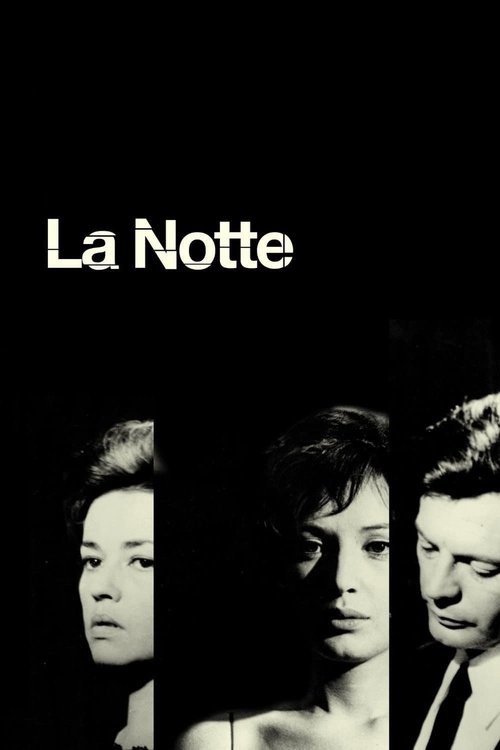
La Notte
1961 · Michelangelo Antonioni
For a contemplative night when you want a film about adult life as it's actually lived — the slow drift of a long relationship — rather than escape. It's a thinking-and-feeling watch, best when you're willing to meet it halfway.
What it's about
One day and one night in Milan with Giovanni, a celebrated novelist who's run out of things to say, and his wife Lidia, who has quietly run out of reasons to stay. They visit a dying friend in the hospital, drift separately through the city, and end up at an industrialist's lavish all-night party, where money, boredom, and temptation circle them both. It's the anatomy of a marriage examined over a single sleepless stretch, ending at dawn.
The experience
Elegant, chilly, and quietly wrenching — the tension comes not from what's said but from the growing space between two people in the same rooms. It moves slowly and deliberately, and the final stretch has real emotional weight.
Performances
Marcello Mastroianni and Jeanne Moreau, two of the era's greatest faces, play the couple almost entirely in glances and evasions — Moreau's long solitary walk through Milan is a wordless tour de force of restlessness.
The craft
Antonioni turns modern Milan — glass towers, empty lots, rain-slicked streets — into a mirror for the marriage, framing his couple against architecture that dwarfs and separates them. The black-and-white photography is severe and beautiful, and the party sequence is a masterpiece of choreographed drift. It won the Golden Bear at Berlin.
Why it matters
The central panel of Antonioni's famed trilogy on modern disconnection, it cemented him as the defining filmmaker of alienation and set the template for decades of films about marriages examined over a single day or night.
Snapshot
La Notte is the second panel of Antonioni's so-called "alienation trilogy" (or "incommunicability trilogy"), bracketed by L'Avventura (1960) and L'Eclisse (1962). Shot in black and white over the course of a single day and night in Milan, it follows Giovanni Pontano — a celebrated novelist with nothing left to say — and his wife Lidia through a slow disintegration: a hospital visit to a dying friend, Lidia's aimless wandering through the city's modernist periphery, an evening party at a new-money industrialist's villa, and a long, terrible dawn on a golf course where the marriage is finally and quietly annihilated. The film won the Golden Bear at the 11th Berlin International Film Festival in 1961, consolidating Antonioni's position as the central figure of European modernist cinema.
Industry & production
La Notte was produced as an Italian-French co-production. Antonioni's own company Nepi Film partnered with the French producers Silver Film and Sofitedip — a structure common to prestige Italian cinema of the early 1960s, when the French market and French financing opened access to international talent. The arrangement allowed the casting of Jeanne Moreau, whose work with Louis Malle (Les Amants, 1958) and Jacques Demy had made her the defining face of European female interiority, alongside Italian industry pillars Marcello Mastroianni and Monica Vitti. Vitti had emerged via L'Avventura and was, at this moment, both Antonioni's creative partner and an international art-cinema star in formation. The film was financed in the context of Italy's economic boom — the "miracolo economico" — which had made Milan the capital of a modernizing nation, and which the script consciously positions as the sociological backdrop for its inquiry into bourgeois exhaustion.
Technology
Antonioni and cinematographer Gianni Di Venanzo shot in black and white on 35mm using a widescreen theatrical ratio, a choice that turned the horizontal expanse of the frame into an instrument of psychological distance. The wide format permitted Antonioni to trap characters at the margins of compositions while vast architectural and urban spaces colonized the center — a spatial grammar that color would have partially dissolved. Di Venanzo's work in La Notte is notable for its tonal restraint: deep, matte blacks, a silky mid-range, and carefully managed gradations of urban gray that give the film its quality of overcast immanence. The camera technology available — lighter Arriflex and Cameflex bodies alongside conventional Mitchell configurations — allowed the long-take, ambulatory sequences, particularly Lidia's extended walk, to register as something between documentary observation and lyric drift.
Technique
Cinematography
Di Venanzo was one of the supreme Italian cinematographers of the period, and La Notte is among his finest work. Where classical cinematography treats architecture as backdrop, Di Venanzo, following Antonioni's instructions, photographs Milan's modernist buildings — their glass curtain walls, brutalist residential towers, the half-finished structures of the periphery — as active presences that dwarf or absorb the human figures. During Lidia's walk, the camera holds on empty lots, concrete façades, and patched urban wastelands before or after she inhabits them, allowing the cityscape its own dramatic weight. The available-light approach in several exterior and semi-exterior sequences contributes to an aesthetic of contingency — of light as something encountered rather than arranged.
Editing
Eraldo Da Roma, Antonioni's long-serving editor across multiple films, maintains the director's characteristic temporal logic: duration is not compressed to its dramatic essence but extended beyond conventional efficiency. Cuts occur not at climactic moments but slightly before or after them, leaving the viewer suspended in the aftermath or anticipation of event. Transitions between scenes frequently elide conventional cause-and-effect linkage; the cut from the hospital to the streets arrives without emotional or narrative preparation. This temporal looseness is not imprecision — it is the structural equivalent of the film's thematic content: time passing without consequence, without progress.
Mise-en-scène / staging
Antonioni's staging is predicated on separation. In scene after scene, characters who are nominally together occupy different planes, face away from each other, or are bisected by objects and architectural elements. The shallow-focus compositions that isolate individual figures within the wide frame; the refusal to cut to reaction shots in two-shots that might register the impact of words on listeners — these are consistent formal decisions. The party sequence at the Gherardini villa is a masterclass in social choreography: the crowded space does not produce intimacy but amplifies estrangement, each pocket of activity sealed off from the others. Antonioni's use of "dead time" — his willingness to hold the frame as characters move through it or wait or simply exist — was noted immediately by contemporaries as the film's most provocative formal quality.
Sound
Giorgio Gaslini's jazz score, strategically sparse rather than continuous, gives the film its period texture and its class coordinates. Jazz is largely confined to the party sequence, where it functions simultaneously as social realism (the fashionable soundtrack of the Milanese bourgeoisie in 1960) and ironic commentary on the couple's mutual dissociation while dancing. Antonioni and sound designer Claudio Maielli make extensive use of ambient urban noise — traffic, construction, the mechanical textures of modern Milan — as a kind of environmental score during Lidia's walk. Silence, when it comes, is weighted. The film's penultimate scene, where Giovanni reads Lidia's old love letter aloud at dawn, is delivered against birdsong and wind: nature indifferent to the failure of language.
Performance
Antonioni was legendarily demanding about non-expressive performance — he wanted behavior rather than acting, gesture rather than demonstration. Jeanne Moreau's Lidia is one of the great performances in his filmography: largely interior, communicated through stillness and movement rather than dialogue, present in the body's posture and in how she occupies space. The famous walk sequence — nearly wordless, its emotional register available only through what Moreau does with her eyes, her pace, the small decisions of attention — required a performer who understood duration as a performative medium. Mastroianni plays Giovanni's hollowness without self-pity, his charm deployed as evasion. Vitti's Valentina is sharper, cooler, more self-aware than her characters in L'Avventura or L'Eclisse; she and Mastroianni share an intellectual chemistry that makes Giovanni's desire for her plausible without making it sympathetic.
Narrative & dramatic mode
The film operates in what might be called the mode of sustained adjacency: characters orbit crises without entering them, and the narrative's formal shape — beginning with a visit to death, moving through aimless urban wandering, arriving at a shallow social spectacle, ending in a stripped confrontation at dawn — has an arc only in retrospect. Conventional plot events happen at the periphery: the dying friend, the industrialist's offer, the flirtations. What the film records is not events but their weather — the psychological atmosphere in which events fail to cohere into meaning. The ending, in which Giovanni reads aloud a letter he does not recognize as Lidia's, is one of the most formally rigorous endings in European cinema: language, Giovanni's professional medium, is returned to him as evidence of his own absence.
Genre & cycle
La Notte participates in what critics identified, both approvingly and accusingly, as the Italian "cinema of boredom" or cinema of alienation — a loose cycle that includes Antonioni's own trilogy alongside Fellini's La Dolce Vita (1960), which mapped similar bourgeois exhaustion across a Roman social landscape. Where Fellini retained spectacle and satire, Antonioni stripped the image of event and concentrated duration. The film also belongs to a specifically European cycle of marriage films tracing back through Roberto Rossellini's Viaggio in Italia (1954) — arguably the ur-text for the modern European meditation on coupledom in landscape — and forward into Bergman's increasingly rigorous explorations of the same territory. La Notte is the most Bergman-adjacent of the trilogy in its focus on a specific relationship, though Antonioni's sociology and his treatment of space remain distinctly Italian.
Authorship & method
Antonioni's screenplay collaborators — Ennio Flaiano and Tonino Guerra — were both essential contributors to the fabric of Italian literary and cinematic modernism. Flaiano had worked extensively with Fellini and brought a sardonic literary intelligence to the script's depiction of the Italian intellectual class; Guerra, who would become Antonioni's most sustained collaborative partner through the decade and beyond, contributed a structural sensibility aligned with the director's concern for duration and geography. Antonioni's method on set was famously architecture-first: he would scout and select locations, then build scenes around the spatial logic of those environments rather than imposing conventional blocking onto neutral space. The Gherardini villa's modernist geometry, the Milan periphery's desolate half-urban landscape — these were not settings but compositional decisions.
Gianni Di Venanzo brought to his work with Antonioni a background in neorealist documentary practice — he had been a camera operator under figures like Aldo Graziati — and a particular command of location lighting. His death in 1966 at forty-three cut short what was by any measure one of the defining cinematographic careers of the decade; he had also shot Fellini's 8½ (1963) and Juliet of the Spirits (1965) by that point.
Movement / national cinema
La Notte occupies a critical position in Italian cinema's formal break from neorealism. The neorealist inheritance — location shooting, non-professional aesthetics, social engagement — persists in Antonioni's work as a set of practices now redirected toward psychological rather than social-documentary ends. Where neorealism photographed the body in society, Antonioni photographs the body in space, in duration, in the company of architecture that does not speak back. Italian cinema in the early 1960s was in the process of a confident international projection — the co-productions, the film festival presences, the art-house circuit — and Antonioni, alongside Fellini and later Pasolini and Visconti, was central to the image of Italian cinema as an intellectual and artistic enterprise rather than merely a commercial one.
Era / period
The Italian economic miracle provides the film's social substrate. By 1961, Milan had become the industrial and financial capital of a rapidly transforming country; the urban periphery that Lidia walks through — construction cranes, modernist tower blocks, patched wastelands between old and new — indexes the physical upheaval of a society rebuilding itself. The Gherardini party represents the new bourgeoisie produced by this transformation: industrial money without cultural memory, hosting artists and intellectuals it regards as social accessories. Giovanni's crisis is inseparable from this context — his success as a writer is a function of a culture industry newly affluent enough to consume literary reputation, yet his writing has become unmoored from any authentic relation to experience. The film diagnoses modernity's cost in specifically Italian terms.
Themes
The film's central preoccupation is incommunicability — a term Antonioni returned to throughout this period — understood not as a simple failure of language but as a structural condition of modern subjectivity. Giovanni is a writer who cannot write; his novel is celebrated but his next project has no content. Language for him has become performance, charm deployed in place of meaning. Lidia understands this better than he does, and the film is partly her education in what this understanding costs her.
Space and time function thematically as correlates of psychological states: Lidia's walk is not merely a plot device but a phenomenological exercise, the city available to her perception in a way that her marriage is no longer. Eros appears repeatedly — the hospital's nymphomaniac patient who nearly seduces Giovanni; his attraction to Valentina; Lidia's anonymous dance with a stranger at the party — but always as evasion or substitution, desire displaced from its true object or its true absence. Memory is the film's final theme: the love letter read at dawn is a memory of feeling that is no longer available to the person who wrote it, and Giovanni's inability to recognize it as Lidia's is the ultimate index of how thoroughly the past has been vacated.
Reception, canon & influence
La Notte arrived in the wake of L'Avventura's complicated Cannes debut in 1960, where the film was booed by audiences but received the Special Jury Prize and a public letter of support from assembled critics and filmmakers. By 1961, Antonioni's aesthetic had polarized European critical culture into camps, and La Notte — more contained than L'Avventura, more anchored in recognizable social terrain — was received more warmly by general audiences while confirming the enthusiasm of committed advocates. The Berlin Golden Bear was a significant institutional endorsement.
The film's critical fortunes solidified over the 1960s as the European art cinema canon took shape. André Bazin had provided the theoretical framework (the long take, ontological realism) into which Antonioni's practice could be partly — if imperfectly — inserted; critics around Cahiers du Cinéma engaged with the film seriously, though Antonioni's relationship to the French New Wave was one of productive divergence rather than alignment.
Backward influences. Rossellini's Viaggio in Italia is the most direct antecedent — a marriage in crisis traversed through the physical landscape of a city, space externalized as psychological projection. Antonioni had been attentive to neorealism and absorbed its location practice while rejecting its sociology. The film's literary ambient — Italian existentialism, Cesare Pavese's meditations on isolation, the cultural peso of the Italian economic miracle — gave the screenplay its thematic vocabulary.
Forward legacy. La Notte's influence operates across several registers. Its formal vocabulary — the stationary camera holding space after characters vacate it, the refusal of dramatic economy, the use of architecture as psychological landscape — has been assimilated so thoroughly into the grammar of art cinema that it can be difficult to identify specific inheritors. Wim Wenders's early road films and his interest in human figures dwarfed by urban and suburban environments owe a visible debt. Wong Kar-wai's treatment of duration, memory, and romantic disappointment — the time between events carrying as much weight as the events themselves — is unintelligible without Antonioni. Sofia Coppola's Lost in Translation (2003) recapitulates the couple-in-an-inhospitable-city structure with specific debts to this trilogy. The slow cinema of the 2000s — Lisandro Alonso, Carlos Reygadas, Kelly Reichardt — returns to a Antonionian patience with duration as form.
Within Italian cinema, the film contributed to a legitimating discourse around the artisanal, intellectually ambitious feature that would continue through the work of Bernardo Bertolucci, Marco Bellocchio, and others. Its treatment of the "question of the intellectual" — the writer who has nothing left to say, the cultural producer whose social function has been stripped of authentic content — remained a preoccupation of Italian cinema into the 1970s.
A Deleuzian reading
Lidia leaves the party and walks, and the city takes the center of the frame.
The full Deleuzian reading of La Notte →
Reception
It won the Golden Bear at Berlin in 1961, but Antonioni's brand of glacial ennui was genuinely divisive — Pauline Kael skewered it in her 'Come-Dressed-As-the-Sick-Soul-of-Europe Parties' essay. Now it sits comfortably in the canon as the middle panel of the alienation trilogy, its longueurs reread as the whole point.
How La Notte was received, from release to now →
Influences: the films it descends from and the films it influenced
- Viaggio in Italia (1954) — Rossellini's practice of staging a dissolving marriage as a drift through urban architecture — Naples's ruins and streets becoming psychological correlatives for the couple's estrangement — is the direct structural model for La Notte's Milanese perambulation, including the technique of externalizing marital interiority as physical geography.
- Cronaca di un amore (1950) — Antonioni's debut established the lateral tracking shot that follows characters through urban space without privileging any single eyeline, and the widescreen staging of two figures whose emotional distance is rendered through compositional separation within the frame — both techniques refined and interiorized in La Notte.
- Umberto D. (1952) — Zavattini's screenwriting practice of legitimizing extended sequences of quotidian non-event — the maid waking, the old man's fruitless routine — authorized Antonioni to treat dead time and social inaction as formal values rather than incidental material, structuring La Notte's party and nocturnal-wandering sequences.
- L'Avventura (1960) — The film that codified Antonioni's specific formal toolkit — the stationary camera holding empty space after characters exit frame, elliptical cuts that bypass dramatic peaks, and the workflow of scouting architecture first then building blocking from spatial logic — which La Notte inherits wholesale and deploys within a more socially anchored bourgeois milieu.
- Ascenseur pour l'échafaud (1958) — Miles Davis's improvised jazz score, recorded directly to image, established for European art cinema the practice of treating jazz as ambient diegetic texture rather than illustrative accompaniment — Giorgio Gaslini's score for La Notte applies the same logic, using jazz as atmospheric presence rather than emotional punctuation.
- Stromboli (1950) — Antonioni extends Rossellini's extended-duration observation ethics: real-time tracking of a woman's alienation across a single day, refusing to cut to the next beat, with the city functioning as the same kind of non-responsive environment as Stromboli's volcano — a landscape that will not absorb the protagonist's need.
- Il Grido (1957) — Extends the affectless-restraint performance and dedramatized long-take wandering, tracking emotional exhaustion across dead time and urban space.
- L'Eclisse (1962) — The third panel of the trilogy extends La Notte's Gianni Di Venanzo cinematography and Gaslini jazz-score approach to their logical terminus — the final twelve-minute sequence of empty frames and abandoned meeting-places carries the dead-time and empty-space-framing principle to its absolute structural conclusion.
- Jeanne Dielman, 23 quai du Commerce, 1080 Bruxelles (1975) — Akerman extends Antonioni's duration-as-medium principle to its structural limit — real-time domestic sequences where the camera's patience is itself the formal and moral argument — adopting non-expressive behavior as the sole performance register and treating Delphine Seyrig's gestures with the same anti-psychological objectivity Antonioni applies to Moreau.
- Paris, Texas (1984) — Wenders translates Antonioni's widescreen-composition-as-estrangement grammar — the human figure isolated and dwarfed by architectural and geographic space, dialogue that fails to bridge emotional distance — from the Italian economic miracle's desolate urban periphery into the American Southwest's abandoned motels and highways.
- In the Mood for Love (2000) — Wong inherits Antonioni's principle that the interval between events carries as much formal weight as the events themselves — slow-motion staging of figures passing in hallways, the choreography of sustained adjacency that never resolves into contact — extending La Notte's romantic dead-time method into a precisely durational aesthetics of missed connection.
- Lost in Translation (2003) — Coppola replicates Antonioni's technique of staging the alienated couple against architecture that dwarfs and isolates them — Tokyo's luxury hotel corridors functioning as foreign body — while using ambient diegetic sound design in place of conventional score, directly inheriting La Notte's spatial-estrangement compositional logic.
- Liverpool (2008) — Alonso's slow cinema practice of following a figure through landscape with no dramatic economy — camera holding space after the body moves through and departs — directly extends Antonioni's empty-space framing and dead-time principle, treating Patagonian geography the way Antonioni treats the Milanese periphery: as a landscape of pure duration.
- Wendy and Lucy (2008) — Reichardt's elliptical editing strategy — removing conventional cause-effect transitions and bypassing genre-expectation beats — and her use of ambient environmental sound over non-diegetic score both apply Antonionian formal principles to American social realism, including the cut that arrives before or after the dramatic moment rather than at it.
- Certified Copy (2010) — Kiarostami's marriage film as peripatetic drift through Tuscan architecture explicitly invokes Rossellini but its specific technique — sustained adjacency, two figures traversing space whose relational status remains elliptically unresolved, the refusal of psychological exposition across long-take duration — is structurally La Notte's formal method transposed to a Bazinian meditation on the copy.
- Contempt (1963) — Antonioni's sustained real-time tracking of a marriage's dissolution through interior architectural space — the party sequence in which Lidia and Giovanni navigate rooms without converging — directly prefigures Contempt's apartment sequence method: long takes through corridors as a spatial map of emotional estrangement, the frame observing rather than amplifying.
- Red Desert (1964) — Develops Milanese modernist glass-and-steel architecture as visual entrapment—flat reflective surfaces trapping figures in the frame's geometry—a staging logic Red Desert directly transfers to chemical-plant scaffolding and fog-choked industrial canals.
- The Graduate (1967) — The frame-within-frame compositions trapping characters inside architectural apertures — windows, doorways, reflective surfaces — that Surtees deploys throughout comes from Antonioni's systematic use of this device to convert bourgeois domestic space into a staging of psychological captivity.
- Scenes from a Marriage (1974) — Antonioni's sustained long takes diagnose the couple's intimacy deficit through duration in shallow-focus confinement without score — the long-take, near-absent-score model Bergman deploys in his most extended confrontation sequences, where cutting away from discomfort is refused as a formal discipline.
- Hiroshima Mon Amour (1959) — Resnais established the template of two figures whose communication failure is rendered through elliptical cutting rather than expository dialogue, and Emmanuelle Riva's performance of withdrawn interiority without expressive display directly prefigures Jeanne Moreau's non-expressive behavior as La Notte's central performance mode.
- L'Année dernière à Marienbad (1961) — Both films deploy elliptical temporal structure through architectural spaces — hotel, villa — that have absorbed emotional history; where Resnais fragments time through montage, Antonioni fragments it through the held take, but both treat the modernist built environment as a space where past and present are spatially indistinguishable.
- The Leopard (1963) — Near-contemporaneous Italian art film deploying the same formal vocabulary — extended duration without conventional dramatic cuts, ambient sound privileged over musical score, stillness-as-interiority in performance, the bourgeois party sequence as vehicle for class alienation — in active aesthetic conversation with The Leopard about what Italian prestige cinema could do with duration and social critique.
- Diary of a Chambermaid (1964) — Jeanne Moreau's interiorized, guarded screen presence — the watchful, ironic withholding she brings to the chambermaid.
Similar films
- L'Eclisse (1962) — influence & lineage · same viewing thread
- L'Avventura (1960) — influence & lineage
- Last Year at Marienbad (1961) — influence & lineage
- Elevator to the Gallows (1958) — influence & lineage
- In the Mood for Love (2000) — influence & lineage
- Journey to Italy (1954) — influence & lineage
- La Dolce Vita (1960) — same viewing thread
- The Mother and the Whore (1973) — same viewing thread
All the films related to La Notte →
Watch it with: curated runs of related films
- Adrift in the Modern World — Watch these when you want to drift through postwar Rome and Paris alongside people who have everything and feel nothing — they rhyme on beautiful boredom, aimless days, and a search for meaning that modern comfort keeps failing to supply.