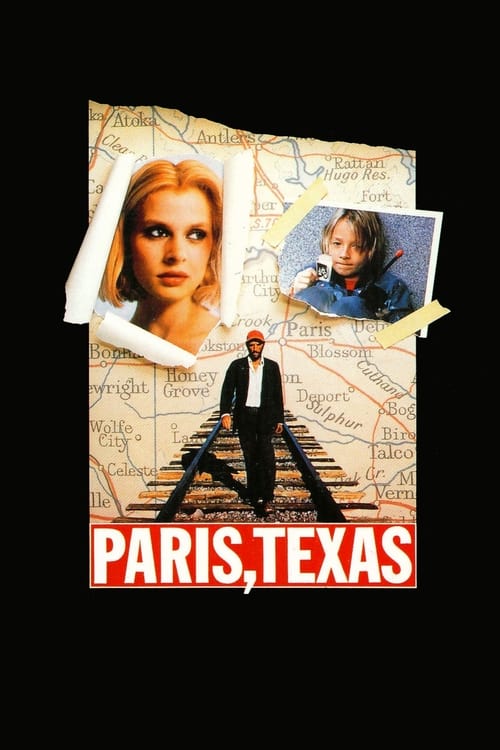
Paris, Texas
1984 · Wim Wenders
For when you want a film to break your heart gently — a contemplative evening, patient viewing, and probably a good cry about love, regret, and the people we fail.
What it's about
A gaunt, silent man walks out of the Texas desert with no memory and no explanation, four years after abandoning his wife and young son. His brother retrieves him, and as language and memory slowly return, the man sets out on a road trip to face the family he walked away from and understand why he left.
The experience
Slow, spacious, and quietly devastating — long stretches of neon, highway, and silence that lull you before the emotional core opens up and knocks the wind out of you. It's tender rather than bleak, but it sits with you for days.
Performances
Harry Dean Stanton, a lifelong character actor finally given a lead, carries the first half almost wordlessly and makes a broken man's silence eloquent; Nastassja Kinski turns a single late scene into one of the most affecting stretches of acting of the decade.
The craft
Robby Müller's cinematography turns the American Southwest into a dream of green neon, red dusk, and endless horizontal space — it's one of the most beautiful-looking films of the 1980s and begs for the biggest screen you can find. Ry Cooder's slide-guitar score is inseparable from it, a lonesome sound that has been imitated ever since. Sam Shepard's script saves its words, then spends them all in one unforgettable conversation.
Why it matters
It won the Palme d'Or at Cannes in 1984 and stands as the definitive European gaze on America — a touchstone for road movies, indie filmmakers, and anyone who's tried to film loneliness in a landscape.
Snapshot
A man emerges from the Texan desert mute and amnesiac, is retrieved by his estranged brother, slowly recovers language and memory, drives to Houston to find the wife he abandoned four years earlier, and delivers her back to the son she has never stopped loving — before disappearing again. Paris, Texas is simultaneously the purest and most emotionally exposed film of Wim Wenders's career: a road movie that ends not with movement but with stillness, a drama of reunion that culminates in the recovery of loss rather than its repair. Winner of the Palme d'Or at Cannes in 1984, it remains the definitive statement of the European art-cinema fascination with America — not the America of spectacle and abundance, but of horizontal space, neon vacancy, and the wreckage of private mythology.
Industry & production
Paris, Texas was produced through Wenders's own company, Road Movies Filmproduktion (West Germany), in co-production with Argos Films (France) and with participation from Channel 4 Films (UK) — the kind of multinational European art-cinema financing structure that had become the dominant funding model for ambitious non-commercial work by the early 1980s. German public broadcasters and European co-production frameworks had underwritten New German Cinema throughout the 1970s; Paris, Texas represents a mature, internationally legible form of that system, oriented not toward the domestic German market but toward the global festival circuit and art-house distribution.
The film arrived after a bruising experience for Wenders: his Hollywood attempt, Hammett (1982), produced by Francis Ford Coppola's Zoetrope Studios, had been subject to extensive studio interference and reshoots, and was a troubled, largely unsatisfying work by Wenders's own account. Paris, Texas was a conscious return to the conditions — European money, auteur control, American locations — that had produced his road trilogy of the mid-1970s. The budget was modest; exact figures are not well documented in the public record, but it was unmistakably a low-overhead production built around landscape, performance, and a skeleton crew.
Technology
Paris, Texas was shot in the anamorphic widescreen format using Panavision lenses and 35mm negative, yielding an aspect ratio of approximately 2.39:1. This choice was not incidental. The extreme horizontal frame is load-bearing: it makes the West Texas terrain — caliche flats, motel strips, highway interchanges — feel both vast and imprisoning simultaneously, and in the peepshow sequence it places two faces in adjacent halves of a single image that a narrower frame could not have held. Cinematographer Robby Müller relied heavily on practical and natural light sources, resisting fill that would soften the hard, flat luminosity of the desert sun or the garishly colored interiors of roadside America. The visual grammar is observational rather than expressionist: light is found, not manufactured.
Technique
Cinematography
Robby Müller's work on Paris, Texas is among the canonical achievements of 1980s cinematography. Müller had been Wenders's regular collaborator since Alice in the Cities (1974), and he brought to the American Southwest the same economy of means and sensitivity to available light that had characterized their German road pictures. His desert sequences favor long focal lengths that compress the landscape, rendering Travis a small figure absorbed into the immensity of the terrain — a visual strategy that establishes his psychological condition before a word of exposition has been offered. Interiors are rendered with a corresponding attention to the quality of existing light sources: the pink and blue glow of neon, the sickly fluorescence of institutional spaces, the warm domestic incandescence of Walt's Los Angeles house. The peepshow sequence is the film's technical and dramatic peak: a one-way mirror separates Travis from Jane in adjacent booths, and Müller stages the exchange so that the audience's alignment with each character shifts as the lighting conditions change — when Travis darkens his side of the glass, Jane suddenly sees him reflected, and the asymmetry of vision that has structured the entire film collapses into mutual exposure.
Editing
Peter Przygodda, Wenders's editor across much of his 1970s and 1980s work, assembled Paris, Texas with a patience calibrated to the film's emotional rhythm rather than to narrative urgency. The early sequences of Travis's wordless retrieval from the desert are cut to allow behavior to accumulate rather than to compress it; scenes run past their obvious end points, letting silence and inactivity carry weight. Przygodda's pacing is not the slow cinema of deliberate duration for its own sake — it is rather a form of fidelity to the way shock, grief, and reawakening actually move through a person's body. The transitions between the Texan and Californian sections, and later between Los Angeles and Houston, use Ry Cooder's score as a structural anchor, allowing the landscape sequences to breathe across the cut.
Mise-en-scène / staging
Wenders's staging consistently works through contrast of scale and enclosure. The film's first and last images place Travis in open, inhospitable exterior space; its emotional climaxes take place in small, enclosed volumes — the motel room where Travis and Hunter share a bed and begin to reconnect, the phone booth in which Travis composes his fragmented declaration to Jane, above all the peepshow booths themselves. These boxes within boxes — booth, mirror, glass partition, the rectangular frame of the image — produce a spatial logic of containment that speaks directly to the film's themes of men who build walls around themselves and then find they cannot get out. Wenders stages the peepshow scene across two setups that never share the screen simultaneously until the mirror turns Travis's reflection back on himself: a precision of blocking that has been widely analyzed in film studies literature as a condensed metaphor for failed communication and the problematics of the male gaze.
Sound
The sonic texture of Paris, Texas is spare in the extreme. Dialogue in the first half-hour is nearly absent; the ambient sound of highway, wind, and harsh environments is mixed high, so that the world's indifference to Travis registers as acoustic fact. Ry Cooder's score — built on slide guitar figures of lamentation and drift — enters and withdraws like a weather system, and is at its most present during the transitional landscape sequences that serve as punctuation between dramatic units. The decision to use a solo slide guitar rather than a conventional orchestral score gave the film a specifically American sonic identity — Delta blues filtered through the Southwest — that anchors its emotional register in a tradition of American vernacular music without ever becoming illustrative or sentimental.
Performance
Harry Dean Stanton had worked steadily in American film and television for three decades before Paris, Texas, typically in supporting roles; this was the film that disclosed the full range of what he was capable of. His performance in the early sections relies almost entirely on physical bearing — the walk, the eyes, the quality of stillness — to communicate a man who has returned from somewhere language cannot describe. When Travis begins to speak, and then eventually to talk at length, the accumulation of silence behind those words gives them an extraordinary weight. Nastassja Kinski, then at the height of her international visibility following Roman Polanski's Tess (1979) and Paul Schrader's Cat People (1982), gives a performance of considerable technical control in the peepshow sequence, delivering a character defined by what she withholds before the scene strips that control away. Dean Stockwell, as Walt, provides the film's emotional through-line — a warm, bewildered normality against which Travis's damage registers most clearly. Hunter Carson, son of co-writer L.M. Kit Carson, plays Hunter with an unforced naturalness that the scene between him and Stanton in the motel particularly demands.
Narrative & dramatic mode
Paris, Texas is structured as a recovery narrative that withholds its own premise: we come to understand what Travis lost only as he himself recovers the memory of having lost it. The narrative withholds exposition the way Travis withholds speech — both are protections that gradually fail. Wenders and Shepard organize the film in three geographical movements (desert/Texas, Los Angeles, Houston) corresponding to three psychological phases (amnesia, reorientation, reckoning), and the dramatic mode is essentially elegiac: the film earns no happy resolutions, only moments of honesty delivered at great cost and too late for them to repair what they diagnose. The ending — Travis driving away from a parking garage while Hunter and Jane are reunited below — is one of the 1980s' most carefully refused consolations.
Genre & cycle
Paris, Texas inhabits and revises the American road movie, a form that Wenders had already anatomized in Alice in the Cities and Kings of the Road. The genre's conventional movement — toward freedom, self-discovery, open possibility — is here routed through its opposite: the road leads not away from obligation but back toward it, and the film's emotional logic insists that the wanderer's journey is a failure mode, not a liberation. The film is also legible within the tradition of the domestic melodrama, specifically the 1950s American family-in-crisis cycle associated with directors like Douglas Sirk and Nicholas Ray, whose influence on New German Cinema is well established. Wenders refracts that melodrama through an art-cinema distance that prevents identification from becoming manipulation: we understand the anguish without being given a score that instructs us how to feel about it.
Authorship & method
Wenders developed the screenplay with Sam Shepard, the Pulitzer Prize-winning American playwright whose "family trilogy" — Buried Child (1978), True West (1980), Curse of the Starving Class — had established him as the defining chronicler of American domestic mythology and masculine failure. The script underwent revision with L.M. Kit Carson, and screen credit was shared. Shepard's thematic fingerprints are everywhere: the absent father, the mythologized West, the violence buried in ordinary American self-presentation, the difficulty men have naming their own interior states. Wenders brought to this material his characteristic visual patience, his foreigner's analytical distance from American iconography, and his sustained collaboration with Robby Müller, whose eye had been trained on exactly this kind of found-landscape work for a decade. Ry Cooder's score completes the creative triangle: three figures — German director, American playwright, American musician — each bringing a distinct tradition of engagement with the American vernacular.
Movement / national cinema
Wenders is a central figure of New German Cinema, the movement that transformed West German film in the late 1960s and 1970s alongside Rainer Werner Fassbinder, Werner Herzog, Volker Schlöndorff, and others. That movement was institutionally enabled by German public television funding (ZDF, WDR), regional film subsidy programs, and the cultural logic established by the Oberhausen Manifesto (1962). By 1984, however, with Fassbinder dead (1982) and the movement's internal coherence fragmenting, Paris, Texas represented a post-national inflection of its sensibility: a German film about America, financed across three European countries, whose subject is precisely the impossibility of simply belonging to the landscape you inhabit. Wenders's American period — from Alice in the Cities through Paris, Texas — can be read as a sustained inquiry into what it means to film a foreign country from inside the mythology that country has exported to you.
Era / period
The film belongs to the first half of the 1980s art-cinema moment: post-New Hollywood, post-New German Cinema's heroic phase, and coincident with the consolidation of the international festival circuit as the primary distribution mechanism for serious non-English-language filmmaking. It is also situated at a specific moment in American cultural history — the Reagan era — when the mythologies of the frontier and the American family were being aggressively reasserted at a political level. Wenders offers no direct political commentary, but the film's ruined family, its desolate spaces, and its insistence on the costs of masculine escapism register as a quiet counter-image to the period's official optimism.
Themes
The film's central preoccupations are communication and its failure — specifically, the failure of men to speak truthfully to the people they love until the damage is irreversible. Absence as a form of violence; the American landscape as a mirror for psychological desolation; the myth of the solitary wanderer examined and found to be a wound dressed up as freedom; the economics of looking (the peepshow as a pay-per-minute structure for emotional contact that is nonetheless real); fatherhood as an obligation that survives the abandonment of it; and the way memory, when it returns, brings not relief but the full weight of what was done with it.
Reception, canon & influence
Critical reception. Paris, Texas won the Palme d'Or at Cannes 1984, where it was greeted as a major work. Critical consensus formed quickly around it as Wenders's finest achievement: the combination of Müller's cinematography, Cooder's score, and Stanton's performance was recognized as exceptional on release, and the film's reputation has not diminished. It is regularly cited in critical surveys and ranked among the significant films of the 1980s.
Influences on the film (backward). The debts are specific and layered. Formally, Wenders draws on the wide-open compositional logic of the classical Hollywood Western — particularly the Monument Valley films of John Ford — repurposing the mythic American landscape as a space of psychological rather than heroic drama. The paintings of Edward Hopper inform Müller's sense of American light and the isolation of figures in commercial spaces (motels, diners, interiors at night). Sam Shepard's dramatic precedents — especially the spatial and familial claustrophobia of Buried Child and True West — provide the screenplay's structural grammar. Nicholas Ray's cinema, beloved by the Cahiers generation and by Wenders specifically, contributes the melodramatic undertow and the interest in male failure within the American domestic sphere.
Legacy (forward). Paris, Texas has had a diffuse but measurable influence on subsequent filmmaking. Its model of the minimalist, landscape-driven road movie with a focus on masculine damage and withheld speech can be traced in the work of directors including Jim Jarmusch (who worked with Müller on Down by Law and Mystery Train), Todd Haynes, and Kelly Reichardt, among others. The peepshow sequence in particular has become a set-piece reference point in discussions of film technique, screen acting, and the staging of emotional disclosure. Ry Cooder's score established a template for the use of American roots music in art cinema that has been widely imitated. More broadly, the film's success helped consolidate the international art-house distribution infrastructure that would underwrite the next generation of European and world cinema throughout the late 1980s and 1990s.
A Deleuzian reading
A man walks out of the desert in a red cap and a dirty suit, drinks the last of a saloon's ice water, and keeps walking until he drops.
The full Deleuzian reading of Paris, Texas →
Reception
It won the Palme d'Or at Cannes in 1984 and was embraced in Europe, while its American release was modest and some US critics bristled at a German's melancholy take on their own West. Four decades on it's fully canonized — routinely called Wenders' masterpiece and one of the defining films of the 1980s.
How Paris, Texas was received, from release to now →
Influences: the films it descends from and the films it influenced
- Alice in the Cities (1974) — Robby Müller's first road-film collaboration with Wenders, establishing the available-light, long-lens observational cinematography and displaced man-and-child journey structure that Paris, Texas would crystallize a decade later in 35mm anamorphic widescreen.
- Kings of the Road (1976) — Peter Przygodda's extended-duration editing and Wenders's staging of masculine stasis along a highway corridor — scenes running past their obvious endpoints, movement as evasion rather than progress — set the emotional grammar Paris, Texas inherits and deepens.
- Written on the Wind (1956) — Sirk's deployment of domestic architecture, saturated color, and framing composition to externalize psychological states characters cannot speak aloud; the melodrama grammar Paris, Texas learns from and then strips of its artifice.
- Fear Eats the Soul (1974) — Fassbinder's direct transposition of Sirkian melodrama into New German Cinema's contemporary domestic space — staging emotional repression through doorways, thresholds, and enclosing interiors — is the immediate European template for Wenders's American version.
- Zabriskie Point (1970) — Antonioni used anamorphic widescreen to render the American Southwest desert as a screen for alienated European interiority, the direct spatial precedent for Wenders's strategy of dwarfing figures inside the horizontal frame of the terrain.
- Two-Lane Blacktop (1971) — Road-movie subversion in which driving expresses existential suspension rather than forward momentum; character backstory is withheld and destination refused — the closest American antecedent to Paris, Texas's anti-arrival narrative logic.
- The Passenger (1975) — Extended-duration takes in which ambient sound dominates over dialogue intelligibility, and a man erasing his identity through horizontal movement before ending in physical enclosure; the pacing and existential grammar Paris, Texas directly inherits.
- Stroszek (1977) — Wenders returns to the Stroszek configuration with a larger budget: a German director deploying Robby Müller's available-light wide-angle photography to critique the American Dream, with Ry Cooder's slide guitar as diegetic folk counterpoint and a male protagonist whose psychological and geographic dislocation are structurally inseparable.
- La Notte (1961) — Wenders translates Antonioni's widescreen-composition-as-estrangement grammar — the human figure isolated and dwarfed by architectural and geographic space, dialogue that fails to bridge emotional distance — from the Italian economic miracle's desolate urban periphery into the American Southwest's abandoned motels and highways.
- Journey to Italy (1954) — Reunites an estranged couple across a vast landscape rendered through traveling shots, the terrain functioning as interlocutor and the reconciliation arriving as an unearned grace — Rossellini's road-movie-of-estrangement transposed to America.
- The American Friend (1977) — The Wenders–Müller partnership cemented here reaches full maturity, carrying forward the expressive-yet-naturalistic color and frames-within-frames into the American landscape.
- Il Grido (1957) — Opens on a mute man walking out of an emptied landscape, using terrain and silence to carry an incommunicable interior — Antonioni's drifter transposed to the desert.
- Down by Law (1986) — Robby Müller's cinematography again, with ambient sound design foregrounded over dialogue, a three-movement structure through American landscapes, and performance built on physical stillness — the road-as-entrapment grammar carried forward into black-and-white.
- Bagdad Cafe (1987) — A West German director uses the American Mojave Desert as an emotional landscape in the same neon-vacancy visual register, with the same sense of displaced Europeans finding provisional human connection inside American nowhere spaces.
- Lost in Translation (2003) — Lance Acord's long-focal-length compression isolating figures inside vast urban environments, ambient sound design foregrounded over dialogue, extended-duration scenes trusting physical stillness, and withheld exposition governing the emotional content of the central relationship.
- Old Joy (2006) — Peter Sillen's anamorphic widescreen cinematography, ambient sound consistently foregrounded over dialogue, extended-duration pacing in which scenes run past their narrative endpoints, and a road structure built entirely around masculine emotional withholding.
- Wendy and Lucy (2008) — Available-light cinematography, Michelle Williams's performance mode of physical stillness carrying what language cannot articulate, withheld backstory, ambient sound design, and a displacement structure in which movement leads back to dispossession rather than destination.
- Breaking the Waves (1996) — Robby Müller's specific cinematographic grammar here—available-light desaturation, telephoto zoom compression that isolates figures against blurring backgrounds, location shooting in harsh natural light—is the visual language Müller carries directly into Breaking the Waves; the collaboration is continuous across the decade.
- Dancer in the Dark (2000) — Showcases cinematographer Robby Müller's textural method — naturalistic available light, emotional use of color temperature — the same hand that supplies Dancer's drama-section visual identity.
- The End of Violence (1997) — Codifies Wenders' Hopper-derived painterly eye for American space — saturated, becalmed compositions of roadside and neon — that returns as the nocturnal LA cityscape here.
- The Station Agent (2003) — The solitary man read against a flat American landscape, shot in available-light naturalism with the figure dwarfed by the horizon, is the Wenders/Müller compositional grammar Bokelberg adapts to a walking train-tracker.
- What's Eating Gilbert Grape (1993) — The near-mute, recessive wandering lead and the dead-end American flatland rendered as emotional geography rather than scenery.
- Chocolat (1988) — Denis served as first assistant director, absorbing Wenders's landscape-horizon framing and the patient held long take that lets a static figure-in-terrain shot accrue meaning over duration — the visual grammar she gives the African plain in Chocolat.
- Mystery Train (1989) — Robby Müller's saturated neon-and-roadside palette and the foreigner-adrift-in-mythic-America gaze carry directly into Mystery Train's Memphis as seen by strangers.
- Stranger Than Paradise (1984) — Robby Müller's available-light cinematography deployed simultaneously on a contemporaneous American art film, rendering the same neon vacancy and flat geography; both films treat masculine drift as a formal principle rather than a subject to be explained.
- Fool for Love (1985) — Sam Shepard adapts his own stage play, sharing the same dramatic DNA present in Paris, Texas — men who mythologize their absences, domestic entrapment staged as spatial enclosure, performance built on withheld information and conspicuous physical stillness.
- Wings of Desire (1987) — Wenders extends the same anamorphic widescreen enclosure-vs-open-space staging to a divided city, with Przygodda editing and extended-duration pacing; the film continues the emotional grammar of Paris, Texas with a figure watching human connection from outside it.
- The Brown Bunny (2003) — Extreme extended-duration road sequences shot windshield-POV in real time, available-light cinematography, physical stillness as the primary performance mode, and a withheld trauma that retroactively structures the entire film — the American anti-road-movie premise taken to its logical extreme.
- Faraway, So Close! (1993) — Sibling: establishes Wenders's elegiac road-movie restlessness and the use of an American pop/rock score (Ry Cooder there, U2 here) as emotional connective tissue over wandering, searching characters.
- Sling Blade (1996) — Ry Cooder's spare slide-guitar score replaces orchestral cueing with atmospheric regional mood, paired with a near-mute returning protagonist — the template for Lanois's ambient soundtrack and Karl's laconic affect.
- Perfect Days (2023) — With Robby Müller, Wenders builds a near-silent protagonist whose interior life is read through gesture and landscape rather than speech — the wordless-acting template reused for Hirayama.
- The Straight Story (1999) — Slow humane traversal of the American interior toward familial reconciliation, roots-music score and unhurried cutting privileging silence over incident.
- Repo Man (1984) — Müller's same-year, sun-bleached flat-daylight palette of the American Southwest is the prestige counterpart to the identical lighting language he lends Repo Man's L.A.
Similar films
- Stranger Than Paradise (1984) — influence & lineage
- Alice in the Cities (1974) — influence & lineage
- Two-Lane Blacktop (1971) — influence & lineage
- Wings of Desire (1987) — influence & lineage
- The Man Without a Past (2002) — same viewing thread
- My Own Private Idaho (1991) — shared sensibility
- No Country for Old Men (2007) — shared sensibility
- Before Sunset (2004) — shared sensibility
All the films related to Paris, Texas →
Watch it with: curated runs of related films
- Quiet Lives at the World's Edge — Watch these when you want a life pared down to essentials — someone walking out of society to start from zero, or simply living out their days at the margins.
Film essays and courses that include it
- The Rubble and the Road: New German Cinema 1972–1984
- The Difficult Love: How Cinema Learned to See Inside the Family
- The Weight of Absence: Cinema's Grammar of Grief
- Sand and Silence: A Century of Desert Cinema
- The Ones Who Stay to Watch: A Course in the Cinema of the Seer
- The Glass Between Us
- The Children of the Rubble
- The Freedom That Leads Nowhere
- The Space That Forgot What It Was For
- Alone in the Crowd