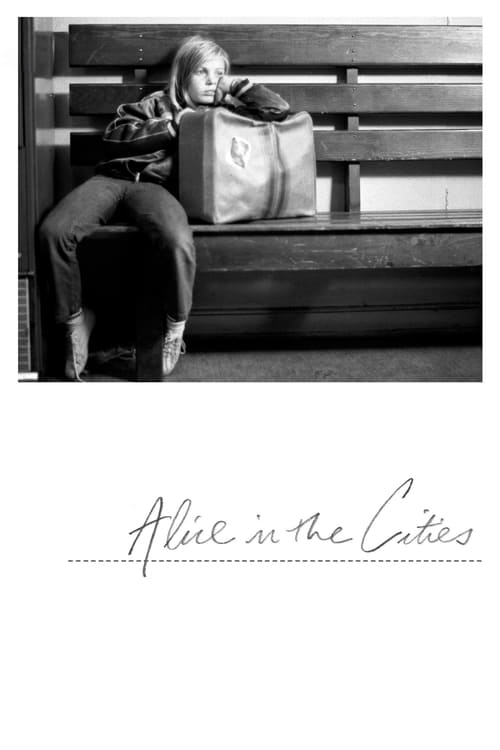
Alice in the Cities
1974 · Wim Wenders
For a contemplative evening when you want tenderness without sentimentality — a film to sink into rather than be gripped by. Perfect when you're feeling a bit unmoored yourself.
What it's about
Philip Winter, a German journalist adrift in America, can't write the article he was sent for — he just takes Polaroids of things that never look like what he saw. Trying to fly home, he gets entangled with a woman and her nine-year-old daughter Alice, and when the mother disappears, he's left minding the girl. The two of them drift through Germany searching for a grandmother's house they know only from a faded photograph.
The experience
Gentle, wry, and quietly moving — almost nothing 'happens,' and yet you find yourself completely inside it. It has the loose, observant rhythm of a long drive with someone you're slowly coming to love.
Performances
Rüdiger Vogler's rumpled, half-checked-out Winter and young Yella Rottländer's frank, unimpressed Alice make one of cinema's great mismatched pairs — her utter naturalness keeps the film honest.
The craft
Robby Müller's grainy black-and-white 16mm photography turns gas stations, trains, and jukeboxes into something luminous, and Wim Wenders lets scenes breathe at the pace of real looking. It's a film about images — Polaroids, TV static, snapshots — that is itself gorgeous to look at.
Why it matters
The first panel of Wenders's road-movie trilogy and a foundational work of New German Cinema, it established the wandering, image-haunted sensibility that would carry him to Paris, Texas and beyond.
Snapshot
Alice in the Cities (Alice in den Städten) is the film in which Wim Wenders found the voice that would define him: the alienated wanderer, the camera as a way of doubting the world, the road as both escape and trap. A German journalist named Philip Winter, paralyzed by writer's block while reporting on the United States, drifts home to Germany saddled with a nine-year-old girl, Alice, whose mother has vanished. Their search for the grandmother's house — guided only by a single faded photograph — becomes a quiet, accidental love story between a man who has lost the ability to see and a child who restores it to him. Shot in grainy black-and-white 16mm by Robby Müller, the film is the first panel of Wenders's loose "Road Movie Trilogy," and one of the foundational works of New German Cinema. It is modest in incident and enormous in influence: a template for the contemplative road movie that runs forward through Jim Jarmusch, Sofia Coppola, and Kelly Reichardt.
Industry & production
The film was produced within the distinctly West German ecology of the early 1970s, in which public television money and a filmmakers' cooperative substituted for a collapsed commercial studio system. Alice in the Cities was made in association with Westdeutscher Rundfunk (WDR), the Cologne-based public broadcaster whose film commissioning was, alongside ZDF's, the financial bloodstream of the entire New German Cinema. Distribution ran through Filmverlag der Autoren, the Munich author-distributor collective founded in 1971 by Wenders and a group of peers precisely to give young directors a channel outside the major distributors.
This funding model shaped the film's aesthetic as much as its economics. Television financing favored small crews, location shooting, 16mm stock, and the intimate scale of a two-hander; it tolerated — even encouraged — the unhurried, essayistic register that commercial cinema would not have underwritten. The production was lean and largely improvisatory, built around a small repertory of Wenders's regular collaborators rather than a conventional industrial unit. Precise budget and box-office figures for the film are not part of the well-documented public record, and I will not invent them; what is clear is that it was made cheaply, on the margins, in the manner of nearly all the early New German features.
Technology
Two technologies sit at the literal and thematic center of the film. The first is the 16mm format itself and its high-contrast black-and-white photography, which gives the American and German landscapes a documentary, almost reportorial grain — appropriate to a protagonist who is, after all, a journalist.
The second is the Polaroid instant camera, which functions as the film's controlling metaphor. Philip wanders America compulsively shooting Polaroids, and in an early, much-discussed moment he complains that the photographs never show what he actually saw — the instant image fails to capture the experience, a gap between representation and reality that is the film's deepest preoccupation. Wenders, who had trained partly as a painter and engraver, was fascinated by the Polaroid's strange ontology: a self-developing object that promises immediacy yet delivers only a deficient souvenir. The film thus stages, in 1974, an early and remarkably prescient meditation on image saturation and the inadequacy of the photographic record — a theme Wenders would return to throughout his career and eventually make explicit in his own Polaroid memoir decades later. American television is the third technological motif: Philip, alone in a motel, watches a film interrupted by ads and angrily smashes or switches off the set, the broadcast image standing for the colonization of consciousness by American media.
Technique
Cinematography
Robby Müller's photography is the film's glory and the beginning of one of the great director-cinematographer partnerships in postwar cinema. Working in black-and-white, Müller favors long takes, available light, and a watchful, slightly detached camera that observes characters within deep, often desolate environments — American highway strips, the elevated suspension railway (the Schwebebahn) of Wuppertal, the anonymous high-rises of the industrial Ruhr. The framing is patient and architectural; people are frequently small against landscapes, windows, and reflective surfaces. Müller's gift here, as in his later work for Wenders, Jarmusch, and Lars von Trier, is for a kind of lyrical neutrality — images that are composed yet never insistent, that let the viewer look rather than directing the look. The grainy monochrome lends the whole a documentary melancholy that is inseparable from the film's meaning.
Editing
Peter Przygodda, Wenders's long-term editor, cuts to the rhythm of duration rather than incident. The film's tempo is deliberately slack and wandering, mirroring the aimlessness of its road structure; scenes are allowed to run to their natural exhaustion, transitions are unhurried, and the cumulative effect is of real, lived time passing. This refusal of conventional dramatic compression is itself a statement — the editing enacts the film's belief that meaning accrues in the in-between moments rather than in plot points.
Mise-en-scène / staging
The staging is documentary and undecorated. Wenders shoots in real motels, airports, diners, trains, and streets, and stages action loosely within them, often in wide shots that preserve the integrity of the space. The recurring visual environments — terminals, highways, hotel rooms, the liminal architecture of transit — externalize the characters' rootlessness. The Wuppertal Schwebebahn, gliding above the river, is the film's most indelible image of suspension: motion without arrival.
Sound
The soundtrack pointedly juxtaposes American rock with the German setting, dramatizing the cultural occupation the film diagnoses. The German experimental rock band Can contributed music, and the film famously incorporates a Chuck Berry concert that Philip and Alice attend — a sequence that grounds the soundtrack in the live, physical presence of American popular culture on European soil. (Canned Heat's "On the Road Again" is also associated with the film's road-movie texture.) Ambient sound — traffic, rails, airports, television — is given full weight, sustaining the documentary realism.
Performance
Rüdiger Vogler, as Philip Winter, became Wenders's on-screen alter ego across the trilogy; his performance is interiorized, weary, faintly comic in its passivity, a man watching his own disengagement. The revelation is Yella Rottländer as Alice, whose unsentimental, sometimes prickly naturalism keeps the film clear of whimsy — she is a real, difficult child, not a screenwriter's moppet. Lisa Kreuzer plays the mother, Lisa. The chemistry between the adult and the child, built on genuine irritation as much as affection, is what makes the film's emotional arc credible.
Narrative & dramatic mode
The film operates in a minor, anti-dramatic key. Its mode is the picaresque drift — a sequence of encounters and waystations rather than a tightly plotted causal chain. The nominal quest (find the grandmother's house from a photograph with no address) is almost comically thin, and Wenders knows it; the search matters less than the relationship it forces into being. The dramaturgy withholds the conventional satisfactions of resolution, motivation, and climax in favor of mood, observation, and the slow thaw of a man re-learning to attend to the world through the demands of a child. Crucially, the ending refuses closure: the film closes on a train, in motion, the journey unfinished — and a newspaper in the final stretch carries word of the death of John Ford, the great American director of journeys, a gesture of homage and mourning folded into the open ending. (Ford had died in 1973, during the film's gestation.)
Genre & cycle
Alice in the Cities is a road movie, but it deliberately Europeanizes a quintessentially American form. Where the American road movie of the era (Easy Rider, Two-Lane Blacktop — the latter a Wenders touchstone) tends toward myth, speed, and violent fatalism, Wenders slows the genre down, empties it of action, and turns it into a vehicle for reflection on displacement and the image. It is the first of his "Road Movie Trilogy" — followed by Wrong Move (1975, scripted by Peter Handke) and Kings of the Road (1976) — three films unified by Vogler's wandering protagonists and the theme of men in motion across a haunted Germany. The film also sits within a small cycle of 1973–74 features about adults and surrogate children on the road; Wenders himself acknowledged the unsettling resemblance to Peter Bogdanovich's Paper Moon (1973), which he reportedly saw with dismay during production, fearing he had been anticipated.
Authorship & method
The film is the pivotal early statement of Wenders's authorship — the moment his recurring obsessions cohered: the journey without destination, the crisis of the image, the ambivalent love of America, the man unable to feel until a relationship obliges him to. His method here is improvisatory and intuitive: he has often described shooting without a finished script, letting the route and the locations generate the story, discovering the film in the making. This openness to chance is the practical correlate of the film's philosophy of attention.
The authorship is profoundly collaborative, and the collaborators are the people who would build Wenders's body of work. Robby Müller (cinematography) defined the look. Peter Przygodda (editing) defined the rhythm. The screenplay is credited to Wenders with Veith von Fürstenberg. Rüdiger Vogler became the recurring face of the Wenders protagonist. Standing behind the whole sensibility is the writer Peter Handke, Wenders's close artistic interlocutor (they had collaborated on The Goalkeeper's Fear of the Penalty, 1972), whose literature of alienated perception is everywhere in the film's DNA even though Handke is not its credited writer.
Movement / national cinema
The film is a cornerstone of New German Cinema (Neuer Deutscher Film), the wave of young directors — Fassbinder, Herzog, Schlöndorff, Kluge, von Trotta, and Wenders among them — who emerged in the wake of the 1962 Oberhausen Manifesto's declaration that "Papa's cinema is dead." Sustained by television money and the Filmverlag cooperative, this movement set itself the task of reckoning with the German present, including the long aftermath of fascism and the postwar reconstruction of identity. Wenders's particular contribution to the movement was to frame the German condition as one of cultural colonization — a country whose own images, music, and dreams had been supplied by America, a thesis the film states and that Wenders would later distill in Kings of the Road's famous line about the Americans having "colonized our subconscious."
Era / period
Made in 1974, the film is steeped in the texture of its moment: the post-1968 disillusionment, the early-1970s sense of cultural exhaustion, the saturation of European life by American media in the decades after the war. The Germany Philip returns to is the Wirtschaftswunder's gray hinterland — the Ruhr's industrial sprawl, anonymous apartment blocks, the worn modernity of a country that has rebuilt itself materially while remaining unsure of who it is. The film's America, conversely, is the roadside-commercial America of motels and gas stations and television, glimpsed by a European who finds it both seductive and hollow.
Themes
The film's governing theme is the crisis of seeing — the failure of images (Polaroids, television, the journalist's words) to deliver the reality they promise, and the corresponding difficulty of genuine perception in a mediated world. Bound to this is alienation and writer's block as a spiritual condition: Philip cannot write because he cannot feel, and cannot feel because he can no longer truly look. Displacement and rootlessness pervade the film — characters in perpetual transit, at home nowhere. American cultural imperialism runs throughout, the German soul furnished with borrowed dreams. And against all this, the film proposes a fragile redemption through human connection and care: the child Alice, by needing him, forces Philip out of his solipsism and back into attention, into the present, into a tentative capacity for love. The journey, finally, is less geographic than perceptual — a man learning to see again.
Reception, canon & influence
Alice in the Cities was warmly received and is now regarded as one of Wenders's finest films and a landmark of New German Cinema, often cited as the work in which he fully arrived as an artist. (I am not aware of well-documented box-office figures, and will not fabricate them; its impact was critical and historical rather than commercial.) It helped establish Wenders's international reputation in the years before his breakthroughs with Kings of the Road, The American Friend (1977), Paris, Texas (1984), and Wings of Desire (1987).
The influences on the film run backward to several sources: the American journey films of John Ford (mourned within the picture itself); the road-movie counterculture cinema of Monte Hellman and Dennis Hopper; the contemplative domestic humanism of Yasujirō Ozu, whom Wenders revered and would later honor in the documentary Tokyo-Ga (1985); and the alienated literary sensibility of Peter Handke. Bogdanovich's Paper Moon hovers as an uneasy near-twin.
The legacy forward is large. Alice in the Cities is a foundational text of the modern slow, observational road movie, and its DNA is visible in Jim Jarmusch (Stranger Than Paradise, Down by Law — both shot, tellingly, by Robby Müller), in the wandering, mood-driven cinema of figures like Aki Kaurismäki and Kelly Reichardt, and, in its story of an adult and a child drifting in mutual rescue, in films from Sofia Coppola's Lost in Translation (a kindred study of alienation and connection) onward. Within Wenders's own work it is the seed of everything: the man on the road, the doubted image, the love of and quarrel with America — themes that would flower a decade later, with another lost man and another reconstituted family, in Paris, Texas.
A Deleuzian reading
Start with the Polaroid.
The full Deleuzian reading of Alice in the Cities →
Reception
A modest arthouse item in 1974 — really only Wenders' breakthrough among German critics — it has steadily climbed ever since, and post-restoration (and the Criterion Road Trilogy box) it's now routinely called one of the greatest road movies and, by many, Wenders' finest film.
How Alice in the Cities was received, from release to now →
Influences: the films it descends from and the films it influenced
- The Searchers (1956) — Supplies the elegiac American-journey structure of a man defined by a home he cannot reach — a debt the film makes explicit by mourning Ford's death within its diegesis, inheriting Ford's framing of the wanderer against landscape as a moral condition rather than scenery.
- Tokyo Story (1953) — Models the contemplative humanism Wenders revered (and later honored in Tokyo-Ga): the patient, low, near-static observation of ordinary gesture and the use of 'dead time' between events as the real subject, which Wenders converts into duration-over-incident pacing.
- Two-Lane Blacktop (1971) — Establishes the existential American road movie of route-over-plot — non-professional inertness, engine-and-asphalt minimalism, and an open, unresolved ending — the picaresque-drift template Wenders Europeanizes.
- Easy Rider (1969) — Provides the countercultural model of location-driven, improvisatory shooting scored by juxtaposed American rock, where the soundtrack and the highway, not narrative, generate the film's meaning.
- Five Easy Pieces (1970) — Prototypes the New Hollywood drifter who cannot feel and flees every attachment, the alienated-male naturalism and class-restless wandering Wenders transposes onto Philip Winter.
- L'Avventura (1960) — Pioneers narrative drift as method — dead time, abandoned plot threads, figures dwarfed by architecture and emptied landscape — the formal license to let mood and place displace incident that underwrites Wenders's 'crisis of seeing.'
- The Goalkeeper's Fear of the Penalty (1972) — Wenders's own prior Handke collaboration that first installs the literature of alienated perception — the doubted, estranging image and the protagonist watching the world fail to cohere — with Robby Müller already shaping the look.
- Stromboli (1950) — Wenders cites Viaggio in Italia as the formal model for displaced figures traversing incomprehensible landscapes without resolution; the episodic phenomenological structure — place observed rather than dramatized, characters failing to inhabit their environments — descends directly from Rossellini's Bergman films.
- Paris, Texas (1984) — Flowers the same seed a decade on — a mute, unfeeling man reconstituting a family with a child — pushing Müller's love-quarrel with the American landscape and the redemptive/doubted photographic image to its fullest statement.
- Stranger Than Paradise (1984) — Carries the lineage forward through the same cinematographer, Robby Müller — black-and-white, available-light long takes and deadpan picaresque drift, America observed by displaced outsiders, with duration held past the point of conventional incident.
- Down by Law (1986) — Again shot by Müller in available-light black-and-white, extending the transit/escape drift and naturalistic, scene-by-scene improvisation, with rhythm and mood prioritized over plot mechanics.
- Ariel (1988) — Inherits the mood-driven working-class drift and economy of gesture, deploying the same American-rock-on-the-radio juxtaposition against bleak transit spaces to score a wordless emotional life.
- Lost in Translation (2003) — Rebuilds the central dyad — an adult and a much younger companion in mutual rescue amid alienating hotel-and-transit architecture — sustaining atmosphere and the crisis of connection over event, and closing on the same withheld, open ending.
- Wendy and Lucy (2008) — Extends the observational, duration-over-incident road film into American minimalism — available-light realism, documentary locations, and a refusal of plot resolution that leaves the drifter's journey deliberately unclosed.
- Central Station (1998) — The adult/lost-girl road pairing searching for an absent relative across an observed landscape, with documentary-flavored attention to passing places — structural blueprint for the surrogate-guardian journey.
- Stranger Than Paradise (1983) — The black-and-white transatlantic road movie with a European gaze on American emptiness is Wenders' template; he literally supplied Jarmusch the leftover film stock that seeded the project.
- One Million Yen Girl (2008) — The template for the episodic road picture built from arrivals and departures rather than plot, where landscape and transit substitute for exposition — Tanada borrows its drift-by-locale segmentation.
- C'mon C'mon (2021) — A reluctant adult guardian ferries a sharp young girl across a shifting geography in observational monochrome, with drama dissolved into wandering, undramatic transit.
- Foreign Land (1996) — Establishes the elliptical monochrome travelogue built from airports, hotels and thresholds, cutting on absence and departure — the transience-space grammar and threshold-framing Walter Carvalho adopts.
- Until the End of the World (1991) — Establishes the Wenders/Müller road-movie template Until the End of the World inflates to planetary scale — a drifting protagonist and the recurring Polaroid, which makes the recorded image itself the object of contemplation rather than a prop.
- Paper Moon (1973) — The uneasy near-twin: a black-and-white road film built on the same con of an adult and a sharp-tongued child thrown together, the dyad's reluctant tenderness becoming the engine the plot otherwise lacks.
- Kings of the Road (1976) — The immediate companion piece, reuniting the exact Vogler–Müller–Przygodda team for another black-and-white male road drift through German transit-architecture, extending the same improvisatory, route-generated shooting method.
- Tokyo-Ga (1985) — The essayistic pilgrimage that makes the film's buried Ozu debt explicit, foregrounding the crisis-of-the-image as overt subject and the camera as an instrument of attention.
- The Enigma of Kaspar Hauser (1974) — Wenders films a non-professional child lead in available-light long takes under an episodic travelogue structure and places pre-existing Chuck Berry recordings anachronistically against contemporary landscape footage, deploying the same pairing of observational photography and disjunctive scoring.
- Faraway, So Close! (1993) — Ancestor of method: the documentary instinct to let the real, unstaged world and real locations intrude on the fiction — the same impulse behind casting Gorbachev and Lou Reed as themselves here.
- The American Friend (1977) — The immediately prior Wenders–Müller collaboration that perfects the available-light shooting, frames-within-frames compositions, and road-movie ellipsis that The American Friend grafts onto a thriller plot.
- Perfect Days (2023) — Wenders' formative New German Cinema road film of patient observation and grainy 16mm texture — the slice-of-life, drift-and-watch grammar he later refines into ritual.
Similar films
- Paris, Texas (1984) — influence & lineage
- Lost in Translation (2003) — influence & lineage · same viewing thread
- Night on Earth (1991) — same viewing thread
- Before Sunrise (1995) — same viewing thread
- The American Friend (1977) — shared sensibility
- Wings of Desire (1987) — shared sensibility
- The Meetings of Anna (1978) — shared sensibility
- Alice (1988) — shared sensibility
All the films related to Alice in the Cities →
Watch it with: curated runs of related films
- Strangers Who Walk and Talk — Watch these back to back for the particular magic of two people, a city, and a few borrowed hours of talk that may not outlast the night.