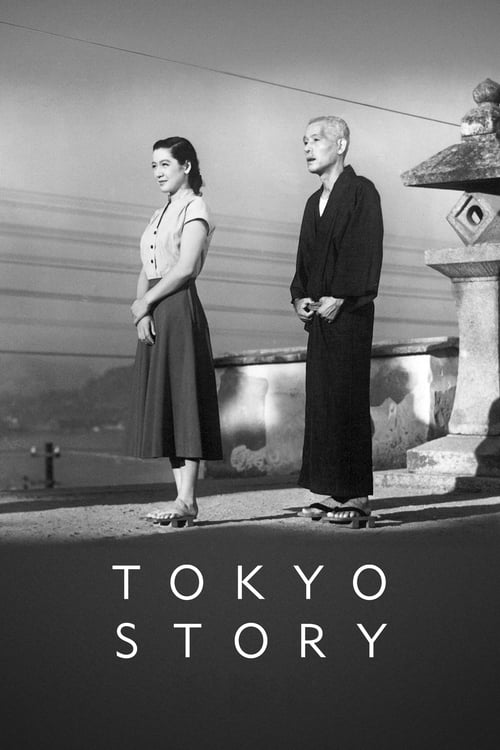
Tokyo Story
1953 · Yasujirō Ozu
For when you want a slow, contemplative film that earns real emotion — one to sit with in silence and think about for days, maybe with a call to your parents afterward. This is challenge-adjacent comfort: gentle on the surface, deep underneath.
What it's about
An elderly couple make the long trip from their small seaside town to Tokyo to visit their grown children — a busy doctor son and a brisk hairdresser daughter — only to find that the children can't quite make room for them. The one person who shows them real warmth is Noriko, the widow of their son killed in the war. Out of these small visits, polite evasions, and quiet kindnesses, the film builds a portrait of how families drift apart simply by living.
The experience
Calm, patient, and almost entirely without raised voices — and then, somewhere along the way, quietly devastating. It works by accumulation: nothing dramatic seems to happen, and yet by the end you feel the whole weight of time passing between parents and children.
Performances
Setsuko Hara's Noriko is legendary — a smile that carries grief, generosity, and loneliness all at once — and Chishū Ryū brings a heartbreaking mildness to the aging father.
The craft
Ozu's style is instantly recognizable: a low, still camera, carefully composed rooms, conversations played straight to the lens, and absolute refusal of melodrama. That formal restraint is exactly what makes the feeling land — the film trusts small gestures and silences to carry what other movies would score and underline.
Why it matters
Regularly ranked among the greatest films ever made and the defining work of Ozu's career, it became a touchstone for filmmakers around the world drawn to stillness, everyday life, and emotional understatement.
Snapshot
An elderly couple travel from their coastal hometown of Onomichi to Tokyo to visit their grown children. The children — a doctor and a hairdresser — find them an inconvenience. It is Noriko, the widow of their youngest son killed in the war, who shows them genuine warmth. On the return journey, the mother falls ill and dies. The father is left alone.
That is the plot. What the film does with it is among the most quietly devastating things in cinema. Tokyo Story renders the ordinary tragedy of time — children growing away from parents, parents becoming strangers to their children — with such formal precision and such complete absence of melodrama that the grief arrives almost as a surprise. The film is a cornerstone of world cinema and the defining achievement of Yasujirō Ozu's mature style.
Industry & production
Ozu made Tokyo Story at Shochiku's Ofuna studios, where he had worked since 1927. Shochiku cultivated the shomin-geki — domestic drama of everyday middle- and working-class life — as a house specialty, and Ozu was its supreme practitioner by the early 1950s. His unit operated with a high degree of autonomy and consistency: the same core collaborators, the same deliberate pre-production process, the same near-military precision on set.
The screenplay was co-written with Kōgo Noda, Ozu's writing partner on virtually every film from 1936 onward. The two retreated to an inn in Tateshina, a mountain resort in Nagano Prefecture, for their customary intensive drafting sessions. Ozu and Noda openly acknowledged that they had watched Leo McCarey's Make Way for Tomorrow (1937) and found it a generative model — an American film about adult children who cannot accommodate aging parents. Where McCarey pushed toward pathos and activist social critique, Ozu stripped the premise to something colder and more elliptical.
Specific production costs for the film are not publicly documented in sources available to Western scholarship, and box-office figures from the domestic release have not been reliably cited in the critical literature.
Technology
Tokyo Story was shot in standard 35mm black-and-white on orthochromatic-adjacent stock. There is no special-process cinematography and no location shooting in the contemporary sense: exterior scenes in Onomichi and Tokyo were captured on location, but the controlled interior work — the tatami rooms, the hairdressing salon, the clinic — was done on stage at Ofuna.
The film predates the widescreen revolution that would transform Japanese studio production by the mid-1950s. Its 1.37:1 Academy ratio is the format Ozu used throughout his career until Equinox Flower (1958), his first color film. The squarish frame is inseparable from the compositional logic of the tatami-level camera: it centers figures, isolates them, gives negative space an almost architectural weight.
Technique
Cinematography
Yūharu Atsuta served as director of photography, as he did on most of Ozu's sound-era films from Late Spring (1949) onward. The signature that defines Ozu's visual world — a camera mounted roughly 50 centimeters from the floor, approximating the sightline of a person seated on tatami — reaches its fullest integration here. The position is not naturalistically justified; it is a formal axiom. Everyone in Tokyo Story is seen at this level, whether they are standing, seated, or lying down. The effect is a strange equality of address and a slight elevation of the ordinary into the ceremonial.
Atsuta's lighting is soft and largely frontal. Deep shadow is avoided. Characters are rendered in even, uninsistent light that resists expressionistic coding — nobody's face darkens to signal villainy or glows to suggest virtue. The camera is almost invariably static. Panning and tracking shots are extremely rare in Ozu's mature work; those that appear in Tokyo Story — slight lateral moves following movement on trains — register as exceptions that prove the rule.
Editing
Ozu's editing system violates the 180-degree rule as a matter of principle. Eyeline matches cut across the axis; reverse-angle shots face the wrong direction by conventional continuity standards. The effect is a space that cannot be mapped onto a floor plan — an intimate, slightly disorienting geometry that keeps the viewer hovering just outside the social world they are observing.
Between scenes and sequences, Ozu inserts what scholars have variously called "pillow shots" (a term introduced by Noël Burch) or "still-life shots": brief, static images of objects, rooftops, laundry on a line, chimneys, a Coca-Cola sign. These shots have no narrative function. They do not establish geography or advance cause-and-effect. They suspend the drama, introduce something close to meditation, and accumulate into a texture of ordinary life that gives the human scenes their weight. David Bordwell's Ozu and the Poetics of Cinema (1988) provides the most rigorous formal analysis of this editing system.
Mise-en-scène / staging
Actors are positioned with extreme care relative to the camera and to each other. Ozu frequently stages conversations not as over-the-shoulder exchanges but as sequential single-shots, each character speaking toward the camera — a theatrical, almost Nō-derived staging that has the effect of turning dialogue into something like alternating soliloquies. Characters are often in the foreground with architectural or domestic detail precisely arranged behind them.
Props and household objects are given equivalent compositional attention. A bottle of Sapporo beer, a teapot, a clock on a shelf — these are not background dressing but active elements of the frame. The Atami resort sequence, in which the children dispatch the parents to a crowded, noisy tourist hotel to be rid of them, is staged with deliberate contrast to the domestic interiors: bustle and disorientation replacing stillness.
Sound
The score was composed by Takanobu Saitō, Ozu's composer across his postwar features. It is spare to the point of near-silence in many sequences. Where music appears, it tends toward a gentle, slightly melancholic register — strings and piano that never dramatize what the images understate. Ozu resisted underscoring emotional peaks; the most devastating scenes in Tokyo Story often carry no music at all.
Ambient sound — street noise, train sounds, birdsong in Onomichi — is used with documentary attention. The soundscape of Tokyo (louder, more mechanical, less ordered) is implicitly contrasted with that of the coast without the film announcing the contrast editorially.
Performance
Chishū Ryū, Ozu's great recurring actor across nearly forty years, plays Shukichi with a stillness that refuses both self-pity and sentimentality. Ryū's performance technique — minimal gesture, slow movement, a face that registers feeling without dramatizing it — is the human equivalent of Ozu's camera style.
Setsuko Hara had played a character named Noriko in Late Spring (1949) and Early Summer (1951), though each is a distinct role. The three films are retrospectively known as the Noriko Trilogy. Her Tokyo Story Noriko — the accommodating widow who has more reason than anyone to have moved on — carries what Hara's own public persona encoded: a quality of warmth held at a slightly formal distance. Her smile, which she deployed in many Ozu films and which became something of a critical shorthand ("the Noriko smile"), has been read as both genuine generosity and a kind of self-protective performance. The film never resolves the ambiguity.
Narrative & dramatic mode
Tokyo Story operates through radical subtraction. Its structure omits what other films would foreground: there is no confrontation between Shukichi and his children, no accusatory scene in which the parents articulate their hurt, no deathbed reconciliation. Tomi's death occurs offscreen, between a scene in which she is clearly failing and one in which a telegram has already been sent. The narrative does not manufacture occasions for feeling; it creates conditions in which feeling accumulates around silence and absence.
The irony at the film's moral center is precise: the person with the least obligation — Noriko, technically no longer family since her husband is dead — behaves with the most grace. The film allows this to stand without commentary. Kyoko, the youngest daughter still at home, rages at the selfishness of her siblings; Noriko gently tells her that she too will probably be the same someday. This exchange is among the most quietly nihilistic passages in Ozu's work, and one of the most honest.
Genre & cycle
Tokyo Story belongs to the shomin-geki (literally "drama of common people"), a Japanese studio genre developed in the late silent period and matured through the 1930s. Its practitioners included Yasujirō Shimazu, Heinosuke Gosho, and Mikio Naruse; Ozu was the genre's most formally rigorous and internationally recognized exponent. The shomin-geki characteristically concerns the domestic and emotional lives of urban lower-middle-class families — small businessmen, low-ranking white-collar workers, tradespeople — observed without romantic idealization or class satire.
Within Ozu's own filmography, Tokyo Story sits at the apex of a cycle of parent-child films that spans There Was a Father (1942), Late Spring, Early Summer, and the later Late Autumn (1960) and An Autumn Afternoon (1962).
Authorship & method
Ozu's collaboration with Kōgo Noda is one of cinema's great sustained writing partnerships. Noda had been a prolific screenwriter since the silent era; from the mid-1930s he worked almost exclusively with Ozu. Their method — extended retreat, meticulous scene-by-scene construction, dialogue revised until every line had a specific tonal function — produced scripts with the density of finished prose. The scenario for Tokyo Story is credited to both.
Atsuta Yūharu joined Ozu's unit as camera operator in the 1930s and became his principal cinematographer through the postwar period. His role was partly executional — implementing Ozu's precise shot specifications — and partly collaborative. Ozu's shot designs were worked out in detail during pre-production and then faithfully executed; the camera's low position, its strict stasis, the exact distance from subject to lens were not improvised on the day.
Yoshiyasu Hamamura edited Tokyo Story, as he had edited many Shochiku productions. The editing system is so distinctive that it must be understood as Ozu's formal signature rather than the editor's independent contribution, though the specific collaborators who helped realize it deserve acknowledgment.
Movement / national cinema
Tokyo Story is classical Japanese studio cinema at its most refined. It has no connection to the nūberu bāgu (Japanese New Wave) that would emerge in the late 1950s and early 1960s with directors like Nagisa Ōshima and Masahiro Shinoda — figures who consciously positioned themselves against the studio tradition Ozu represented.
The film's international profile belongs to a mid-century emergence of Japanese cinema into Western critical consciousness driven principally by Akira Kurosawa's Rashomon (1950), which won the Venice Golden Lion and opened the West to Japanese film exports. Ozu's work was largely absent from that initial wave — his films circulated very little in Europe and North America during the 1950s. The critic and scholar Donald Richie, resident in Japan from the early postwar years, was the single most important figure in bringing Ozu's cinema to Western attention through essays, screenings, and his 1974 monograph Ozu: His Life and Films.
Era / period
Japan's San Francisco Peace Treaty took effect in April 1952, formally ending the American occupation; Tokyo Story was released in November 1953. The film registers this transition precisely. The Tokyo the parents visit is a city in rapid reconstruction — the economic miracle is not yet visible but the social disruption of modernization is. The adult children's schedules, their small apartments, their professional ambitions, are recognizably symptoms of a society reorganizing around productivity and individual advancement. Onomichi, the coastal hometown, represents an older Japan — slower, more rooted, organized around the rhythms of household and neighborhood.
The war is present as absence. Kenji, the Hirayamas' youngest son, is dead. This is stated, not dramatized. His death — and Noriko's survival as his widow — is the structural fact that makes the film's central irony possible. The generation that fought and died is not grieved in Tokyo Story; it is simply the gap the living must work around.
Themes
The governing aesthetic concept in Ozu's work — articulated most fully by Paul Schrader in Transcendental Style in Film (1972) — is mono no aware: the pathos of things, an awareness of transience that is neither despair nor consolation. Ozu does not aestheticize this concept; he enacts it structurally. The pillow shots, the still camera, the withholding of melodrama — these are formal correlates of an acceptance that things pass and that grief and disappointment are not exceptional but ordinary.
The film's specific thematic terrain includes: the erosion of filial piety in a modernizing society; the loneliness of old age within nominally intact families; the paradox of obligation (those with the least have the most); the long aftermath of the war as social dislocation; and the impossibility of fully knowing the people closest to us. None of these themes is announced. They accumulate in silences and in the spaces between what characters say and what they mean.
Reception, canon & influence
In Japan, Tokyo Story was received as a significant work; it ranked among the top films in Kinema Junpo's annual critics' poll for 1953. Its domestic status was strong, though Ozu's position within Japanese critical culture during his lifetime was that of an admired, somewhat old-fashioned master — his quietism setting him apart from the socially urgent cinema then emerging.
Western critical reception was slow. The film screened at very few European festivals in the 1950s, and American distribution was essentially nonexistent during Ozu's lifetime (he died in 1963). The canonization of Tokyo Story in the West occurred across the 1960s and 1970s, driven by Richie's advocacy, by the availability of subtitled prints through art-house circuits, and by Schrader's Transcendental Style, which placed Ozu alongside Robert Bresson and Carl Theodor Dreyer as a filmmaker of "holy" slowness. By the 1982 Sight & Sound decennial poll the film had entered the upper tier of the critical canon, and in the 2012 poll it ranked third. Precise rankings in subsequent polls should be verified against current sources.
Influences on the film. McCarey's Make Way for Tomorrow is the acknowledged narrative progenitor. The formal architecture — the spatial system, the pillow shots, the axial cuts — evolved through Ozu's own films of the 1930s and 1940s, particularly The Only Son (1936), There Was a Father, and Late Spring.
Influence forward. The film's legacy is long and specific. Wim Wenders, one of the most vocal Ozu devotees in Western cinema, made Tokyo-Ga (1985), a documentary essay-pilgrimage to the city Ozu filmed; his Wings of Desire and late features show formal and tonal debts. Jim Jarmusch has cited Ozu's patient observational mode as foundational. Hou Hsiao-hsien's domestic tableaux — particularly The Time to Live and the Time to Die (1985) and A Time for Drunken Horses — are unthinkable without the example of Ozu's spatial grammar transplanted into Taiwanese context.
The most direct contemporary heir is Hirokazu Kore-eda. Still Walking (2008), Our Little Sister (2015), and Shoplifters (2018) revisit Ozu's thematic territory — family bonds, the presence of the dead among the living, ordinary social disappointment — with an openly acknowledged discipleship. Where Ozu strips, Kore-eda allows more documentary texture, but the structural inheritance is unmistakable: the low camera, the seasonal frame, the refusal of cathartic confrontation.
Tokyo Story is also a founding document of what came to be called slow cinema — the international tendency toward long takes, reduced narrative event, and durational attention associated with directors including Béla Tarr, Abbas Kiarostami, Pedro Costa, and Chantal Akerman. The formal principles Ozu developed at Shochiku in the early 1950s became, decades later, a template for cinema that insists on duration as a condition of meaning.
A Deleuzian reading
Smoke drifts from a row of chimneys.
The full Deleuzian reading of Tokyo Story →
Reception
Japanese studios thought Ozu was 'too Japanese' to travel, so the West barely saw it until the late 1950s — then it won the Sutherland Trophy in London in 1958 and never stopped climbing, eventually topping the 2012 Sight & Sound directors' poll as the greatest film ever made.
How Tokyo Story was received, from release to now →
Influences: the films it descends from and the films it influenced
- Make Way for Tomorrow (1937) — The narrative architecture — elderly parents separated from each other by unaccommodating adult children, their final meeting staged as irrecoverable goodbye — is the direct plot template Ozu transplants into Japanese domestic space, transposing sentiment into elliptical restraint.
- The Only Son (1936) — Ozu's tatami-level camera position, axial cut geometry, and pillow-shot punctuation are fully established here; Tokyo Story inherits this complete spatial vocabulary rather than inventing it.
- There Was a Father (1942) — The sequential single-shot staging of parent-child interaction — each figure filmed separately in matched setups rather than shared frame — prefigures Tokyo Story's formal grammar of emotional distance rendered through spatial separation.
- Late Spring (1949) — The Ozu-Noda screenwriting method — scenes written until each line carries precise tonal function, confrontational resolution systematically elided — and Setsuko Hara's Noriko-smile performance mode are carried directly into Tokyo Story.
- Jeanne Dielman, 23 quai du Commerce, 1080 Bruxelles (1975) — Akerman extends Ozu's static-camera, props-as-composition grammar into feminist durational study of household labor; the fixed camera observing meal preparation without editorial comment inherits Ozu's domestic mise-en-scène logic, radicalized into unbroken real-time duration.
- Stranger Than Paradise (1984) — The black screen inserted between each scene functions as a direct Western translation of Ozu's pillow shots — the interstitial void as breath between dramatic units — and Jarmusch's flat, affectless performance register echoes the minimal-gesture mode Ozu refined across two decades.
- Tokyo-Ga (1985) — Wenders literally lowers the camera to tatami level in several passages, enacting craft pilgrimage through formal imitation; the essay-film adopts Ozu's low-angle observational stance to document the 1980s Tokyo Ozu had filmed three decades earlier.
- The Time to Live and the Time to Die (1985) — Hou transplants Ozu's low-angle static-camera domestic tableau into Taiwanese village space; the frontal staging of family meals and the static medium shot held on a face after speech ends are direct spatial debts Hou has explicitly acknowledged.
- Wings of Desire (1987) — The patient observational mode — camera stationed at near-head level, still or barely moving, watching figures in public space without reverse-cut — and the elliptical subtraction of connective narrative tissue reflect Wenders's sustained engagement with Ozu's grammar, transposed to Berlin.
- Taste of Cherry (1997) — Kiarostami's elliptical narrative structure — the protagonist's goal and fate held back, scenes cut before resolution — applies Ozu's principle of elliptical subtraction to a philosophical durational form; the static camera stationed on a face rather than tracking action is a shared formal commitment.
- Still Walking (2008) — Kore-eda imports Ozu's structural refusal of cathartic confrontation — the death haunting the family reunion is never discharged into drama — and places characters in low-camera domestic tableaux where grief persists as ambient texture, a direct inheritance of Tokyo Story's seasonal-visit architecture.
- Our Little Sister (2015) — Inherits the Noriko-smile performance mode — characters whose surface warmth and performed cheerfulness mask inward grief — and Ozu's seasonal domestic frame, the film's emotional arc marked by plum wine and cherry blossoms as Ozu's were marked by seasonal transitions.
- Shoplifters (2018) — The sequential single-shot staging of family meals, each character observed in their own composed frame with food-preparation props bearing compositional weight, directly inherits Ozu's spatial grammar of the domestic table, here layered with documentary roughness that Ozu would have stripped away.
- Father Mother Sister Brother (2025) — The static, low, frontal compositions and the structuring of a family's mortality around anticlimactic, half-spoken encounters is the template Jarmusch's static-wide-frontal framing and unspoken-feeling dramaturgy descend from.
- Down by Law (1986) — Ozu's pillow shots—autonomous cuts to teapots, corridors, and doorways that punctuate scenes without narrative function—are the direct precedent for Müller and Jarmusch's use of static shots of New Orleans space as contemplative intervals rather than scene-setting transitional material.
- Fireworks (1997) — Ozu's tatami-level stationary frontal camera and transitional 'pillow shots'—still-life inserts between scenes—are the direct structural model for Kitano's planimetric compositions and for the device of intercalating Horibe's paintings as self-contained cinematic images.
- Diary of a Country Priest (1951) — Parallel and independent development of the same transcendental formal cluster: minimal-gesture performance (Bresson's non-actor 'models'), elliptical subtraction of emotionally legible scenes, and a camera that refuses expressive movement as a condition of spiritual attention.
- Satantango (1994) — Tarr extends the Ozuian principle that duration is a condition of meaning — the sustained single-shot observation as the basic formal unit — from domestic miniaturism to epic rural endurance, refusing shot-reaction cutting in favor of the same camera patience Ozu practiced at a tenth the scale.
- Ikiru (1952) — Ozu's geometric staging of family as institutional entrapment — pillow shots of rooftops and corridors as moral punctuation — and his fixed low-angle camera held at restrained medium distance on scenes of death and grief work the identical formal problem as Ikiru from within the same postwar Japanese humanist tradition.
- Umberto D. (1952) — A contemporaneous study of dignity in old age that, like Umberto D., builds pathos from dead time, restrained framing, and the quiet refusal of melodramatic consolation rather than from plot.
- A Man Escaped (1956) — The third pillar of Schrader's transcendental-style triad: de-dramatized affect, elided emotional climaxes (a death occurs off-screen between scenes), and an austere fixed grammar that finds depth by showing less.
- The Eel (1997) — The serene, low-angle tatami-level decorum of the bourgeois family that Imamura, Ozu's former assistant, inverts here into a frayed working-class milieu while retaining the patient duration-over-momentum pacing.
- A Silent Voice: The Movie (2016) — Source of the low, tatami-level camera and 'pillow shot' inserts of empty space that Yamada translates into her low-framing and floating cutaways.
- Perfect Days (2023) — Perfect Days quotes Ozu's tatami-level static camera and 'pillow shots' — cutaways to empty rooms, treetops and objects that carry emotion between scenes, restaged as Hirayama's lingering inserts of komorebi and toilets.
- The Man Without a Past (2002) — The locked-off, low, frontal camera and the held tableau — figures composed against interiors with the frame never moving to chase them — is the compositional grammar Kaurismäki and Salminen adopt wholesale.
- Yearning (1964) — Ozu's parallel postwar shomin-geki achieves tragic understatement through subtractive elision and a withheld emotional climax, the same restraint aesthetic Naruse practices in a more mobile register.
- Early Summer (1951) — The trilogy's companion piece, deploying the identical formal system — 50mm static low angles, 360-degree cutting across matched eyelines, pillow shots, straight cuts — as a shared craft grammar.
- Floating Clouds (1955) — Contemporary summit of anti-melodramatic Japanese filmmaking sharing eye-level framing, restrained non-diegetic scoring, and the refusal to underline grief — the same austerity-of-feeling Naruse practices.
Similar films
- Still Walking (2008) — influence & lineage · same viewing thread
- Shoplifters (2018) — influence & lineage · same viewing thread
- Our Little Sister (2015) — influence & lineage · same viewing thread
- Late Spring (1949) — influence & lineage
- The Time to Live and the Time to Die (1985) — influence & lineage
- Tokyo Twilight (1957) — same viewing thread
- An Autumn Afternoon (1962) — same viewing thread
- Maborosi (1995) — same viewing thread
All the films related to Tokyo Story →
Watch it with: curated runs of related films
- The Weight of the Unspoken — A run of quietly shattering films where the largest feelings never get said aloud — love that outlasts reason, grief that gathers over a single family dinner, a long marriage cracked open by one old letter.
Film essays and courses that include it
- Duration and Doubt: The Art Film from Dreyer to Kiarostami
- Radical Attention: A Century of Art Cinema
- The Art of Duration: Slow Cinema from Dreyer to Tarr
- The Wound of Time: Cinema's Elegiac Masters
- The Difficult Love: How Cinema Learned to See Inside the Family
- The Weight of Absence: Cinema's Grammar of Grief
- The Long Reckoning: Cinema Faces Age and Death
- The Japanese Invention: Seven Decades of Cinematic Grammar
- The Ones Who Stay to Watch: A Course in the Cinema of the Seer
- What Comes After the Time-Image?
- Too Much Time
- When Nothing Happens
- The Heir to Ozu