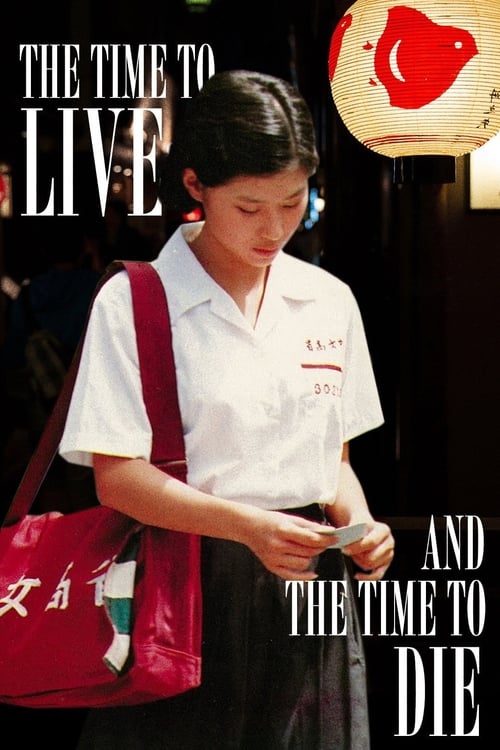
The Time to Live and the Time to Die
1985 · Hou Hsiao-hsien
For when you want a film to sit with — slow cinema that pays off in genuine feeling rather than plot. Best on a contemplative night when you're willing to meet it halfway; it will stay with you for days.
What it's about
A family that fled mainland China settles in a small southern Taiwanese town, and the film follows their son Ah-hsiao from watchful childhood into restless, half-delinquent adolescence across the 1950s and 60s. Drawn from director Hou Hsiao-hsien's own memories — he narrates the opening himself — it's a chronicle of growing up in exile: schoolyards and street gangs, a grandmother who still dreams of walking back to the mainland, and the slow procession of losses that turn a boy into an adult.
The experience
Patient, observational, and quietly overwhelming — it accumulates rather than builds, until ordinary domestic scenes carry enormous emotional weight. You watch it the way you remember your own childhood: in long, still moments that suddenly hurt.
The craft
Hou shoots in long, fixed takes framed through doorways and courtyards, letting life happen at a distance that somehow makes it more intimate, not less. The film's power is structural: memory rendered as rhythm, with death arriving the way it does in life — offscreen, mid-routine, without music telling you what to feel.
Why it matters
Widely considered the crystallizing work of the Taiwan New Cinema movement and one of the great autobiographical films, it established Hou Hsiao-hsien as a major world filmmaker and shaped a generation of directors drawn to stillness and memory.
Snapshot
The Time to Live and the Time to Die (童年往事, Tongnian wangshi, literally "memories of childhood") is Hou Hsiao-hsien's most directly autobiographical film and, for many critics, the crystallizing statement of the Taiwan New Cinema movement. Structured as a chronicle of a mainlander family settled in the southern Taiwanese town of Fengshan (near Kaohsiung) across the 1950s and early 1960s, it follows a boy nicknamed Ah-hsiao — Hou's surrogate — from childhood into a restless, half-delinquent adolescence, punctuated by the successive deaths of his father, mother, and grandmother. The film opens with Hou's own voice on the soundtrack, framing what follows as personal recollection. What emerges is less a plotted narrative than a patiently accreted portrait of exile, generational drift, and mortality, rendered in the long-take, distanced style that would become Hou's signature. It won the FIPRESCI Prize at the 1986 Berlin International Film Festival and is routinely ranked among the essential works of postwar Asian cinema.
Industry & production
The film belongs to the brief, extraordinary window (roughly 1982–1987) when Taiwan's film industry, its commercial genre output flagging against Hong Kong competition and imported product, opened space for a cohort of young, personal filmmakers. The state-linked Central Motion Picture Corporation had catalyzed the New Cinema with the 1982 omnibus In Our Time, and Hou had already moved decisively toward autobiographical realism in The Boys from Fengkuei (1983) and A Summer at Grandpa's (1984). The Time to Live and the Time to Die was made on the modest budgets characteristic of the movement, prioritizing location shooting, natural light, and small crews over studio resources. I want to be candid that the precise financing and producing arrangements of this particular title are not something I can specify with confidence from the historical record; what is secure is that it was produced within the low-budget, artisanal ecosystem of mid-1980s Taiwanese art cinema rather than as a mainstream commercial vehicle. The reliance on real locations in and around Fengshan and Kaohsiung, and on a family home reconstructed or repurposed from period-appropriate spaces, is integral to the film's texture and typical of the New Cinema's production ethos.
Technology
Technologically the film is conservative by design. It was shot on 35mm color film with a largely static camera, using available and softly supplemented light rather than elaborate rigs. Hou's aesthetic in this period actively resists the tools of spectacle: there is little camera movement, no optical showmanship, and a preference for long lenses and deep, planimetric compositions that keep the apparatus invisible. The most significant "technology" at work is arguably the recording and construction of sound — a layered field of ambient noise (cicadas, radio broadcasts, rain, household activity) built in post-production, since sync-sound location recording was not the norm in Taiwanese production of the era and dialogue and atmosphere were substantially assembled afterward. That post-synchronized workflow, common to the industry, shapes the film's slightly abstracted, memory-like acoustic space.
Technique
Cinematography
The cinematography is credited to Mark Lee Ping-bing (Lee Ping-Bin), whose collaboration with Hou around this period would become one of the defining director–cinematographer partnerships in world cinema. The visual grammar is built on the sustained long take from a fixed, often frontal position, frequently framing action through doorways, windows, and the rectilinear architecture of the family house so that the domestic interior becomes a nested series of frames. The camera holds at a respectful middle distance — rarely a close-up — and lets figures move within, into, and out of the frame while the shot persists. Deep-focus staging keeps foreground and background legible at once, so a conversation in a front room and a figure glimpsed in a rear courtyard belong to the same continuous space. Natural light and a muted, warm palette give the images the quality of faded recollection rather than heightened drama.
Editing
The editing, the work of Hou's longtime editor Liao Ching-song, is founded on ellipsis. Scenes are joined with a marked economy that skips over the "connective" incidents a conventional drama would dramatize; years pass in a cut, and the film trusts the viewer to register the passage through changes in the actors, seasons, and household. Within scenes the cut is withheld — Liao and Hou let takes run long past the point at which mainstream découpage would move on, so that duration itself carries emotional weight. The rhythm is contemplative and accretive rather than propulsive; meaning gathers between shots and across the film's large temporal leaps rather than being spelled out.
Mise-en-scène / staging
Mise-en-scène is where the film does much of its work. The Fengshan house — its front room, its interior thresholds, the chair associated with the father, the courtyard and street beyond — becomes a stable stage across which time visibly moves. Hou stages the family's life in wide, balanced compositions that treat the environment as a full participant, and he repeatedly returns to the same spatial vantage points, so that recurrence itself communicates the accumulation and erosion of a family. Period detail — clothing, furnishings, radio and news of the mainland — is handled with understatement rather than nostalgia. The staging keeps death offscreen or at a distance: the family's losses are registered through their aftermath and through the survivors' bodies in space rather than through dramatized deathbed scenes.
Sound
The soundtrack is dense with the ambient life of the household and town but sparing with music. Diegetic sound — radio broadcasts (including news from and about the mainland), insects, weather, the murmur of family — carries the atmosphere and situates the family historically. Non-diegetic score is used with restraint; I would rather not attribute a specific composer here, as I cannot confirm the credit with certainty, and the film's sonic identity in any case rests more on its atmospheric sound design than on a musical theme. The linguistic soundscape is itself meaningful: the mix of Hakka (the family's mainland dialect), Taiwanese Hokkien (the surrounding community), and Mandarin (school and state) audibly maps the family's dislocation.
Performance
Performance is pitched toward the naturalistic and unforced, in keeping with the New Cinema's rejection of melodramatic acting. Hou draws quiet, undemonstrative work from his cast, favoring behavior over emotive display; grief is conveyed through stillness and small gesture. The grandmother — a widely celebrated performance generally credited to Tang Ju-yun — anchors the film's emotional register, her senile, gentle insistence on "walking back" to the mainland becoming the movie's most indelible thread. The child and adolescent playing Ah-hsiao are handled so that their opacity reads as authentic rather than as failed expressiveness. I'll note that I can't vouch for every cast attribution with full confidence, but the ensemble is composed to feel like an ordinary family observed rather than a set of star turns.
Narrative & dramatic mode
The film's dramatic mode is elliptical, episodic, and observational — a memoir told as a sequence of durations rather than a causal plot. There is no engine of goal and obstacle; instead the film advances through the natural rhythm of a household and the punctuating shocks of death. Its first-person framing (Hou's opening narration) establishes subjectivity, but the visual treatment is paradoxically detached, viewing the remembered self from a cool distance. This tension between intimate material and distanced observation is central to the film's power: it refuses catharsis and sentiment, letting loss land obliquely. The two-part movement — a childhood dominated by the father's illness and death and the family's diminished exile, then an adolescence of gang scuffles, pool halls, tentative first love, and the mother's and grandmother's deaths — traces the passage from a world defined by the parents to one in which the children are left, rooted in a Taiwan the elders never accepted as home.
Genre & cycle
Nominally a drama, the film is best understood within the specific cycle of autobiographical coming-of-age films that Hou and his collaborators produced in the mid-1980s. It is frequently grouped with The Boys from Fengkuei and Dust in the Wind (1986) as a loose trilogy of youth and memory, and with A Summer at Grandpa's as part of a sustained inquiry into childhood, family, and the Taiwanese landscape. More broadly it sits within the "memory film" and the national bildungsroman — works that use a personal coming-of-age to narrate a collective historical experience, here the mainlander (waishengren) predicament of the postwar decades.
Authorship & method
The film is a foundational statement of Hou's authorship: the long take, the fixed distanced camera, the elliptical structure, and the fusion of personal memory with historical witness that would culminate in A City of Sadness (1989). Its method was collaborative in ways that matter. The screenplay was written with Chu T'ien-wen (Zhu Tianwen), the novelist who became Hou's essential creative partner across decades; her literary sensibility and her role in shaping Hou's narrative economy are inseparable from the film's achievement. The cinematography of Mark Lee Ping-bing and the editing of Liao Ching-song supplied the two other pillars of Hou's mature style. A frequently cited turning point in Hou's method — well attested in the critical literature — is Chu's recommendation that he read the autobiography of the modern Chinese writer Shen Congwen; Shen's compassionate yet detached, "cold-eyed" narrative perspective is widely credited with helping Hou arrive at the serene, distanced long-view that governs this film. The autobiographical origin also functioned as method: Hou drew directly on his own upbringing in Fengshan, and his framing narration signs the film as memoir.
Movement / national cinema
The Time to Live and the Time to Die is a cornerstone of Taiwan New Cinema (台灣新電影), the movement that, alongside Edward Yang's more urban, modernist work, redefined Taiwanese film in the 1980s by turning to realist, personal, historically grounded storytelling. The film exemplifies the movement's commitments: location realism, non-melodramatic performance, attention to Taiwan's multilingual social fabric, and a willingness to narrate the island's postwar history from below. Its treatment of the mainlander family's exile also engages directly with questions of Taiwanese identity and memory that the movement, and Hou in particular, would continue to excavate.
Era / period
Set across the 1950s and early 1960s, the film depicts the first post-1949 generation of mainland émigrés putting down reluctant roots in a Kuomintang-ruled, martial-law-era Taiwan. The elders live in the provisional expectation of returning "home" to the mainland — an expectation the grandmother literalizes in her wanderings — while the children grow into Taiwanese lives. The period texture (radio bulletins, school regimentation, the economic modesty of a garrison-town family) situates the private story within the larger arc of Cold War Taiwan. The film was made in 1985, at the tail end of the martial-law period (which ended in 1987), when the New Cinema was newly able to address such recent history with candor.
Themes
Its central themes are memory and mortality: the film is, structurally, a meditation on how a family is thinned by death and how the young absorb loss. Exile and the impossibility of return run throughout — the generational gap between elders who face toward the mainland and children who belong to Taiwan is the film's great subject, condensed in the grandmother's futile search for the road back to Meixian. Coming of age and the guilt of survivorship shape the second half, where Ah-hsiao's adolescent aimlessness and later remorse register the cost of growing up amid death. Underlying all of it is the passage of time itself — the "time to live and the time to die" of the English title — treated not as tragedy to be dramatized but as a natural rhythm to be observed.
Reception, canon & influence
Critically the film was received as a major work almost immediately and has only grown in stature. It won the FIPRESCI Prize at the 1986 Berlin International Film Festival and was recognized at the Golden Horse Awards — most securely for its screenplay by Chu T'ien-wen and Hou — helping to consolidate Hou's international reputation. In the decades since, it has been widely canonized: it appears on major critics' and directors' lists of the finest films, and it is a fixture in accounts of both Taiwan New Cinema and the broader tradition of contemplative, long-take art cinema.
Looking backward, the film's influences are as much literary as cinematic. The Shen Congwen connection — the detached, humane long view — is the most concrete documented lineage. Critics have repeatedly likened Hou's static, domestic, threshold-framed compositions to Yasujirō Ozu, though Hou has said he arrived at his style largely independently and only later engaged deeply with Ozu, so the affinity is better read as convergence than direct debt. The broader realist currents of the New Cinema and Chu T'ien-wen's literary milieu are the film's proximate context.
Looking forward, its legacy is substantial. Together with Hou's other 1980s work it helped establish the long-take, elliptical, observational mode that became foundational to what would later be theorized as "slow cinema," and Hou became a touchstone for a generation of internationally acclaimed directors — figures associated with festival art cinema across Asia and beyond frequently cite him. The film's fusion of autobiographical memory, national history, and durational form set a template that Hou himself extended in Dust in the Wind and A City of Sadness, and that continues to inform filmmakers working at the intersection of personal memory and historical witness.
A Deleuzian reading
There is a chair in the front room of the house at Fengshan, and the father sits in it.
The full Deleuzian reading of The Time to Live and the Time to Die →
Reception
At home it landed mid-Taiwan-New-Cinema, when these quiet autobiographical films were still a hard commercial sell — but the FIPRESCI prize at the 1986 Berlinale helped announce Hou to the world, and it's since climbed into virtually every list of the greatest Taiwanese (and greatest Chinese-language) films ever made.
How The Time to Live and the Time to Die was received, from release to now →
Influences: the films it descends from and the films it influenced
- Tokyo Story (1953) — The fixed low camera framing domestic figures through doorways and thresholds, and the decision to place a family death entirely offscreen between scenes, is the exact tableau-and-ellipsis grammar Hou converged on (by his own account independently) for the family-illness passages.
- L'Avventura (1960) — Dedramatized 'dead time' and an elliptical structure that withholds the ostensible dramatic event, teaching the durational holding of a shot after its narrative business is done.
- Germany Year Zero (1948) — Post-synchronized sound over a non-professional child protagonist observed against real historical rubble — the neorealist coupling of dubbed track, naturalistic child performance, and national-history-as-backdrop that Hou reworks.
- Jeanne Dielman (1975) — Frontal planimetric framing of domestic routine held in near-real-time long takes, with the violent climax kept curt and undramatized — the durational domestic observation Hou shares.
- The Boys from Fengkuei (1983) — Hou's own pivot film: after Chu T'ien-wen gave him Shen Congwen's autobiography, he pulled the camera back into the distanced, static long shot that this film systematizes.
- A Summer at Grandpa's (1984) — Rural childhood rendered as elliptical episodes observed from a fixed observational distance, the immediate compositional and structural rehearsal for the Fengshan memoir.
- Late Spring (1949) — Hou's autobiographical family film adopts Ozu's contemplative fixed-camera tableaux and elliptical handling of deaths offscreen, the domestic stillness and withheld-event narration descending directly from Late Spring.
- Dust in the Wind (1986) — Hou immediately extends the same autobiographical coming-of-age ellipsis with Mark Lee Ping-bing's natural-light long takes, keeping the departures and losses in the gaps between shots.
- A City of Sadness (1989) — The culmination of this film's method: distanced tableaux, a multilingual (Hokkien/Mandarin/Japanese) soundscape, and mass historical violence held offscreen while the camera stays fixed on the family interior.
- A Brighter Summer Day (1991) — Fuses autobiographical adolescent memory with national history in patient long takes and threshold-framed interiors — the personal-memoir-as-historical-witness template this film set.
- Maborosi (1995) — Kore-eda's debut adopts the fixed distanced long take and mourning-in-stillness, staging its central death offscreen and dwelling on the surviving figure in deep, natural-lit space, explicitly in Hou's wake.
- Platform (2000) — A durational long-take chronicle of a decade of social change told in elliptical episodes from a distanced camera — Jia's avowed extension of Hou's memory-and-history durational form.
- Goodbye, Dragon Inn (2003) — Pushes the long-duration static planimetric shot and ambient-only sound design toward near-silence, radicalizing the observational holding this film helped codify for slow cinema.
- Uncle Boonmee Who Can Recall His Past Lives (2010) — Builds mood from immersive ambient natural soundscapes and unhurried durational takes, part of the festival slow-cinema generation that names Hou as a touchstone.
- Taipei Story (1985) — Hou co-wrote and starred in it; the two directors were trading the same planimetric static framing and natural-light interiors that define the Taiwan New Cinema look in the same year.
- That Day, on the Beach (1983) — Christopher Doyle's natural-light long takes structuring a memory told in elliptical flashback — the New Cinema's parallel experiment in durational recollection.
- In the Mood for Love (2000) — Direct collaborator debt — cinematographer Mark Lee Ping-bing carries the same natural-light, threshold-and-doorway framing of cramped interiors, with the affair elided into gaps.
- Terrorizers (1986) — The contemporaneous Taiwan New Cinema aesthetic of long-take observational distance and the static, deep-focus wide shot as the movement's shared house style.
Similar films
- Dust in the Wind (1986) — influence & lineage · same viewing thread
- Taipei Story (1985) — influence & lineage · same viewing thread
- A City of Sadness (1989) — influence & lineage · same viewing thread
- A Brighter Summer Day (1991) — influence & lineage · same viewing thread
- Goodbye, Dragon Inn (2003) — influence & lineage · same viewing thread
- The Boys from Fengkuei (1983) — influence & lineage
- Tokyo Story (1953) — influence & lineage
- That Day, on the Beach (1983) — influence & lineage
All the films related to The Time to Live and the Time to Die →
Watch it with: curated runs of related films
- Sinophone Slow Cinema — A run of Chinese-language films — Taiwan's New Wave and its mainland and Bi Gan heirs — where time pools and city, family, and memory recur; watch them near each other, from A Brighter Summer Day to An Elephant Sitting Still, for how they rhyme on drift and the weight of the past.