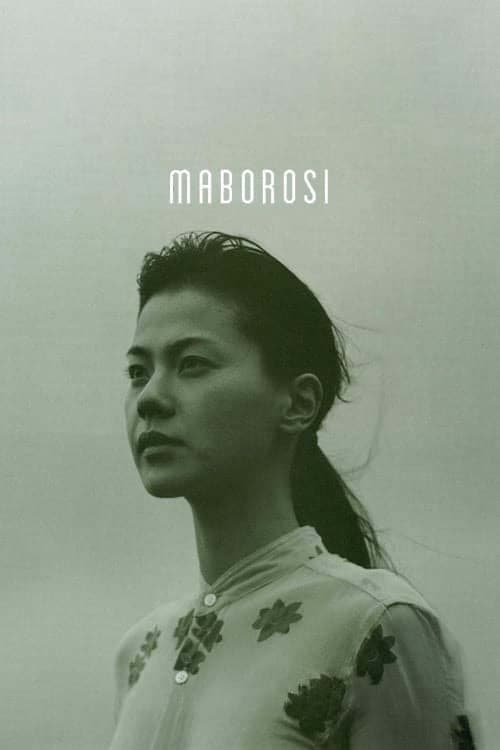
Maborosi
1995 · Hirokazu Kore-eda
The gentle humanist whose Monster (with a posthumous Sakamoto score and queer-childhood reveal) generated real festival argument; invoked in every conversation about family, ethics, and whether kindness can be an aesthetic.
For when you're ready to sit with sadness rather than be distracted from it — a patient, meditative film for a quiet night alone. This is contemplative cinema; come willing to slow your pulse to its rhythm.
What it's about
A young Osaka woman's husband dies suddenly, without warning and without any reason anyone can name. Years later she remarries into a fishing village on a remote coast, and the film quietly watches her try to build a new life while carrying a grief that has no explanation — and therefore no clear end.
The experience
Slow, hushed, and profoundly still — long shots held from a distance, rooms so dark you lean in, sorrow expressed through weather and light rather than dialogue. It doesn't devastate you in a burst; it settles over you gradually and stays for days.
Performances
Makiko Esumi carries the film almost wordlessly as Yumiko, letting grief register in posture and silence rather than speeches.
The craft
Kore-eda composes some of the darkest, most painterly images of 1990s cinema — figures small against sea and sky, interiors lit like dusk — and the cinematography won a prize at Venice. Watch it in a dark room on the best screen you have; its power lives in shadow and distance.
Why it matters
The debut that announced Kore-eda as a major filmmaker and a touchstone of contemplative art cinema, shaping how slow, observational drama would be discussed for years after.
Snapshot
Maborosi (幻の光, Maboroshi no hikari, "phantom light") is the first narrative feature by Hirokazu Kore-eda, who arrived at it from a decade of documentary and television work. Adapted from a short story by the novelist Teru Miyamoto, it follows Yumiko, a young Osaka woman whose husband Ikuo walks into the path of a train one night for no reason anyone can name. Years later she remarries into a fishing community on the Noto Peninsula, and the film observes her attempt to keep living beside a grief that has no explanation and therefore no end. Shot in long, distant, largely static takes and in some of the darkest images in 1990s cinema, it announced Kore-eda as a major figure of contemplative art cinema and won the cinematography prize at the 1995 Venice Film Festival. It remains a touchstone of what would later be called "slow cinema."
Industry & production
Maborosi was produced within the orbit of Japanese independent and television-adjacent film production rather than the declining major-studio system. Kore-eda had spent the late 1980s and early 1990s making documentaries for television — including work on social subjects such as welfare and memory — and Maborosi represents his crossing into fiction while retaining a documentarian's patience. The film adapts Teru Miyamoto's short story of the same name; Miyamoto is a well-regarded literary source for Japanese cinema, his fiction having also underpinned Kōhei Oguri's Muddy River (1981), which situates Maborosi within a lineage of literary, humanist adaptation.
The production is notable for the meticulousness of its planning. Kore-eda has spoken in interviews about storyboarding the film exhaustively in advance, composing each shot on paper before shooting — a rigor he later described as a lesson in the limits of over-control, and one he consciously moved away from in subsequent films built around improvisation and the unpredictability of non-professional and child performers. The lead role went to Makiko Esumi, then known primarily as a fashion model, in a performance that depends heavily on restraint and physical presence rather than dialogue. Precise budget and box-office figures for the film are not something I can state reliably, and I won't invent them; it was a modest art-cinema production whose economic footprint came less from ticket sales than from festival prestige and later international distribution.
Technology
Technologically Maborosi is conservative by design: it was shot on 35mm film, and its entire aesthetic identity rests on the properties of the photochemical image at the edge of underexposure. The film pushes deep into shadow — interiors lit to near-silhouette, figures reduced to dark shapes against windows and doorways — in a way that exploits film's capacity to hold detail and gradation in very low light while letting large areas fall to black. This is not a film of technological novelty but of technical extremity: the achievement is in exposure control, lighting discipline, and the confidence to let the frame remain dim for long durations. Its relationship to technology is essentially the classical one of the art film — using established 35mm craft with unusual severity rather than pursuing new tools.
Technique
Cinematography
The cinematography, by Masao Nakabori, is the film's most celebrated element and the basis of its Venice award. Nakabori and Kore-eda favor the long take, the fixed or barely-moving camera, and framings held at a marked distance from the characters. People are frequently seen in long shot, small within landscapes, corridors, and rooms; the camera tends to observe from across a space rather than enter it. Light is the governing subject. Daylight exteriors on the Noto coast are gray, wide, and weather-beaten; interiors are extraordinarily dark, with figures often rendered as silhouettes moving through pools of shadow. The compositional instinct is toward stillness, symmetry, and the doorway or corridor as a frame-within-the-frame — a vocabulary that invites, and has repeatedly drawn, comparison to Ozu, though Kore-eda's distances are colder and his darkness more absolute.
Editing
The film is edited elliptically and unhurriedly. It moves in blocks of time separated by gaps — the years between Yumiko's first marriage and her second pass without transitional exposition — and it favors fades and quiet cuts over momentum. The cutting rhythm is slow because the shots are long; meaning accrues from duration and from what is withheld rather than from juxtaposition. Crucially, the film elides the events one might expect a drama to dramatize: Ikuo's death is not shown as spectacle, and much of Yumiko's interior life is left in the spaces between scenes. This restraint at the level of assembly is what gives the film its sense of a life continuing quietly around an unhealed wound.
Mise-en-scène / staging
Staging is architectural and depth-oriented. Kore-eda blocks his actors within the real geometry of houses, streets, and the fishing village, often placing them deep in the frame or at its edges and letting the surrounding space carry as much weight as the figures. Thresholds — sliding doors, windows, the mouth of a tunnel, the line where land meets sea — recur as staging devices, so that characters are constantly framed by openings that separate inside from outside, safety from the pull of the dark. The Noto Peninsula setting is used documentarily: the textures of a working coastal community, its funerals and daily labor, ground the film's metaphysical grief in concrete social life.
Sound
The sound design is spare and attentive to environment: wind, sea, rain, trains, the small sounds of domestic routine. Silence and ambient noise do much of the emotional work, and dialogue is sparse and understated. The score, by the Taiwanese musician Chen Ming-chang, is used sparingly and plaintively; his involvement is one of the film's direct threads to Taiwanese New Cinema, with which Kore-eda's style shares a sensibility. Music is deployed as punctuation rather than continuous underscoring, preserving the film's overall quiet.
Performance
Performance is pitched almost entirely below the level of overt expression. Makiko Esumi's Yumiko communicates through posture, stillness, and small gestures; the film asks her to carry grief without the conventional signposts of screen acting, and much of its power depends on her opacity — we watch her the way the camera does, from outside. Takashi Naito, as her second husband Tamio, offers a gentler, more grounded warmth, and Tadanobu Asano appears as the doomed first husband Ikuo. The ensemble, including the coastal community's older residents, is directed toward naturalism and understatement consistent with Kore-eda's documentary background.
Narrative & dramatic mode
The dramatic mode is elliptical, interiorized, and anti-climactic in the best sense. Maborosi refuses the machinery of cause and explanation that a suicide-and-aftermath story would conventionally supply. Ikuo leaves no note, no legible motive; the film's entire dramatic proposition is the impossibility of closure. Rather than build toward revelation, it proceeds as a series of observed states — waiting, grieving, half-recovering — and locates its climax not in a plot event but in an emotional confrontation late in the film, when Yumiko finally voices to Tamio her inability to understand why Ikuo walked toward death. The title's "phantom light" — a beckoning glow said to draw people out toward the sea — is offered by Tamio less as an explanation than as an image for the unknowable, a way of living alongside a question that cannot be answered.
Genre & cycle
Nominally a drama, Maborosi belongs less to a genre than to a mode: the contemplative, durational art film. In the terms critics later adopted, it is an early exemplar of "slow cinema," and it sits within a broader cycle of 1990s Asian art cinema characterized by long takes, minimal narration, and an ethnographic attention to place — a current strongly associated with Taiwan's Hou Hsiao-hsien and Edward Yang and with the festival circuit that championed them. Within Japanese cinema it can be read as part of a humanist, quotidian tradition of films about grief, family, and endurance, distinct from the more sensational currents of the same decade.
Authorship & method
Maborosi is the origin point of Kore-eda's authorship, and it establishes his enduring subject — how the living carry the dead — even as its method differs from his later work. Kore-eda has been candid that the film was planned to an almost architectural degree, every shot storyboarded in advance, and that he came to see this control as a constraint; his subsequent films (After Life, Nobody Knows, and onward) loosened toward improvisation and a looser, warmer camera. Yet the thematic DNA is already fixed here: absence, memory, and the ethics of continuing to live.
His collaborators shape the film decisively. Cinematographer Masao Nakabori is arguably co-author of its visual identity, responsible for the underexposed, distanced images that define it. Composer Chen Ming-chang links the film to the Taiwanese milieu Kore-eda admired. The screenplay adapts Teru Miyamoto's story; the screenwriting credit is generally attributed to Yoshihisa Ogita, though I'd flag that this is the kind of below-the-line credit worth confirming against a primary source rather than taking on assertion. The editing credit likewise I cannot attribute with confidence and won't guess. What is secure is the authorial partnership between Kore-eda's documentary-trained patience and Nakabori's photographic severity.
Movement / national cinema
The film stands at an interesting angle to Japanese national cinema. It emerges after the studio era's collapse, from television and independent production rather than the majors, and it explicitly looks outward — toward Taiwanese New Cinema — for its stylistic bearings as much as toward the domestic tradition of Ozu and Naruse to which critics reflexively compared it. Kore-eda has acknowledged Hou Hsiao-hsien as a key influence, and the presence of Chen Ming-chang makes that affiliation concrete. Maborosi thus belongs to a pan-Asian art-cinema formation of the 1990s, defined less by nation than by a shared festival-borne aesthetic of duration and observation, even as its landscapes and rituals are deeply Japanese.
Era / period
Made and released in 1995, Maborosi is a product of a transitional moment in both Japanese cinema and the international art film. Domestically, it arrives amid the long aftermath of the studio system's decline and the rise of independent and festival-oriented production. Internationally, it lands at the point where the Asian art film was becoming central to the major European festivals, and where a slower, more austere aesthetic was gaining critical prestige as a counter to mainstream velocity. Its 1995 Venice premiere places it precisely within that ascendancy; its wider international release followed over the next couple of years through art-house distribution.
Themes
The film's governing theme is grief without cause — the specific torment of a death that offers no reason and therefore no resolution. From this flow its other concerns: the persistence of the dead among the living; the possibility and guilt of moving on; the tension between the warmth of a new life and the pull of the old loss. The "phantom light" of the title crystallizes a metaphysics of the unknowable — the sense that some part of human motive and mortality lies permanently beyond understanding, and that living well may mean making peace with that darkness rather than dispelling it. Landscape and light carry these ideas materially: the sea as the site of both livelihood and death, the recurring darkness as the visual form of a grief that never fully lifts.
Reception, canon & influence
Critically, Maborosi was received as a major debut. Its 1995 Venice premiere brought it the festival's cinematography award (the Golden Osella), and international critics singled out the beauty and severity of its images, frequently invoking Ozu and Hou Hsiao-hsien while noting Kore-eda's distinct coldness and control. It circulated widely on the festival and art-house circuit and was later restored and re-released, sustaining its reputation among cinephiles; it is regularly cited as one of the strongest directorial debuts of the decade.
Its influences run backward toward Ozu's domestic framing and the Taiwanese New Cinema of Hou Hsiao-hsien — long takes, distant observation, the primacy of place — with the direct link of composer Chen Ming-chang; the alienated, unexplained tenor of the drama has also drawn comparisons to European modernists of absence. Its legacy runs forward in two directions. First, within Kore-eda's own career, it is the seed of an oeuvre — After Life, Nobody Knows, Still Walking, Shoplifters — that became one of the most acclaimed bodies of work in contemporary cinema, even as he traded Maborosi's severity for greater warmth and looseness. Second, it stands as an early, influential instance of the durational aesthetic that critics would later theorize as "slow cinema," and it helped consolidate the 1990s prestige of a distinctly Asian mode of contemplative filmmaking on the world stage. Claims that specific major filmmakers publicly championed the film circulate in reception history; where I cannot verify such attributions precisely, I flag them as unconfirmed rather than repeat them as fact.
A Deleuzian reading
There are shots in *Maborosi* where you have to hunt the frame to find the woman in it.
The full Deleuzian reading of Maborosi →
Reception
A quiet festival-circuit debut in 1995 (it picked up the Golden Osella for cinematography at Venice), Maborosi spent years as a connoisseur's secret — then Shoplifters' Palme d'Or sent everyone back through Kore-eda's filmography, and it got recrowned as one of the great first features.
How Maborosi was received, from release to now →
Influences: the films it descends from and the films it influenced
- Late Spring (1949) — The low, static 'tatami-eye' camera and empty pillow-shots of thresholds, corridors and vacated rooms that Kore-eda borrows to let architecture carry emotion the characters withhold.
- Tokyo Story (1953) — Ozu's 90-degree cutting and frontal doorway/threshold framing of domestic space, and the ellipsis that jumps over a death to dwell on the survivors, model Maborosi's own grief-after-the-fact structure.
- A City of Sadness (1989) — The fixed distant long-take that observes figures small within landscape and interior depth—Hou's 'primacy of place'—is the direct template, reinforced by shared composer Chen Ming-chang.
- Dust in the Wind (1986) — Hou's patient wide shots of trains, tunnels and coastal thresholds, and his refusal to dramatize turning points, feed Maborosi's undramatized departures and its scale of tiny human against vast setting.
- L'Avventura (1960) — The anti-climactic ellipsis around an unexplained disappearance—withholding cause and resolution so absence itself becomes the subject—is the modernist device Maborosi transposes to a husband's motiveless suicide.
- Diary of a Country Priest (1951) — Bressonian performance of restraint—flattened affect, suppressed reaction, gesture over expression—supplies the minimalist acting register Makiko Esumi holds throughout.
- Ugetsu (1953) — Mizoguchi's long-take staging in depth, moving figures through planes of a single unbroken shot rather than cutting, underlies Maborosi's depth-blocking and reluctance to edit within a scene.
- Jeanne Dielman (1975) — The durational, real-time observation of a widow's domestic ritual in fixed frontal frames—elapsed time as the true subject—prefigures the slow-cinema grammar Maborosi consolidates.
- A Scene at the Sea (1991) — Kore-eda builds grief from locked-off distant long takes, near-silence, and an unexplained off-screen death, extending the same stillness-as-mourning craft.
- Yearning (1964) — Kore-eda's debut about a young widow's unspoken grief adopts Naruse's patient eye-level distance, expressive silence, and refusal of catharsis as a self-conscious inheritance of shomin-geki restraint.
- Chikamatsu Monogatari (1954) — Static, distanced long takes and low-key domestic mourning inherit Mizoguchi's ethic of the withheld close-up and the camera's respectful distance from suffering.
- The Time to Live and the Time to Die (1985) — Kore-eda's debut adopts the fixed distanced long take and mourning-in-stillness, staging its central death offscreen and dwelling on the surviving figure in deep, natural-lit space, explicitly in Hou's wake.
- After Life (1998) — Kore-eda's own next film loosens Maborosi's storyboarded severity toward documentary-style improvisation, but keeps the core subject—how the living hold the dead—and the observational distance.
- Nobody Knows (2004) — Extends the debut's elliptical, undramatized handling of catastrophe—events happen off-beat and unexplained—while trading the cold static frame for a warmer, looser handheld camera.
- Still Walking (2008) — Directly inherits the Ozu-derived domestic threshold framing and the theme of grief that never resolves, refined into the single-house, single-day structure Maborosi first gestured toward.
- Shoplifters (2018) — The culmination of the authorship Maborosi seeds—restraint, ellipsis, and the ethics of continuing to live—now with the improvisational warmth that replaced the debut's architectural control.
- Wendy and Lucy (2008) — American minimalist realism carrying forward the sparse-score, ambient-sound, distant-framing observation of a solitary figure enduring loss without melodrama or explanatory backstory.
- Last Life in the Universe (2003) — Kore-eda's static, distant compositions framing grief and silence prefigure Last Life's deathward quiet and underplayed performance thermostat.
- The Taste of Tea (2004) — Sets the slow-cinema template of held, distant, near-still long shots and contemplative dead time that Ishii's plotless family reverie inherits (the explicit 'Kore-eda-adjacent' debt).
- Christmas in August (1998) — Kore-eda's distant fixed frames, available natural light, and grief handled through ellipsis (the cause of loss withheld, mourning shown only in aftermath) prefigure Christmas in August's exact restraint just three years earlier.
- The Mourning Forest (2007) — A fellow Japanese art-cinema exploration of carrying the dead, built on the same underexposed natural light, ambient-diegetic sound and durational walking through landscape.
- Vive L'Amour (1994) — Contemporary Taiwanese-adjacent slow cinema sharing the near-scoreless soundtrack, sustained static long-takes and a final held shot that lets grief play out in real time without dialogue.
- Sátántangó (1994) — The other 1990s pillar of durational aesthetics later theorized as 'slow cinema'—extreme long-take duration and low-key monochromatic imagery pushing the same anti-narrative patience to an extreme.
- Secret Sunshine (2007) — An Asian art-cinema study of a widow's grief-without-consolation that shares Maborosi's refusal of catharsis and its long observational takes holding on a woman processing bereavement.
- The Puppetmaster (1993) — Made in the same moment and idiom Kore-eda revered—extreme distant framing, elliptical historical narration and unhurried long-takes—marking the Taiwanese New Cinema current Maborosi runs parallel to.
- Fireworks (1997) — Kore-eda's debut uses the same stationary frontal camera with figures placed in deep space, withholds information about a death at the film's center, and processes grief through ambient silence and elegiac-mode accumulation rather than dramatic declaration—a parallel formal development within the same Japanese festival-cinema moment.
- The Eel (1997) — A sibling in the late-humanist cycle that dramatizes guilt and grief recovery through long-take duration, water/coastal ambience and near-wordless suppression rather than plot momentum.
- Flowers of Shanghai (1998) — Kore-eda's distant static tableaux and elliptical treatment of grief, letting figures move within a held frame lit by available light, is a direct absorption of Hou's fixed-long-shot observation.
- Eureka (2001) — A Japanese contemporary rendering grief's aftermath through held static compositions and domestic-threshold staging, muted to near-silence — the same durational treatment of survivorship.
Similar films
- Tokyo Story (1953) — influence & lineage · same viewing thread
- Still Walking (2008) — influence & lineage · same viewing thread
- Nobody Knows (2004) — influence & lineage · same viewing thread
- Shoplifters (2018) — influence & lineage · same viewing thread
- Late Spring (1949) — influence & lineage
- Tokyo Twilight (1957) — same viewing thread
- After Life (1999) — same viewing thread
- An Autumn Afternoon (1962) — same viewing thread
All the films related to Maborosi →
Watch it with: curated runs of related films
- The Weight of the Unspoken — A run of quietly shattering films where the largest feelings never get said aloud — love that outlasts reason, grief that gathers over a single family dinner, a long marriage cracked open by one old letter.