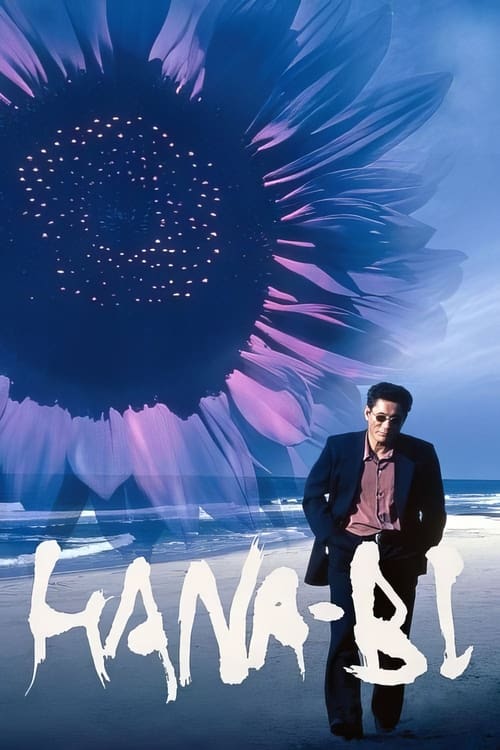
Fireworks
1997 · Takeshi Kitano
For a contemplative late night when you want beauty and melancholy together — when you need to feel something deep but don't want it shouted at you. Meditative, sad, strangely consoling.
What it's about
A Tokyo police detective, hollowed out by tragedy on the job and his wife's terminal leukemia, walks away from the force with debts to a yakuza loan shark and a paralyzed former partner on his conscience. He decides to settle every account at once — through one desperate act — and then takes his wife on a final, wordless journey through the Japanese seaside and countryside.
The experience
Serene and brutal by turns: long stretches of stillness, deadpan humor, and painterly calm, punctured by violence that arrives in sudden, shocking bursts. It sneaks up on you — what starts as a crime film ends as one of the most quietly heartbreaking love stories in the genre.
Performances
Takeshi Kitano directs himself in the lead and gives a nearly silent, granite-faced performance where a twitch or a glance carries whole scenes — tenderness and menace living in the same expression.
The craft
Kitano composes the film like a series of paintings — including actual paintings, naïve and haunting, woven into the story — set against Joe Hisaishi's aching score. The editing withholds and elides in ways that make even simple scenes feel charged, and the seaside imagery lingers long after.
Why it matters
Its Golden Lion at Venice in 1997 turned Kitano from a cult genre figure into a major international auteur and put Japanese cinema back at the center of the world stage.
Snapshot
Hana-bi — the Japanese title split deliberately by Kitano into hana (flower) and bi (fire), so that the film announces its central tension in a single hieroglyph before a frame is shown — is the work that transformed Takeshi Kitano from a cult director appreciated by genre enthusiasts into a figure of international art-cinema consequence. Its Golden Lion at the 54th Venice International Film Festival in 1997 arrived as both a validation and a surprise: Japanese cinema had been largely absent from the major European prize circuits for some years, and this quiet, intermittently violent story of a detective unraveling under the weight of guilt, love, and mortality seemed an unlikely candidate for the highest honor in world cinema. Kitano had made six features before it. Hana-bi is the film that made the preceding six feel like a single sustained rehearsal.
Industry & production
By 1997 Kitano was simultaneously one of Japan's most bankable television personalities — "Beat Takeshi," the irreverent comedian — and the director of a string of low-to-mid-budget crime films that had been commercially modest at home while accumulating critical prestige abroad. Sonatine (1993) had been a commercial failure upon its Japanese release despite rapturous reception in France and elsewhere; the domestic audience for Kitano the director and the domestic audience for Beat Takeshi the entertainer barely overlapped. Hana-bi was produced under the Office Kitano banner, which Kitano had established partly to secure greater creative autonomy, in association with TV Man Union and Bandai Visual. The financing structure allowed Kitano the kind of editorial control — literal and figurative — that Japanese studio pictures typically did not accommodate.
The film's personal genesis is inseparable from a near-fatal motorcycle accident Kitano suffered in August 1994, which left him hospitalized for months and resulted in partial right-side facial paralysis. During his recovery he began painting compulsively — abstract, cartoon-inflected canvases that would eventually migrate directly into the film. The accident, then, is not merely biographical backdrop: it is a production event. Kitano returned to filmmaking physically altered, and Hana-bi is in part the document of that alteration. The paintings Nishi's paralyzed partner Horibe makes during the film are Kitano's own work, executed for this purpose, and Horibe's turn to art after his body is destroyed recapitulates Kitano's own convalescent discovery of the medium. Kids Return (1996) had been Kitano's first post-accident film; Hana-bi is the one in which the accident is fully metabolized into form.
Technology
Hana-bi was shot on 35mm film, conventional for Japanese production of the period and entirely appropriate to Kitano's aesthetic: the grain and tonal depth of photochemical film suit the long, still passages that constitute the film's emotional core. No unusual format or lens strategy distinguishes the production at a technical level. The film's technological interest lies not in novelty but in restraint — a deliberate refusal to use the camera as an expressive instrument in the manner of, say, Hong Kong action cinema of the era. Steadicam and handheld shooting are largely absent; the frame does not move in order to track violence but stays put while violence intrudes upon it. The paintings were created by Kitano ahead of production and exist as physical artworks that were photographed into the film rather than generated digitally. In 1997, this was simply how such imagery was incorporated; the absence of digital compositing is itself a fact about what the images feel like — they are objects in the world, not effects.
Technique
Cinematography
Hideo Yamamoto, who photographed several of Kitano's films in this period, employs a rigorously frontal, stationary camera. Compositions are frequently planar and wide: figures occupy the middle distance, space extends behind them, and the edges of the frame are allowed to remain active without drawing the camera toward them. The visual grammar consistently refuses conventional shot-reverse-shot grammar for emotional confrontations. When Nishi stares at another character, we may or may not receive that character's point of view; the film is comfortable withholding the countershot. Natural light is privileged outdoors; interior scenes are unobtrusive in their lighting without the gray-flat look that can afflict underfunded naturalism. The palette is notably varied — the beach sequences, the snow-covered landscapes, the urban commercial strips — and Yamamoto allows each location to supply its own color temperature rather than imposing a unifying grade across the picture.
Editing
Kitano edits his own films, and his approach to editing is perhaps the most distinctive element of his cinema as a whole. The technique is frequently described as elliptical: the cut habitually removes the moment of maximum intensity and presents instead what precedes or follows it. An act of violence is suggested rather than shown; we see a gun raised, then a body prone, the intervening event expunged. This is often read as restraint or minimalism, but the effect is more particular than those terms suggest — it creates a cognitive gap that the viewer is forced to close, making spectatorship itself a form of complicity. Time within scenes is compressed or expanded non-psychologically: Kitano cuts for structural rhythm rather than continuous illusion, and the film occasionally achieves a staccato quality, moments arriving and departing before the viewer has fully inhabited them. The parallel editing between Nishi's present-tense journey with Miyuki and the backstory sequences is low on traditional signaling — dissolves, title cards, musical shifts — trusting the audience to navigate between temporal registers without guidance.
Mise-en-scène / staging
Kitano stages action with the minimum of movement consistent with legibility. Actors do not cross, circle, or approach one another in the manner that theatrical staging conventionally uses to externalize interior dynamics. Nishi is almost always either still or in sudden decisive motion with nothing between those states. The road-trip passages — in which Nishi and Miyuki move through Japan visiting various locations — are staged as a series of tableaux: couple in a frame, landscape behind them, minimal business. The paintings intercalated into the film function as a formal extension of this tableau logic: they are images of violent or fantastical subjects rendered in a flat, almost childlike style that drains them of the very kinetic energy the subjects nominally possess. A man shot through the eye; a dog with angel wings; flowers erupting from a bird's body. These images rhyme with the film's staging strategy, converting violence and metamorphosis into arrested form.
Sound
Joe Hisaishi's score is among the most important elements of Hana-bi's affective structure. Hisaishi — whose ongoing collaboration with Hayao Miyazaki had established him as Japan's most prominent film composer — brings to the film a spare, piano-led idiom that is melodically simple without being banal. The score does not comment ironically on the action; it accompanies, swells, and occasionally lifts the material toward an unexpected lyricism. The relationship between Hisaishi's compositions and the film's violence is precisely calibrated: the music does not prepare us for sudden brutality but sometimes continues through it, creating a tonal disjunction that is more unsettling than conventional "shock" scoring would be. Silence is also deployed with precision. Extended sequences contain no score, and the ambient sound — wind, sea, distant traffic — is mixed at an undemonstrative level. The film does not use sound to compensate for what the image withholds.
Performance
Kitano performs Nishi with the specificity that his post-accident physiognomy made available: the right-side facial paralysis meant that his face could not perform conventional emotional semaphore, and the performance is built on this constraint rather than around it. Nishi's inscrutability is not an actor's studied blankness but something more involuntary and therefore more convincing. The performance is almost entirely in the body — in the quality of Kitano's stillness, in the abrupt deliberateness of his movements, in the rare moments when something flickering crosses his face. Kayoko Kishimoto as Miyuki is Nishi's photographic negative: expressive, delicate, communicating through small gestures what the film's sparse dialogue refuses to articulate. Ren Osugi as Horibe carries the film's secondary arc — from vigorous detective to suicidal paraplegic to artist — across a performance that shifts register without calling attention to its own shifts.
Narrative & dramatic mode
Hana-bi operates through a logic of moral accounting that the film refuses to adjudicate. Nishi's crimes — the bank robbery, the apparent murders of yakuza who pursue him, the final act of shooting his terminally ill wife before turning the gun on himself — are presented as a coherent set of obligations that Nishi is discharging. The film neither condemns nor endorses; it watches. The romantic journey with Miyuki is sustained partly by stolen money, and the film does not consider this tainted in any conventional sense. The dramatic mode is closer to elegy than to thriller: Hana-bi proceeds in the knowledge of its ending — that Nishi and Miyuki are on a last trip — and the audience is admitted to this knowledge early enough that each idyllic pause becomes pre-emptively elegiac. The narrative structure is deceptively non-linear; the Horibe subplot unfolds in a separate time-space from the Nishi storyline and the two never directly intersect after the early scenes.
Genre & cycle
Hana-bi inhabits the yakuza and cop-film genre conventions of Japanese cinema while systematically draining them of their usual pleasures: the procedural is stripped away, the action sequences are infrequent and brief, the gangsters are peripheral rather than antagonistic protagonists. The film belongs to a loose cycle of Japanese crime pictures in the 1990s that were more interested in masculine melancholy and institutional disillusionment than in genre mechanics — a cycle Kitano himself had substantially originated with Violent Cop (1989) and Sonatine. Internationally, it was received in the context of the European art film and the emerging discourse around Asian Extreme cinema, two contexts that somewhat misrepresent it: Hana-bi is neither a conventional festival arthouse film nor a provocation. It is a genre film that has undergone a slow metabolic transformation, retaining the skeleton of the policier while replacing its organs with something else.
Authorship & method
Kitano's authorial position on his films is unusually comprehensive: he writes, directs, edits, and acts. The paintings in Hana-bi are literally his. This degree of control is less a directorial vanity than a coherent creative necessity — the films depend on a unified sensibility governing decisions that in collaborative filmmaking can pull against one another. The editing, in particular, seems to require the director's participation because the rhythm of a Kitano film is not a product of script pacing but of post-production compression.
Hideo Yamamoto (cinematographer) and Joe Hisaishi (composer) are the significant recurring collaborators in this period. Both are skilled at constructing a professional technical surface that does not assert itself ahead of Kitano's vision — Yamamoto does not pursue the decorative beauty that might feel incongruous beside Kitano's flat staging; Hisaishi does not construct a score that tells the audience what to feel with greater definiteness than Kitano intends.
Movement / national cinema
Hana-bi arrives at an interesting moment in Japanese cinema: the immediate post-bubble period in which the domestic industry faced significant commercial pressure, international co-production became increasingly common, and a number of directors — Hirokazu Koreeda, Shinji Aoyama, Naomi Kawase alongside Kitano — were gaining attention at European festivals. The film does not belong to the J-horror wave developing simultaneously, nor to the anime expansion of the same decade. It is more plausibly grouped with a strain of Japanese cinema characterized by formal austerity, existential concern, and a notable independence from Hollywood genre mechanics. The Ozu inheritance — static camera, domestic intimacy, acceptance of death — is available as a genealogical frame, though Kitano's crime-film skeleton distinguishes him from that tradition.
Era / period
The late 1990s saw Japanese cinema diversify internationally in ways that had not been true since the 1950s and 1960s. The festival circuit that had championed Kurosawa and Mizoguchi was now available to a new generation, and Hana-bi's Venice prize arrived at a moment when French and Italian critics were particularly enthusiastic about East Asian cinema broadly. The film's release year — 1997 — coincides with a globally significant moment in Asian cinema: the Hong Kong handover had prompted anxious interrogations of Hong Kong cinema's identity; Wong Kar-wai's Happy Together won Best Director at Cannes in 1997; Korean cinema was beginning its commercial and critical expansion. Hana-bi participated in this revaluation of Asian filmmaking without being reducible to it.
Themes
The film's central thematic opposition is encoded in its title: hana and bi, flower and fire, beauty and destruction, the fact that they can simultaneously name something as cheerful as fireworks and as deadly as conflagration. Nishi's two defining actions — his tender, extravagant care for Miyuki and his methodical, remorseless violence against those who threaten him — are not treated as moral contradictions but as two expressions of the same orientation. Love in Hana-bi is not opposed to violence; it requires violence to sustain itself.
The film thinks seriously about guilt without constructing a conventional guilt narrative. Nishi feels responsible for Horibe's paralysis, and his response is financial provision rather than confession or apology; language is simply unavailable to him as a medium for moral reckoning. The theme of conversion — Horibe converting his paralyzed body into an instrument of art, Kitano converting his own accident into cinema — runs through the film. Dying and the management of dying dominate the relationship between Nishi and Miyuki: the film treats death neither as tragedy nor as release but as a fact requiring arrangement. The final beach scene, with Nishi shooting first his wife and then himself while a pair of children fly a kite nearby, resolves the film on a note of terrible tenderness.
Reception, canon & influence
The Golden Lion at Venice 1997 was Hana-bi's decisive critical event. The jury, presided over by Liv Ullmann, awarded it the top prize in a competition that included significant competition; the win elevated Kitano's status from European cult figure to recognized master. Critical reception in France had been warm toward Kitano since at least Sonatine, and French critics provided much of the initial theoretical apparatus for understanding his work — particularly the analysis of his editing as a form of structural rhythm rather than conventional narrative continuity. English-language critical reception was somewhat slower but ultimately enthusiastic; the film arrived in the United States and United Kingdom in 1998 to reviews that emphasized its severity and beauty.
Looking backward, the film's influences are identifiable if not documented in Kitano's own statements with any great systematic detail. The debt to Jean-Pierre Melville — particularly the taciturn, existentially burdened male protagonist and the stripped-down genre mechanics of films like Le Samouraï (1967) — is visible in the film's bones. Robert Bresson's influence, often cited in discussions of Kitano, is available in the elliptical treatment of causation and the use of non-expressive performance as a vehicle for spiritual inquiry; the comparison should not be overstated, since Kitano's aesthetic sensibility is substantially different from Bresson's Catholic rigor. Yasujiro Ozu is a formal ancestor in the static camera and the acceptance of mortality as subject matter, though Hana-bi is not a domestic drama and the correspondence should be held loosely.
Looking forward, the film's influence on Asian cinema has been considerable if diffuse. Park Chan-wook and others associated with the New Korean Cinema were attentive to what Kitano had demonstrated about the viability of slow, character-centered crime films as international festival cinema. The template of the stoic male protagonist navigating criminal obligation while maintaining a private ethical code can be found in numerous East Asian crime films of the 2000s. More broadly, Hana-bi contributed to the critical legitimacy of genre filmmaking in art-cinema contexts — the understanding that a film could work simultaneously as a genre piece and a formally rigorous authorial statement without sacrificing the integrity of either.
The film's current canonical standing is secure. It regularly appears on critical lists of the great films of the 1990s and is considered the central work of Kitano's filmography, the film against which his other work is measured. Whether it will prove to have been an endpoint or a beginning in some longer development is a question that Kitano's subsequent films — Kikujiro (1999), Brother (2000), the self-reflexive Takeshis' (2005) trilogy — have answered in ways that suggest Hana-bi may indeed represent a peak rather than a turning point. That makes it more rather than less important to the history of cinema: films that crystallize a director's vision at the moment of its fullest articulation are irreplaceable.
A Deleuzian reading
A man raises a gun.
The full Deleuzian reading of Fireworks →
Reception
It won the Golden Lion at Venice in 1997 and instantly turned 'Beat' Takeshi — still best known in Japan as a TV comedian — into an international auteur; today it's settled in as the consensus entry point to Kitano, the one that made the West take him seriously.
How Fireworks was received, from release to now →
Influences: the films it descends from and the films it influenced
- Tokyo Story (1953) — Ozu's tatami-level stationary frontal camera and transitional 'pillow shots'—still-life inserts between scenes—are the direct structural model for Kitano's planimetric compositions and for the device of intercalating Horibe's paintings as self-contained cinematic images.
- Au hasard Balthazar (1966) — Bresson's elliptical editing withholds the decisive instant of violence, presenting only before and aftermath; his insistence on actors as 'models' suppressing expression in favor of physical comportment is the direct technical source for Kitano's expunged gunshots and paralysis-constraint performance mode.
- L'Argent (1983) — Bresson's final film deploys ambient silence as emotional register and cuts between scenes without psychological bridging, delivering moral accounting for a criminal life without authorial judgment—the narrative stance and tonal grammar Kitano transfers to Nishi's reckoning.
- Pale Flower (1964) — Shinoda's yakuza-genre deconstruction refuses catharsis through existential stillness and emotional detachment from violence; the protagonist's affectless observation of death with ambient silence substituting for dramatic scoring establishes the template Hana-bi refines.
- Branded to Kill (1967) — Suzuki structures yakuza narrative as tonal rhythm rather than causal sequence, using abrupt scene-to-scene cuts that discard connective tissue and treat each episode as a discrete visual unit—the structural-rhythm editing approach Kitano inherits.
- Once Upon a Time in America (1984) — Leone's non-linear parallel editing withholds temporal markers—no dissolves, no title cards—trusting the viewer to navigate across decades; Morricone's score runs continuously through brutal violence, delivering both the low-signal structural editing and the score-over-violence technique Hana-bi deploys.
- Sonatine (1993) — Kitano's own prior film establishes the tableau-composition-in-open-landscape grammar, the sustained juxtaposition of playful inactivity with abrupt lethal violence, and the practice of running Hisaishi's score through both—formal discoveries Hana-bi directly inherits and deepens.
- A Scene at the Sea (1991) — Carries forward the photo/painting-montage coda, Hisaishi's emotionally direct melody, and the coupling of tranquil stillness with abrupt violence-of-fate.
- Sympathy for Mr. Vengeance (2002) — Park inherits Kitano's elliptical cut away from violence's decisive moment—implement raised, then aftermath, the act itself absent—and structures a revenge narrative around moral accounting without authorial adjudication, applying the technique to Korean crime cinema.
- 3-Iron (2004) — Kim radicalizes Kitano's body-over-dialogue principle by making the male protagonist entirely mute throughout; physical comportment and staging carry all characterization, and ambient silence becomes the dominant sound register—performance-through-paralysis-constraint taken to its logical terminus.
- Drive (2011) — Refn runs Cliff Martinez's electronic score continuously through sudden acts of violence without scoring around them, replicates Kitano's body-over-dialogue mode in Gosling's near-mute Driver, and uses elliptical cuts that remove the decisive moment of each violent act.
- Only God Forgives (2013) — Refn's most Kitano-indebted film uses stationary frontal tableaux for scenes of ambient menace, deploys performance-through-facial-immobility across the cast, and scores brutal violence with a continuous Thai musical accompaniment—a near-systematic transposition of Hana-bi's visual grammar to Bangkok.
- The Assassin (2015) — Hou carries tableau composition and the withheld countershot to a programmatic extreme: scenes are structured by pictorial and rhythmic logic rather than dramatic exchange, and ambient sound fills the space where scoring would conventionally anchor the viewer's emotional response.
- Outrage (2010) — Yanagijima's high-contrast held frames, frontal compositions, and deliberate refusal of the moving camera—and Kitano's self-edited staccato rhythm—reached full crystallization in Hana-bi; Outrage applies this established cinematographic language intact while stripping all lyrical episodes for organizational proceduralism.
- Kikujiro (1999) — Demonstrates Kitano's director-as-editor method — pathos manufactured in the cut — over tableau blocking and Yanagijima's flat stillness, with lush Hisaishi set against austere images.
- Zatoichi (2003) — Perfects the elliptical-violence cut — eliding the blow itself to show only the instant before and the aftermath — that defines Zatoichi's combat editing.
- Dolls (2002) — Self-ancestor establishing Kitano's elliptical editing (he cuts as editor), his own naïf paintings inserted as imagery, and the Yanagijima planar frame — the mature style Dolls extends after stripping away the crime genre.
- Like Someone in Love (2012) — Katsumi Yanagijima's Kitano grammar — centrally composed, locked-off frames held past comfort, with violence delivered as offscreen sound over a static shot — is the exact severity he carries into Kiarostami's Tokyo and the final window.
- Maborosi (1995) — Kore-eda's debut uses the same stationary frontal camera with figures placed in deep space, withholds information about a death at the film's center, and processes grief through ambient silence and elegiac-mode accumulation rather than dramatic declaration—a parallel formal development within the same Japanese festival-cinema moment.
- Flowers of Shanghai (1998) — Hou sustains a stationary frontal camera inside closed interiors, compresses time through cuts that remove transitions entirely, and withholds emotional confrontation—a parallel tableau-editing practice to Kitano's, developed independently within the same late-1990s festival circuit.
- Eureka (2000) — Aoyama's three-and-a-half-hour elegiac drama uses extended ambient silence, structural-rhythm cutting that treats scene duration as emotional weight rather than narrative efficiency, and desaturated imagery—a direct extension of Hana-bi's tonal register within Japanese 1990s art cinema.
- The Man Without a Past (2002) — Kitano's painterly static compositions, abrupt elliptical editing that elides action, and a curated Hisaishi score scoring an impassive protagonist's tenderness are a sibling deadpan tradition marrying stillness to genre feeling.
- Departures (2008) — Pairs Hisaishi's mournful string scoring with composed, near-static frames about grief and death-work, the collaborator method and formal restraint Departures draws on.
Similar films
- Sonatine (1993) — influence & lineage
- Maborosi (1995) — influence & lineage
- Pale Flower (1964) — influence & lineage
- The Assassin (2015) — influence & lineage · same viewing thread
- Tokyo Story (1953) — influence & lineage · often watched together
- Au Hasard Balthazar (1966) — influence & lineage · often watched together
- Dolls (2002) — often watched together
- Bullet Ballet (1998) — often watched together
All the films related to Fireworks →
Watch it with: curated runs of related films
- Stillness, Then the Blade — Watch these back to back for the way each one holds its breath — painterly stillness, coiled calm, and violence that lands like a single brushstroke.