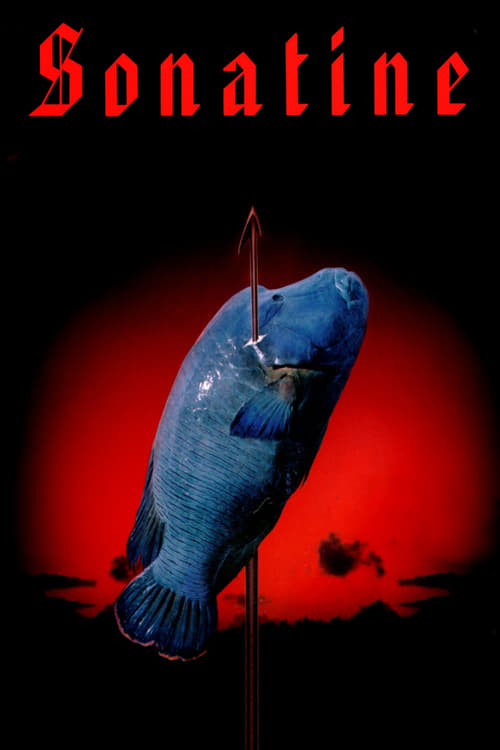
Sonatine
1993 · Takeshi Kitano
For when you want a gangster film that feels like nothing else — slow, strange, darkly funny, more hypnotic than thrilling. One to watch late at night when you're open to an odd, contemplative spell.
What it's about
Murakawa, a Tokyo yakuza boss grown tired of the life, is sent to Okinawa to mediate a gang war that turns out to barely exist. Ambushed and expendable, he and his surviving men hole up at a beach house to wait things out — and the crime film dissolves into something stranger: grown killers playing games in the sand while their fate circles closer.
The experience
Long stretches of deadpan calm and childlike play, punctured by violence that arrives flat, fast, and without warning. It's funny in a way that makes the dread worse — serene on the surface, fatalistic underneath, and oddly beautiful.
Performances
Kitano himself, as Murakawa, is a masterclass in stillness — an impassive face that somehow radiates exhaustion, menace, and a weird playfulness all at once.
The craft
Kitano strips the yakuza movie to its bones: static frames, abrupt cuts, gunfights over in a blink, and games on the beach given more screen time than the plot. Joe Hisaishi's score floats over it all, tender where the images are cold. The rhythm is the art — it teaches you how to watch it.
Why it matters
It made Kitano an international name and became a cult touchstone, proving a crime film could run on silence and stillness. Its deadpan violence and beach-idyll melancholy echo through decades of crime cinema since.
Snapshot
A yakuza underboss named Murakawa, already hollowed out by years of killing, is dispatched to Okinawa on a transparently pretextual assignment and spends much of the film waiting on a sun-bleached beach for a death he appears to have already accepted. Kitano's fourth feature as director strips the yakuza genre to its existential skeleton: the criminal codes, the hierarchical rituals, the Hong Kong-inflected choreography of gunplay — all are evacuated, replaced by a long pastoral interlude of men playing children's games in the sand. What remains is a meditation on fatalism and the strange lightness that descends when the will to survive has been surrendered. The film's title — borrowed from the musical form, a simplified or abbreviated sonata — telegraphs its formal ambition: a chamber piece, intimate in scale, rigorously shaped, its three implicit movements (Tokyo, conflict, beach) mirroring the structure of exposition, development, and recapitulation leading to silence.
Industry & production
By 1993 Kitano had established himself as a dominant figure in Japanese popular culture through decades of television comedy, first as part of the duo Two Beat and then as a solo performer and television host known by his stage name "Beat Takeshi." His directorial career began by accident: in 1989 he stepped in when Kinji Fukasaku withdrew from Violent Cop, rewriting the script and reshaping the film into something distinctly his own. Boiling Point (1990) and A Scene at the Sea (1991) followed, each marking a further retreat from conventional genre mechanics toward stillness and ellipsis. Sonatine was produced by Bandai Visual and Shochiku, companies with roots in mainstream Japanese commercial cinema. Despite the institutional backing, the film performed modestly at the Japanese box office — the commercial disappointment was pronounced enough that Kitano later reflected on considering retirement from directing. What saved the project's reputation was the international festival circuit, where its distinctiveness made an immediate impression on critics and programmers accustomed to the kinetic excess of Hong Kong action cinema and the sociological heaviness of Fukasaku-school yakuza films. The film's European reception in particular helped reframe Kitano as an art-cinema auteur rather than a celebrity director making genre entertainments.
Technology
Shot on 35mm, Sonatine makes no particular claim to technological novelty, and that is appropriate to its aesthetic. Kitano and his regular cinematographer Hideo Yamamoto worked with available light and practical locations on the Okinawan coast, letting the subtropical flatness of the landscape — white sand, pale sky, dull sea — register as a kind of visual numbness rather than tropical abundance. The absence of technological spectacle is part of the argument: violence, when it arrives, is rendered with the same flat visual grammar as the beach games that precede it, collapsing the usual cinematic distinction between ordinary time and action-film time.
Technique
Cinematography
Hideo Yamamoto, who would remain Kitano's primary collaborator through Hana-bi (1997) and Kikujiro (1999), shoots with a pronounced preference for static, wide-angle setups at a slight remove from the action. The camera rarely tracks or follows; figures enter and exit the frame, and the camera stays. This compositional strategy has the effect of making death feel unhurried — when a character is shot, the camera does not rush to confirm it; the body simply becomes a part of the landscape. On the beach, Yamamoto's frames are frequently emptied of drama: sky and sand in near-equal portions, with figures dwarfed in the middle distance. The Okinawan light — bleaching, shadowless, slightly overexposed — gives the pastoral scenes a quality somewhere between paradise and limbo. Interiors in Tokyo are lit with a flatter, harder municipal light that makes the city feel transactional and airless, a world these men are already half-departed from.
Editing
Kitano edits his own films, and the editorial sensibility in Sonatine is perhaps his most radical articulation of a style built on strategic omission. Conventional cause-and-effect connective tissue — the cutaway that confirms a gunshot has connected, the establishing shot that orients a new scene — is systematically withheld. Scenes begin after their premises have been established and end before their conclusions are shown; the audience is required to infer the narrative connectors. Violence, notably, is sometimes visible and sometimes simply implied by what follows a cut: a body found, a conversation already over. This editorial approach is not naïvete or experiment for its own sake; it carries a philosophical weight. If you cannot locate the precise moment death arrived, death becomes ambient, always already present. The editing also controls tone: beach sequences are held long past the point of narrative necessity, turning play into something that reads like suspended time.
Mise-en-scène / staging
The beach section — easily half the film's running time — is its formal center of gravity, and Kitano stages it as a series of discrete games: sumo bouts, fireworks aimed at one another in the dark, a spinning roulette wheel played with guns, paper dolls built from newspaper. The activities are recognizably childlike in a way that reads simultaneously as comedy, tenderness, and dread. Kitano does not underline the irony; he simply presents the games and lets the juxtaposition accumulate. When violence erupts, it is staged with comparable flatness — not the balletic or operatic violence of Hong Kong genre cinema, but sudden, ugly, and brief. A sequence in which Murakawa kills several men in a bar is almost defiantly anti-spectacular: no slow motion, no stylized choreography, no music underscoring the moment. The staging throughout privileges spatial clarity and temporal honesty over dramatic amplification.
Sound
Joe Hisaishi's score is a collaboration fundamental to the film's emotional register. Hisaishi — already internationally known for his work with Hayao Miyazaki at Studio Ghibli — brought to the Kitano partnership a melodic restraint quite unlike the sweeping orchestral scale of the Ghibli films. For Sonatine, the score is sparse and melancholy: piano-led themes that circle and return, maintaining a modal ambiguity that refuses to anchor scenes in either grief or hope. The music arrives selectively; much of the film runs in ambient silence punctuated by wind, ocean noise, and the mundane sounds of men at rest. When Hisaishi's score enters, the contrast makes the images seem retrospective, already elegiac. The sonic design extends this logic: dialogue is sparse and functional, and the sounds of violence — gunshots, the physical sounds of bodies — are not glamorized by recording technique.
Performance
Kitano performs Murakawa with an economy bordering on physical stillness. His face is famously inexpressive — the result of partial facial paralysis sustained in his 1994 motorcycle accident, which came after Sonatine's completion, meaning the deadpan look here is an act of deliberate restraint rather than physical necessity. (The accident would profoundly shape his subsequent films, but Sonatine itself is a prefiguration of those preoccupations from a different source.) Murakawa registers boredom, fatalism, and occasional dry humor through almost imperceptible modulations of posture and eye movement. The ensemble around him — several drawn from Kitano's television circle, including the reliable Susumu Terajima — performs in an equally understated register, giving the beach sequences their quality of low-key authenticity rather than theatrical whimsy. Aya Kokumai, as Miyuki, provides the film's one relationship of genuine tenderness, and its one relationship Murakawa does not know how to protect.
Narrative & dramatic mode
Sonatine operates in a mode of conspicuous narrative deficiency. The plot mechanics of the yakuza genre — turf wars, betrayals, the architecture of organizational loyalty — are present but deliberately underdeveloped. Murakawa suspects early on that he has been sent to Okinawa to die, that the gang war is a pretext, that his boss has decided he has become inconvenient. He does not act on this knowledge. The film does not structure itself around his investigation or resistance; instead it watches him drift into stasis. What drives the narrative, insofar as anything drives it, is not plot but tonal descent: from the hard functional world of Tokyo gangsterism through the surreal suspension of the beach interlude toward a final act whose violence is almost an afterthought to the death that has already been accepted. The dramatic mode is elegiac rather than tragic — tragedy requires a fall from a position of agency, and Murakawa has evacuated his agency long before the film's conclusion.
Genre & cycle
The yakuza film as a Japanese genre has two major registers in its postwar history. The ninkyo eiga (chivalry films) of Toei studios in the 1960s and early 1970s — associated with stars like Koji Tsuruta and Ken Takakura — valorized a code of honor that placed the yakuza in deliberate opposition to modernity's moral corruption, framing criminality in terms borrowed from samurai drama. Against this, Kinji Fukasaku's Battles Without Honor and Humanity cycle (beginning 1973) demolished the chivalric mythology, presenting yakuza organization as a chaos of betrayal, contingency, and grotesque violence driven by nothing nobler than survival and greed. Kitano in Sonatine departs from both modes. He retains the hierarchical structure and the fatalism of the genre, strips away both the chivalric sentimentality and Fukasaku's sociological fury, and arrives at something closer to late-career existentialism: yakuza life presented not as meaningful transgression but as an attenuated form of boredom, its violence drained of significance. The film is also in dialogue with the international art-cinema treatment of crime — Melville's French noirs, particularly Le Samouraï (1967) and Le Cercle Rouge (1970), with their laconic protagonists and their sense of criminal life as a kind of monastic vocation ending in mandatory death.
Authorship & method
Kitano functions as a total auteur in the sense that he writes, directs, and edits his films, and his editorial decisions represent the primary signature of his work. He has said in interviews that he makes films from images and rhythms rather than from narrative construction, and Sonatine bears this out: the script functions as a loose armature for sequences assembled and shaped in the editing room. His method on set is reportedly informal, with minimal rehearsal and a willingness to allow improvisation within the staging he has established.
Hideo Yamamoto's cinematography is an integral rather than subordinate contribution: the characteristic Kitano image — wide, static, slightly detached — emerges from a collaboration in which Yamamoto's technical sensibility and Kitano's compositional instincts reinforce each other. Joe Hisaishi's compositional role is similarly foundational: the score does not illustrate the images but exists in a relationship of contrast and counterpoint with them, arriving precisely where Kitano's editorial silences create space for reflection. The Kitano-Hisaishi creative partnership is one of the more sustained director-composer relationships in contemporary Japanese cinema, producing a distinctive tonal signature across multiple films.
Movement / national cinema
Sonatine occupies a transitional position in Japanese cinema of the 1990s. The decade saw the domestic film industry under significant commercial pressure from American imports and from the domestic television industry that had largely supplanted theatrical cinema in popular culture. The major studio system — Toho, Toei, Shochiku — had contracted; independent and co-production models were increasingly necessary for non-mainstream work. Kitano's position was anomalous: his television fame gave him commercial viability and industry leverage while his directorial films pursued a formal austerity that the same industry found commercially difficult. His international recognition would eventually feed back into domestic prestige, but at the time of Sonatine's release the gap between his critical reputation abroad and his box-office performance at home was pronounced. The film sits within the broader category of the Japanese art film that sustained an international exhibition profile — alongside the late work of Shohei Imamura, the quietism of Hirokazu Kore-eda's emerging career, and the genre-inflected art cinema that found audiences on the European festival circuit — while remaining distinctly connected to popular genre entertainment rather than art-house prestige filmmaking.
Era / period
The early 1990s in Japan coincided with the collapse of the economic bubble, a period of profound national anxiety about institutional stability that found expression across Japanese cultural production. The deflation of Sonatine's gangster world — its hierarchy shown as arbitrary, its codes as hollow — reads in context as part of a broader cultural interrogation of organizational loyalty and institutional authority. Whether Kitano consciously intended this resonance is not documented with any precision, but the film's timing gives its nihilism a historically specific texture. The period also saw the international consolidation of a global art cinema circuit — Toronto, Venice, Berlin, Cannes — that was actively seeking work from outside the Hollywood-European axis, creating the exhibition infrastructure through which Sonatine reached its most enthusiastic audiences.
Themes
Fatalism is the film's governing principle, and Kitano renders it not as melodrama but as weather — something that has arrived and settled. Murakawa's apparent death wish is legible not as pathology but as a form of clarity: a man who has looked at what he has become and decided the inventory does not merit preservation. The beach section recasts this existential exhaustion through play, evoking a childlike state prior to ambition, prior to violence, prior to the social structures that have made Murakawa's life what it is. Play here is not escape; it is a different time signature, one in which the end can be deferred without being forgotten. The relationship between violence and beauty runs throughout: the fireworks sequence, in which characters aim rockets at one another in the dark, is among the most tonally complex moments Kitano has filmed — pure visual beauty generated by the instruments of violence, pleasure and danger inseparable. The film is also, obliquely, about the limits of masculine codes — the yakuza ethos as a system that has no mechanism for men who tire of it, who become unable to perform the violence the system requires.
Reception, canon & influence
Critical reception and canonization. Sonatine was not a commercial success in Japan on initial release, and the domestic critical reception was respectful rather than ecstatic. The film's canonization was substantially driven by international festival response and by the advocacy of foreign filmmakers and critics who positioned Kitano within a lineage of European and American auteur cinema. Director Jim Jarmusch was among the more visible champions of Kitano's work in the anglophone world, and the film circulated through repertory cinemas and critical retrospectives in Europe and North America in the years following its release. By the time Hana-bi won the Golden Lion at Venice in 1997, Sonatine had been retrospectively installed as the work that established the mature Kitano style.
Influences on the film (backward). The debts are multiple and stratified. Jean-Pierre Melville's criminal existentialism — particularly the systematic evacuation of expressiveness from his protagonists, the treatment of criminal milieu as a closed world with its own doomed logic — is the most frequently cited precedent, and it is visible in the film's structure and in Kitano's performance mode. Within Japanese cinema, the nihilism of Fukasaku's jitsuroku yakuza films provides a generic substrate that Kitano strips back further still. Seijun Suzuki's formal experiments in the yakuza genre — the arbitrary stylization, the narrative incoherence as aesthetic strategy — have a more oblique presence. American noir's treatment of the criminal as a man already dead is a background assumption the film takes for granted.
Legacy and forward influence. Sonatine's influence on subsequent crime cinema is difficult to attribute with precision but clearly legible in style and tone. The film contributed significantly to the international visibility of a certain register of Asian crime cinema — spare, fatalistic, choreographically restrained — that would influence the work of Hong Kong director Johnnie To, whose crime films of the following decade share several of Sonatine's compositional and tonal priorities. Within the Japanese industry, the film's reframing of the yakuza as an existentially exhausted figure rather than a figure of either chivalric honor or sociological spectacle opened space for subsequent genre deconstructions. More broadly, the film demonstrated that genre material could sustain a rigorous formal austerity without becoming a genre parody — that slowness and stillness were not in contradiction with the pleasures of crime cinema but could intensify them. Kitano's subsequent career was built on this foundation, culminating in the Venice recognition that secured his place in the international canon, and Sonatine remains the clearest statement of the aesthetic logic the later films elaborate and vary.
A Deleuzian reading
Two men crouch in the dark sand throwing fireworks at each other.
The full Deleuzian reading of Sonatine →
Reception
Ignored in Japan on release — audiences couldn't accept TV comedian 'Beat' Takeshi as a deadpan gangster auteur — it found its life abroad after screening at Cannes, and is now widely ranked among Kitano's very best films.
How Sonatine was received, from release to now →
Influences: the films it descends from and the films it influenced
- Le Samouraï (1967) — Melville's model of the criminal protagonist as existentially evacuated figure — impassive face, economy of gesture, silence held past the point of comfort — is the direct template for Kitano's construction of Murakawa and for the tonal strategy of stripping yakuza genre conventions to expose the existential skeleton beneath.
- Pale Flower (1964) — Shinoda deploys ambient environmental sound — the drone of pachinko parlors, city noise — in place of conventional dramatic scoring, using texture rather than orchestral cue to render the yakuza world as existentially flat; Kitano's sparse piano and ambient silence strategy descends from this deliberate substitution of soundscape for emotional underscoring.
- Branded to Kill (1967) — Suzuki's practice of fragmenting yakuza narrative through elliptical cuts — scenes beginning mid-action and terminating before their conclusions, without orienting connective tissue — is the formal precursor to Kitano's strategic omission editing, which withholds cause-and-effect confirmation (the gunshot that connects, the death confirmed) as a philosophical rather than merely stylistic gesture.
- Pickpocket (1959) — Bresson's theory of non-expressive performance — the model instructed to suppress psychological demonstration so that interiority becomes legible through gesture and spatial behavior rather than facial reaction — is the foundational precedent for Kitano's deadpan acting method, in which Murakawa's inner vacancy is readable precisely because the face refuses to perform it.
- Battles Without Honor and Humanity (1973) — Fukasaku's handheld-chaotic, sociologically dense yakuza staging — overlapping violence, cramped interiors, documentary grain — defines the genre apparatus that Sonatine systematically evacuates; Kitano's static camera, emptied mise-en-scène, and unhurried anti-spectacle acquire their force as deliberate formal inversions of Fukasaku's maximalist template.
- Violent Cop (1989) — Kitano's debut as director introduced the static wide-angle setup held as figures enter and exit rather than tracking them, and the sudden unorchestrated violence eruption without slow-motion or musical underscoring — both devices that Sonatine crystallizes into a fully articulated aesthetic system.
- A Scene at the Sea (1991) — Kitano's preceding film established the formal grammar of the beach as a zone of near-wordless suspended time, rendered through static wide-angle holds and duration rather than action cutting, with non-professional performance flatness; Sonatine inherits this compositional template and darkens it from pastoral simplicity toward elegiac fatalism.
- Drunken Angel (1948) — Takes the deflated hoodlum to deadpan stillness and sets Joe Hisaishi's gentle piano over abrupt killings — the cheerful-music-over-a-dying-man discovery here turned into an entire aesthetic register.
- Merry Christmas, Mr. Lawrence (1983) — Formalizes the debt beyond persona: static frontal compositions held past comfort, violence elided at the cut, and an ending that arrests on a held image — the freeze-frame logic of Hara's final close-up turned into a whole grammar.
- Kids Return (1996) — Using the same Kitano-editing / Hisaishi-piano / Yamamoto-cinematography apparatus assembled for Sonatine, Kids Return applies the tonal descent structure — two figures drifting toward irrecoverable failure — to a youth and boxing context, demonstrating how the formal system transfers across genre while the elegiac register remains constant.
- Hana-bi (1997) — Hana-bi extends Sonatine's Yamamoto-static / overexposed coastal grammar to a more openly elegiac register, integrating Kitano's own paintings as intertitle sequences and ending on a beach farewell that functions as a direct formal self-quotation of Sonatine's pastoral interlude — the continuity of the compositional system made explicit.
- Kikujiro (1999) — Kikujiro transports Sonatine's beach-game-sequences — two figures in coastal space, playing children's games, deferring an unspoken terminus — to a road-trip comedy register; the Hisaishi piano score, more foregrounded here than in Sonatine, shows the formal system operating in a major key, confirming that the apparatus is the constant and the tone its variable.
- Eureka (2000) — Aoyama's four-hour film adopts Kitano's compositional strategy of static wide-angle frames in which survivors of violence drift through sepia-toned pastoral landscapes, using long-duration holds and near-total score absence to render post-traumatic time as suspended — the most thorough formal extension of Sonatine's beach-section grammar by a non-Kitano Japanese director.
- Elephant (2003) — Van Sant's elliptical withholding of cause-and-effect narrative connective tissue — scenes beginning without establishing context and terminating before consequences are shown, violence arriving without stylistic announcement or musical emphasis — is the most formally precise American application of the editorial strategy Kitano perfected in Sonatine, transposed to the high school massacre genre.
- Drive (2011) — Refn adopts Kitano's specific staging of anti-spectacular violence — sudden eruptions without slow-motion, choreographic underscoring, or musical cue, embedded within long sequences of near-wordless stillness — and applies it to American crime-film genre; the Driver's impassive deadpan, interiority expressed through spatial behavior rather than dialogue, is the clearest Anglophone inheritance of the Murakawa character construction.
- Only God Forgives (2013) — Refn structures the film as a tonal descent through visual and sonic flatness — neon-overexposed Bangkok light functioning as a tropical equivalent to Sonatine's bleached Okinawan coast — with Cliff Martinez's sparse electronic score occupying the same structural role as Hisaishi's piano: a thin melodic line adrift in ambient silence.
- Outrage (2010) — The Kitano/Yanagijima static-frontal frame language and stillness-before-violence rhythm achieved their first mature form in Sonatine; Outrage inherits this visual grammar while deliberately flattening its lyrical interludes into pure procedural momentum, treating the inherited aesthetic as a genre instrument rather than a lyrical one.
- Zatoichi (2003) — Kitano's own template of deadpan minimalist performance punctuated by sudden brutal eruptions and childlike play, ported here from modern crime into period dress.
- Battle Royale (2000) — Forges the impassive, deadpan-then-detonating Kitano violence persona that Battle Royale imports intact into Kitano's teacher figure, using his auteur stillness as the film's still center of menace.
- Ghost Dog: The Way of the Samurai (1999) — Jarmusch arrives at a formally parallel aesthetic through shared genealogy — both films derive the impassive criminal ritualist from Le Samouraï — substituting RZA's sparse, repetitive hip-hop score in place of Hisaishi's piano phrases; Ghost Dog is a sibling-in-influence rather than a direct stylistic descendant, both films discovering that Melville's model translates across cultural contexts when its essence (stillness, code, fatalism) is preserved.
- Bullet Ballet (1998) — Structures violence as long flat stillness punctured by a single unheralded burst with no build-up and no aftermath coverage, performed by the director himself as an affectless lead — the arrhythmic stillness-and-seizure grammar Tsukamoto works in.
Similar films
- Violent Cop (1989) — influence & lineage
- A Scene at the Sea (1991) — influence & lineage
- Fireworks (1997) — influence & lineage
- Pale Flower (1964) — influence & lineage
- Kikujiro (1999) — influence & lineage
- Outrage (2010) — shared sensibility
- Zatoichi (2003) — shared sensibility
- Ichi the Killer (2001) — shared sensibility
All the films related to Sonatine →