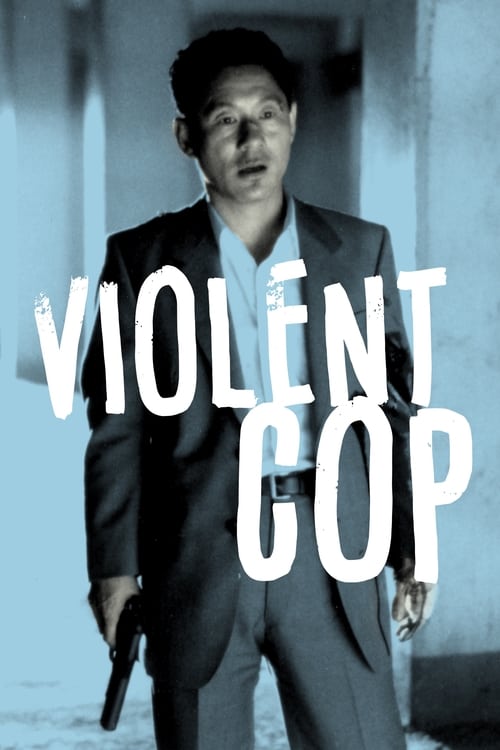
Violent Cop
1989 · Takeshi Kitano
For when you want something hard, stripped-down, and uncompromising — a late-night watch for a stern mood, not a fun cop movie. Definitely challenge, not comfort.
What it's about
Detective Azuma is the kind of cop the department can neither control nor quite fire: he walks into suspects' homes and beats confessions out of them, and he doesn't much distinguish between criminals and colleagues. When a drug investigation points toward someone inside the force and a yakuza network behind it, Azuma's pursuit turns personal — with his vulnerable sister caught in the fallout.
The experience
Cold, quiet, and genuinely startling — long stretches of deadpan stillness broken by violence that arrives without warning and without music telling you how to feel. It's closer to a slow-burning stare than a thriller, and it gets under your skin precisely because it refuses to excite you.
Performances
Takeshi Kitano, acting under his stage name Beat Takeshi, is mesmerizing in the lead — an almost expressionless face and a flat-footed walk concealing something coiled and frightening. He was known in Japan as a comedian; here he invented a screen presence with no obvious precedent.
The craft
Kitano's directorial debut already shows his signature: static camera, elliptical cuts that skip the moments other films would milk, silences where speeches should be, and an oddly jaunty piano score playing against the brutality. The violence is filmed plainly, without slow motion or glamour, which makes it land harder.
Why it matters
It transformed a TV comedian into one of Japan's most important filmmakers overnight and laid the foundation for the deadpan, art-house crime cinema that would carry Kitano to international acclaim through the 1990s.
Snapshot
Violent Cop — Japanese title Sono otoko, kyōbō ni tsuki ("That Man, Ferociously" or, idiomatically, "Warning: This Man Is Wild") — is Takeshi Kitano's directorial debut, a police procedural stripped of procedural comfort and rebuilt as something harder and stranger. Detective Azuma (played by Kitano under his stage name Beat Takeshi) operates in the nether zone between law and criminality: he beats suspects without compunction, ignores department protocols, and pursues a yakuza-linked drug ring with a doggedness that is indistinguishable from personal compulsion. What sets the film apart from its contemporaries is not the brutality per se but the aesthetic intelligence governing how that brutality is presented — through long silences, elliptical edits, and a camera that refuses to sensationalize the violence it witnesses. The film announced a major directorial sensibility at the very first attempt.
Industry & production
The film's origin story is a minor piece of Japanese film history. Kitano was attached to the project as lead actor, not director; the production was already in development at Shōchiku when the originally slated director withdrew. Kitano stepped in to take the helm — reportedly with considerable latitude to reshape the screenplay, credited to Hisashi Nozawa. He used that latitude substantially, cooling the register of the original material, slowing its pacing, and excising the conventional thriller machinery that the script retained from earlier drafts. The exact circumstances of the original director's departure and the degree of Kitano's script revisions are not fully documented in English-language sources, and the record in Japanese scholarship is worth treating with some care, though the broad outline — Kitano as reluctant or opportunistic inheritor of the project — is well established.
By 1989, Kitano was enormously famous in Japan as one-half of the comedy duo Two Beat and as a television personality of near-ubiquitous reach. His "Beat Takeshi" persona was associated with anarchic, sometimes cruel comedy. Taking the lead in a hard-edged crime film was itself a statement, and the distance between his public image and the stone-faced nihilism of Azuma was part of what gave the film its initial charge with Japanese audiences.
Technology
Violent Cop was shot on 35mm using the standard production infrastructure of Japanese commercial cinema of its era. No technological novelty distinguishes its production; the film does not self-consciously exploit new equipment or post-production tools. Its visual distinctiveness is a function of compositional and editorial choice rather than technical innovation. The practical locations — suburban Tokyo housing blocks, urban streets, nondescript interiors — are used as found, without elaborate set construction. The late-1980s look carries the slightly worn grain characteristic of Japanese crime films of the period, a texture that suits the movie's refusal of glamour.
Technique
Cinematography
The cinematography (the director of photography on this film is not confidently established in the sources available to me, and I decline to attribute the work to a specific name without certainty) is defined above all by compositional restraint and a willingness to let space go dead. Kitano favors middle-distance framing: the camera rarely moves in close for emotional amplification during scenes of violence or confrontation, and when it does, the effect is more clinical than intimate. Static shots hold for longer than convention demands; the film treats the interval — the gap between arrival and event — as dramatic material in its own right. Wide shots of urban Tokyo periphery establish Azuma's world as banal and indifferent to human scale. The palette is cool, unglamorous.
Editing
Editing is the film's most theoretically consequential dimension. Kitano edits against the grain of action-cinema rhythm, systematically removing what viewers of the genre expect: the shot of the blow landing, the reaction that confirms it registered, the cutaway that sustains suspense. He cuts to black, or cuts away just before or just after the expected climactic instant, so that violence arrives as a disruption of viewing as much as a disruption of narrative. Scenes end with the air let out of them. This ellipsis is not clumsy omission but a coherent poetics — one that several critics have found analogous in spirit (if not in direct lineage) to Robert Bresson's refusal of the cinematic "effect." The editing rhythm communicates Azuma's psychology: events happen with no windup, no aftermath, no moral punctuation.
Mise-en-scène / staging
Kitano stages confrontations in ways that deny the spatial clarity of conventional action cinema. Blocking is often counter-intuitive: bodies move through doorways and around furniture in patterns that feel observed rather than choreographed. The famous opening sequence — in which a group of delinquents is beaten by Azuma in a matter-of-fact extension of a street pursuit — withholds the tight coverage that would make the violence legible as spectacle. Space is used to isolate characters from each other even when they share the frame. Azuma's apartment, his sister's life, the precinct corridors — these environments are rendered as places where people fail to connect. The staging enacts the film's central thematic proposition: that human contact, in this world, takes the form of force.
Sound
Sound is used sparingly, almost austerely. Silence — or near-silence, occupied only by ambient urban texture — functions as the film's default state. Dialogue does not fill space; exchanges are short, clipped, sometimes answered with nothing. The score is minimal and largely avoids the emotive orchestration that Japanese crime cinema of the period often borrowed from Hollywood genre conventions. The sound of violence is presented without enhancement: punches are not emphasized; the sonic reality is flat, almost reportorial. This flatness is part of what makes individual bursts of violence so destabilizing — they arrive without acoustic announcement.
Performance
Kitano's performance as Azuma is a masterclass in self-withholding. Playing against the expressivity his comedy persona demanded, he presents Azuma as a face through which almost nothing passes: the mouth barely moves, the eyes offer little access. This affectlessness is not blankness but a kind of pressure — the containment of something that occasionally, without warning, escapes. The supporting cast is calibrated to him: none of the other performances push toward the heightened register that might restore a sense of conventional drama. The result is an ensemble in which the ordinary surfaces of social interaction (a conversation with a partner, an exchange with a suspect) feel permanently on the verge of rupture.
Narrative & dramatic mode
The film's story follows a loose investigative arc: Azuma pursues a drug network, discovers that a colleague is implicated, protects a compromised subordinate, watches his sister become entangled with the yakuza, and moves toward a final confrontation. But calling this a plot in the conventional sense misrepresents the film's experience. Narrative causality is deliberately attenuated — events are connected but not explained, consequences arrive without being announced, and the film's closure is not resolution but extinction. The dramatic mode is closer to behaviorist observation than to story. Kitano is interested in what people do, not in the psychological architecture behind it. Motivation is withheld in the same way that the editing withholds the moment of impact.
The film ends with violence that is sudden, undecorated, and total. Azuma's trajectory ends not in triumph or tragedy in any cathartic sense but simply in stopping. This refusal of dramatic fulfillment is consistent across Kitano's career and is already fully formed here.
Genre & cycle
Violent Cop enters a well-established Japanese genre tradition — the keisatsu mono (police story) and its harder subgenre of yakuza-inflected crime drama — and systematically undermines its conventions. The keisatsu-eiga had a decades-long history of producing police protagonists who operate in moral ambiguity, but they typically retained some procedural framework, some institutional narrative, within which the protagonist's transgressions were legible. Kitano dispenses with this framework almost entirely. Azuma's relation to the police bureaucracy is decorative; the department exists as a backdrop against which his autonomy is defined.
The film is also in dialogue with the yakuza genre traditions associated with Toei studio's long-running output and, more specifically, with the harder, more disillusioned vein of crime cinema that Kinji Fukasaku had established with his Battles Without Honor and Humanity series (1973–74). Fukasaku's films portrayed the yakuza world as chaotic, unglamorous, and ultimately meaningless — a framing that Kitano inherits and extends. The influence of American cop films of the 1970s — Dirty Harry most obviously, with its brutal detective operating outside departmental ethics — is present but should not be overstated; Kitano strips away the vigilante-justice moral architecture that makes Callahan a legible ideological figure and leaves something more opaque.
Authorship & method
Kitano's authorial identity crystallized almost fully in this first film. The methods that would define his subsequent career — long takes, elliptical editing, minimal dialogue, sudden eruptions of violence, nihilistic plotting, attention to the surfaces of male friendship — are all present here, though some would be developed with greater confidence in Boiling Point (1990), Sonatine (1993), and Hana-bi (1997). What the film establishes is a directorial sensibility committed to resisting the pleasures that genre cinema ordinarily delivers: the payoff, the identification, the catharsis.
The screenplay credit belongs to Hisashi Nozawa, but the degree to which Kitano reworked the material in production and in the editing room complicates any strict separation of writer and director. Kitano is known across his career for using the editing room as a creative space equivalent in importance to the shoot itself, and the evidence of Violent Cop suggests this was true from the start. The composer for the film's sparse score and the film's director of photography are credited in Japanese sources; where I cannot verify the attribution with confidence, I note the gap rather than fill it.
Movement / national cinema
The film sits within Japanese cinema at a specific inflection point. The studio system that had organized Japanese film production through the postwar decades was in accelerating decline by the late 1980s; Shōchiku, like other major studios, was supplementing feature production with smaller, genre-oriented pictures, some of which — like this one — created space for unexpected formal experimentation. The pinku eiga (erotic film) sector had long served as an incubator for directorial talent; the broader crime genre served a similar function for directors willing to work within commercial parameters while subverting them.
Kitano is not easily assimilated to any organized movement. He arrived without apprenticeship in the conventional sense, without the art-cinema credentials of the Japanese New Wave (Oshima, Imamura, Yoshida), and without the genre mastery of a Fukasaku. His emergence belongs to a more irregular pattern of Japanese cinema in the 1980s and early 1990s, in which filmmakers came to features from television, advertising, or adjacent entertainment industries and brought with them perspectives unformatted by film-school or assistant-director orthodoxy.
Era / period
1989 is the final year of the Showa era; the emperor Hirohito died in January, and the transition to Heisei carried with it a widely felt sense of historical change. Japan was at or near the peak of its economic bubble — a moment of extreme prosperity that carried its own forms of anxiety and unreality. The Japan of Violent Cop does not look like the bubble: its locations are peripheral, unglamorous, and occupied by people for whom prosperity is a rumor. The film's sense of a world in which institutions have failed and individuals navigate through force and improvisation resonates with, though it does not explicitly address, the social contradictions of that moment.
Themes
The film's central preoccupation is the relationship between rule and force, institution and individual will. Azuma is not a corrupt cop in the standard sense — he does not take bribes, does not use his power for personal enrichment. He is, in a more disturbing way, a pure agent of force who has simply detached that force from any legitimating framework. The law means nothing to him; neither does its transgression. This raises a question the film does not answer and does not try to: what, if anything, does Azuma believe?
Loyalty and its limits constitute a secondary theme. Azuma's relationships — with his subordinate, with his sister — are rendered in terms of protection that slides into violence. He does not offer comfort; he offers the application of force in one's interest. The film suggests that in this world, this is what care looks like: a bleak proposition, held without sentimentality.
Mortality and purposelessness hover over the entire film. Azuma's compulsion reads less as justice-seeking than as an inability to stop — an incapacity for stillness that the film finally resolves only through death.
Reception, canon & influence
In Japan, Violent Cop performed respectably on release and was received as a striking debut, though the scale and nature of its initial critical reception in Japanese-language outlets is not fully documented in the sources available to me. Its stature grew substantially as Kitano's subsequent films accumulated international recognition, particularly after Sonatine found an audience in Europe and Hana-bi won the Golden Lion at Venice in 1997.
Backward influences — what shaped the film — include Fukasaku's yakuza cycle, the spare violence of American crime cinema of the 1970s (Peckinpah, the Siegel-era Eastwood films), and something less easily sourced: the anti-narrative instincts of experimental and art cinema that Kitano absorbed, apparently, through proximity rather than study. Connections to Bresson's elliptical method are frequently noted by critics, though whether these represent conscious influence or parallel discovery is not established.
Forward influence is substantial. The film effectively created the template for a mode of Asian crime cinema in which violence is deadpan, pacing is glacial, and nihilism is structural rather than incidental. Its most direct progeny is Kitano's own subsequent work, which refined and complicated the methods established here. More broadly, the film's formal solutions — the elliptical cut, the affectless performance, the refusal of genre satisfaction — entered the vocabulary of Asian crime cinema in ways that can be traced through Park Chan-wook's earlier work and through the long tradition of Hong Kong and Korean crime filmmaking that became internationally visible in the 1990s and 2000s. Within Japanese cinema, the film helped authorize a harder, more formally adventurous approach to the crime genre that outlasted its immediate commercial moment.
Violent Cop is now firmly canonical as the founding document of Kitano's directorial career — a film that arrived fully formed, without the apprentice hesitancy that marks many debuts, and established its author's terms in a manner that subsequent work elaborated but did not substantially revise.
A Deleuzian reading
The blow you don't see.
The full Deleuzian reading of Violent Cop →
Reception
In 1989 Japan this landed as a shock — TV comedian 'Beat Takeshi' making a stone-faced, brutal cop picture nobody asked for. Once Sonatine and Hana-bi made Kitano an international auteur in the '90s, it was retroactively canonized as one of the great directorial debuts in crime cinema.
How Violent Cop was received, from release to now →
Influences: the films it descends from and the films it influenced
- Pickpocket (1959) — Bresson's elliptical editing system — cutting away from the decisive moment to its physical aftermath rather than depicting impact — and his 'model' performance method, training non-actors to suppress expression in favor of mechanical behavior, are the direct source of Kitano's signature cut and his affectless-performance grammar.
- Branded to Kill (1967) — Suzuki's dissolution of Nikkatsu crime-film conventions through irrational narrative ellipsis and anti-climactic violence staging created the template within Japanese genre cinema for formal subversion that Kitano inherits — replacing Suzuki's surrealist playfulness with nihilistic deadpan.
- Le Samouraï (1967) — Melville's reduction of the crime film to geometric space and a protagonist who communicates exclusively through physical comportment rather than speech — interior life expressed only through what the body does to other bodies — provides the formal precedent for Azuma's affectless cop.
- The Wild Bunch (1969) — Peckinpah's systematic removal of heroic glamour from onscreen killing — deaths that arrive suddenly, end mid-gesture, and carry no musical amplification — establishes the anti-spectacle of violence that Kitano refines into his elliptical cut: the body already fallen before the audience registers the blow.
- Dirty Harry (1971) — Siegel's rogue-detective formula — officer operating outside institutional sanction, using personal violence where procedure fails — provides the genre scaffold Kitano then evacuates of its American satisfaction logic, converting righteous transgression into simple transgression with no moral settlement.
- Battles Without Honor and Humanity (1973) — Fukasaku's yakuza cycle established the keisatsu-eiga's anti-heroic grammar — violence as institutional function rather than individual drama, police and criminal hierarchies as mirror bureaucracies — which Kitano inherits as genre scaffold while replacing Fukasaku's kinetic handheld registers with static long-take observation.
- Merry Christmas, Mr. Lawrence (1983) — Kitano's directing career begins from the persona Ōshima extracted from a TV comedian as Sergeant Hara — the unblinking frontal medium shot on an impassive face from which violence arrives without a reaction beat before or after.
- Sonatine (1993) — Sonatine takes Violent Cop's static long-take and elliptical-violence system to its formal conclusion by inserting extended passages of ludic male stasis — beach games between episodes of killing — that transform the anti-cathartic structure into an explicit subject: men waiting for death without dramatic preparation.
- Cure (1997) — Kurosawa's near-silence ambient sound design and affectless performance mode — violence staged in static middle-distance shots without musical amplification, an investigation that refuses cathartic resolution — extends Kitano's formal vocabulary into the Japanese horror-crime hybrid, applying elliptical editing and structural anti-catharsis to a serial-killer procedural.
- Ghost Dog: The Way of the Samurai (1999) — Jarmusch explicitly models Ghost Dog's affectless hitman performance on Kitano's method — long silences, communication through gaze and physical action, absence of explanatory dialogue — and stages the film's violence with the same deadpan non-amplification: sudden, undramatized, consequence-first.
- The Mission (1999) — To deploys static wide-angle compositions and spare masculine interaction — the lobby stakeout sequence in particular — with the same elliptical restraint and sudden precise violence Kitano established, transposing the formal vocabulary into Hong Kong crime cinema with acknowledged debt to Kitano's influence on his staging approach.
- Sympathy for Mr. Vengeance (2002) — Park's elliptical handling of violence — cutting to consequence rather than depicting impact, staging death in wide static shots with minimal performer reaction — directly inherits Kitano's editing method, which Park has cited as a formative influence on his approach to screen violence.
- Drive (2011) — Refn imports Kitano's affectless-minimalist performance template — protagonist who communicates through gaze and physical action across long silences — and the sudden-violence rhythm of extended static passages punctuated by brief explosive action, transposing the Kitano mode into American genre cinema with explicit authorial acknowledgment.
- Outrage (2010) — Kitano's directorial debut establishes the foundational performance register—impassive face, institutional yakuza framing, sudden explosive action without emotional preparation—that Outrage inherits and extends from a single protagonist to a full suppressed-menace ensemble.
- A Scene at the Sea (1991) — Kitano's debut establishes the locked-off frame and the abrupt, unglamorized burst of violence that this film abstracts from crime into pure existential fate.
- The Seventh Continent (1989) — Haneke independently applies Bressonian ellipsis in the same year — cutting away from decisive actions, refusing cathartic release, using near-silence ambient sound to mark the ordinariness of destruction — running as an exact formal parallel to Kitano's method without cross-influence, both drawing from the same Bresson grammar.
- Boiling Point (1990) — Kitano's immediate follow-up extends Violent Cop's elliptical system by fragmenting narrative causality further through structural non-sequitur and temporal discontinuity, pushing attenuated-causality editing to the point where the protagonist's trajectory becomes openly illegible.
- Goodbye South, Goodbye (1996) — Hou independently applies middle-distance static framing and observational long takes — with non-expressive performance and elliptical causality — to Taiwan's criminal underworld, converging on Kitano's formal vocabulary through shared Ozu and Bresson lineage rather than direct influence.
Similar films
- Sonatine (1993) — influence & lineage
- Cure (1997) — influence & lineage
- Branded to Kill (1967) — influence & lineage
- Ghost Dog: The Way of the Samurai (1999) — influence & lineage
- Ichi the Killer (2001) — shared sensibility
- Outrage (2010) — shared sensibility
- Fireworks (1997) — shared sensibility
- Zatoichi (2003) — shared sensibility
All the films related to Violent Cop →